

Over 90 percent of British buildings will need significant energy improvements to meet future environmental goals. Property owners across London and the wider United Kingdom are feeling the pressure as energy efficiency regulations become increasingly strict. Understanding the accredited energy assessor role is the first step towards compliance and sustainable building management. Here you will discover why these specialised professionals are essential for British property owners facing evolving standards and practical challenges.
Table of Contents
- Defining The Accredited Energy Assessor Role
- Types Of Energy Accreditation In The UK
- Qualifications And Training Requirements
- Legal Duties And Professional Responsibilities
- EPC Assessment Process And Practical Impact
Key Takeaways
| Point | Details |
|---|---|
| Role of Accredited Energy Assessors | They are specialised professionals who evaluate energy efficiency in properties and issue Energy Performance Certificates (EPCs). |
| Categories of Accreditation | There are two main types: domestic energy assessors for residential properties, and non-domestic energy assessors for commercial or public buildings. |
| Qualifications Required | A structured pathway of formal qualifications and continuous professional development is necessary to ensure expertise and compliance with regulations. |
| Legal Responsibilities | Assessors must conduct evaluations with precision and accuracy, adhering to national standards and ethical guidelines, with serious penalties for non-compliance. |
Defining the Accredited Energy Assessor Role
An accredited energy assessor is a specialised professional authorised to conduct comprehensive energy efficiency evaluations for residential, commercial, and public properties across London and the United Kingdom. These trained experts play a crucial role in determining a building’s energy performance and providing actionable recommendations for improvement.
Accredited energy assessors are qualified professionals who must be members of an approved accreditation scheme to ensure they meet stringent industry standards. Their primary responsibility involves conducting detailed property assessments that result in Energy Performance Certificates (EPCs), which provide critical insights into a building’s energy efficiency, potential carbon emissions, and recommended enhancement strategies.
The role of an accredited energy assessor encompasses several key technical activities:
- Conducting thorough property inspections
- Measuring and analysing energy consumption patterns
- Assessing building fabric and insulation quality
- Evaluating heating, cooling, and lighting systems
- Calculating energy efficiency ratings
- Producing comprehensive Energy Performance Certificates
Professional energy assessors must possess specialised technical knowledge, including understanding building construction principles, energy systems, and current regulatory requirements. Their assessments provide property owners, landlords, and potential buyers with valuable information about a building’s energy performance, helping them make informed decisions about potential improvements and understanding potential energy-related costs.
Types of Energy Accreditation in the UK
In the United Kingdom, energy assessor accreditations are comprehensively divided into two primary categories: domestic energy assessors and non-domestic energy assessors. These specialised professional classifications ensure precise and targeted energy performance evaluations across different property types.
The energy performance regulations mandate distinct accreditation requirements for each sector. Domestic energy assessors focus exclusively on residential properties, conducting detailed evaluations of houses, flats, and apartments to determine their energy efficiency and potential improvements. These professionals are trained to assess residential building characteristics, heating systems, insulation quality, and potential energy-saving modifications.
Non-domestic energy assessors, in contrast, specialise in evaluating commercial, industrial, and public buildings. Their accreditation involves more complex assessment techniques, including:
- Analysing large-scale building systems
- Evaluating commercial heating and cooling infrastructure
- Assessing industrial energy consumption patterns
- Producing comprehensive commercial Energy Performance Certificates
- Identifying energy efficiency opportunities in complex building environments
To maintain their professional standing, both domestic and non-domestic energy assessors must undergo rigorous training, pass comprehensive examinations, and remain current with evolving energy efficiency standards and technological advancements. This ensures that property owners receive accurate, up-to-date assessments that support sustainable building management and compliance with national energy regulations.
Qualifications and Training Requirements
Becoming an accredited energy assessor in the United Kingdom requires a structured and rigorous pathway of professional development. Formal qualifications are essential, with different requirements for domestic and non-domestic energy assessment specialisations that ensure comprehensive technical expertise and regulatory compliance.

For domestic energy assessors, the journey begins with obtaining a Level 3 Certificate in Domestic Energy Assessment, which provides the foundational knowledge necessary to evaluate residential property energy performance. Candidates with prior experience in construction, property surveying, or related technical fields may benefit from accelerated training pathways, leveraging their existing technical understanding of building systems and structural characteristics.
Non-domestic energy assessor qualifications are more complex and typically require more advanced educational credentials:
- Level 3 Diploma in Non-Domestic Energy Assessments
- Level 4 Diploma in Commercial Energy Assessments
- Specialised training in industrial and commercial building systems
- Advanced understanding of complex energy infrastructure
- Comprehensive knowledge of commercial building regulations
Beyond initial qualifications, energy assessors must maintain their professional standing through continuous professional development, regular recertification, and staying current with evolving energy efficiency technologies and regulatory standards. This ongoing commitment ensures that assessors provide accurate, up-to-date insights into property energy performance, supporting sustainable building management and helping property owners make informed environmental and economic decisions.
Legal Duties and Professional Responsibilities
Accredited energy assessors in the United Kingdom operate within a stringent regulatory framework that demands exceptional professional standards and legal accountability. These professionals are entrusted with critical responsibilities that directly impact property transactions, energy efficiency reporting, and environmental sustainability.
The core legal obligations require energy assessors to conduct energy assessments with reasonable care and precision, ensuring every evaluation meets rigorous national standards. This involves using approved calculation methodologies, maintaining absolute accuracy in energy performance documentation, and producing comprehensive Energy Performance Certificates (EPCs) that provide genuine insights into a property’s energy characteristics.
Key professional responsibilities encompass several critical areas:
- Maintaining absolute accuracy in energy assessment documentation
- Using officially approved calculation software and methodologies
- Entering Energy Performance Certificates into the national register
- Adhering to strict ethical and professional conduct guidelines
- Protecting client confidentiality during assessment processes
- Continuously updating professional knowledge of energy efficiency regulations
Beyond technical competence, energy assessors have a fundamental legal obligation to support broader environmental goals. Their detailed assessments not only facilitate property transactions but also contribute to national energy efficiency strategies, helping property owners understand and improve their buildings’ environmental performance. Failure to meet these professional standards can result in significant penalties, including potential removal from accreditation schemes and legal repercussions for providing misleading or inaccurate energy performance information.
EPC Assessment Process and Practical Impact
The Energy Performance Certificate (EPC) assessment is a comprehensive evaluation that provides critical insights into a property’s energy efficiency and environmental performance. This systematic process involves a detailed examination of multiple building characteristics that collectively determine a property’s overall energy consumption and potential environmental impact.
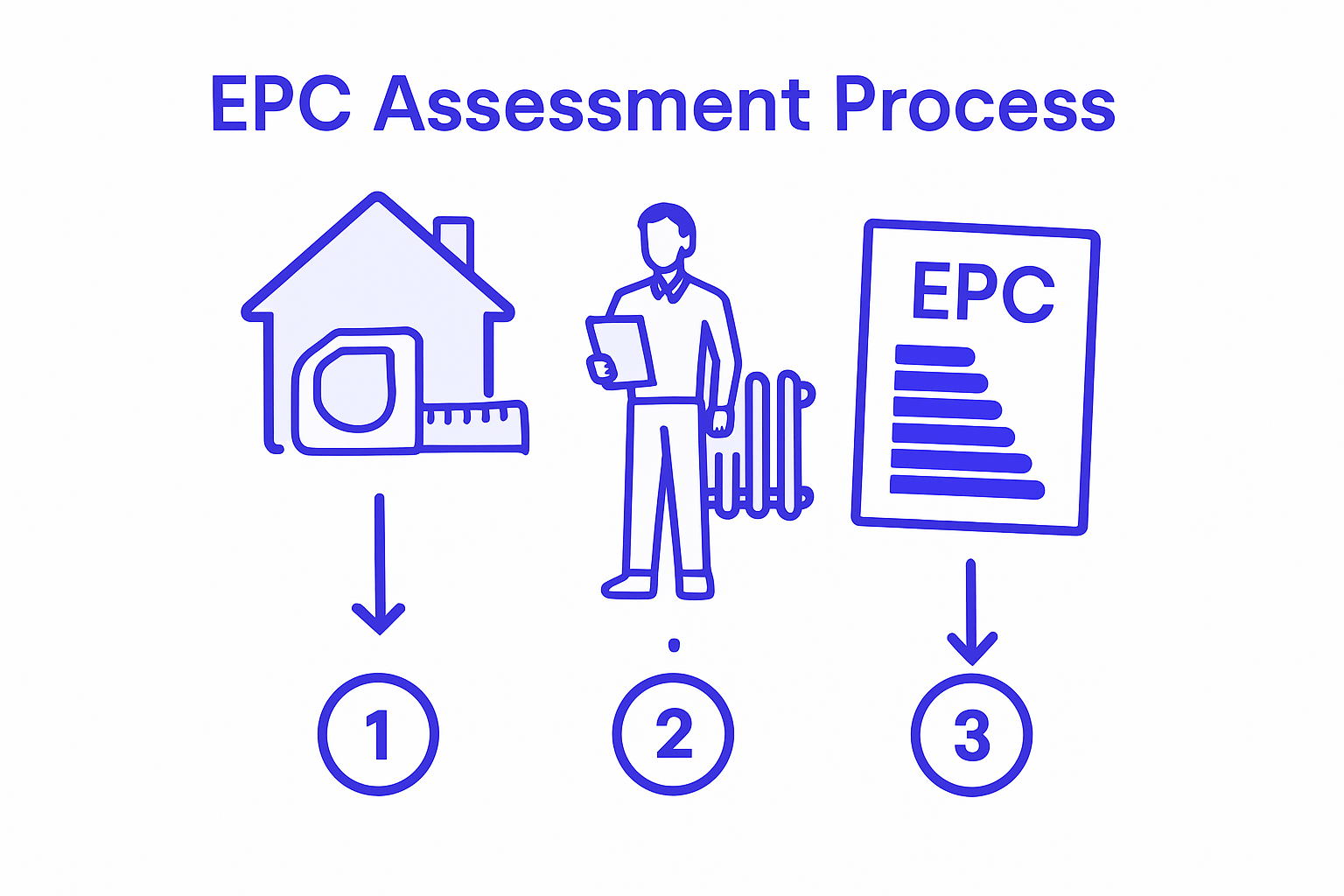
During the EPC assessment process, an accredited energy assessor conducts a meticulous inspection of the property, gathering essential data about its construction, heating systems, insulation, and energy infrastructure. This rigorous examination includes measuring room dimensions, evaluating wall and roof insulation quality, assessing heating and cooling systems, and analysing window and door energy efficiency.
Key elements of the comprehensive EPC assessment include:
- Measuring precise building dimensions and architectural details
- Evaluating thermal insulation quality in walls, floors, and roofs
- Inspecting heating and hot water system efficiency
- Assessing lighting systems and their energy consumption
- Calculating potential heat loss through windows and doors
- Identifying opportunities for energy-saving improvements
The practical impact of an EPC assessment extends far beyond a simple energy rating. The certificate provides property owners with a roadmap for potential energy efficiency improvements, potential cost savings, and environmental sustainability. By highlighting specific areas for enhancement, EPCs empower property owners to make informed decisions about energy upgrades, potentially increasing property value and reducing long-term energy expenditure.
Simplify Your Journey With an Accredited Energy Assessor in London
Understanding the critical role of an accredited energy assessor is the first step to ensuring your property complies with UK energy performance regulations. If you are a property owner, landlord, or estate agent facing the challenge of obtaining accurate Energy Performance Certificates that reflect your building’s true energy efficiency, you are not alone. The complex requirements around EPC assessments, legal accountability, and detailed energy analysis can feel overwhelming without expert guidance.
Complete EPC is here to ease that burden. Our team of qualified and experienced assessors specialises in delivering thorough Energy Performance Certificates for both domestic and commercial properties across London. We guarantee the lowest rates in the UK market without compromising on accuracy or professionalism. Benefit from our seamless service that not only helps you meet legal obligations but also provides clear recommendations to improve energy efficiency, reduce costs, and increase your property’s value. Learn more about how we ensure compliance by visiting our Energy Performance Regulations UK page and explore our expert breakdown of the EPC Assessment Process.
Don’t delay securing your compliant and comprehensive Energy Performance Certificate. Visit Complete EPC today to get started with trusted accredited energy assessors who put your property needs first.
Frequently Asked Questions
What qualifications are required to become an accredited energy assessor?
To become an accredited energy assessor, individuals must obtain formal qualifications specific to domestic or non-domestic energy assessment. For domestic assessors, a Level 3 Certificate in Domestic Energy Assessment is required, while non-domestic assessors need a Level 3 Diploma in Non-Domestic Energy Assessments or a Level 4 Diploma in Commercial Energy Assessments.
What does the energy assessment process entail?
The energy assessment process involves a detailed inspection of the property, which includes measuring building dimensions, evaluating insulation quality, assessing heating and cooling systems, and analysing energy consumption patterns. This comprehensive evaluation culminates in the creation of an Energy Performance Certificate (EPC).
Why are Energy Performance Certificates (EPCs) important?
EPCs are important as they provide critical insights into a property’s energy efficiency and potential carbon emissions. They offer property owners actionable recommendations for energy improvements, which can lead to cost savings and increased property value.
How do accredited energy assessors ensure compliance with regulations?
Accredited energy assessors ensure compliance by adhering to established legal obligations and using approved calculation methodologies. They must maintain high standards of accuracy in their assessments, produce Energy Performance Certificates that meet national standards, and stay updated with evolving regulations and technologies.
Recommended
- London’s Ultimate Guide to Energy Performance Certificates: Enhance Your Property’s Efficiency – Complete EPC
- The Londoner’s Checklist for Obtaining an Energy Performance Certificate – Complete EPC
- The Essential London Guide to Energy Performance Certificates: Save Money and the Environment – Complete EPC
- Unlocking Energy Savings in London: Your Guide to EPC Certificates – Complete EPC