

Over 85 percent of British landlords now face higher expectations for energy efficiency as tenants and lenders pay closer attention to property ratings. With recent regulations and shifting market trends in the United Kingdom, understanding Energy Performance Certificates has never been more important for anyone renting out property. This guide will clarify how EPCs impact landlords, from legal duties and financial benefits to strategies that could boost your property’s rental value and appeal.
Table of Contents
- What Is An EPC For Landlords?
- Types Of EPC And Property Applications
- Legal Requirements For Landlords In London
- Financial Impact And Cost Savings
- Enhancing Rental Value And Tenant Appeal
Key Takeaways
| Point | Details |
|---|---|
| EPC Requirement | An Energy Performance Certificate (EPC) is mandatory for landlords before renting properties in the United Kingdom, and must be obtained prior to marketing the property. |
| Minimum Standards | Since April 2020, it is legally required for properties to have a minimum EPC rating of E, with significant penalties for non-compliance. |
| Financial Benefits | Properties with higher EPC ratings attract better tenants, reduce vacancy rates, and can demand higher rents, leading to overall increased profitability. |
| Improving Appeal | Enhancing a property’s EPC rating through energy-efficient upgrades can significantly increase its marketability and tenant satisfaction. |
What Is an EPC for Landlords?
An Energy Performance Certificate (EPC) is a crucial document that provides an assessment of a property’s energy efficiency and potential environmental impact. Introduced in 2007, these certificates are mandatory for landlords renting out properties in the United Kingdom. The certificate rates a building’s energy performance on a scale from A (most efficient) to G (least efficient), offering potential tenants and buyers a clear understanding of the property’s energy characteristics.
Landlords must obtain an EPC before marketing their property for rent, and the certificate remains valid for 10 years. When created, the EPC involves a comprehensive assessment by a qualified energy assessor who examines various elements such as insulation, heating systems, lighting, and windows. This detailed evaluation of rental property energy standards helps tenants understand potential energy costs and environmental impact before committing to a rental agreement.
The certificate not only serves a regulatory purpose but also provides practical insights for property improvements. It includes recommendations for enhancing a property’s energy efficiency, which can potentially increase the property’s value and reduce long-term running costs. For landlords, this means the EPC is more than just a legal requirement – it’s a strategic tool for property management and investment.
Pro Tip – Energy Efficiency Strategy: Review your property’s EPC recommendations annually and prioritise cost-effective improvements that can enhance your property’s energy rating, potentially making it more attractive to prospective tenants and potentially increasing its market value.
Types of EPC and Property Applications
Energy Performance Certificates (EPCs) are categorised into two primary types: Domestic EPCs for residential properties and Non-Domestic EPCs for commercial and industrial spaces. Each type serves a distinct purpose in assessing and communicating energy efficiency standards across different property categories. Domestic EPCs typically cover residential buildings like houses, flats, and apartments, while non-domestic certificates focus on offices, retail spaces, warehouses, and other commercial premises.
For residential landlords in London, domestic EPCs are the most common requirement. These certificates provide a comprehensive energy efficiency rating for residential properties, helping potential tenants understand the expected energy consumption and associated costs. Commercial property owners, however, must navigate more complex non-domestic property energy efficiency regulations, which include specific minimum standards for renting out commercial spaces.
The application process for each EPC type varies depending on the property’s characteristics. Domestic EPCs involve a detailed assessment of residential elements like heating systems, insulation, windows, and lighting. Non-domestic EPCs require a more comprehensive evaluation, considering additional factors such as industrial equipment, complex heating and cooling systems, and specific operational energy requirements. Both certificate types include recommendations for improving energy efficiency, but the scope and depth of these suggestions differ significantly between residential and commercial properties.
Here is a comparison of Domestic and Non-Domestic EPCs to clarify their differences:
| Aspect | Domestic EPC | Non-Domestic EPC |
|---|---|---|
| Property Type | Houses, flats, apartments | Offices, shops, warehouses |
| Assessment Focus | Insulation, heating, lighting, windows | Equipment, HVAC, industrial operations |
| Complexity | Standardised checklist, less complex | Customised, more detailed analysis |
| Recommendations | Basic energy-saving measures | Advanced upgrades, compliance strategies |
Pro Tip – Certificate Selection: Always confirm the specific EPC type required for your property by consulting with a qualified energy assessor, as using the incorrect certificate can lead to compliance issues and potential legal complications.
Legal Requirements for Landlords in London
London landlords must navigate a complex landscape of legal requirements when it comes to Energy Performance Certificates (EPCs), with strict regulations governing property rentals. Minimum energy efficiency standards have been implemented to ensure rental properties meet specific energy performance benchmarks, making compliance a critical responsibility for property owners.
Since April 2020, landlords in London are legally mandated to ensure their rental properties achieve a minimum EPC rating of E before letting to new or existing tenants. This requirement applies to both domestic and commercial properties, with significant penalties for non-compliance. Landlords must provide the EPC to prospective tenants at the earliest opportunity, demonstrating the property’s energy efficiency and potential running costs. The certificate must be current and valid, with a maximum validity period of 10 years.
The legal obligations extend beyond simply obtaining an EPC. Landlords must ensure their properties meet the minimum energy efficiency standards, which may require investments in improvements such as better insulation, more efficient heating systems, or upgraded windows. Failure to comply can result in substantial financial penalties, including potential fines of up to £5,000 for residential properties and even higher amounts for commercial spaces. These regulations are part of a broader governmental strategy to reduce carbon emissions and improve overall energy efficiency in the UK’s property sector.
Pro Tip – Legal Compliance Strategy: Proactively review your property’s EPC rating annually and plan incremental improvements to stay ahead of legal requirements, potentially avoiding last-minute costly renovations and ensuring continuous rental eligibility.
Financial Impact and Cost Savings
Energy Performance Certificates (EPCs) represent more than a regulatory requirement; they are strategic financial instruments for London landlords. Buy-to-let financing options can be significantly influenced by a property’s energy efficiency rating, with higher-rated properties potentially securing more favourable lending terms and interest rates.
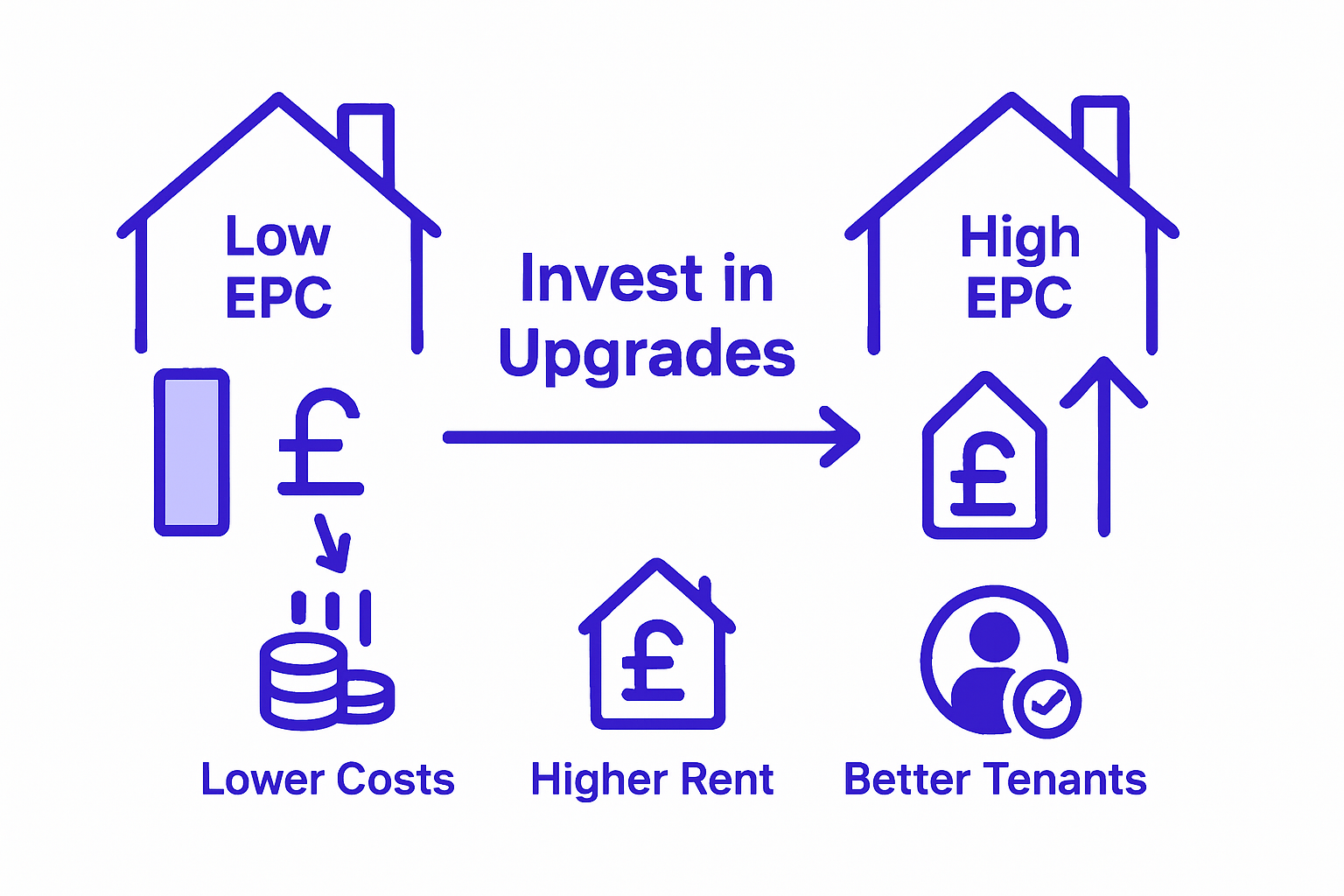
Improving a property’s EPC rating can yield substantial financial benefits beyond compliance. Properties with better energy efficiency ratings typically attract higher-quality tenants, reduce vacancy periods, and command premium rental prices. The potential cost savings extend to tenants as well, with more energy-efficient properties offering lower utility bills. Research suggests that properties with ratings of A or B can demonstrate up to 20% lower energy consumption compared to properties with lower ratings, translating into meaningful financial savings for both landlords and occupants.

The financial implications of EPCs are multifaceted. Landlords can strategically invest in energy improvements that not only ensure legal compliance but also increase property value. Upgrades such as improved insulation, modern heating systems, and double-glazing can enhance the EPC rating while simultaneously increasing the property’s market value. Additionally, these improvements can lead to reduced maintenance costs, improved tenant retention, and potentially higher rental yields. The initial investment in energy efficiency can result in long-term financial benefits that far outweigh the upfront costs.
Pro Tip – Investment Strategy: Prioritise energy efficiency upgrades that offer the most significant return on investment, focusing on improvements that simultaneously boost your EPC rating and property value.
Enhancing Rental Value and Tenant Appeal
London landlords have discovered that Energy Performance Certificates (EPCs) are powerful tools for attracting high-quality tenants and differentiating their properties in a competitive rental market. Property marketability significantly improves with higher energy efficiency ratings, enabling landlords to stand out and potentially command premium rental prices.
Modern tenants are increasingly environmentally conscious and financially savvy, placing substantial value on properties with excellent energy efficiency. A high EPC rating signals to potential renters that a property offers lower utility costs, reduced environmental impact, and superior living conditions. Properties with A or B ratings can attract more discerning tenants who are willing to pay higher rents for improved energy performance. This trend is particularly pronounced in urban areas like London, where environmental awareness and cost-effectiveness are paramount considerations for renters.
The strategic improvements that enhance EPC ratings can transform a property’s appeal. Upgrades such as advanced insulation, smart heating systems, double-glazed windows, and energy-efficient appliances not only improve the energy rating but also create a more attractive living environment. These investments demonstrate a landlord’s commitment to tenant comfort and sustainability, potentially reducing vacancy periods and attracting long-term, responsible tenants who appreciate well-maintained properties.
The following table summarises the main benefits EPC improvements offer to landlords and tenants:
| Benefit Area | Landlord Advantage | Tenant Advantage |
|---|---|---|
| Energy Costs | Lower running and maintenance costs | Reduced utility bills |
| Value | Increased property market value | Better living standards |
| Compliance | Avoidance of legal penalties | Assurance of safer, efficient home |
| Attractiveness | Higher demand from quality tenants | Healthier, more comfortable environment |
Pro Tip – Tenant Attraction Strategy: Highlight your property’s EPC rating and energy-efficient features in rental listings, using them as key selling points to differentiate your offering and attract high-quality, environmentally conscious tenants.
Ensure Your London Property Meets EPC Requirements with Complete EPC
Navigating the legal and financial challenges of Energy Performance Certificates can be overwhelming for London landlords. The article highlights the critical need to secure a valid EPC rating of at least E to avoid costly penalties and improve your property’s appeal to quality tenants. Understanding your property’s energy efficiency and acting on EPC recommendations are key to reducing running costs, boosting rental value, and staying compliant with regulations. If you are looking to transform these challenges into opportunities, timely and accurate EPC assessments are essential.
At Complete EPC, we specialise in providing professional EPC services for both domestic and commercial properties across London. Our qualified assessors deliver detailed energy reports with tailored improvement advice designed to increase your property’s market value and attract environmentally conscious tenants. Don’t risk legal issues or miss out on financial benefits — take the proactive step today by visiting our Energy Performance Certificate service page to secure your certificate swiftly and affordably. Act now and turn your property into a sustainable, high-value asset before the next tenancy period begins.
Frequently Asked Questions
What is an Energy Performance Certificate (EPC)?
An Energy Performance Certificate (EPC) is a document that assesses a property’s energy efficiency and environmental impact, rating it from A (most efficient) to G (least efficient).
Why do landlords need an EPC before renting out properties?
Landlords must obtain an EPC to comply with legal requirements, ensuring that their properties meet minimum energy efficiency standards and providing potential tenants with information about expected energy costs.
How can improving an EPC rating benefit landlords financially?
Improving an EPC rating can lead to better tenant retention, higher rental prices, and reduced running costs. Properties with higher ratings may also secure more favourable lending terms for buy-to-let financing.
What types of properties require different EPC assessments?
Domestic EPCs are typically required for residential properties like houses and flats, while non-domestic EPCs are needed for commercial properties, such as offices and retail spaces, to assess their energy efficiency.
Recommended
- 7 Essential EPC Compliance Tips for London Property Owners – Complete EPC
- Everything London Landlords Need to Know About Commercial EPC Certificates – Complete EPC
- The Benefits of an Energy Performance Certificate for London Properties – Complete EPC
- Why Londoners Need an EPC for Their Properties – Complete EPC