

Every british property owner in London faces strict energy efficiency rules that can affect both property value and legal obligations. Over 85 percent of properties in London require an up-to-date Energy Performance Certificate to remain compliant and avoid penalties. Getting the EPC process right the first time saves money and stress. This guide breaks down each critical step to help you meet all british energy standards with confidence and clarity.
Table of Contents
- Step 1: Assess Your Property’s EPC Requirements
- Step 2: Identify Qualified And Accredited EPC Assessors
- Step 3: Compare Assessor Experience And Local Expertise
- Step 4: Evaluate Pricing, Service Guarantees, And Reviews
- Step 5: Verify Credentials And Confirm Your EPC Appointment
Quick Summary
| Key Point | Explanation |
|---|---|
| 1. Assess EPC requirements thoroughly | Identify your property’s type, age, and energy systems to ensure compliance and potential efficiency improvements. |
| 2. Choose accredited EPC assessors | Confirm the assessor’s credentials and specialisation to ensure an accurate and legal energy performance certificate. |
| 3. Evaluate local expertise critically | Focus on assessors with knowledge of London’s property types and energy regulations for a relevant assessment. |
| 4. Compare pricing and services | Request itemised quotes and service guarantees to avoid hidden charges and ensure quality assessment. |
| 5. Verify credentials before appointment | Confirm the assessor’s accreditation and prepare documentation to streamline the assessment process effectively. |
Step 1: Assess your property’s EPC requirements
Identifying your property’s specific Energy Performance Certificate (EPC) requirements is a crucial first step for London property owners. Understanding these requirements helps you navigate legal compliance and potential energy efficiency improvements effectively.
Begin by determining your property type and usage, as different building categories have unique EPC assessment criteria. Residential properties like houses and flats, as well as commercial spaces such as offices and retail units, each require tailored evaluation approaches. EPC legal requirements for UK property owners can vary significantly depending on your specific building characteristics, so a precise initial assessment is key.
Your assessment should include several critical factors: the property’s age, total floor area, current energy systems, and recent renovation history. Residential properties built before 2008 might have different compliance standards compared to newer constructions. Commercial properties also have specific guidelines based on their usage type and total floor space. Gathering documentation such as previous energy bills, building plans, and maintenance records will streamline your initial EPC assessment process.
Advanced tip: Compile a comprehensive property information folder before scheduling an EPC assessment. This proactive approach will help assessors conduct a more efficient and accurate evaluation of your London property’s energy performance.
Here is a summary of key documentation and property details needed for an effective EPC assessment:
| Required Information | Why It Matters | Typical Examples |
|---|---|---|
| Property age and build details | Determines applicable EPC criteria | Year built, construction type |
| Floor area and layout | Assesses energy use and heat loss | Floor plans, measurement sheets |
| Current energy systems | Evaluates efficiency opportunities | Boiler, insulation, windows |
| Renovation and maintenance records | Confirms recent efficiency upgrades | Invoices, service logs |
| Previous energy consumption | Gives context for assessor evaluation | Energy bills, smart meter data |
Step 2: Identify qualified and accredited EPC assessors
Locating a competent and legally recognised energy performance certificate assessor requires strategic research and careful verification. Your goal is to find a professional who meets strict government standards and can provide an accurate assessment of your property’s energy efficiency.
Start by confirming the assessor’s professional credentials. The importance of hiring a qualified EPC assessor cannot be overstated. The official government guidelines mandate that only accredited energy assessors can legally produce valid energy performance certificates. Look for professionals registered with recognised bodies such as the Royal Institution of Chartered Surveyors (RICS) or accreditation schemes approved by the Ministry of Housing, Communities and Local Government.
When evaluating potential assessors, request evidence of their current accreditation, professional indemnity insurance, and experience with properties similar to yours. Check their membership status with official energy assessment organisations and verify their credentials through national registration databases. Commercial properties and residential buildings might have slightly different assessment requirements, so ensure the assessor specialises in your specific property type.

Professional tip: Request sample EPC reports from potential assessors to evaluate the depth and quality of their documentation before making a final selection.
Step 3: Compare assessor experience and local expertise
Comparing potential EPC assessors requires a strategic approach that goes beyond basic credentials. Your objective is to find an assessor with deep understanding of London’s unique property landscape and energy performance nuances.
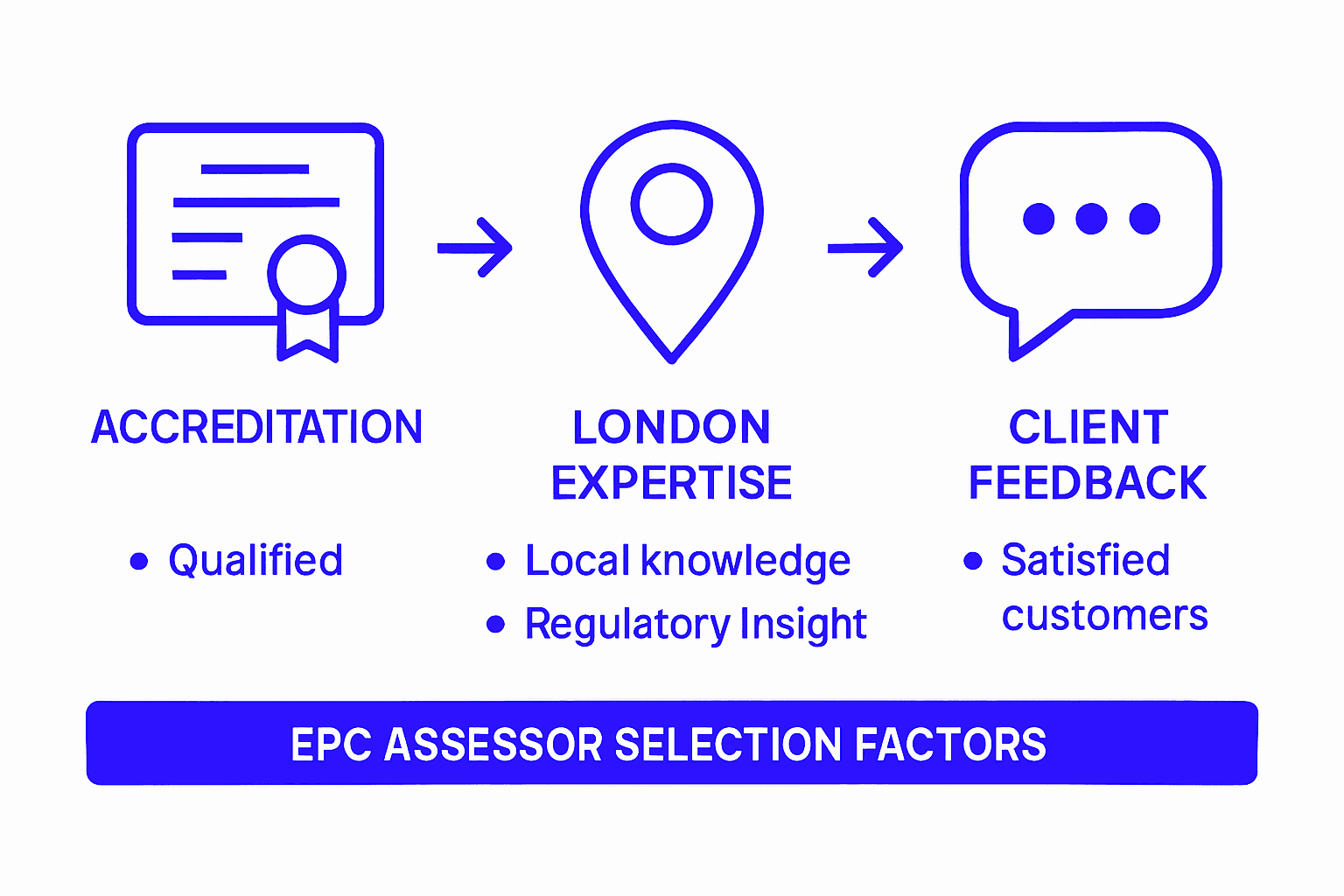
EPC ratings and planning policies across London reveal the critical importance of localised expertise. Property owners should prioritise assessors who demonstrate comprehensive knowledge of regional energy efficiency standards, particularly those familiar with London’s diverse property types ranging from historic townhouses to modern commercial spaces. Pay close attention to an assessor’s track record with properties similar to yours in terms of age, construction type, and specific neighbourhood characteristics.
Experience matters significantly when selecting an EPC assessor. Request detailed portfolios that showcase previous assessment work, focusing on the depth and quality of their reporting. Consider assessors who regularly update their professional knowledge, especially given the ongoing reforms to energy performance building regulations. Look for professionals who demonstrate continuous learning and can interpret complex energy efficiency guidelines specific to London properties.
Professional tip: Request references from previous clients in your specific property category and verify the assessor’s familiarity with recent local energy efficiency trends and regulations.
Step 4: Evaluate pricing, service guarantees, and reviews
Selecting the right EPC assessor involves more than just checking credentials. You will need to carefully compare pricing structures, service guarantees, and independent reviews to make an informed decision about your energy performance certificate assessment.
A comprehensive guide to energy performance certificates underscores the importance of understanding the full scope of services provided. When evaluating potential assessors, request detailed quotes that break down all costs upfront. Be wary of assessors offering suspiciously low prices, as these might indicate hidden charges or substandard work. Look for transparent pricing models that include the full assessment, report generation, and potential follow-up consultations.
Beyond pricing, investigate the assessor’s service guarantees and customer support reputation. Request information about their turnaround times, report accuracy, and post-assessment support. Check online reviews and testimonials from previous clients, paying particular attention to feedback from property owners with similar property types to yours. Professional associations and trade body recommendations can provide additional validation of an assessor’s reliability and service quality.
Professional tip: Create a comparison spreadsheet to systematically evaluate different assessors, including their pricing, turnaround times, additional services, and customer reviews to help you make an objective selection.
Compare the main factors to evaluate when choosing between EPC assessors:
| Evaluation Factor | Impact on Outcome | What to Look For |
|---|---|---|
| Accreditation | Legal validity of certificate | RICS or government-approved scheme |
| Local experience | Accuracy for property type | Assessments in your area |
| Transparent pricing | No hidden costs or surprises | Itemised quotes, clear terms |
| Client feedback | Likelihood of reliable service | Positive reviews, client references |
Step 5: Verify credentials and confirm your EPC appointment
Finalising your EPC assessment requires meticulous attention to detail and a systematic approach to verifying the assessor’s professional standing. Your primary goal is to ensure complete compliance and receive an accurate energy performance certificate for your London property.
A comprehensive government guide to energy performance certificates emphasises the critical importance of verifying an assessor’s credentials before scheduling an appointment. Request the assessor’s official accreditation number and cross reference this with the national registration database. Confirm their membership with recognised bodies such as the Royal Institution of Chartered Surveyors or government approved energy assessment schemes. Ensure they hold current professional indemnity insurance and specialise in assessments for properties similar to yours.
During the credential verification process, schedule a preliminary consultation to discuss the specific requirements of your property. Prepare a comprehensive list of questions about their assessment methodology, expected turnaround times, and any potential additional services. Request sample reports from previous assessments to evaluate the depth and quality of their documentation. Confirm the exact appointment details including date, time, estimated duration, and any preparatory steps you need to take before the assessor arrives.
Professional tip: Create a checklist of required documents and property information to have ready during the assessor’s visit, which will help streamline the assessment process and ensure nothing is overlooked.
Find the Best EPC Assessor for Your London Property with Complete EPC
Choosing the right Energy Performance Certificate assessor can be overwhelming when you need to meet legal requirements and improve your property’s energy efficiency. This article highlights the challenge of locating qualified, accredited assessors who understand London’s unique property types and local regulations. Your goal is clear: secure accurate and reliable EPC assessments that help reduce energy costs and increase property value.
At Complete EPC, we take the stress out of this process by providing qualified assessors with extensive London expertise, transparent pricing, and comprehensive EPC reports tailored to your property type. Whether you own a historic townhouse or a modern commercial space, our team ensures your assessment complies fully with government standards while delivering actionable recommendations. Avoid costly mistakes and hidden fees by choosing our professional service with a lowest price guarantee.
Ready to take the next step in securing a trusted EPC assessment? Visit Complete EPC to book your appointment today. Learn more about the importance of hiring a qualified EPC assessor and how we help streamline your compliance needs. Don’t delay — ensure your London property meets all energy performance regulations swiftly and efficiently by connecting with us now.
Frequently Asked Questions
What are the key factors to consider when selecting an EPC assessor for London properties?
To choose an EPC assessor, consider their accreditation, local experience, and transparency in pricing. Verify their credentials, and ensure they are familiar with properties similar to yours to ensure accurate assessments.
How can I confirm the credentials of a potential EPC assessor?
You can confirm the credentials by requesting their official accreditation number and checking it against national registration databases. Ensure they have current professional indemnity insurance and belong to recognised professional organisations.
What documentation should I prepare before my EPC assessment appointment?
Prepare documentation such as property age, floor area, current energy systems, and maintenance records. Having this information ready will help streamline the assessor’s evaluation process and improve the accuracy of the assessment.
How do I compare different EPC assessors effectively?
Create a comparison spreadsheet that includes factors like pricing, turnaround times, service guarantees, and client feedback. This structured approach allows you to weigh the pros and cons of each assessor based on your unique needs.
What type of questions should I ask during the preliminary consultation with an EPC assessor?
Ask about their assessment methodology, expected turnaround times, and any additional services they provide. Clarifying these details will help you understand the process better and set proper expectations for the assessment outcome.
How long does it typically take to receive an EPC report after the assessment?
After the assessment, you can usually expect to receive your EPC report within 7 to 14 days. Confirm the expected timeline during your consultation to ensure you have everything planned accordingly.
Recommended
- 7 Simple Steps to Get an EPC for Your London Property – Complete EPC
- 7 Key Steps to Meet EPC Regulations in London Properties
- The Londoner’s Checklist for Obtaining an Energy Performance Certificate – Complete EPC
- 7 Essential EPC Compliance Tips for London Property Owners – Complete EPC
- Best Solar Thermal Solutions – Expert Comparison 2025 – Skan Plumbing & Heating
- Rôle de l’expert immobilier – Impact sur vos droits – Avocat Immobilier Paris