

Nearly one in four British landlords could face serious fines if their London properties fail new energy efficiency standards. With energy costs continuing to rise and legal requirements tightening, understanding Energy Performance Certificate ratings matters more than ever. This guide breaks down how EPC rules affect British property owners, what minimum ratings mean for rentals, and practical ways to improve your property’s compliance and value.
Table of Contents
- Minimum EPC Ratings Explained For Properties
- Legal Standards Enforced Across London
- EPC Requirements For Landlords And Sellers
- Penalties And Compliance Checks In Practice
- Exemptions, Appeals, And Practical Scenarios
Key Takeaways
| Point | Details |
|---|---|
| Understanding EPC Ratings | Every landlord in London must achieve a minimum EPC rating of E for their properties to be legally lettable. |
| Legal Implications | Non-compliance can result in substantial financial penalties and restrictions on renting properties with EPC ratings below E. |
| Proactive Improvements | Landlords are encouraged to invest in energy efficiency upgrades to enhance their properties’ EPC ratings and reduce energy costs. |
| Exemptions and Appeals | There are specific exemptions available, but they require thorough documentation and justification to be pursued successfully. |
Minimum EPC ratings explained for properties
Every London landlord must understand the Energy Performance Certificate (EPC) ratings, which provide a crucial assessment of a property’s energy efficiency. The EPC rates properties on a scale from A to G, where A represents the most energy-efficient properties and G represents the least efficient. According to UK government guidance, domestic private rented properties must achieve a minimum rating of E to be legally lettable.
The rating system evaluates multiple aspects of a property’s energy performance, including insulation quality, heating systems, windows, and overall construction. Properties rated F or G are considered substandard and cannot be legally rented unless specific exemptions apply. These ratings are determined through comprehensive assessments that examine the property’s energy consumption, carbon dioxide emissions, and potential for improvement.
Landlords must take proactive steps to understand and potentially upgrade their property’s energy efficiency. Minimum Energy Efficiency Standards (MEES) regulations mandate that most UK properties require an EPC, with clear expectations for rental properties. This means landlords may need to invest in improvements such as better insulation, more efficient heating systems, or double-glazed windows to meet the required standards.
For properties currently below the E rating, landlords have several options to improve their EPC score. These might include upgrading thermal insulation, replacing older heating systems with more efficient models, installing smart heating controls, or improving window and door seals. Understanding these potential improvements can not only help meet legal requirements but also potentially increase property value and reduce energy costs.
Here is a comparison of typical EPC improvement measures and their likely impact:
| Upgrade Measure | Likely Improvement in Rating | Additional Benefit |
|---|---|---|
| Upgrade loft insulation | Often 1-2 bands higher | Reduces heating bills |
| Install efficient boiler | 1 band higher possible | More reliable heating |
| Fit double-glazed windows | Up to 2 bands higher | Less noise, improved comfort |
| Add smart heating controls | Usually 1 band higher | Increases control, energy savings |
Property Efficiency Tip: Research potential energy improvements before conducting a formal EPC assessment, as strategic upgrades can significantly boost your property’s energy rating and rental potential.
Legal standards enforced across London
London’s property landscape is governed by stringent Energy Performance Certificate (EPC) regulations that require landlords to meet specific legal standards for energy efficiency. The UK government’s guidance specifies that domestic private rented properties in London must achieve a minimum EPC rating of E, with properties rated F or G being legally prohibited from rental unless specific exemptions are granted.

The legal framework surrounding EPC standards is continuously evolving, with local authorities pushing for even more ambitious energy efficiency targets. The London Assembly has been particularly proactive, recently calling for landlords to upgrade rental properties to an EPC rating of C by 2028. This progressive approach demonstrates the city’s commitment to reducing carbon emissions and improving overall building energy performance across residential and commercial sectors.
Legal enforcement of these standards involves potential financial penalties for non-compliance. Landlords who fail to meet the minimum EPC requirements can face substantial fines, with local authorities empowered to investigate and issue penalties. These regulations apply uniformly across different property types, including residential dwellings, shared accommodations, and commercial spaces, ensuring a comprehensive approach to energy efficiency standards in the capital.
The implications of these legal standards extend beyond mere compliance. Landlords who proactively improve their properties’ energy efficiency can benefit from increased property values, lower energy costs, and improved tenant attraction. The regulations create a clear incentive for continuous property improvement and investment in sustainable building technologies.
Compliance Strategy Tip: Conduct a pre-emptive EPC assessment and develop a strategic improvement plan before legal deadlines to avoid potential penalties and maximise property value.
EPC requirements for landlords and sellers
Landlords and property sellers in the UK have specific Energy Performance Certificate (EPC) obligations that are critical to understand before marketing or letting a property. The UK government mandates that an EPC must be provided to prospective tenants or buyers at the earliest opportunity, with each certificate remaining valid for a decade from its initial assessment date.
The legal requirements differ slightly between selling and letting properties. For landlords, the EPC must demonstrate a minimum energy efficiency rating of E, with properties rated F or G being legally prohibited from rental without specific exemptions. Sellers, while not bound by the same minimum rating restrictions, must still present a current EPC to potential buyers, ensuring transparency about the property’s energy performance and potential running costs.
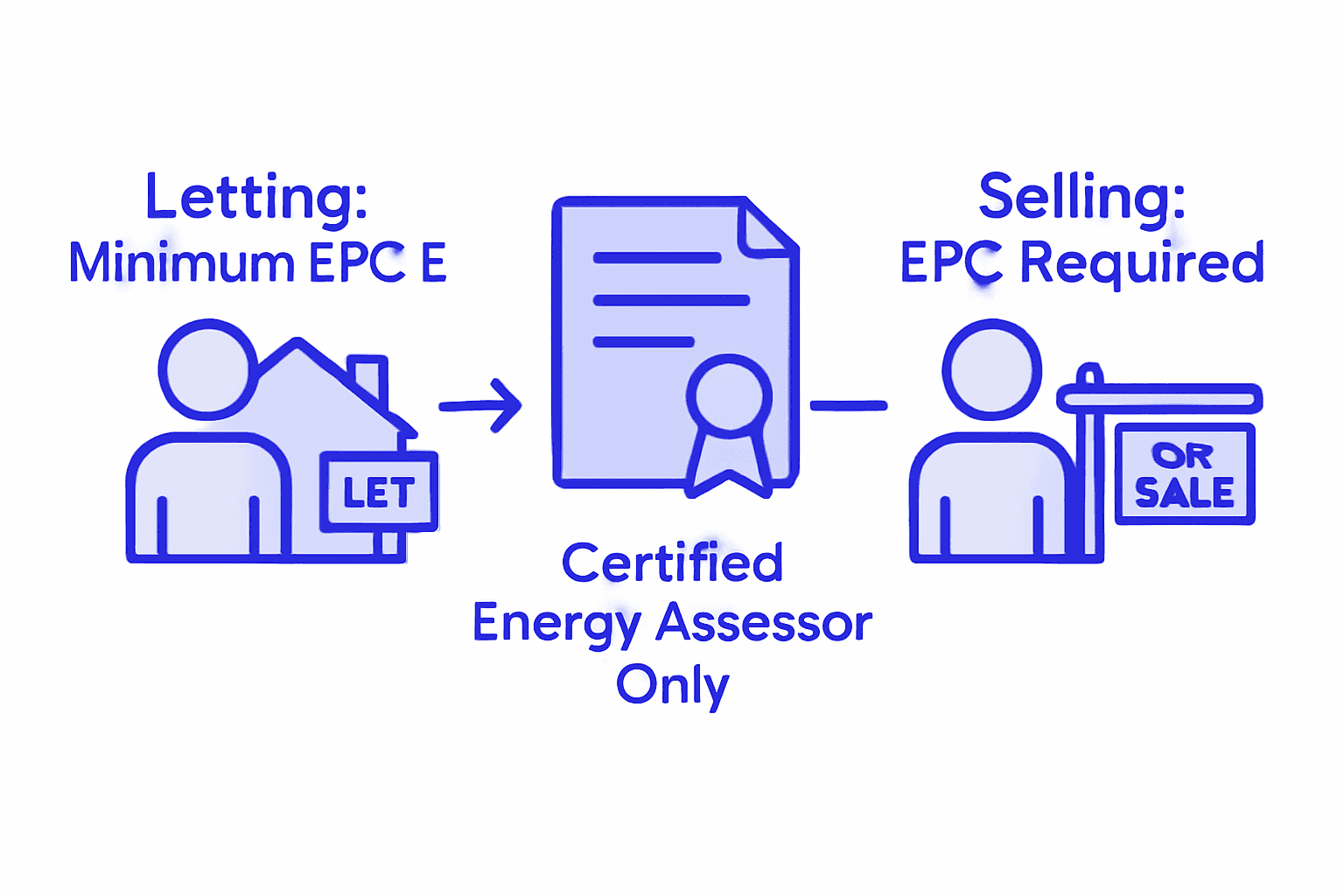
Professional energy assessors play a crucial role in this process, being the only individuals authorised to produce legally recognised EPCs. These qualified professionals conduct comprehensive evaluations of a property’s energy efficiency, examining factors such as insulation, heating systems, windows, and overall building construction. The assessment generates a standardised certificate that provides clear recommendations for potential energy efficiency improvements, which can be valuable for both sellers and landlords looking to enhance their property’s market value.
Beyond legal compliance, EPCs offer strategic advantages for property owners. A high-quality energy performance rating can potentially increase property value, attract more environmentally conscious tenants or buyers, and provide a roadmap for reducing long-term energy expenditure. Proactive property owners often use EPC recommendations as a strategic investment guide for gradual property improvements.
Documentation Strategy Tip: Always engage a certified energy assessor and retain copies of your EPC, as these documents are essential for legal compliance and can serve as valuable property improvement references.
Penalties and compliance checks in practice
London landlords must take Energy Performance Certificate (EPC) compliance extremely seriously, as local authorities are empowered to enforce stringent penalties for properties failing to meet minimum energy efficiency standards. Non-compliant landlords can face substantial financial penalties ranging from £500 to £5,000, depending on the property’s rateable value and duration of non-compliance.
The compliance checking process involves systematic local authority investigations that can be triggered through various mechanisms. These may include random property inspections, tenant complaints, or cross-referencing rental property databases. Landlords found in violation of EPC regulations may initially receive a compliance notice, providing an opportunity to rectify the property’s energy performance before more severe financial penalties are imposed.
Interestingly, projected financial implications for the broader housing market are significant. Analytical research suggests that if proposed 2030 energy efficiency regulations were comprehensively enforced today, homeowners could potentially face up to £1.66 billion in cumulative fines. This projection underscores the critical importance of proactively addressing energy efficiency requirements and maintaining current, valid Energy Performance Certificates.
Beyond immediate financial penalties, non-compliance can result in additional consequences that extend beyond monetary fines. Landlords may find themselves unable to legally rent their properties, facing potential legal challenges from tenants, and experiencing diminished property market value. The regulatory framework is designed not just to punish, but to incentivise meaningful improvements in building energy performance.
This table summarises potential consequences for EPC non-compliance:
| Consequence | When It Applies | Long-Term Impact |
|---|---|---|
| Financial penalties | Non-compliance discovered | Loss of profits |
| Letting restriction | Below minimum EPC rating | Unable to rent property |
| Tenant legal action | Prolonged illegal rental status | Costly disputes, compensation |
| Lower property value | Persistently poor EPC rating | Reduced market attractiveness |
Compliance Preparation Tip: Conduct regular energy assessments and maintain up-to-date documentation to stay ahead of potential compliance investigations and avoid unexpected financial penalties.
Exemptions, appeals, and practical scenarios
Navigating the complex landscape of Energy Performance Certificate (EPC) exemptions requires a nuanced understanding of the regulations. The UK government provides specific guidelines that allow landlords to register exemptions under carefully defined circumstances. These exemptions are not blanket permissions but rather carefully scrutinised scenarios that protect both property owners and the broader energy efficiency objectives.
Key exemption categories include situations where energy efficiency improvements would potentially devalue the property by more than 5%, or where a landlord can conclusively demonstrate that all possible cost-effective improvements have been implemented without achieving the required EPC rating. Additional exemptions may apply in complex scenarios such as listed buildings, conservation areas, or properties with specific architectural constraints that make standard energy improvements challenging or impossible to implement.
The appeals process for EPC-related decisions is structured to provide landlords with a fair mechanism to challenge assessments or exemption determinations. Property owners must compile comprehensive documentation, including professional surveys, cost analyses, and detailed evidence supporting their exemption claim. This might involve obtaining independent energy assessments, gathering quotes from certified contractors, and presenting a clear narrative about why standard improvements are not feasible for their specific property.
Practical scenarios demonstrate the complexity of EPC compliance. For instance, a landlord with a Georgian terrace house might face unique challenges in retrofitting energy efficiency measures without compromising the building’s historical integrity. Similarly, properties with structural limitations or those located in conservation zones may require bespoke approaches to meeting energy performance standards, necessitating careful negotiation and expert guidance.
Strategic Documentation Tip: Maintain a comprehensive file of all energy assessment reports, improvement quotes, and correspondence related to your property’s EPC status to support potential exemption or appeal processes.
Ensure Your Property Meets London’s Minimum EPC Requirements with Expert Support
Navigating the complex legal landscape of EPC ratings can be overwhelming for London landlords facing stringent minimum energy efficiency obligations. With the risk of heavy penalties and letting restrictions for properties rated below E, it is critical to act promptly. Whether you are dealing with necessary property upgrades, understanding potential exemptions, or preparing for compliance checks, having accurate and professional energy assessments is essential.
At Complete EPC, we specialise in delivering comprehensive and affordable Energy Performance Certificates tailored to both domestic and commercial properties across London. Our team of qualified assessors provides detailed reports with clear improvement recommendations that align with government requirements and landlord goals. Don’t leave your property’s legal compliance and market value to chance. Visit Complete EPC today to secure your energy certificate and take proactive steps towards meeting London’s evolving energy efficiency standards.
Act now to avoid costly fines and maximise your property’s rental potential with reliable EPC certification from Complete EPC.
Frequently Asked Questions
What is an EPC rating, and why is it important for landlords?
An Energy Performance Certificate (EPC) rating assesses a property’s energy efficiency on a scale from A (most efficient) to G (least efficient). It is important for landlords as it determines whether a property can be legally rented; properties must achieve a minimum rating of E to be lettable.
What are the legal requirements for EPC ratings for rental properties?
Landlords must ensure their rental properties have a minimum EPC rating of E. Properties rated F or G cannot be rented unless specific exemptions apply. Regular assessments and potential improvements may be necessary to comply with these standards.
How can landlords improve their EPC ratings?
Landlords can improve their EPC ratings by upgrading insulation, installing efficient heating systems, fitting double-glazed windows, and adding smart heating controls. These improvements not only boost the EPC score but can also reduce energy costs and enhance property value.
What are the penalties for not complying with EPC regulations?
Penalties for non-compliance can range from £500 to £5,000, depending on the property’s rateable value and the duration of non-compliance. Additionally, landlords may face restrictions on renting out their properties and potential legal action from tenants.