

Commercial property owners across Central London face strict british legal requirements for Energy Performance Certificates that can directly impact asset value and marketability. Failing to meet these standards may result in fines up to £5,000 for non-compliance. Understanding which properties need an EPC, how to arrange compliant inspections, and how to maintain records gives you confidence as regulations evolve and buyer expectations rise.
Table of Contents
- Step 1: Identify Mandatory EPC Requirements For Your Property
- Step 2: Engage Qualified EPC Assessors For A Compliant Inspection
- Step 3: Prepare Building Documentation And Access For Assessment
- Step 4: Review The EPC Report And Implement Recommended Actions
- Step 5: Verify Compliance And Maintain Up-To-Date EPC Records
Quick Summary
| Key Insight | Explanation |
|---|---|
| 1. EPC Required for Transactions | Obtain an Energy Performance Certificate when selling, renting, or constructing commercial properties over 50 square metres. |
| 2. Engage Qualified Assessors | Hire accredited energy assessors to ensure a compliant and thorough property evaluation for your EPC. |
| 3. Prepare Essential Documentation | Organise all relevant energy documentation and ensure accessible areas for the assessor to guarantee an efficient inspection. |
| 4. Review and Implement Recommendations | Analyse your EPC report to identify practical upgrades that can enhance energy efficiency and property value. |
| 5. Maintain Updated EPC Records | Systematically manage and verify your EPC documentation to comply with regulations and avoid penalties. |
Step 1: Identify mandatory EPC requirements for your property
Identifying mandatory Energy Performance Certificate (EPC) requirements is crucial for commercial property owners in the United Kingdom. Your goal is to understand precisely when and how you must obtain an energy performance certificate for commercial premises.
Commercial properties require an EPC in specific circumstances including when you are selling, renting, or constructing a new building. The certificate rates your property’s energy efficiency on a scale from A to G, with A representing the most efficient rating. These certificates remain valid for 10 years and are legally required for most commercial buildings over 50 square metres. Some critical scenarios mandating an EPC include property transactions, new construction projects, and significant renovations that modify the building’s energy characteristics.
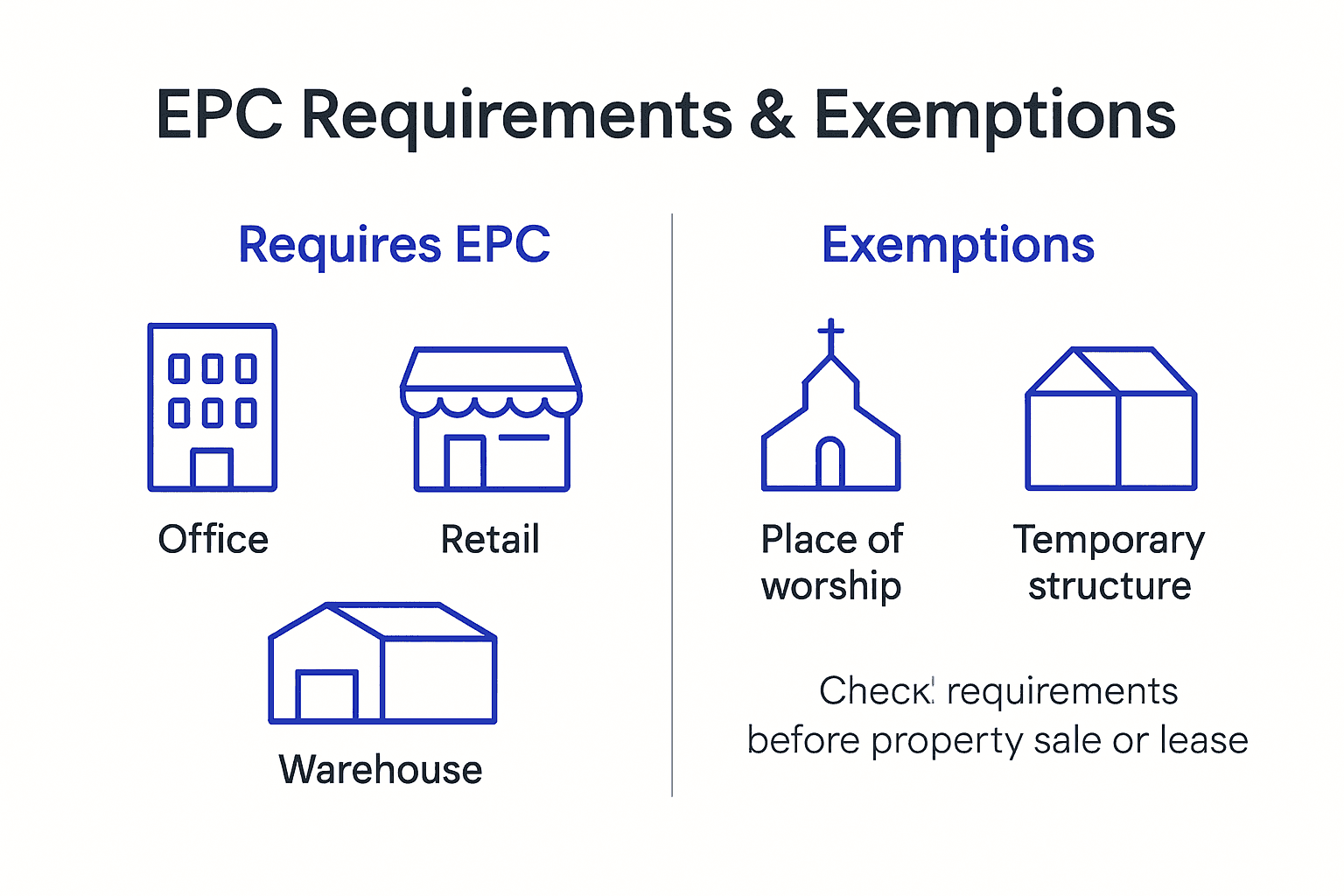
While most commercial properties need an EPC, certain exceptions exist. Buildings used exclusively for worship, temporary structures, and small detached buildings under 50 square metres are typically exempt from these requirements. Your specific obligation depends on factors like building size, usage, and intended transaction type.
Here is a quick reference table outlining which commercial properties typically require an EPC and which may be exempt:
| Property Type | EPC Required | Typical Reason for Exemption |
|---|---|---|
| Office buildings over 50 m² | Yes | Not usually exempt |
| Retail units in shopping centres | Yes | Not usually exempt |
| Places of worship (e.g., churches) | No | Religious use exemption |
| Temporary structures (under 2 years) | No | Short-term use exemption |
| Small detached buildings (<50 m²) | No | Size threshold exemption |
| Industrial warehouses over 50 m² | Yes | Not usually exempt |
Top Tip: Schedule your EPC assessment well in advance of any property transaction to avoid last minute compliance issues and potential legal penalties.
Step 2: Engage qualified EPC assessors for a compliant inspection
Engaging the right EPC assessor is essential for ensuring a comprehensive and legally compliant energy performance evaluation of your commercial property. Your primary objective is to find and work with professionally accredited commercial energy assessors who understand the nuanced requirements of commercial property inspections.
To secure a qualified EPC assessor, you must prioritise professionals who are accredited by approved government schemes. These assessors possess specialised expertise in evaluating complex commercial building systems including building fabric, heating infrastructure, lighting networks, and ventilation mechanisms. A skilled assessor will conduct a thorough examination that goes beyond simple visual inspection, using standardised methodologies to generate detailed reports that meet strict legal standards. They will assess your property’s current energy efficiency and potential ratings, providing insights that can help you understand and potentially improve your building’s environmental performance.
When selecting an assessor, verify their credentials, review their experience with similar commercial properties, and confirm they are registered with a recognised accreditation body. Request examples of previous commercial EPC reports and ensure they have experience in your specific property type, whether it is an office complex, retail space, or industrial facility.
Top Tip: Request references and sample reports from previous commercial property assessments to validate an assessor’s expertise and thoroughness before commissioning their services.
Step 3: Prepare building documentation and access for assessment
Successfully preparing your commercial property for an Energy Performance Certificate assessment requires meticulous document organisation and comprehensive site accessibility. Your primary objective is to ensure a smooth assessment process by providing complete building documentation that enables the assessor to conduct a thorough evaluation.

Gather and organise all relevant documentation related to your building’s energy systems before the assessment date. This includes technical specifications for heating and cooling systems, lighting infrastructure, building fabric details, insulation records, and previous energy performance data. The assessor will require unrestricted access to all areas of the property, including mechanical rooms, utility spaces, and individual floor zones. Ensure that locked areas can be readily accessed and that any security protocols are communicated in advance to prevent potential assessment delays.
Prepare a comprehensive folder or digital repository containing blueprints, system specifications, maintenance records, and recent renovation documentation. Highlight any energy efficiency upgrades or modifications that might positively impact the property’s energy performance rating. Having these documents readily available demonstrates professionalism and facilitates a more accurate and efficient assessment process.
Below is a summary of key documentation to prepare before your EPC assessment and its inspection importance:
| Document Type | Inspection Relevance | Example Content |
|---|---|---|
| Heating & cooling records | Confirms system specifications | Boiler certificates, AC manuals |
| Building fabric details | Assesses insulation and materials | Wall construction specs, U-values |
| Lighting system info | Evaluates energy use, efficiency | Lighting layout, wattage details |
| Renovation documentation | Shows recent efficiency improvements | Upgrade certificates, retrofit plans |
Top Tip: Create a digital backup of all documentation and have physical copies accessible during the assessment to streamline the process and provide immediate evidence of your property’s energy characteristics.
Step 4: Review the EPC report and implement recommended actions
Reviewing your Energy Performance Certificate report requires a strategic approach to understanding and actioning the recommended improvements for your commercial property. Your goal is to systematically analyse the energy efficiency insights and potential upgrade pathways that can enhance your building’s performance and value.
Carefully examine the current and potential energy efficiency ratings detailed in the report, paying close attention to specific recommendations across key systems such as insulation, heating, lighting, and ventilation. Prioritise improvements based on their potential impact on energy performance, cost effectiveness, and long term building value. Consider both immediate upgrades that can be implemented quickly and more comprehensive renovations that might require substantial investment but offer significant long term benefits. Focus on recommendations that not only improve your property’s energy rating but also potentially reduce operational costs and increase tenant attractiveness.
Work with energy efficiency professionals to develop a structured implementation plan that breaks down recommended actions into manageable stages. Create a timeline for upgrades, allocating budget and resources strategically. Some improvements might qualify for government incentives or grants, so investigate additional financial support mechanisms that could offset implementation costs. Track your progress carefully and be prepared to update your approach as new technologies and energy efficiency standards emerge.
Top Tip: Develop a comprehensive tracking spreadsheet documenting each recommended improvement, estimated cost, potential energy savings, and implementation timeline to maintain a clear and organised approach to your energy efficiency upgrades.
Step 5: Verify compliance and maintain up-to-date EPC records
Maintaining accurate and current Energy Performance Certificate records is a critical responsibility for commercial property owners to ensure ongoing legal compliance. Your objective is to systematically manage and verify your EPC documentation to avoid potential penalties and regulatory challenges.
Conduct a comprehensive review of your existing EPC records at least six months before their expiration. Check that each certificate remains valid and meets the current Minimum Energy Efficiency Standards (MEES). Pay particular attention to the certificate’s issue date, ensuring it covers the entire period of your current property usage or planned transactions. Establish a digital and physical filing system that allows quick retrieval of documents, including the original EPC, assessment notes, and any improvement recommendations. Store digital copies in secure cloud storage and maintain physical backups in a dedicated property management file.
Create a proactive tracking mechanism to monitor upcoming EPC renewal dates and potential regulatory changes. Set calendar reminders for certificate expiration and schedule reassessments well in advance. Consider developing a comprehensive compliance log that tracks not just EPC certificates but also any energy efficiency improvements implemented, which can demonstrate your commitment to maintaining and enhancing your property’s environmental performance.
Top Tip: Implement a digital calendar with automated alerts for EPC renewal dates and regulatory compliance milestones to ensure you never miss a critical documentation deadline.
Ensure Your Commercial Property Meets EPC Legal Requirements with Confidence
Navigating the complexities of Energy Performance Certificate regulations can feel overwhelming, especially with strict UK laws demanding valid EPCs for commercial properties over 50 square metres. From understanding when an EPC is mandatory to engaging accredited assessors and preparing detailed documentation, the process demands precision to avoid costly penalties and delays. If you are a property owner, landlord, or estate agent aiming to stay compliant while unlocking energy efficiency improvements, you are not alone in facing these challenges.
At Complete EPC, we specialise in delivering expert EPC assessments tailored for commercial buildings across London. Our team of qualified professionals ensures every step—from scheduling inspections to reviewing comprehensive reports—is managed seamlessly. We provide detailed recommendations aligned with legal standards and help you track ongoing compliance effortlessly. Take the next step to safeguard your property’s value, reduce energy costs, and secure legal peace of mind with our competitively priced services. Discover how we can support your compliance journey by visiting Complete EPC today and make sure your commercial property meets its energy certification obligations without stress.
Frequently Asked Questions
What are the mandatory EPC requirements for my commercial property?
To meet legal EPC obligations, your commercial property typically requires an Energy Performance Certificate when selling, renting, or constructing over 50 square metres. Ensure you obtain an EPC prior to any transaction to comply with regulations and avoid penalties.
How do I find a qualified EPC assessor?
Engage an accredited EPC assessor who is registered with a recognised body and has experience in commercial property evaluations. Request their credentials and previous reports to confirm their expertise before scheduling an assessment.
What documents do I need to prepare for an EPC assessment?
Prepare essential documents such as technical specifications for heating and cooling systems, building fabric details, and any previous energy performance data. Having a complete set of documentation ready can streamline the assessment process and ensure a thorough evaluation.
How can I improve my property’s EPC rating after the assessment?
After reviewing your EPC report, prioritise the recommended improvements based on their potential impact and cost efficiency. Develop an implementation plan that outlines timelines and budgets, focusing on upgrades that can enhance your energy performance rating by reducing costs over time.
How often should I verify and update my EPC records?
You should review your EPC records at least six months before their expiration to ensure compliance with current regulations. Establish a regular schedule for checks and updates to avoid lapses in your property’s documentation and maintain legal obligations.
Recommended
- EPC for Commercial Property: Complete Guide London – Complete EPC
- Complete Guide to EPC and Legal Compliance UK – Complete EPC
- 7 Key EPC Legal Requirements UK Property Owners Must Know – Complete EPC
- EPC Compliance Deadlines – Avoiding Legal Penalties in London
- What is Commercial Property Insurance? Understanding Its Importance – Rental Income Insurance
- Why Renovate Commercial Property: Boost Value and Success – Astrotech Construction