

Most British landlords in London face a real challenge when trying to upgrade property energy efficiency. With regulatory complexity and high upfront costs slowing progress, over £3.1 billion is lost every year in the United Kingdom due to missed efficiency opportunities. This growing issue affects long-term property values and compliance with EPC regulations. Discover how smart solutions can help you break down common energy barriers and achieve sustainable improvements for your London properties.
Table of Contents
- Defining Energy Efficiency Barriers In Property
- Types Of Barriers: Physical, Behavioural, Financial
- Legal And Regulatory Challenges In London
- Financial Impacts And Missed Opportunities
- Proven Strategies For Overcoming Energy Barriers
Key Takeaways
| Point | Details |
|---|---|
| Understanding Barriers | Energy efficiency improvements face financial, technical, and regulatory challenges that hinder progress in London’s property market. |
| Historic Properties | Upgrading historic buildings for energy efficiency requires balancing heritage preservation with modern standards. |
| Financial Consequences | Owners ignoring energy efficiency risk decreased property values and face substantial penalties and higher operational costs. |
| Strategic Improvements | Implementing a phased approach for energy assessments and targeted upgrades can enhance property performance effectively. |
Defining Energy Efficiency Barriers in Property
Understanding energy efficiency barriers requires examining the complex challenges property owners face when attempting to improve building performance. These obstacles are multifaceted, ranging from financial constraints to regulatory complexity, and significantly impact London’s sustainable housing landscape.
Research indicates that property energy efficiency improvements are hindered by several interconnected factors. Comprehensive stakeholder perspectives reveal multiple systemic challenges, including:
- Financial limitations preventing upfront investment
- Technical knowledge gaps among property owners
- Complex regulatory environments
- Uncertainty about potential energy savings
- Preservation concerns for historic buildings
Historic properties present unique challenges in energy efficiency upgrades. Government research on historic home adaptations demonstrates that heritage conservation often conflicts with modern energy efficiency standards. Owners must balance maintaining architectural integrity with implementing sustainable improvements, a delicate process requiring specialised expertise and careful planning.
Professional Tip: Conduct a comprehensive energy assessment before implementing any modifications to understand your specific property’s unique efficiency challenges and potential solutions.
Types of Barriers: Physical, Behavioural, Financial
Energy efficiency barriers in London properties manifest through three critical dimensions: physical infrastructure limitations, behavioural patterns, and financial constraints. Each category presents unique challenges that collectively impede sustainable property improvements and energy performance upgrades.
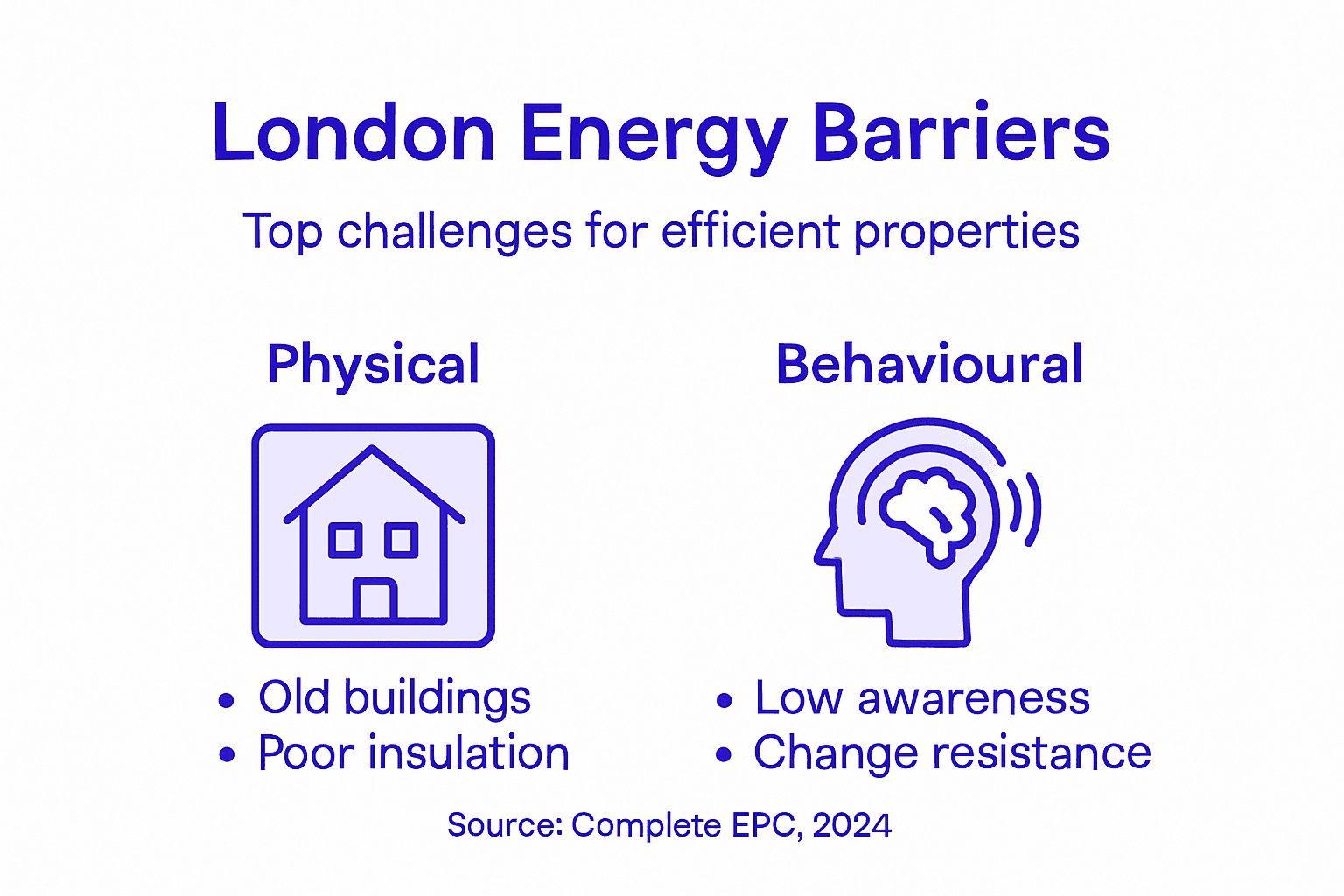
Physical barriers primarily relate to the structural characteristics of buildings. Older London properties, particularly historic structures, often have inherent design limitations that make energy efficiency retrofitting complex. These might include poor insulation, outdated heating systems, single-glazed windows, and architectural features that resist modern energy-saving modifications.
Behavioural insights into energy use reveal that property owners and occupants play a significant role in energy efficiency challenges. Psychological factors such as lack of awareness, resistance to change, and limited understanding of energy consumption patterns create substantial obstacles. Some residents remain unaware of their energy usage habits or the potential impact of small behavioural modifications.
Financial barriers represent another critical dimension. Many property owners face substantial upfront costs associated with energy efficiency upgrades. These investments can include:
- Advanced insulation installations
- Replacing inefficient heating systems
- Installing double or triple-glazed windows
- Implementing renewable energy technologies
- Conducting comprehensive energy assessments
The financial burden often deters property owners from making necessary improvements, creating a significant impediment to widespread energy efficiency adoption in London’s property market.
The following table summarises the three key types of energy efficiency barriers affecting London properties:
| Barrier Type | Example Challenges | Typical Impact on Owners |
|---|---|---|
| Physical | Poor insulation, outdated heating systems | Costly retrofits, structural limitations |
| Behavioural | Low awareness, resistance to change | Missed savings, inefficient energy use |
| Financial | High upfront investment costs | Delayed upgrades, increased expenses |
Professional Tip: Consider staged energy efficiency improvements, prioritising low-cost interventions that offer immediate returns and gradually building towards more substantial upgrades.
Legal and Regulatory Challenges in London
London’s energy efficiency landscape is increasingly defined by complex legal and regulatory frameworks that challenge property owners and landlords. These regulations aim to drive sustainable transformation while simultaneously creating significant compliance requirements for the city’s diverse property market.

Recent tribunal decisions reveal the intricate enforcement mechanisms surrounding the Energy Efficiency (Private Rented Property) Regulations 2015. These legal frameworks impose strict minimum energy efficiency standards, with potential penalties for non-compliance that can substantially impact property management strategies.
The Energy Act 2023 represents a pivotal moment in London’s regulatory environment, introducing sweeping changes designed to accelerate the city’s transition towards net-zero emissions. Key regulatory developments include:
- Mandatory energy efficiency upgrades for rental properties
- Enhanced penalties for non-compliant properties
- Streamlined frameworks for renewable energy deployment
- Increased transparency requirements for energy performance
- Progressive tightening of minimum energy efficiency standards
Navigating these legal complexities requires property owners to remain proactive and informed. The regulatory landscape continues to evolve, with government strategies increasingly focused on incentivising and mandating energy efficiency improvements across residential and commercial properties.
Professional Tip: Consult with a specialised energy compliance expert to develop a comprehensive strategy that anticipates future regulatory changes and minimises potential legal risks.
Financial Impacts and Missed Opportunities
The financial landscape of energy efficiency in London reveals substantial economic consequences for property owners who fail to address energy performance challenges. Comprehensive research highlights the significant economic potential being systematically overlooked through inadequate energy demand reduction strategies.
Studies demonstrate staggering financial implications for property owners. UK homes and businesses are collectively losing approximately £3.1 billion annually due to barriers preventing comprehensive energy efficiency improvements. These missed opportunities stem from multiple interconnected factors, including:
- High upfront investment costs
- Limited understanding of potential financial returns
- Complex implementation processes
- Insufficient awareness of available technologies
- Regulatory uncertainty
The economic impact extends beyond immediate financial losses. Properties with poor energy efficiency experience reduced market value, higher operational costs, and diminished attractiveness to potential tenants or purchasers. The long-term financial consequences of neglecting energy efficiency upgrades can far outweigh the initial investment required for meaningful improvements.
Moreover, the financial risks are not merely theoretical. Property owners who delay energy efficiency investments risk facing increasingly stringent regulatory penalties, reduced property valuations, and escalating energy costs. The transition towards more sustainable building practices represents not just an environmental imperative, but a critical economic strategy for protecting and enhancing property assets.
Here is a summary of regulatory and financial risks of ignoring energy efficiency improvements:
| Risk Category | Consequence | Long-Term Effect |
|---|---|---|
| Regulatory | Legal penalties or fines | Ongoing compliance costs |
| Market Value | Property values drop | Lower resale or rental income |
| Energy Costs | Utility bills remain high | Reduced annual savings |
| Missed Incentive | Loss of government support | Harder access to improvement funding |
Professional Tip: Conduct a comprehensive energy performance assessment to identify the most cost-effective efficiency improvements that offer the highest return on investment.
Proven Strategies for Overcoming Energy Barriers
Addressing energy efficiency challenges requires a multifaceted approach that combines strategic planning, technological innovation, and collaborative problem-solving. Strategic recommendations highlight critical pathways for transforming property energy performance across London’s diverse property landscape.
Successful strategies for overcoming energy barriers involve a comprehensive approach that addresses multiple dimensions of the challenge:
- Conducting detailed energy performance assessments
- Implementing targeted retrofit interventions
- Leveraging financial incentives and government schemes
- Developing long-term sustainable upgrade plans
- Enhancing technical knowledge and skills
Property owners must adopt a systematic approach to energy efficiency improvements. This involves first understanding the specific energy performance characteristics of their property, identifying the most cost-effective interventions, and developing a phased implementation strategy. The most effective approaches combine immediate low-cost improvements with strategic long-term investments that progressively enhance overall building performance.
Technological advancements and innovative financing models are emerging as powerful tools for addressing energy efficiency barriers. Solutions such as green mortgages, energy performance contracts, and government-backed improvement loans are creating new opportunities for property owners to overcome financial constraints. These mechanisms not only provide financial support but also help mitigate the perceived risks associated with substantial energy efficiency investments.
Professional Tip: Develop a comprehensive energy efficiency roadmap that prioritises interventions based on their potential return on investment and alignment with long-term property value enhancement strategies.
Overcome Energy Efficiency Barriers with Expert Guidance from Complete EPC
The challenges of improving energy efficiency in London properties are clear. Financial constraints, complex regulations, and physical limitations often halt progress despite the urgent need for sustainable upgrades. If navigating these energy efficiency barriers feels overwhelming, you are not alone. Understanding detailed energy performance and compliance requirements is critical to unlocking the value and savings your property deserves.
Complete EPC specialises in providing professional energy performance certificates for both domestic and commercial properties across London. Our expert assessors offer thorough evaluations that identify key improvement opportunities tailored to your property. With a focus on delivering competitive pricing and guaranteed lowest rates in the UK, Complete EPC supports you through legal compliance and cost-effective energy efficiency planning. Don’t miss out on maximising property value or risking costly regulatory penalties. Start your journey towards overcoming energy efficiency obstacles today by visiting Complete EPC and discover how our reliable services and insightful recommendations can guide you forward. Whether you need a quick EPC assessment or detailed advice on energy improvements, take the next step with Complete EPC’s Energy Performance Services to protect your investment and support London’s sustainable future.
Frequently Asked Questions
What are common barriers to energy efficiency improvements in properties?
Energy efficiency improvements are often hindered by financial constraints, technical knowledge gaps, complex regulatory environments, uncertainty about potential energy savings, and preservation concerns for historic buildings.
How do physical barriers affect energy efficiency in older properties?
Physical barriers in older properties can include poor insulation, outdated heating systems, and architectural features that limit modern energy-saving modifications, making retrofitting more complex and costly.
What financial challenges do property owners face regarding energy efficiency upgrades?
Property owners frequently encounter significant upfront costs for energy efficiency upgrades, such as installing advanced insulation or renewable energy technologies, which can deter necessary improvements.
How can property owners navigate the regulatory challenges of energy efficiency?
To navigate regulatory challenges, property owners should stay informed about compliance requirements, consult with energy compliance experts, and develop comprehensive strategies that address current and future regulations.
Recommended
- Energy Efficiency Steps for London Properties Made Simple
- 7 Practical Office Energy Saving Tips for London Properties
- 7 Essential EPC Improvement Recommendations for London Homes – Complete EPC
- The Key to Managing Utility Costs in London Homes – Complete EPC
- Glyphosate Ban in Brighton and Hove: Leading the Way for Sustainable Weed Control