

Managing a commercial property in London often means grappling with intricate energy standards designed to curb carbon emissions and reduce fuel use. Understanding Part L Compliance is essential for landlords and estate agents eager to avoid costly mistakes and legal difficulties. This guide reveals practical insights into energy efficiency requirements, highlights common pitfalls, and explains compliance methods that support property value and regulatory approval.
Table of Contents
- Defining Part L Compliance And Common Missteps
- Types Of Part L Regulations And Their Scope
- Legal Standards For Commercial Property Owners
- Part L Requirements For Energy Performance Certificates (Epcs)
- Risks, Penalties, And Cost Implications
- Practical Steps For Achieving Part L Compliance
Key Takeaways
| Point | Details |
|---|---|
| Understanding Part L Compliance | It is crucial for commercial property owners in London to meet energy efficiency and carbon emission standards outlined in Part L of the Building Regulations to avoid legal complications. |
| Common Compliance Pitfalls | Typical issues include inadequate planning, incomplete documentation, and failure to perform required tests, which can hinder adherence to regulations. |
| Importance of Energy Performance Certificates (EPCs) | EPCs are essential for demonstrating compliance and can influence property value; owners should ensure accurate assessments are conducted. |
| Proactive Compliance Strategies | Engaging certified energy assessors early and maintaining thorough documentation throughout the development process can mitigate risks and improve compliance outcomes. |
Defining Part L Compliance and Common Missteps
Part L Compliance represents a critical legal framework designed to regulate energy efficiency and carbon emissions in commercial properties across London. Under the Building Regulations for energy conservation, these standards establish mandatory requirements for new constructions, renovations, and material changes of use.
The core objectives of Part L focus on reducing overall energy consumption and minimising carbon footprints for commercial buildings. Key components of compliance include:
- Minimum thermal performance standards
- Airtightness requirements
- Appropriate insulation levels
- Efficient heating and cooling systems
- Comprehensive documentation and evidence tracking
Commercial property owners must navigate several complex compliance pathways, with common missteps often derailing their energy efficiency efforts. Technical assessment methodologies like Standard Assessment Procedure (SAP) for residential properties and Simplified Building Energy Model (SBEM) for non-domestic buildings play crucial roles in demonstrating regulatory adherence.
Most property managers encounter challenges when attempting to meet these stringent standards. Typical compliance obstacles frequently include:
- Inadequate initial planning
- Incomplete technical documentation
- Failure to conduct comprehensive airtightness testing
- Neglecting photographic evidence requirements
- Limited engagement with qualified energy assessors
Understanding these potential pitfalls helps London commercial property owners proactively address compliance requirements, avoiding potential legal complications and financial penalties.
Here’s a summary of the main compliance methodologies for commercial properties:
| Methodology | Target Building Type | Key Application | Business Impact |
|---|---|---|---|
| Standard Assessment Procedure (SAP) | Residential dwellings | Design and performance rating | Guides energy efficient planning |
| Simplified Building Energy Model (SBEM) | Non-domestic/commercial | Regulatory assessment | Enables legal compliance and EPC issuance |
| Energy Performance Certificate (EPC) | All property types | Market transactions, upgrades | Impacts property value and leasing |
Pro tip: Always consult a certified energy assessor early in your project planning to identify potential compliance challenges and develop strategic mitigation strategies.
Types of Part L Regulations and Their Scope
Part L regulations represent a comprehensive framework for managing energy efficiency across different building types in the United Kingdom. Building regulations cover two primary volumes, each addressing distinct property categories and their specific energy performance requirements.
The regulations are strategically divided into two key volumes:
- Volume 1: Focuses on residential dwellings
- Includes new and existing houses
- Covers flats and residential care homes
- Volume 2: Addresses non-residential buildings
- Encompasses commercial properties
- Includes industrial and public buildings
- Applies to educational and healthcare facilities
Each volume establishes precise performance standards targeting critical energy efficiency aspects. These include fabric performance metrics, building services efficiency, airtightness requirements, and strategies for integrating renewable energy technologies. Technical compliance parameters cover multiple dimensions such as:
- Thermal insulation standards
- Heating system efficiency
- Lighting energy consumption
- Ventilation performance
- Carbon emission reduction targets
The comprehensive scope of Part L regulations ensures that both new constructions and existing building renovations meet stringent energy conservation guidelines. Regulatory requirements impact various property modifications, including extensions, material alterations, change of use scenarios, and building services installations.
Commercial property owners must carefully navigate these complex requirements, understanding that compliance extends beyond mere documentation to fundamental structural and operational energy efficiency improvements.
Pro tip: Engage a qualified energy assessor early in your project planning to develop a comprehensive strategy for meeting Part L regulatory requirements across different property types.
Here’s how the two main Part L regulation volumes differ:
| Regulation Volume | Coverage Area | Typical Properties | Main Compliance Focus |
|---|---|---|---|
| Volume 1 | Residential buildings | Houses, flats, care homes | Insulation, heating, airtightness |
| Volume 2 | Non-residential | Shops, factories, schools | Lighting, ventilation, service efficiency |
Legal Standards for Commercial Property Owners
Commercial property owners in the United Kingdom face stringent legal obligations under Part L of the Building Regulations, which establish comprehensive energy efficiency standards. Legally binding energy performance requirements mandate specific compliance measures for both new and existing commercial properties.
The key legal standards for commercial property owners include:
- Compliance Variants:
- Part L2A for new non-domestic buildings
- Part L2B for existing buildings undergoing renovation
- Performance Requirements:
- Minimum thermal insulation standards
- Airtightness testing
- Heating system efficiency
- Lighting energy consumption metrics
Minimum Energy Efficiency Standards (MEES) play a crucial role in defining legal obligations for commercial landlords. These regulations directly impact property leasing capabilities and potential financial penalties. Commercial property owners must carefully navigate these requirements to avoid significant legal and financial consequences.
Commercial landlord obligations extend beyond basic compliance, encompassing broader responsibilities such as:
- Maintaining building fabric efficiency
- Ensuring effective heating and ventilation systems
- Obtaining and maintaining valid Energy Performance Certificates (EPCs)
- Demonstrating continuous improvement in energy performance
Non-compliance can result in severe repercussions, including substantial financial penalties, restrictions on leasing properties, and potential legal challenges. Property owners must proactively understand and implement these regulatory requirements to protect their investments and maintain legal standing.

Pro tip: Conduct regular energy assessments and maintain comprehensive documentation to ensure ongoing compliance with Part L regulations and minimise potential legal risks.
Part L Requirements for Energy Performance Certificates (EPCs)
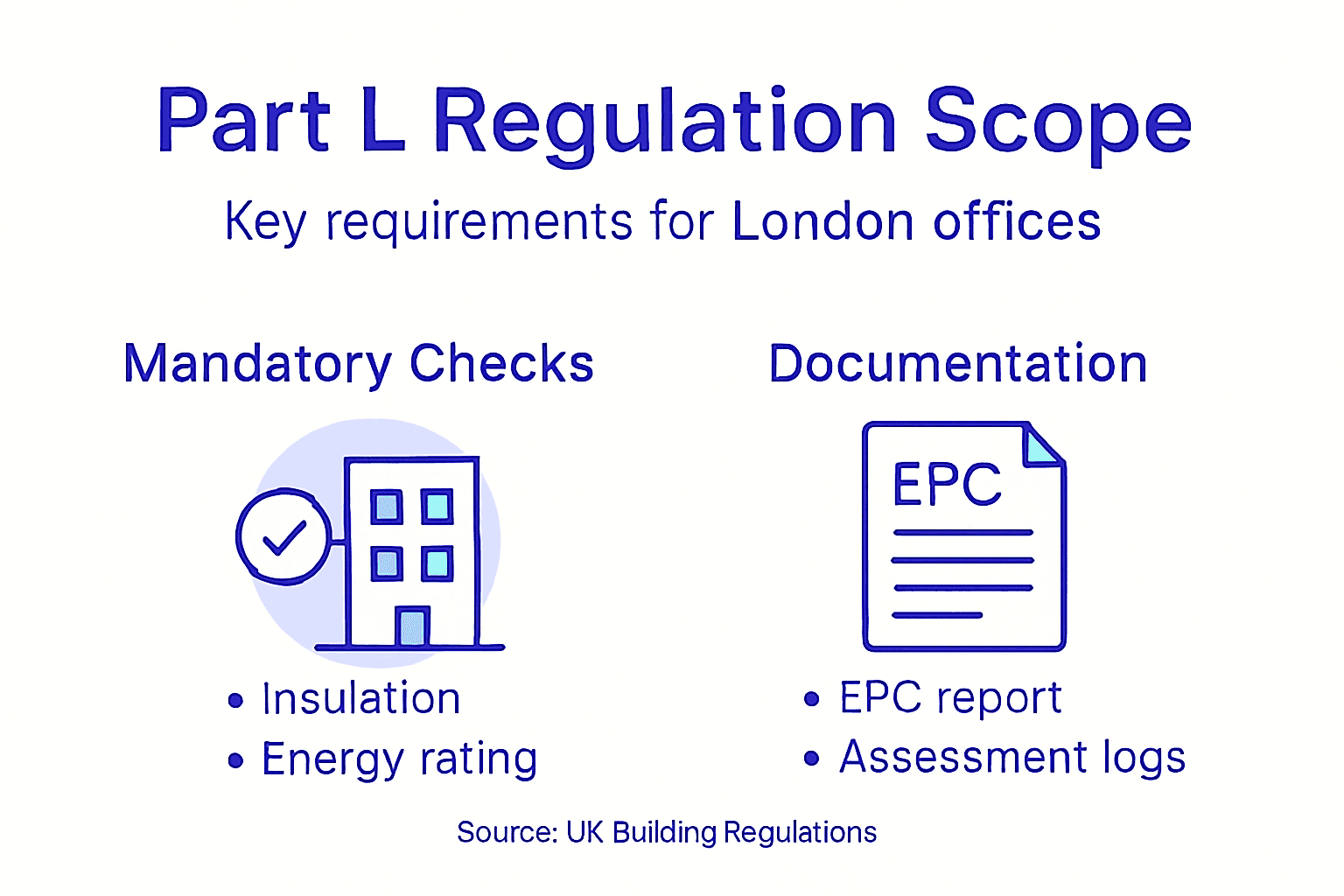
Energy Performance Certificates (EPCs) are a critical component of Part L compliance for commercial properties in the United Kingdom. Mandatory energy efficiency documentation serves as a comprehensive assessment of a building’s energy performance and potential improvements.
The key requirements for EPCs in commercial properties include:
- Certification Criteria:
- Ratings from A (most efficient) to G (least efficient)
- Valid for ten years from issuance
- Must reflect significant energy feature changes
- Mandatory Scenarios:
- New building constructions
- Property sales or rentals
- Major renovation projects
- Building use modifications
Technical Assessment Parameters encompass multiple dimensions of energy performance evaluation. Commercial property owners must ensure their EPC comprehensively addresses:
- Thermal insulation effectiveness
- Heating system efficiency
- Lighting energy consumption
- Ventilation system performance
- Renewable energy integration potential
The EPC provides more than just a rating; it offers detailed recommendations for improving energy efficiency. These insights can help property owners make informed decisions about potential upgrades and investments that could reduce long-term energy costs and enhance building performance.
Commercial property managers must understand that an EPC is not merely a bureaucratic requirement but a strategic tool for demonstrating environmental responsibility and potential cost savings.
Pro tip: Schedule professional energy assessments before major property transactions to ensure your EPC accurately reflects current building performance and potential improvements.
Risks, Penalties, and Cost Implications
Commercial property owners face significant financial and legal risks when failing to comply with Part L regulations. Non-compliance can trigger substantial enforcement actions, ranging from formal penalties to long-term operational challenges.
The potential risks associated with Part L non-compliance include:
- Financial Implications:
- Costly retrofit requirements
- Increased construction modification expenses
- Potential project delays
- Reduced property market value
- Legal Consequences:
- Stop work orders
- Building control approval delays
- Formal enforcement notices
- Potential litigation risks
Penalty Structures can be particularly complex and financially punitive. Local authorities have multiple mechanisms to enforce compliance, including:
- Issuing formal enforcement notices
- Imposing substantial financial penalties
- Preventing property transactions
- Mandating immediate remedial works
Commercial property developers face significant reputational risks beyond direct financial penalties. Non-compliance can damage professional credibility, potentially limiting future business opportunities and investor confidence.
The long-term cost implications extend far beyond immediate penalties. Inefficient buildings result in higher operational energy costs, reduced tenant attractiveness, and potential market devaluation.
Pro tip: Invest in proactive compliance strategies and early professional assessments to mitigate potential financial and legal risks associated with Part L regulations.
Practical Steps for Achieving Part L Compliance
Achieving Part L compliance requires a strategic and comprehensive approach throughout the entire property development process. Practical compliance strategies demand meticulous planning from the earliest stages of design and construction.
Key practical steps for ensuring Part L compliance include:
- Early Design Considerations:
- Engage experienced architects familiar with Part L regulations
- Conduct comprehensive energy modelling
- Perform initial SAP assessments
- Thermal Performance Optimisation:
- Select high-performance insulation materials
- Minimize thermal bridging
- Achieve specified U-value standards
Technical Implementation Strategies involve multiple critical components:
- Implementing robust thermal insulation for:
- Walls
- Roofs
- Floors
- Integrating renewable energy sources
- Solar photovoltaic systems
- Heat pump technologies
- Efficient energy generation solutions
Comprehensive documentation and quality control are essential throughout the construction lifecycle. Property developers must maintain:
- Detailed design calculations
- Photographic evidence of installation
- Air tightness test results
- Commissioning reports
- Compliance certification documentation
Successful Part L compliance demands a holistic approach, integrating energy efficiency considerations into every stage of property development.
Pro tip: Engage professional energy assessors early in your project to develop a comprehensive compliance strategy and minimize potential retrofit costs.
Ensure Your London Commercial Property Meets Part L Compliance with Expert Energy Certification
Navigating the complex requirements of Part L Compliance can feel overwhelming, especially when faced with thermal performance standards, airtightness testing, and legal obligations like obtaining accurate Energy Performance Certificates (EPCs). These challenges can cause costly delays, penalties, and increased operational expenses if not properly managed. At Complete EPC, we understand the critical importance of thorough and precise energy assessments that go beyond paperwork to safeguard your property’s future.
Our team of qualified energy assessors specialises in providing detailed EPC reports tailored for London commercial properties. We help you identify improvement opportunities, comply with Part L regulations including Part L2A and L2B, and maintain valid certificates crucial for property transactions and leasing. With competitive pricing and a commitment to seamless service, we support property owners, landlords, estate agents, and solicitors in achieving compliance without stress. Don’t risk financial penalties or lower property value when expert help is just a click away.
Take control of your compliance journey today. Discover how we simplify energy certification and regulatory adherence at Complete EPC. Learn more about the importance of Energy Performance Certificates for your commercial property and get started with a trusted partner who understands Part L requirements in depth.
Frequently Asked Questions
What is Part L Compliance?
Part L Compliance refers to the legal framework under the Building Regulations in the UK that governs energy efficiency and carbon emissions for commercial properties. It encompasses standards for new constructions, renovations, and material changes of use to reduce energy consumption and environmental impact.
What are the main challenges commercial property owners face in achieving Part L Compliance?
Common challenges include inadequate initial planning, incomplete technical documentation, failure to conduct necessary airtightness testing, and limited engagement with qualified energy assessors. These obstacles can hinder efforts to meet energy efficiency standards.
What technical assessment methodologies are used for Part L Compliance?
The primary methodologies for Part L Compliance are the Standard Assessment Procedure (SAP) for residential properties and the Simplified Building Energy Model (SBEM) for non-domestic buildings. These assessments evaluate a building’s energy performance and compliance with regulations.
How often should commercial property owners assess their compliance with Part L regulations?
Commercial property owners should conduct regular energy assessments, especially before significant property transactions or renovations, to ensure ongoing compliance with Part L regulations and to mitigate potential legal and financial risks.
Recommended
- Understanding Commercial EPC Requirements in London – Complete EPC
- EPC Compliance Deadlines – Avoiding Legal Penalties in London
- EPC Enforcement Process – What London Landlords Face
- 7 Essential EPC Compliance Tips for London Property Owners – Complete EPC
- Why Gutter Cleaning Matters for Building Managers
- What is Commercial Property Insurance? Understanding Its Importance – Rental Income Insurance
- Types Of Boilers For Landlords – Ensuring Safety And Compliance – Skan Plumbing & Heating