

TL;DR:
- Domestic energy assessments evaluate property efficiency and influence legal compliance and market value.
- New regulations and assessment methods will raise standards, making early improvements strategic.
- Accurate, fabric-first upgrades are key to maximizing property value and ensuring ongoing compliance.
Many London landlords treat an Energy Performance Certificate as little more than a box-ticking exercise. That assumption is becoming increasingly costly. A domestic energy assessment is the formal process behind every EPC, and it carries real legal weight, financial consequences, and now a fast-approaching overhaul that will change how properties are rated entirely. With stricter standards on the horizon and fines already in force, understanding what an assessment actually involves, what the law requires, and how to use it strategically could be the difference between a compliant, high-value property and one that sits unsellable or unlettable in a tightening market.
Table of Contents
- What is a domestic energy assessment?
- Core legal requirements and exemptions for London properties
- How upcoming reforms will change energy assessments
- Tackling common challenges: edge cases, hard-to-treat homes, and the performance gap
- Maximising your property’s value and compliance through strategic assessment
- Energy assessments in London: what experts and the industry aren’t saying
- Take the next step in energy assessment for your London property
- Frequently asked questions
Key Takeaways
| Point | Details |
|---|---|
| Compliance is essential | Landlords must have a valid EPC to legally rent out property and avoid penalties. |
| Regulations are changing | New standards and assessment models will apply from late 2026 onward. |
| Strategic assessment adds value | Smart use of energy assessments can boost property value and long-term profitability. |
| Exemptions require evidence | Claims for exemption must be documented and officially registered to count. |
| Professional advice matters | Experienced assessors help ensure accurate, law-abiding, and value-driven outcomes. |
What is a domestic energy assessment?
A domestic energy assessment is a structured inspection of a residential property carried out by a qualified energy assessor. Its purpose is to evaluate how energy-efficient a building is and to produce an Energy Performance Certificate, the document required by law for most property sales and lettings in England.
During the assessment, the assessor examines several key elements of the property:
- Wall construction and insulation type
- Roof and floor insulation
- Window glazing and draught-proofing
- Heating systems, boilers, and controls
- Hot water systems
- Lighting and renewable energy installations
The assessor uses this data to calculate an energy efficiency rating on a scale from A (most efficient) to G (least efficient). The resulting EPC is then lodged on the national register and is valid for ten years, unless significant works are carried out.
For London landlords, the stakes are clear. Landlords of domestic private rented properties in England must hold a valid EPC rated E or above, with fines reaching up to £5,000 for non-compliance. That is not a theoretical risk. Local authorities have enforcement powers, and a property that cannot be legally let represents a direct loss of rental income.
“An EPC is not just a certificate. It is a legal document that determines whether your property can be let at all.”
Beyond compliance, the assessment also flags specific improvements. These recommendations are practical and ranked by cost-effectiveness, giving landlords a clear roadmap for improving their rating over time. Ignoring them is not just a missed opportunity; in a market where tenants and buyers are increasingly energy-conscious, a poor rating can reduce your property’s appeal and its value.
Core legal requirements and exemptions for London properties
Now that you know what the domestic energy assessment is, it is vital to grasp the precise legal standards and where genuine exemptions exist.
The Minimum Energy Efficiency Standard (MEES) sets the legal floor for lettable properties. Here is a summary of the key obligations and exemption types:
| Obligation or exemption | Detail |
|---|---|
| Minimum EPC rating to let | E or above |
| EPC validity period | 10 years |
| Maximum fine for non-compliance | £5,000 |
| High cost exemption | Improvements exceed £3,500 cap |
| Third-party consent exemption | Freeholder or tenant refuses permission |
| Devaluation exemption | Works would reduce property value by more than 5% |
| Listed building exemption | Only if improvements unacceptably alter character |
To check your current compliance position, follow these steps:
- Locate your existing EPC on the national register using your property’s postcode.
- Confirm the rating is E or above and that the certificate has not expired.
- Review the improvement recommendations listed on the certificate.
- Identify whether any recommended measures have already been installed.
- If the rating is F or G, assess whether an exemption applies before taking any action.
Pro Tip: Exemptions are not permanent. Most last for five years, after which you must reassess the property. Always register your exemption on the PRS Exemptions Register with supporting evidence, such as written refusals from tenants or surveyor reports on devaluation. Without registration, the exemption offers no legal protection.
Providing a valid EPC to tenants at the start of a tenancy is also a legal requirement. Missing this step can affect your ability to serve a Section 21 notice, which is a serious practical consequence many landlords overlook.

How upcoming reforms will change energy assessments
Once legal basics are in hand, it is crucial to look ahead: the landscape for energy assessments is getting an overhaul.
The current assessment methodology, known as RdSAP (Reduced Data Standard Assessment Procedure), is being replaced by the Home Energy Model, with new EPCs expected from late 2026 or 2027. Alongside this, the government intends to raise MEES to a C rating by 2030, with a cost cap of £10,000 per property.
| Feature | Current RdSAP | New Home Energy Model |
|---|---|---|
| Metrics used | Single energy efficiency score | Fabric, heating, smart readiness, energy cost |
| Occupant behaviour | Not considered | Partially incorporated |
| Renewable energy weighting | Limited | Stronger weighting |
| Assessment complexity | Moderate | Higher, more detailed |
This shift matters enormously for London property portfolios. A property that currently sits at a D rating may find it harder or easier to reach C under the new model, depending on its specific characteristics. The multi-metric approach rewards properties with good insulation and modern heating systems more accurately.
Here is what landlords and property owners should do now:
- Commission a current EPC if yours is more than five years old, to establish a baseline.
- Identify the gap between your current rating and a C, using the EPC’s improvement recommendations.
- Prioritise fabric improvements such as loft insulation and cavity wall insulation, which tend to deliver the biggest rating gains.
- Get indicative costs from qualified contractors to assess whether you fall within the £10,000 cap.
- Avoid delaying action until 2029; costs for insulation and heat pump installation are likely to rise as demand increases.
The 2030 deadline sounds distant, but for landlords managing multiple properties in London, the planning, budgeting, and scheduling of works takes time. Starting now puts you in a far stronger position.
Tackling common challenges: edge cases, hard-to-treat homes, and the performance gap
Beyond the main rules, many landlords and owners grapple with exceptions and grey areas. Here is how to navigate them.
One of the most persistent myths is that listed buildings are automatically exempt from EPC requirements. They are not. Listed buildings are not auto-exempt; exemption only applies if the specific improvements required would unacceptably alter the building’s character or appearance. You must still assess what improvements are feasible and register any exemption with supporting evidence.
For hard-to-treat properties, such as solid-walled Victorian terraces common across inner London, the challenges are real but not insurmountable. Available exemptions and improvement options include:
- External wall insulation, where planning permission allows
- Internal wall insulation, which reduces floor area but can significantly improve ratings
- Secondary glazing as an alternative to full replacement windows in conservation areas
- High-efficiency heating controls, which are lower cost but still improve the score
- Registering a high-cost exemption if the total improvement cost exceeds £3,500
There is also the issue of the performance gap. The current RdSAP methodology calculates energy use based on the physical characteristics of the building, not on how it is actually used. This means a property with inefficient occupant behaviour may receive a better EPC rating than its real-world energy bills suggest, and vice versa. The result is that some landlords invest in improvements that deliver less rating gain than expected.
Pro Tip: Focus on fabric-first improvements before upgrading heating systems. Insulating the building envelope reduces heat loss regardless of how the property is used, and it tends to produce more reliable rating gains under both the current and the new assessment methodology.
Maximising your property’s value and compliance through strategic assessment
With the right approach, assessments become not only a legal requirement but a route to stronger returns and peace of mind.
Preparing properly for your domestic energy assessment makes a measurable difference to the outcome. Follow these steps:
- Gather documentation for any improvements already made, including boiler installation certificates, insulation guarantees, and window replacement records.
- Ensure all loft hatches are accessible and that the assessor can inspect all habitable rooms.
- Confirm that heating controls, thermostats, and hot water cylinders are visible and accessible.
- Check that any solar panels or renewable energy systems are documented and functioning.
- Brief the assessor on any recent works not yet reflected in the existing EPC.
Choosing a qualified, experienced assessor matters more than many landlords realise. Accredited assessors are registered with approved bodies and must carry professional indemnity insurance. An assessor who knows London’s housing stock, including its Victorian terraces, mansion flats, and purpose-built blocks, will produce a more accurate and useful report.
“Fabric-first improvements consistently deliver the most reliable gains in EPC ratings and the strongest return on investment for landlords.”
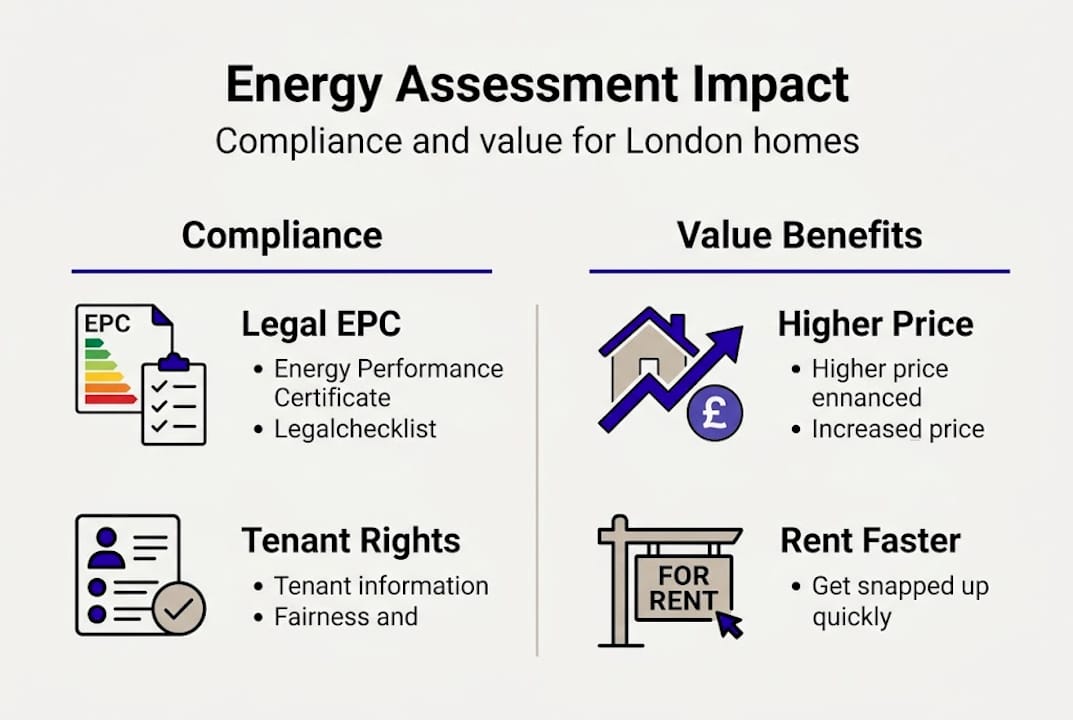
Compliance and value are closely linked. A property with a strong EPC rating is easier to let and sell, commands stronger interest from buyers and tenants, and carries lower risk of enforcement action. In London’s competitive rental market, a C-rated property stands out against F and G-rated alternatives in ways that directly affect void periods and achievable rent.
Energy assessments in London: what experts and the industry aren’t saying
The conversation around domestic energy assessments tends to focus on compliance deadlines and cost caps. What gets less attention is the quality problem sitting at the heart of the current system.
Critics have questioned the accuracy of some EPC ratings, pointing to inconsistencies between assessors and the limitations of a methodology that cannot account for how a building actually performs in use. Two assessors visiting the same property can produce different ratings, and that is a real problem when compliance and investment decisions rest on the outcome.
Our view is that waiting for the new Home Energy Model to resolve these issues is not a sound strategy. The transition will bring its own period of uncertainty, and properties that are already well-insulated and efficiently heated will fare better under any methodology. The landlords who act now, focusing on genuine fabric improvements rather than chasing a number, will be better positioned regardless of how the rating system evolves.
The real value of a domestic energy assessment is not in the letter on the certificate. It is in understanding your property deeply enough to make improvements that last.
Take the next step in energy assessment for your London property
Understanding the rules is one thing; acting on them is what protects your investment and your rental income. Whether you need to commission a first assessment, renew an expired EPC, or plan improvements ahead of the 2030 standard, the right support makes the process straightforward. Our EPC assessment process guide walks you through exactly what to expect, while our overview of EPC benefits for London properties shows how compliance translates into real value. When you are ready to understand your current rating and what it means for your property, our EPC rating guide is the place to start. Our qualified assessors are ready to help you move forward with confidence.
Frequently asked questions
How long does an Energy Performance Certificate last in London?
An EPC is valid for 10 years across England, including London, provided no major works have been carried out on the property since it was issued.
What exemptions are possible if my property can’t get the required EPC rating?
Registerable exemptions include high improvement costs exceeding £3,500, lack of third-party consent, risk of property devaluation above 5%, or works that would unacceptably alter a listed building’s character.
When will the new Home Energy Model affect energy assessments?
The Home Energy Model is expected to become the standard methodology for new EPCs from late 2026 or 2027, replacing the current RdSAP system.
Do listed buildings in London automatically get exempted from EPC improvement requirements?
No. Listed buildings are not automatically exempt; exemption only applies where specific improvements would unacceptably alter the building’s character, and supporting evidence must be registered.