

TL;DR:
- London landlords often believe their properties comply with energy rules, but upcoming regulations require upgrades to EPC C by 2030, risking fines and rental restrictions. Early action, thorough documentation, and strategic upgrades can turn compliance into a competitive advantage, attracting tenants and increasing property value. Planning now for multi-metric EPC assessments and exemptions ensures future-proofed portfolios and mitigates financial and reputational risks.
Many London landlords believe their property is compliant with current energy rules, yet significant regulatory changes are already in motion that could expose them to serious fines and rental restrictions. From 1 October 2030, all privately rented properties must meet an EPC C standard under new metrics, marking the most substantial shift in energy efficiency law for landlords in a generation. This guide walks you through the current standards, the incoming requirements, compliance steps, valid exemptions, and how to turn these regulations into a genuine financial and strategic advantage.
Table of Contents
- What are the current and upcoming energy efficiency regulations?
- Key compliance requirements and penalties explained
- Understanding exemptions and edge cases
- Recent and upcoming changes: What London landlords must plan for now
- Why compliance is a strategic opportunity, not just a legal hurdle
- Expert support for every step of compliance
- Frequently asked questions
Key Takeaways
| Point | Details |
|---|---|
| EPC standard is rising | All London rented properties must meet EPC C by 2030 using new metrics. |
| Serious penalties for non-compliance | Fines of up to £30,000 and restricted lettings await those who do not comply. |
| Exemptions exist but are limited | Cost, physical constraints, and listed buildings may offer an exemption, but require evidence and formal registration. |
| Early action brings financial benefits | Upgrading ahead of deadlines can enhance property value and avoid last-minute expense. |
What are the current and upcoming energy efficiency regulations?
Energy efficiency law for the private rented sector (PRS) in England has evolved steadily since the introduction of the Minimum Energy Efficiency Standards, commonly known as MEES. Understanding this trajectory is essential before you can plan your next steps with confidence.
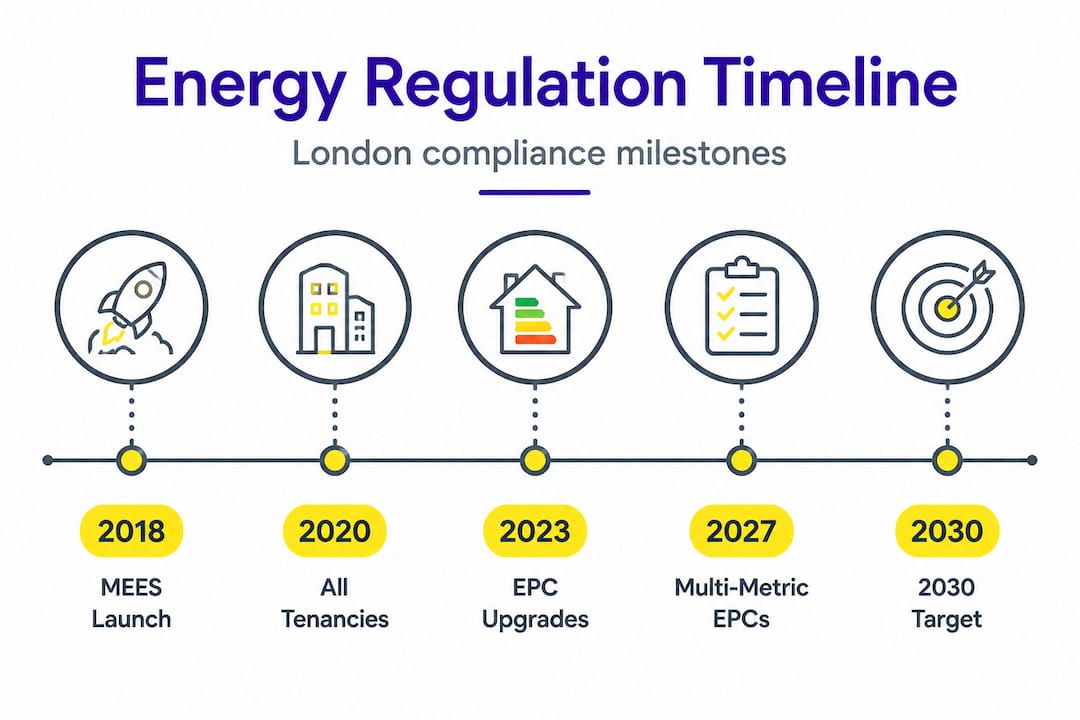
The MEES regulations were first applied to new tenancies in April 2018 and extended to all existing tenancies from April 2020. Since then, domestic private rented properties in England, including every rental home in London, must hold a minimum EPC rating of E. Letting a property below that threshold is unlawful unless a valid exemption is registered.
The Energy Performance Certificate (EPC) is the document that records your property’s energy efficiency on a scale from A (most efficient) to G (least efficient). It is produced by an accredited domestic energy assessor following an on-site inspection and remains valid for ten years from the date of issue.
What is changing and when?
The government’s direction is clear: the minimum standard is rising to EPC C by 2030. Here is a summary of the key milestones:
| Milestone | Date | Requirement |
|---|---|---|
| MEES introduced | April 2018 | EPC E for new tenancies |
| Extended to all tenancies | April 2020 | EPC E for all PRS properties |
| New multi-metric EPC launched | October 2026 | Updated assessment methodology |
| EPC C standard applies | 1 October 2030 | All PRS properties must meet C equivalent |
From October 2026, the EPC itself will change format. The new certificate will use a multi-metric approach, assessing fabric performance (insulation, windows, draught-proofing), heating and smart readiness, and energy cost. This is a significant departure from the current single-score methodology and will affect how ratings are calculated across the board.
“The new metrics are designed to give a more accurate picture of a property’s true energy performance, rather than relying on a single composite figure that can obscure weaknesses in individual areas.”
Key points to understand about the current and incoming framework:
- EPC E is the current minimum for all domestic PRS properties in England and Wales
- EPC C becomes mandatory for all PRS properties from 1 October 2030
- New multi-metric EPCs replace the current format from October 2026
- London landlords are fully covered by these national regulations with no local exemptions
- Commercial properties follow a separate regulatory track, currently requiring a minimum EPC E
Key compliance requirements and penalties explained
With the rules in mind, your next concern is likely how compliance is actually enforced, and what the direct steps are to stay on the right side of the law.
Compliance under MEES is not simply about obtaining an EPC and filing it away. The process requires you to act on the findings, document your decisions, and register any exemptions formally. Here is a clear sequence to follow:
- Check your current EPC. Confirm the rating, the issue date, and the expiry date. An EPC is valid for ten years. If yours has expired or your property is below E, you must act immediately.
- Commission improvements recommended on the EPC. The EPC lists recommended measures in order of impact. You are required to carry out all relevant improvements up to the prescribed cost cap.
- Reach the required rating or exhaust the cost cap. If after all relevant improvements the property still falls below the minimum standard, you may be eligible to register an exemption.
- Register exemptions on the PRS Exemptions Register. This is a public register maintained by central government. All exemptions must be registered before you let or continue letting the property.
- Obtain a new EPC after improvements. This confirms the updated rating and serves as evidence of compliance.
Cost cap and financial limits
The cost cap is a critical protection for landlords. Under current MEES rules, you are not required to spend more than £3,500 (including VAT) per property to meet the E standard. Under the proposed new C standard, this cap is expected to rise to £10,000 per property, or 10% of the property’s value, whichever is lower. This means that for lower-value properties, your maximum required spend could be significantly less than £10,000.
Pro Tip: Keep all receipts, contractor invoices, and improvement quotes organised in a single folder for each property. If you need to register a cost cap exemption, this documentation is what makes or breaks your application.
Proposed penalties for non-compliance:
Properties rented in breach of MEES regulations can face fines up to £5,000 per breach under current rules. Under the proposed 2030 C standard, penalties are expected to rise sharply, with proposals for fines of up to £30,000 per breach enforced by local authorities.
Beyond financial penalties, non-compliant landlords risk having their property listed on the public PRS Exemptions Register incorrectly, facing reputational damage, and being unable to legally let the property at all until compliance is achieved. For portfolio landlords, the risk multiplies across every non-compliant unit.
Understanding exemptions and edge cases
Not every property or upgrade situation is straightforward. Here is what to know if your property falls outside the typical scope.
Valid exemptions under MEES fall into several distinct categories. Each requires specific documentation and must be registered formally before it takes effect. An exemption is not automatic and cannot be assumed.
Valid grounds for exemption include:
- Cost cap reached: You have spent up to the maximum allowed and the property still does not meet the standard
- All relevant improvements made: Every improvement recommended by the EPC has been carried out and the property still falls short
- Third-party consent refused: You need consent from a tenant, leaseholder, or freeholder and it has been denied in writing
- Wall insulation unsuitable: A qualified surveyor has confirmed that cavity or external wall insulation would damage the property’s fabric
- Devaluation: An independent surveyor confirms that the improvements would reduce the property’s market value by more than 5%
- Listed buildings and historic properties: Where required works would alter the character or appearance of a protected structure
The question of listed buildings and HMOs is particularly nuanced. Houses in Multiple Occupation (HMOs) are covered by MEES where a whole-building EPC applies. There is no blanket exemption for HMOs simply because they are multi-let. Listed and historic buildings may qualify for exemption, but only where the local authority or conservation officer confirms that the required works would genuinely alter the property’s character. You must provide written evidence to support this claim on the PRS Exemptions Register.
Domestic versus commercial properties
| Property type | Current minimum | 2030 target | Exemption register |
|---|---|---|---|
| Domestic PRS | EPC E | EPC C | PRS Exemptions Register |
| Commercial | EPC E | TBC | Separate regime |
| Listed/historic | Case by case | Case by case | PRS Exemptions Register with evidence |
| HMO (whole building EPC) | EPC E | EPC C | PRS Exemptions Register |
Commercial properties follow a separate trajectory. The current minimum for commercial lettings is also EPC E, but the timetable and methodology for tightening commercial standards differ from the domestic PRS. If you own mixed-use or commercial property, seek specialist advice rather than assuming domestic rules apply directly.
Most exemptions last up to five years. After that period, you must reassess the property and either achieve compliance or re-register a new exemption with fresh evidence.
Recent and upcoming changes: What London landlords must plan for now
As regulation moves rapidly, foresight is crucial. Here is how to future-proof your portfolio and benefit, not just avoid penalties.
The introduction of multi-metric EPCs from October 2026 is the single most important near-term change you need to plan for. The new format assesses three distinct areas: fabric efficiency (insulation quality, glazing, air permeability), heating and smart readiness (heat pump suitability, smart controls), and energy cost (running costs based on modelled consumption). A property that scores well on the current single-metric EPC may perform differently under the new framework.
What is ‘grandparenting’ and why does it matter?
Grandparenting is the term used to describe the transitional protection given to landlords who achieve EPC C before the October 2029 assessment date. If your property holds a valid EPC C certificate obtained before October 2029, it will be recognised as compliant until that certificate expires, even if the new multi-metric assessment might produce a different result. This is a significant incentive to act early.
The UKGBC has broadly supported the new multi-metric approach but has raised important concerns: assessor training must be robust to prevent inconsistent results, fraud prevention mechanisms need strengthening, and specific guidance for flats (which face different retrofit challenges than houses) is essential. Post-improvement EPCs should be funded within the cost cap, and a national retrofit strategy is needed to support landlords through the process.
Pro Tip: Book your EPC assessment and any required improvement works well before the 2029 deadline. Contractor availability in London will tighten considerably as 2030 approaches, and costs are likely to rise sharply in the final 18 months.
Your two-year action checklist:
- Confirm the current rating and expiry date of every EPC in your portfolio
- Identify properties below C and model the cost of bringing them up to standard
- Prioritise fabric-first improvements: insulation, draught-proofing, and window upgrades deliver the most reliable rating gains
- Obtain quotes from qualified contractors now, before demand peaks
- Understand how the new multi-metric EPC may affect your ratings from October 2026
- Review your documentation and exemption evidence for any properties already on the register
Industry voices are not uniformly positive about the pace of change. Some landlord representatives argue that the cost burden is disproportionate for portfolio landlords managing properties in varied conditions, and that the new Home Energy Model (HEM) underpinning the multi-metric EPC may downgrade ratings for some properties that currently hold a C. Clarity on commercial property timelines also remains limited. These concerns underscore why acting early, rather than waiting for final regulatory detail, is the prudent strategy.
Why compliance is a strategic opportunity, not just a legal hurdle
The most common mistake London landlords make is treating MEES compliance as a cost to minimise rather than a position to strengthen. This framing leads to a pattern of deferred action, last-minute spending at peak contractor rates, and missed financial opportunities.
Consider the grandparenting benefit more carefully. Landlords who achieve EPC C before October 2029 lock in their compliant status until the certificate expires, regardless of what the new multi-metric assessment might reveal. Those who wait until 2030 will face a compressed window, higher contractor costs driven by surging demand, and the full exposure of the new methodology with no transitional protection. Early movers gain regulatory certainty, reduced risk, and the ability to plan improvements on their own timeline and budget.
There is also a rental market dimension that many landlords overlook. Energy-efficient properties attract tenants who are increasingly aware of running costs. A certified EPC C property with good insulation and an efficient heating system is a genuinely more attractive rental proposition in a competitive London market. You may be able to command a modest premium in rent, reduce void periods, and retain tenants longer because their bills are lower and their comfort is higher.
The long-term value to the property itself is equally significant. Fabric-first improvements such as cavity wall insulation, loft insulation, and upgraded glazing not only improve the EPC rating but genuinely increase the asset’s resilience, reduce maintenance issues related to damp and cold, and support a stronger sale valuation when you choose to exit. Viewing retrofit as investment rather than expenditure changes the financial calculation entirely.

Discipline on documentation is the underrated element of successful compliance. Landlords who keep meticulous records of every improvement, every quote obtained, every consent request made and refused, and every assessment carried out are in a far stronger position if a local authority queries their status. Poor documentation is the primary reason exemption applications fail.
Expert support for every step of compliance
Taking stock of your current EPC position and planning your route to C standard compliance does not need to be complicated, but it does need to start now. At Complete EPC, our qualified assessors work with London landlords across every type of property to deliver accurate, reliable EPC assessments and practical improvement guidance. Understanding the London EPC assessment process is the first practical step, and our team is ready to walk you through it clearly and efficiently.
If your current certificate is approaching expiry or was issued before the multi-metric changes take effect, now is the right time to arrange an EPC renewal in London so you have an up-to-date picture of your property’s position. For landlords who want a deeper understanding of the regulatory framework before taking action, our dedicated resource on MEES regulations explained sets out everything you need in clear, practical terms. Act early, document thoroughly, and let our expertise support your compliance journey from assessment through to certificate.
Frequently asked questions
What is the Minimum Energy Efficiency Standard (MEES) for London rentals?
MEES requires all privately rented homes in London to hold at least an EPC rating E today, rising to an EPC C equivalent by 1 October 2030 under new multi-metric assessment criteria.
Do I need a new EPC if my property already meets EPC C?
If your existing EPC is valid and shows a C rating or above, the grandparenting provisions mean you will not need a new multi-metric assessment until your current certificate naturally expires.
How do I register an exemption if I cannot meet the cost cap?
You must document all attempted improvements and evidence of the cost cap being reached, then formally register on the PRS Exemptions Register before letting the property. Most registered exemptions last up to five years, after which you must reassess the property.
What are the penalties for renting a non-compliant property?
Local authorities can currently fine landlords up to £5,000 per breach, with proposed penalties rising to £30,000 per breach once the EPC C standard takes effect in 2030.