

TL;DR:
- EPC ratings are crucial for London landlords to ensure legal compliance, property value, and future readiness. Most properties currently fall into bands D or E, but significant upgrades are needed to meet the upcoming 2030 target of band C. Planning early improvements and seeking expert assessments can help landlords avoid penalties and enhance tenant appeal.
EPC ratings are far more than a bureaucratic box to tick before handing over the keys. For London landlords and property owners, a single rating band can mean the difference between a legally lettable property and one that cannot be rented at all. Many landlords assume their EPC reflects their tenants’ actual energy bills, or that a band E property is safely compliant for the foreseeable future. Neither assumption is accurate, and getting this wrong can result in financial penalties, unlettable properties, and costly last-minute upgrade works. This guide cuts through the confusion, explains exactly how EPC bands work, and shows you what steps to take right now.
Table of Contents
- What is an EPC rating and why does it matter?
- EPC bands explained: the A–G scale
- Legal requirements: minimum standards and exemptions
- Upcoming changes: future EPC targets for landlords
- Improving your EPC rating: practical steps you can take
- Our perspective: why aiming higher than the minimum EPC rating pays off
- Get expert help improving and evidencing your EPC rating
- Frequently asked questions
Key Takeaways
| Point | Details |
|---|---|
| EPC bands are legal benchmarks | Landlords must maintain at least EPC E now and should aim for C by 2030. |
| EPC ratings are estimates | An EPC reflects a modelled assessment of efficiency, not your property’s actual bills. |
| Exemptions need evidence | If your property can’t meet the standard, official exemptions require proof and must be registered. |
| Upgrade now, save later | Improving your EPC band early can protect rental income and property value as standards tighten. |
What is an EPC rating and why does it matter?
An Energy Performance Certificate (EPC) is a formal document that rates a property’s energy efficiency on a scale from A to G. It is produced by an accredited assessor and must be provided to prospective tenants or buyers before a property is marketed. For landlords, it is also a legal compliance document under the Minimum Energy Efficiency Standards (MEES) regulations.
The rating itself is calculated using a methodology called SAP (Standard Assessment Procedure), or more commonly for existing homes, RdSAP (Reduced data Standard Assessment Procedure). The assessor visits the property, records visible evidence about the building fabric, insulation, heating systems, windows, and lighting, and inputs this data into approved software. The software then models the property’s estimated energy performance and generates the EPC band.
One important point that many landlords overlook is that an EPC rating is a modelled estimate, not a measure of what your tenants actually pay. As RdSAP10 Conventions makes clear, because RdSAP relies on reduced datasets and assumptions where information is missing, two similar buildings can produce different EPC outcomes if the assessor-visible evidence differs. This means a loft insulation certificate you can show the assessor, or clear evidence of cavity wall fill, can directly affect your final band.
Here is why EPC ratings matter for you as a landlord:
- Legal compliance: You cannot legally let a domestic property in England or Wales below band E without a registered exemption.
- Marketing and value: A higher EPC rating is increasingly valued by tenants, particularly those managing household budgets closely.
- Future-proofing: The minimum standard is set to rise significantly before 2030 (more on this below).
- Mortgage conditions: Some lenders now require a minimum EPC rating before offering buy-to-let finance.
“An EPC rating reflects how energy efficient a property could be based on its physical characteristics, not how much energy its occupants actually choose to use.” This distinction matters enormously when you are planning upgrades.
EPC bands explained: the A–G scale
Now that you know what an EPC is, it’s helpful to see how the rating bands are split and what they mean for your property.
An EPC band is determined by the property’s SAP score. SAP scores run from 1 to 100 and are generated by the assessment software. A higher score means a more energy-efficient property. The EPC A–G bands correspond to the following SAP score ranges:
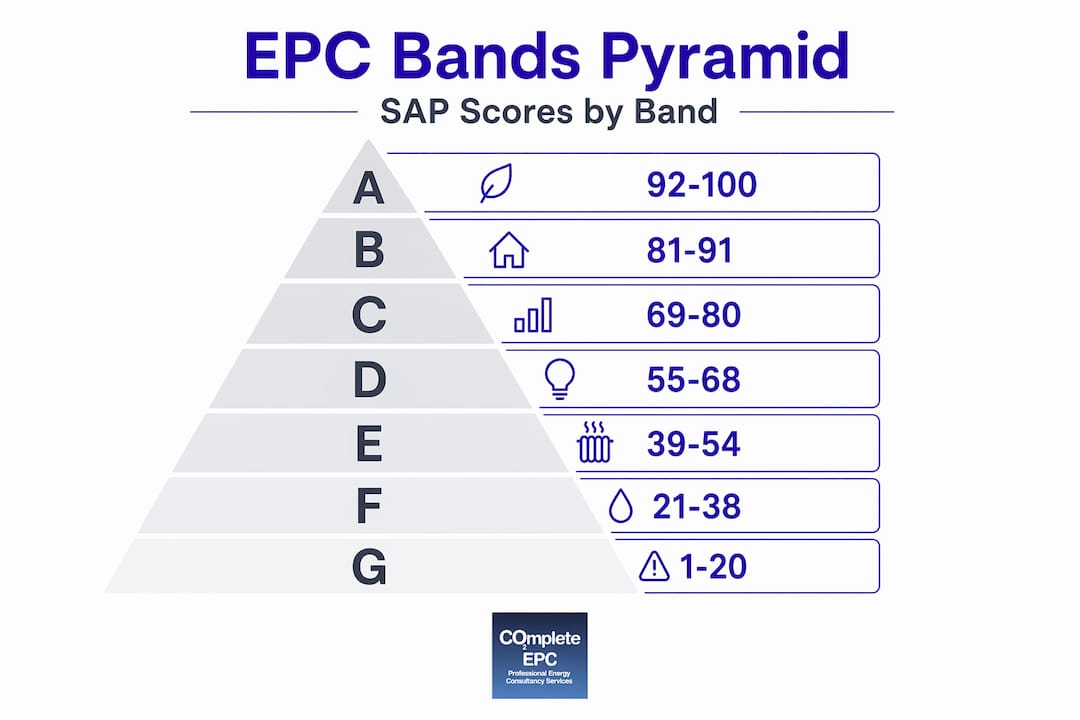
| EPC band | SAP score range | What it means in practice |
|---|---|---|
| A | 92–100 | Highly efficient; very low energy costs |
| B | 81–91 | Very efficient; well-insulated modern build |
| C | 69–80 | Good efficiency; meets likely 2030 legal minimum |
| D | 55–68 | Average efficiency; typical of many UK homes |
| E | 39–54 | Below average; current legal minimum for rentals |
| F | 21–38 | Poor efficiency; cannot be rented without exemption |
| G | 1–20 | Very poor; significant upgrades required |
Most London properties, particularly Victorian terraces and converted flats, fall into band D or E. A well-insulated modern flat might achieve band C, while an unimproved period property with single glazing and no wall insulation could easily sit in band F or G. Understanding where your property lands is the starting point for every compliance and improvement decision you will make.

A common misconception is that a band D rating is “fine” because it sits above the current legal minimum. In reality, band D properties will require significant investment to reach band C before 2030, and leaving this until the deadline approaches means competing with every other landlord in London for the same contractors, products, and grants.
Pro Tip: If you have had an EPC done on your property more than five years ago, the methodology may have changed since then. Booking a new assessment can sometimes reveal a better rating if you have made improvements, or if the updated SAP conventions assess your property type more favourably.
Legal requirements: minimum standards and exemptions
Once you understand where your property sits on the EPC scale, it’s essential to know the legal minimum and what to do if you can’t meet it.
For private rented domestic properties in England and Wales, the current MEES minimum is EPC band E. A landlord may only rent below this standard if they have a valid registered exemption. This applies to both new tenancies and existing ones, meaning you cannot simply wait for a lease to renew before you are required to comply.
If your property does not meet band E, here is the step-by-step process you need to follow:
- Obtain a current EPC to confirm your property’s band and identify recommended improvements.
- Review the recommended measures listed on the EPC, which will detail the most cost-effective upgrades.
- Attempt to install cost-effective improvements, spending up to the cost cap (currently £3,500 including VAT) on eligible measures.
- If improvements are not technically feasible or are cost-prohibitive, you may qualify for an exemption.
- Register your exemption on the official PRS Exemptions Register before letting the property.
- Gather supporting evidence, which varies depending on exemption type (for example, a surveyor’s report for a “high cost” exemption, or written consent refused by a freeholder for a “third party consent” exemption).
The PRS Exemptions Register is the official government platform where landlords register and manage exemptions. You must have an up-to-date EPC and the correct supporting evidence before you can submit a registration.
| Exemption type | When it applies | Evidence required |
|---|---|---|
| High cost | Improvements exceed the cost cap | Three contractor quotes |
| All improvements made | All recommended measures installed | Invoices and EPC post-works |
| Third party consent refused | Freeholder or tenant has refused consent | Written refusal documentation |
| Wall insulation | Technical reasons prevent installation | Surveyor’s or installer’s report |
| Devaluation | Improvements would reduce property value | Independent valuation report |
Non-compliance carries financial penalties of up to £5,000 per property, and local authorities have enforcement powers to issue compliance notices. Importantly, registering a false exemption also carries penalties, so every submission must be accurate and properly evidenced.
Pro Tip: Exemptions are not permanent. Most last for five years, after which you must either reassess compliance or re-register with fresh evidence. Set a calendar reminder when you register so you are not caught out at renewal.
Upcoming changes: future EPC targets for landlords
Staying compliant isn’t just about today’s law. Let’s look ahead to the changes coming for all London landlords.
The most significant shift on the horizon is the planned rise in the MEES minimum from band E to band C by 2030. The government’s 2025 consultation response confirms this target for all tenancies and signals that the new EPC framework will introduce updated metrics. These are expected to include fabric energy efficiency (how well the walls, roof, and floor retain heat) and either smart readiness or heating system performance.
This is a substantial shift. Many London properties currently sitting at band D will need significant improvement to reach band C. That could mean upgrading insulation, replacing a gas boiler with a heat pump, or installing double or triple glazing, depending on the property’s current profile.
What this means in practical terms:
- Band E is a short-term floor, not a safe landing point. If your property currently meets E, you are not protected from future compliance requirements.
- The 2030 deadline sounds distant, but it isn’t. Heating system replacements, planning permissions, and contractor availability in London can all extend project timelines considerably.
- New EPC metrics will change how ratings are calculated. A property that scrapes band C under the current SAP methodology may not meet the equivalent standard once revised metrics are applied.
- Government funding and grant schemes for insulation and low-carbon heating will likely be tied to EPC improvement targets, so acting early may give you access to better financial support.
- Tenant demand for energy-efficient homes is growing. Properties with lower energy costs are increasingly preferred, particularly as energy prices remain volatile.
“Landlords who treat the 2030 target as a distant problem will find themselves under-resourced, underfunded, and potentially facing enforcement action at the worst possible time.”
The time to start planning improvements is now, not in 2029.
Improving your EPC rating: practical steps you can take
Knowing what’s coming, you might be wondering what you can do now to get ahead. Here is how to lift your property’s rating effectively.
The most impactful improvements for a typical London rental property are:
- Loft insulation: One of the most cost-effective upgrades available. If your loft is uninsulated or has less than 270mm of insulation, adding or topping up insulation can move a property by one or even two bands.
- Cavity or solid wall insulation: Wall heat loss is a major factor in SAP scores. Cavity wall insulation is relatively straightforward where cavities exist. Solid wall insulation (internal or external) is more expensive but can deliver significant rating improvements.
- Boiler replacement or heating controls: Replacing an old, inefficient boiler with a modern condensing boiler, or adding smart controls, improves the heating efficiency score within the SAP calculation.
- Double or secondary glazing: Replacing single-glazed windows reduces heat loss and improves the EPC band, particularly for period properties.
- Solar panels: Installing photovoltaic (PV) panels can contribute meaningfully to a higher EPC rating by reducing a property’s net annual energy demand. For broader context on energy efficiency strategies including renewable generation, it is worth exploring how these systems integrate with your property’s overall energy profile.
- LED lighting throughout: A smaller gain, but replacing all fixed lighting with LEDs is a low-cost, quick win that assessors do record.
The evidence you bring to an assessment matters just as much as the physical improvements themselves. As noted in RdSAP10 Conventions, where information is missing the assessor must apply default assumptions, which are typically pessimistic. If you have installed insulation but cannot evidence it with a certificate or installation record, the assessor may not be able to credit it in the model.
Pro Tip: Before booking an EPC assessment, gather all available evidence of improvements: installation certificates, FENSA certificates for windows, Gas Safe records for boiler work, and photographs. This simple step can prevent your property from being rated lower than it should be.
Prioritise improvements by their cost-to-band-improvement ratio. Loft insulation and cavity wall insulation typically deliver the best return per pound spent. Solid wall insulation and heat pump installations are higher cost but will be increasingly necessary as the 2030 deadline approaches.
Our perspective: why aiming higher than the minimum EPC rating pays off
Most guidance for landlords focuses on clearing the minimum bar. Our view, shaped by years of working with London landlords on EPC assessments and compliance planning, is that this approach is genuinely risky.
Scraping band E gives you legal cover today, but it leaves you exposed on every front: financially, competitively, and regulatorily. The government’s policy direction is unambiguous. MEES is tightening to band C by 2030 and new metrics are coming. A landlord who invests now in reaching band C, rather than band E, effectively completes the same journey once instead of twice.
There is also a tenant market reality to consider. London’s rental market is competitive, and tenants are increasingly cost-conscious about energy bills. A band C property commands more interest than a band E equivalent. That is not just an energy story; it is a rental income story. Void periods cost money, and an energy-efficient property is easier to let and easier to retain good tenants in.
The landlords we see struggle most are those who attempt piecemeal improvements in a rush before a deadline. They pay premium contractor rates, face longer lead times, and sometimes have to move tenants out temporarily. Those who plan a phased improvement programme, starting with loft and cavity wall insulation and working towards heating system upgrades, spread the cost and the disruption. They also tend to qualify more easily for grant funding because they have the EPC documentation ready to support their application.
Aiming for band C now is not gold-plating your compliance. It is straightforward financial planning.
Get expert help improving and evidencing your EPC rating
If you’re ready to act on improving your property’s energy performance or need support with compliance, here’s where to turn next. At Complete EPC, we work with London landlords and property owners to provide accurate, professionally conducted EPC assessments across both domestic and commercial properties. Our qualified assessors understand the evidence requirements that directly affect your rating outcome, so you are never penalised for improvements you have already made. Whether you need a straightforward EPC for compliance, guidance on the domestic EPC process, or advice on which upgrades will have the greatest impact on your band, our team is here to help. We offer some of the most competitive rates available, and we make the process straightforward from booking to certificate. Get in touch today to book your assessment or ask about your property’s upgrade options.
Frequently asked questions
What is considered a good EPC rating for London landlords?
A good EPC rating for a rental property is band C or above, as this is set to become the legal minimum for most tenancies by 2030. Achieving band C now protects you from future compliance costs and makes your property more attractive to tenants.
What happens if my rental property doesn’t meet the EPC minimum?
You must not let the property unless you have registered a valid exemption on the PRS Exemptions Register. Letting without a valid exemption can result in a financial penalty of up to £5,000.
How is an EPC rating calculated?
An EPC rating is calculated using the SAP methodology, which models the property’s energy performance based on building fabric, heating systems, and insulation. As RdSAP conventions confirm, the result is a modelled estimate rather than a measure of actual energy consumption.
Are EPC exemptions permanent?
No, EPC exemptions are time-limited, typically lasting five years, and must be renewed with fresh evidence before they expire. You should review your exemption status well in advance of the renewal date.
Can I boost my EPC rating with solar panels?
Yes, installing solar photovoltaic panels can contribute to a higher EPC band by reducing the property’s modelled annual energy demand and carbon output. The impact on your specific rating will depend on the system size and your property’s existing SAP score.