

TL;DR:
- Improving your EPC rating enhances property value, reduces energy costs, and ensures legal compliance before 2030.
- Starting with low-cost measures like LED lighting, loft insulation, and draught-proofing can yield significant points for minimal investment.
Your energy bills are rising, compliance deadlines are tightening, and your property’s EPC rating sits lower than you would like. Improving your EPC rating is not just a regulatory exercise. It directly reduces heating costs, makes your property more attractive to tenants and buyers, and prepares you for the legal requirements that are already on the horizon. Whether you are a landlord managing multiple properties or an owner planning a single upgrade, this guide walks you through every stage: from reading your current score to planning your next reassessment.
Table of Contents
- Key takeaways
- Understanding your current EPC score
- Quick wins: low-cost improvements first
- Mid-range and major upgrades
- Planning and executing your upgrade project
- Verifying your results and future-proofing
- My take on EPC improvement strategy
- How Completeepc can help you improve and comply
- FAQ
Key takeaways
| Point | Details |
|---|---|
| Know your current score | Your numerical EPC score matters as much as your band letter when planning targeted improvements. |
| Start with low-cost measures | LED lighting, loft insulation, and draught-proofing can together add up to 23 points for under £1,300. |
| Comply before the deadline | All rented properties must reach a minimum EPC rating of C by October 2030. |
| Keep your evidence | Assessors need invoices and photos to credit your improvements; without them, your score may default lower. |
| Plan staged upgrades | Prioritise fabric improvements first, then heating systems, to get the best return at each stage. |
Understanding your current EPC score
Before you can plan improvements, you need to understand exactly where you stand. An EPC assigns a property a band from A (most efficient) to G (least efficient), but the band alone tells you only part of the story. Behind each letter sits a numerical score on a scale of 1 to 100. A band E property could score anywhere from 39 to 54, so knowing whether you sit at 42 or 53 makes a real difference when you are calculating how many points you need to reach band C (a score of 69 or above).
An EPC assessment covers several elements that each influence your score. These include:
- Wall construction and insulation (cavity, solid, or timber frame)
- Roof and floor insulation levels
- Window glazing type (single, double, or triple)
- Heating system type, age, and controls
- Hot water system efficiency
- Lighting proportion using low-energy fittings
- Renewable energy installations
Each of these contributes a weighted calculation to your overall score. Older boilers, single glazing, and uninsulated lofts carry the heaviest penalties. You can access your current EPC through the Government’s online register using your property’s postcode. The certificate includes a section called “Recommendations,” which lists suggested improvements alongside estimated point gains and cost ranges. This recommendations section is your most practical planning tool.
Pro Tip: Before booking any upgrades, compare your current certificate’s recommendations against your actual property features. If your loft has been insulated since the last assessment but was not recorded, simply having this verified at your next assessment could gain you points at zero additional cost.
Quick wins: low-cost improvements first
When you are thinking about ways to improve your EPC score, budget-friendly measures with a strong return on points should come first. They reduce heat loss and energy demand before you invest in more expensive systems, and their combined effect is often underestimated.
Here are the most effective low-cost steps, in order of typical point return:
-
Switch all lighting to LEDs. LED bulbs use up to 90% less energy than incandescent equivalents. Replacing every fixed fitting in a property typically adds 3 to 8 EPC points and costs between £100 and £300. This is the single fastest improvement you can make.
-
Top up loft insulation to 270mm. Many older properties have loft insulation at only 100mm or less. Topping this up to the recommended 270mm typically gains 5 to 10 EPC points and costs between £300 and £600, depending on loft size. Combined with LEDs, these measures alone can push a property up by more than 15 points.
-
Draught-proof windows and doors. Sealing gaps around window frames, external doors, loft hatches, and unused fireplaces costs between £200 and £400 and adds a further 2 to 5 points. It also makes the property noticeably warmer without touching the heating system.
-
Insulate your hot water cylinder. If your property has a cylinder-based hot water system, fitting an 80mm jacket costs roughly £15 to £30 and adds 1 to 3 points. The payback time is typically less than a year.
-
Install a programmable or smart thermostat. Upgrading heating controls to include a room thermostat, thermostatic radiator valves, and a programmer can add around 3 to 5 EPC points. It also reduces energy consumption immediately without any fabric changes.
The combined effect of these five steps can realistically move a band E property into band D, and in some cases directly to the lower end of band C, for a total outlay of well under £2,000.
Pro Tip: Always check whether your property is eligible for government grants such as the Great British Insulation Scheme or the ECO4 scheme before paying for insulation out of pocket. Landlords with properties occupied by low-income tenants may qualify for fully funded installations.
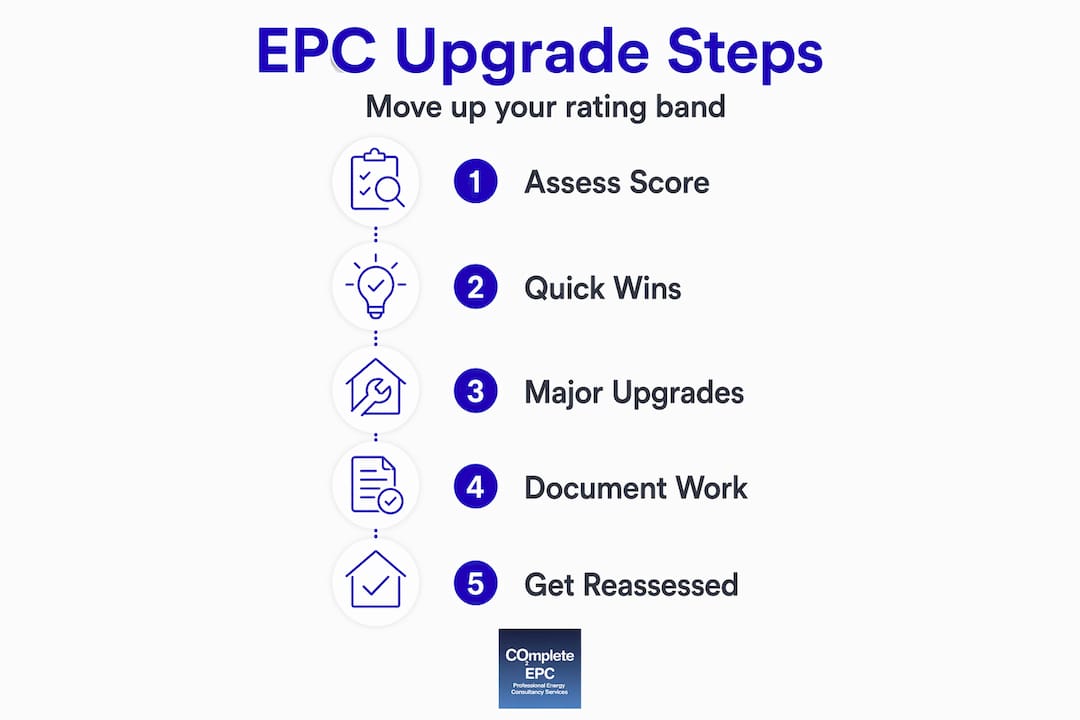
Mid-range and major upgrades
Once you have addressed the low-cost measures, the next set of improvements requires a larger investment but delivers proportionally greater EPC gains. These are the upgrades that typically take a property from band D or E to band C or above.
| Measure | Typical cost | EPC point gain | Notes |
|---|---|---|---|
| Cavity wall insulation | £1,000–£2,000 | 10–15 points | Only suitable for properties with unfilled cavity walls |
| Double glazing (full replacement) | £4,000–£8,000 | 5–10 points | High cost relative to point gain; good for comfort and noise reduction |
| Modern condensing boiler | £2,000–£3,500 | 10–15 points | Also saves around £420 per year in fuel costs |
| Solar PV panels | £5,000–£8,000 | ~18 points | Strongest single point gain; generates income via Smart Export Guarantee |
| Floor insulation | £1,000–£2,500 | 3–6 points | Suspended timber floors benefit most |
A few points on selecting the right measure for your property:
- Cavity wall insulation is one of the highest-value upgrades when suitable, but it requires a survey first. Solid-wall properties are not candidates and may need external or internal wall insulation instead, at significantly higher cost.
- Boiler replacement makes sense if your current boiler is more than 15 years old and running below 80% efficiency. A modern A-rated condensing boiler typically operates at over 90% efficiency, with a measurable impact on both your EPC score and your tenants’ fuel bills.
- Solar PV delivers the largest single point gain of any common measure. However, the fabric-first approach advocated by energy professionals means you should address insulation and draughts before installing renewables, as a well-insulated property requires less solar capacity to hit the same EPC band.
- Air source heat pumps are an increasingly discussed option, but they require significant upfront investment and perform best only after the fabric improvements above are in place.
Planning and executing your upgrade project
Knowing which improvements to make is only half the task. How you plan, sequence, and document the work determines whether those improvements actually appear on your EPC.
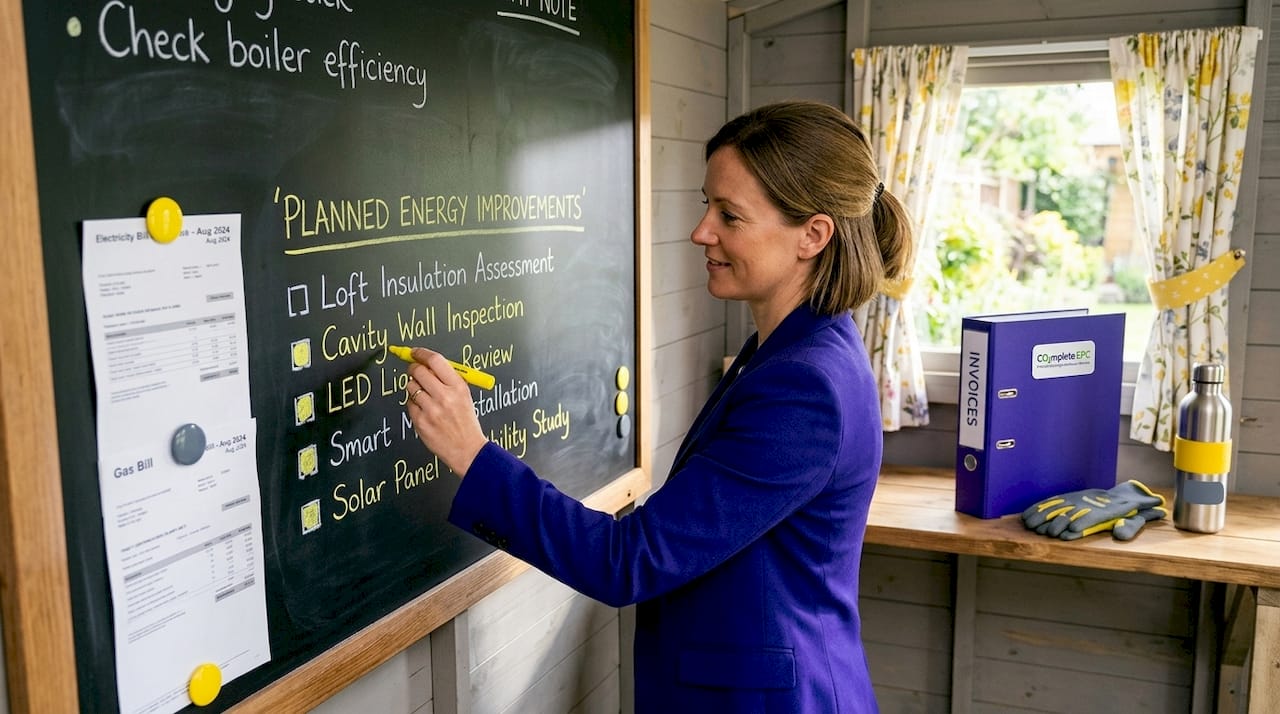
Prioritise by property type and starting band. A solid-wall Victorian terrace needs a different approach to a 1980s semi-detached with cavity walls. Your EPC recommendations report is specific to your property, so use it as your starting point rather than a generic list.
Here is what experienced property owners consistently get wrong:
- Skipping ventilation. When you seal a property tightly through draught-proofing and insulation, you must address ventilation. Without adequate airflow, condensation and damp can follow. Background ventilators or a heat recovery ventilation system may be needed, particularly in older properties.
- Starting with expensive upgrades. Installing a heat pump in a poorly insulated property will not perform efficiently and may not gain you the EPC points you expect. Always address the building fabric before upgrading the heating.
- Failing to gather evidence. Energy assessors require physical evidence of improvements to reflect them in EPC calculations. Without invoices, photographs, and installer certificates, your assessor may apply default conservative assumptions that undervalue your improvements.
Pro Tip: Create a dedicated folder for your property with dated photographs of all installed improvements, installer invoices showing product specifications, and any manufacturer data sheets. Hand this directly to your assessor at the start of your reassessment appointment.
When timing your reassessment, wait until all planned improvements are complete. You pay for each EPC assessment, so splitting upgrades across multiple assessments is an unnecessary expense. Stage your budget across months if needed, but book one reassessment once everything is done.
Verifying your results and future-proofing
Once your upgrades are in place and your new EPC is issued, the work does not stop there. Understanding what your new score means and how to maintain those gains is part of any long-term property strategy.
Each improvement you make converts directly into EPC points. The table below illustrates how several common scenarios play out:
| Starting band | Key improvements made | Likely outcome |
|---|---|---|
| Band E (score 45) | LEDs, loft insulation, draught-proofing | Band D or low C |
| Band D (score 60) | Cavity wall insulation, new boiler | Band C |
| Band D (score 60) | Cavity wall insulation, solar PV | Band C or B |
| Band E (score 50) | Full package including double glazing and boiler | Band C |
The regulatory picture is also shifting. Over half of UK rental properties currently sit below band C, making the drive to improve both a compliance requirement and a market differentiator. From October 2030, all rented properties must meet a minimum C rating. On top of that, the government is introducing new EPC metrics from October 2026, incorporating fabric performance, heating system efficiency, and smart readiness. This means improvements you make now need to account for how they will be measured under the revised framework.
For ongoing maintenance, check loft insulation annually for compression or displacement, service your boiler every 12 months, and keep heating controls calibrated. A well-maintained system performs closer to its assessed rating rather than degrading over time.
My take on EPC improvement strategy
I have seen hundreds of EPC assessments across London properties, and one pattern comes up repeatedly: property owners invest in a new boiler or solar panels and then feel frustrated when their EPC band barely moves. The reason is almost always the same. The building fabric has not been addressed first.
The fabric-first principle is not a theoretical preference. It is the most practical sequencing decision you can make. A poorly insulated property wastes heat before the heating system even has a chance to be efficient. Sorting the loft, walls, and draughts first means every subsequent upgrade performs better and scores higher.
What I have also learned is that the gap between real-world performance and EPC modelled scores is often significant. The EPC is calculated using standardised occupancy assumptions, not your actual usage. That said, a higher EPC score does reliably indicate a better-performing building fabric, which is what matters for both compliance and tenant satisfaction.
The evidence question is one I cannot stress enough. I have seen assessors apply the worst-case defaults to properties where genuine improvements had been made, simply because the landlord could not produce documentation. A folder of invoices and photographs costs you nothing to prepare and can be worth several EPC band positions.
Start with the small wins. Get your loft insulated, swap the lights, seal the draughts. Book one reassessment when it is all done. Then plan the next stage. This methodical approach is less exciting than a single large investment, but it delivers measurable results every time.
— Danny
How Completeepc can help you improve and comply
Completeepc works with property owners and landlords across London to deliver accurate, professional EPC assessments and practical guidance on improvement strategies. Whether you are preparing for a reassessment after upgrades or trying to understand your current EPC rating, the team at Completeepc can help you interpret your score, plan cost-effective measures, and achieve compliance ahead of the 2030 deadline. If you are new to the process, the EPC assessment guide covers every step from booking to receiving your certificate. For broader guidance on energy efficiency across London properties, visit Completeepc’s energy efficiency resource to explore the full range of tools and support available.
FAQ
What is the fastest way to improve my EPC rating?
Switching all fixed lighting to LEDs, topping up loft insulation to 270mm, and draught-proofing doors and windows can collectively add up to 23 EPC points for under £1,300, making this combination the fastest and most cost-effective route to a higher band.
How many points do I need to go from band E to band C?
Band C requires a score of 69 or above. A band E property scoring 45 would need approximately 24 additional points, achievable through a combination of insulation, lighting, draught-proofing, and potentially a new boiler or cavity wall insulation.
Do I need evidence of improvements for my EPC assessment?
Yes. Energy assessors require physical evidence such as invoices, photographs, and installer certificates to reflect improvements in their calculations. Without this documentation, they may apply conservative default assumptions that result in a lower score than your property deserves.
When must rented properties in England reach EPC band C?
All rented properties in England must achieve a minimum EPC rating of C by October 2030, with a maximum landlord investment cap of £10,000 per property for qualifying improvements.
Does solar PV make a big difference to an EPC score?
Solar PV installation can increase an EPC rating by approximately 18 points based on government SAP guidance, making it one of the highest single-measure point gains available. However, it is most effective when combined with prior fabric improvements such as insulation and draught-proofing.