

TL;DR:
- EPC rating E is the legal minimum for rental properties in England and Wales, but it signals below-average energy efficiency and increasing risks. To meet future standards, property owners should invest in targeted improvements like insulation and heating upgrades, with costs ranging around £1,000 to £5,000. Acting now ensures compliance with upcoming regulations and helps avoid substantial penalties or costly upgrades later.
If you own, let, or are buying a property, understanding what is EPC rating E could be the difference between legal compliance and a significant financial penalty. An EPC, or Energy Performance Certificate, rates a building’s energy efficiency on a scale from A (most efficient) to G (least efficient). Band E sits near the lower end of that scale, and while it is currently the legal minimum for rental properties in England and Wales, it carries real risks, rising costs, and a tightening deadline on the horizon. This guide covers what EPC E means technically, what the law requires, and what you should do about it.
Table of Contents
- Key takeaways
- What EPC rating E actually means
- Legal compliance for EPC E in 2026
- The real-world impact of an E-rated property
- How to improve from EPC E to a higher band
- Upcoming changes to EPC assessment
- My view on EPC E and what landlords get wrong
- Get expert EPC support from Completeepc
- FAQ
Key takeaways
| Point | Details |
|---|---|
| EPC E is the legal minimum | Landlords in England and Wales must hold at least an E rating to lawfully let a property. |
| SAP score range is 39–54 | An E rating reflects below-average efficiency, typically found in older or poorly insulated homes. |
| Fines reach up to £30,000 | Non-compliance with minimum energy efficiency standards carries serious financial consequences. |
| EPC C target arrives in 2030 | All private rented homes must reach band C by 1 October 2030, with a £10,000 improvement cost cap. |
| New metrics are coming | Government reforms plan to replace letter bands with multiple performance indicators, changing compliance rules. |
What EPC rating E actually means
An EPC rating E corresponds to a SAP score of 39–54, placing a property in the below-average bracket for energy efficiency. SAP, which stands for Standard Assessment Procedure, is the government-approved method for measuring the energy performance of residential buildings. The higher the score, the more efficient the building.
To put band E into context, here is how it compares to the full EPC scale:
| EPC band | SAP score range | Efficiency level |
|---|---|---|
| A | 92–100 | Most efficient |
| B | 81–91 | Very efficient |
| C | 69–80 | Good |
| D | 55–68 | Average |
| E | 39–54 | Below average |
| F | 21–38 | Poor |
| G | 1–20 | Least efficient |
The average UK home sits around band D, so an E-rated property is already performing below the national norm. In practical terms, this typically means you are looking at an older building, perhaps pre-1980, with limited or absent cavity wall insulation, a single-glazed or poorly sealed window system, and a boiler that is well past its most efficient years.
These typical issues translate directly into higher heating bills, less comfortable indoor temperatures, and a property that requires meaningful investment to bring up to modern standards. Understanding where E sits on the scale is not just useful for context. It is the foundation for every decision that follows, whether you are a landlord planning upgrades or a buyer negotiating a purchase price.
Legal compliance for EPC E in 2026
The Minimum Energy Efficiency Standards, known as MEES, set the legal floor for rental properties in England and Wales. Under current regulations, letting a property below band E is unlawful, with fines reaching up to £30,000 per property. That is not a guideline or a suggestion. It is a hard legal boundary.
In 2026, the minimum remains band E, but the compliance picture is becoming more demanding. Key obligations include:
- New tenancies and renewals: Any new tenancy agreement or renewal must be backed by a valid EPC of at least band E.
- Existing tenancies: Properties already let must also meet the E standard. There is no grace period for long-running tenancies.
- Valid exemptions: Landlords may register a temporary exemption if the cost of improvements exceeds the £3,500 cost cap under the current framework, or if consent from third parties such as freeholders cannot be obtained. Exemptions are logged on the PRS Exemptions Register and last for five years.
- Commercial properties: MEES also applies to non-domestic buildings, with separate compliance pathways.
Looking further ahead, the government has confirmed that all private rented homes must reach EPC C by 1 October 2030. Landlords are expected to invest up to £10,000 per property to achieve this. Band E may keep you legal today, but it already puts you two full bands behind where you need to be in four years.
Pro Tip: Register any valid exemptions promptly on the PRS Exemptions Register. Delayed registration leaves you technically non-compliant even if the underlying reason for exemption is legitimate.
The real-world impact of an E-rated property
Holding an EPC E is not just a legal concern. It has concrete day-to-day consequences for landlords, owners, and tenants alike.
From a running cost perspective, an E-rated home loses heat faster and requires more energy to maintain a comfortable temperature. Tenants in poorly insulated properties face higher bills, which increasingly influences their decision to renew a tenancy or walk away from a viewing altogether. As properties close to non-compliance can slip below E with minor deterioration in building fabric or a change in assessment methodology, landlords are sitting on more risk than a single letter grade suggests.

The marketability challenge is real too. Buyers are more energy-aware than at any point in recent history. A property with an E rating signals ongoing costs and potential upgrade work, which buyers will factor into any offer. For homeowners not subject to rental regulations, an E rating still affects perceived value and saleability, particularly as mortgage lenders begin factoring EPC ratings into green mortgage products.
Consider the risk of slippage. A boiler that fails, a loft that loses insulation integrity, or a damp problem affecting wall performance can all reduce a SAP score. If your property sits at the lower end of the E band, say a SAP score of 40 or 41, a single system failure could push it into band F and make it unlawful to let without an exemption. Early investment is the practical safeguard against that scenario.
How to improve from EPC E to a higher band
Moving your property up from band E does not require a complete renovation. Targeted improvements, planned in the right order, deliver the best return on both score and spend.
- Loft insulation: If your property has an accessible loft with less than 270mm of insulation, topping it up is usually the most cost-effective first step. Heat loss through an uninsulated roof is significant, and the material and installation costs are relatively low.
- Cavity wall insulation: Pre-2000 properties with an unfilled cavity wall are strong candidates. This measure alone can shift a property up by several SAP points and noticeably reduce heating bills.
- Heating system upgrade: Replacing an old G-rated boiler with a modern A-rated condensing boiler, or transitioning to a heat pump, addresses both energy efficiency and future compliance with heating decarbonisation goals.
- Draught proofing: Sealing gaps around windows, doors, and floorboards is low cost and often underestimated in its impact on SAP score.
- Window upgrades: Replacing single glazing with double or triple glazing improves both fabric performance and occupant comfort.
Costs to improve from E to D typically range between £1,000 and £5,000, depending on the measures required and the condition of the property. Phased improvements across multiple years can spread that financial commitment while still counting towards the £10,000 government cap applied against the 2030 EPC C target.
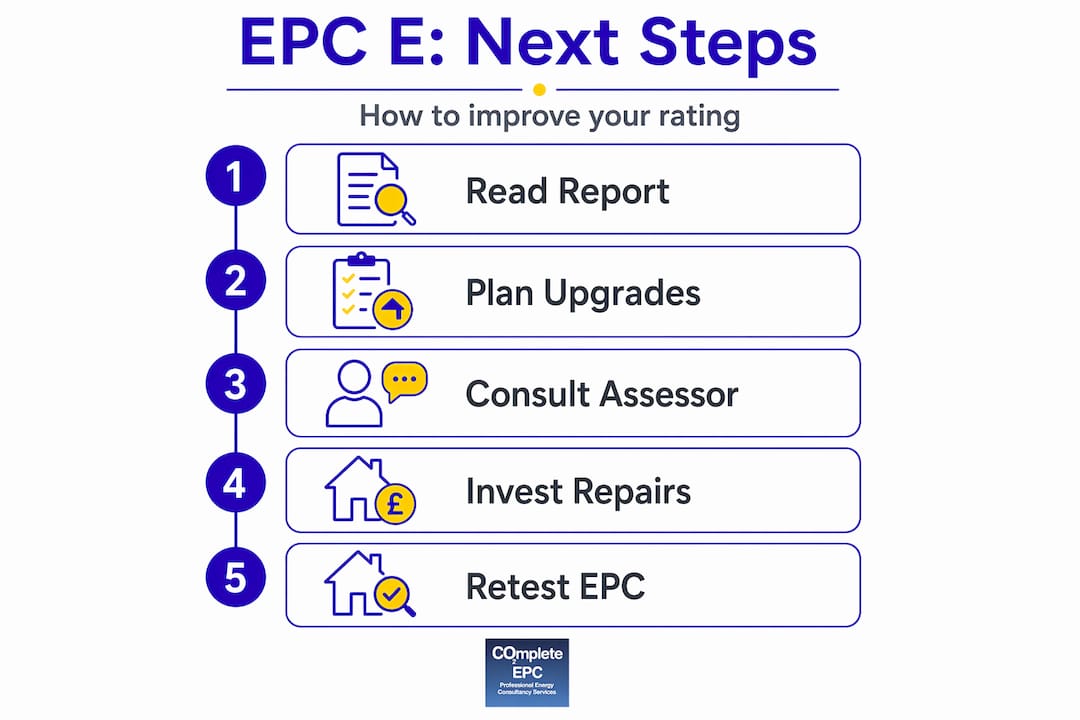
Pro Tip: Always start with the EPC recommendation report. It lists the specific measures assessed for your property and their estimated impact on the SAP score. Acting on those recommendations, in order of cost-effectiveness, is far more reliable than following generic improvement advice.
Consulting a qualified energy assessor before committing to any spend is strongly advisable. Costs vary widely due to hidden property-specific issues and contractor pricing differences, so an independent assessment before you begin protects you from overpriced or poorly targeted work.
Upcoming changes to EPC assessment
The current A to G banding system is not permanent. The government has set out plans to replace single letter EPC bands with a multi-metric framework covering fabric performance, heating efficiency, smart readiness, and estimated energy cost. This is a fundamental shift in how compliance will be judged.
The shift to a multi-metric system means a property could meet one indicator and fail another. Simply reaching band E or even band C under the current letter system will not automatically translate to compliance once the new framework takes effect.
For properties currently sitting at the bottom of band E, this is particularly significant. A home that scrapes through on overall SAP score but has very poor fabric performance, think solid walls, no insulation, or a draughty structure, may fail on the fabric metric even if it passes on heating efficiency. The new framework prioritises actual building performance over blunt add-on fixes. A solar panel installation that nudges a SAP score upward will not compensate for inadequate wall insulation under the new rules.
Landlords and property owners who act now to address fabric and heating fundamentals are, in effect, preparing for both the 2030 EPC C requirement and the new metric system simultaneously. That is a more durable investment than chasing a band improvement through quick fixes.
My view on EPC E and what landlords get wrong
I have worked with enough landlords and property owners to say this clearly: band E is not a comfortable position. It is a warning sign dressed up as compliance.
The most common mistake I see is treating the EPC E rating as a settled matter. “We meet the legal minimum” is the reasoning, and it leads to deferred maintenance, no insulation plan, and then a panicked scramble as 2030 approaches. The reality is that EPC E is increasingly viewed as high risk, and many of those properties are sitting at the lower end of the band with very little margin before they become unlawful to let.
The second issue is over-reliance on potential ratings. A potential EPC rating is theoretical. Actual upgrade costs can vary by 50 to 100% depending on what is found during the work, and the gap between what an EPC report suggests and what a contractor quotes is often substantial. I have seen landlords budget based on potential ratings and end up significantly overspent because the report did not account for uninsulated party walls or non-standard construction.
My genuine advice is to treat EPC E as a prompt to act now, while costs are manageable and options are wider. Phased upgrades spread the financial burden, count toward the £10,000 cap, and leave you better placed for whatever compliance framework follows in the years ahead. Waiting is always the more expensive choice.
— Danny
Get expert EPC support from Completeepc
If your property is rated E and you are unsure what it means for your compliance, your costs, or your next steps, Completeepc is here to help. As a specialist EPC consultancy serving property owners, landlords, and buyers across London, the team carries out thorough assessments and delivers clear, accurate certificates backed by years of practical experience.
Whether you need a new EPC, a renewal ahead of a tenancy, or guidance on improving your rating before the 2030 deadline, Completeepc offers some of the most competitive pricing in the UK market. You can start by reading the EPC rating guide for 2026, which explains how ratings affect property value and what targeted improvements achieve. For a full picture of what the process involves, the EPC assessment process guide walks you through every step. Take action now rather than waiting until the 2030 deadline makes upgrades rushed and expensive.
FAQ
What is EPC rating E in simple terms?
EPC rating E means a property has a SAP score between 39 and 54, placing it in the below-average bracket for energy efficiency. It is the current legal minimum for rented properties in England and Wales.
Can I legally let a property with an EPC rating E?
Yes, an EPC rating E is the current legal minimum under MEES regulations. Letting a property rated F or G without a valid exemption carries fines of up to £30,000.
How much does it cost to improve an EPC E rating?
Improving from band E to band D typically costs between £1,000 and £5,000, depending on the property and the measures required. Common improvements include loft insulation, cavity wall insulation, and heating system upgrades.
Will EPC E still be compliant after 2030?
No. The government has confirmed that all private rented homes must reach at least EPC C by 1 October 2030. Landlords are expected to invest up to £10,000 per property to meet this new standard.
How do I find out what improvements my property needs?
Your existing EPC report includes a recommendations section specific to your property, listing measures and their estimated impact on your rating. A qualified energy assessor can give you a more detailed and costed plan based on a physical inspection.