

TL;DR:
- An EPC remains valid for 10 years from the assessment date, regardless of property improvements.
- Landlords must renew their EPC before expiry to stay compliant and avoid legal and financial risks.
Many landlords assume that fitting a new boiler or upgrading insulation automatically refreshes their EPC. It does not. The epc certificate validity period is fixed from the date of the original assessment, regardless of any improvements made to the property. Getting this wrong can delay lettings, stall sales, and expose you to enforcement action. This guide explains exactly how the validity period works, what triggers the need for renewal, and how to stay compliant with the minimum energy efficiency standards that apply to your properties across England, Wales, Scotland, and Northern Ireland.
Table of Contents
- Key takeaways
- Understanding the EPC certificate validity period
- Legal compliance and the consequences of expiry
- How and when to renew your EPC
- Scottish landlords: updated rules from 2026
- My take on managing EPC validity effectively
- How Completeepc can help with your EPC renewal
- FAQ
Key takeaways
| Point | Details |
|---|---|
| Fixed 10-year lifespan | The EPC certificate lifespan is 10 years from the assessment date, not the issue date. |
| Improvements do not extend validity | Upgrading your property does not refresh the EPC. A new assessment is required to show a better rating. |
| Expired EPC means legal risk | A new EPC is required for marketing, sales, or new tenancies once the current certificate has expired. |
| Scotland has new rules from 2026 | The Energy Performance of Buildings (Scotland) Regulations 2025 introduce mandatory 10-year renewals regardless of tenancy changes. |
| Renewal costs are modest | At roughly £70 for a domestic EPC, renewal is a small cost relative to overall property transaction expenses. |
Understanding the EPC certificate validity period
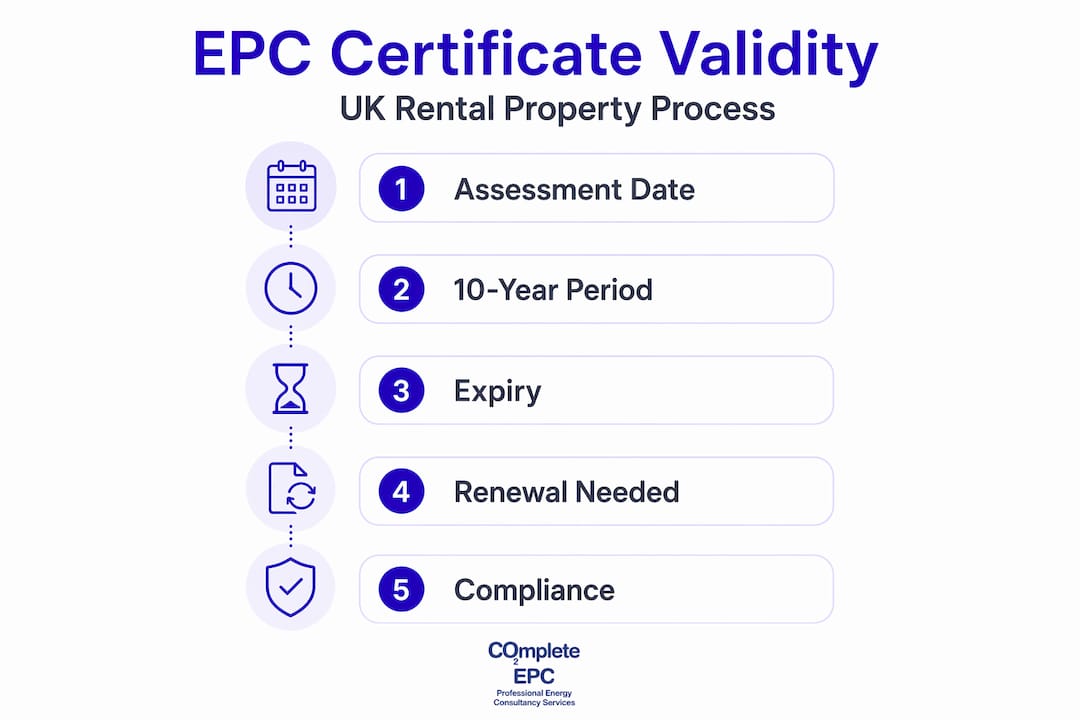
EPCs in England and Wales are valid for 10 years from the date of assessment shown on the certificate. That date is the only one that matters for calculating expiry. Not the issue date. Not the date you uploaded it to the register. The date on which the assessor physically inspected the property.
Here is how to calculate your expiry date precisely:
- Locate your EPC certificate (paper copy or via the national EPC register at gov.uk).
- Find the “date of assessment” field near the top of the document.
- Add exactly 10 years to that date. That is your expiry date.
- Cross-check against the register to confirm the certificate is still lodged and active.
- Diarise a renewal reminder at least three months before the expiry date.
Practitioners use the date of assessment rather than any expiry date listed elsewhere, as this approach gives the most precise compliance planning date. Some certificates display a calculated expiry date, but confirming it against the assessment date yourself avoids any risk of relying on a printing error.
One of the most common misunderstandings among landlords involves property improvements and EPC validity. If you install double glazing, upgrade your heating system, or add loft insulation, the existing certificate does not change. It remains a fixed snapshot of the property as it was on the day of assessment. To reflect any improvements in your EPC rating, you must commission a new assessment. The old certificate continues to run its 10-year clock regardless.
Northern Ireland follows the same 10-year rule as England and Wales. Scotland, however, is moving to a distinct regulatory framework in 2026. More on that in a dedicated section below.
Pro Tip: When you buy a property, always check the EPC register to confirm the assessment date of the existing certificate. If the seller’s EPC is already seven or eight years old, factor renewal into your budget and timeline from the outset.
Legal compliance and the consequences of expiry
The EPC rating validity of your certificate directly affects your obligations under the Minimum Energy Efficiency Standards (MEES). For the private rented sector, the law mandates either an EPC with an E rating or higher, or a valid registered exemption. An expired EPC satisfies neither condition.
The compliance picture for landlords breaks down clearly across these scenarios:
- New tenancy: You must provide a valid EPC to your tenant before they move in. An expired certificate cannot be handed over to satisfy this requirement.
- Property sale: A valid EPC must be available at the point of marketing. Estate agents will typically request it before listing the property.
- Existing tenancy: If the EPC expires during an ongoing tenancy, you are not required to renew it immediately unless you are granting a new tenancy or selling. However, MEES obligations still apply and a valid EPC or registered exemption is required for compliance.
- Commercial properties: Non-domestic EPCs follow the same 10-year validity rule, though the complexity of the assessment differs.
There is no grace period once an EPC expires. The certificate simply ceases to be valid for legal purposes. Using an expired EPC can delay transactions and lead to enforcement action, including fines of up to £5,000 for landlords in breach of MEES requirements.
Exemptions do exist. If a property genuinely cannot reach an E rating despite all cost-effective improvements being made, you can register an exemption on the PRS Exemptions Register. However, exemptions must be registered to be valid and reliable for compliance purposes. They are not automatic and they are not indefinite. Treat exemptions as a short-term compliance measure while you plan for a proper EPC renewal and any associated property upgrades.

Pro Tip: Set a calendar reminder for 90 days before your EPC expiry date. This gives you enough time to commission an assessment, receive the certificate, and resolve any queries before a letting or sale requires it.
How and when to renew your EPC
Timing your renewal well avoids the scramble that catches many landlords out. Aim to commission a new assessment at least two to three months before expiry, particularly if you have made improvements you want reflected in the new rating.
Follow these steps to renew efficiently:
- Search for an accredited domestic energy assessor (DEA) via the Elmhurst Energy or ECMK register, or use a trusted local provider.
- Book the assessment and confirm the assessor’s accreditation before they visit.
- Prepare access to all rooms, loft spaces, and the boiler. Have documentation for any recent upgrades ready.
- Receive the draft report and check the findings before the certificate is lodged on the register.
- Confirm the new certificate is live on the national register and matches the assessment date.
On cost, the average domestic EPC costs approximately £70, which makes the EPC certificate lifespan genuinely good value at roughly once per decade. Government analysis shows the EPC cost represents around 0.6% of average annual rental income. Put simply, it is one of the lowest costs you will face as a landlord.
| Type | Typical cost | Validity period | Assessment complexity |
|---|---|---|---|
| Domestic EPC | £60 to £120 | 10 years | 45 to 90 minutes on-site |
| Non-domestic EPC | £300 to £1,000+ | 10 years | Several hours; software modelling |
If you have recently improved your property, renewal is also an opportunity. A new assessment can show an upgraded rating, which improves your property’s marketability. Prospective tenants and buyers increasingly factor EPC ratings into their decisions. Energy upgrades that boost a property’s value are well documented across the industry, and a fresh certificate that reflects those improvements works directly in your favour.
Scottish landlords: updated rules from 2026
Scotland is operating under a distinct set of rules. The Energy Performance of Buildings (Scotland) Regulations 2025 introduce a new regulatory framework effective from January 2026, including a new Scottish EPC Accreditation Scheme. Scottish landlords need to be aware of several specific points:
- Scotland mandates EPC renewal every 10 years regardless of tenancy changes, going further than the rules in England and Wales.
- The new Scottish EPC Accreditation Scheme changes how assessors are certified and how certificates are lodged.
- Landlords must display their EPC in the property (not just provide it to tenants), which differs from current requirements in England.
- Scotland is targeting Band C ratings for rental properties by 2028, which means many landlords will need both compliance upgrades and updated certificates before that deadline arrives.
- Assessors working in Scotland from 2026 onwards must be registered under the new scheme, so confirm your assessor’s credentials under the updated system before booking.
If you own rental properties in Scotland, start the compliance process now. The 2028 Band C target is not far away, and the combination of new accreditation requirements and mandatory renewal intervals means leaving this until the last moment creates significant risk.
My take on managing EPC validity effectively
I have seen landlords lose weeks on property transactions simply because they did not know their EPC had expired. The certificate was years old, the sale was agreed, and then the conveyancer flagged an invalid EPC. Two weeks lost while a new assessment was booked and the certificate was registered.
In my experience, the single most effective thing you can do is treat EPC expiry dates like tenancy agreement renewal dates. Put them in your property management calendar the day you receive each certificate. Not the year. The exact date. Because the compliance clock does not care about your transaction timeline.
I also think landlords underestimate how much exemptions can give a false sense of security. Yes, exemptions provide temporary compliance relief, but they are not a substitute for a current EPC. I have seen landlords who registered an exemption years ago and assumed it covered them indefinitely. It does not. Exemptions have their own expiry periods and conditions.
The other thing worth saying plainly: if you have upgraded your property, a fresh EPC is not just a legal formality. A better rating genuinely affects how quickly a property lets and what rent it commands. Do not miss the opportunity to capture that on paper.
— Danny
How Completeepc can help with your EPC renewal
Staying on top of EPC validity requirements is straightforward when you have the right support. Completeepc provides professional EPC assessments and renewals for both domestic and commercial properties across London, with qualified assessors who understand exactly what landlords and property owners need to remain compliant.
Whether your certificate is approaching expiry, you have recently upgraded your property and want the rating to reflect that, or you are preparing for a new tenancy or sale, Completeepc’s EPC renewal process is designed to make compliance straightforward. Competitive pricing, experienced assessors, and prompt turnaround mean you are never left waiting when deadlines matter.
You can also explore the full EPC assessment guide to understand exactly what happens during an assessment and how to prepare.
FAQ
How long is an EPC valid for in the UK?
An EPC is valid for 10 years from the date of assessment in England, Wales, and Northern Ireland. Scotland follows the same 10-year period under its updated 2026 regulations.
Does a new boiler or insulation renew my EPC?
No. Property improvements do not extend or refresh the EPC certificate validity period. You must commission a new assessment to obtain an updated certificate that reflects any upgrades.
Can I let a property with an expired EPC?
No. An expired EPC cannot be used to meet your legal obligations under MEES when starting a new tenancy. You need a valid EPC or a registered exemption to let lawfully.
How much does it cost to renew an EPC?
A domestic EPC renewal typically costs between £60 and £120, with the national average around £70. Non-domestic EPCs vary more widely depending on the size and complexity of the property.
How do I check if my EPC has expired?
Search for your property on the national EPC register at gov.uk using the postcode. Find the certificate, locate the date of assessment, and add 10 years to determine whether the EPC rating validity is still current.