

TL;DR:
- A valid EPC must be issued by an accredited assessor before selling or renting a property in London to ensure legality. Landlords should time assessments after energy upgrades and verify their certificates on the official register to avoid penalties. Proper preparation, evidence gathering, and engaging with qualified assessors improve accuracy and maximize the certification’s benefits.
A new EPC certificate, formally known as a new Energy Performance Certificate, is a legally required document that rates your property’s energy efficiency on a scale from A (most efficient) to G (least efficient) and must be produced by an accredited domestic energy assessor before you sell or let. London landlords who skip this step risk fines, failed tenancies, and properties that cannot legally be marketed. This guide covers who can issue a valid certificate, how the EPC certification process works step by step, when you need to commission one, and the mistakes that cost landlords time and money.
Who can issue a new EPC certificate?
An EPC must be issued by an accredited domestic energy assessor before selling or renting out a property in England, including every borough of London. This is not a formality. A certificate produced by anyone without accreditation is legally invalid, meaning your property cannot be marketed and any tenancy agreement relying on it could be challenged.

Accredited assessors in England are registered with government-approved accreditation schemes. The main schemes include Elmhurst Energy, Stroma Certification, and ECMK. You can verify an assessor’s credentials through the official EPC register or by asking them directly for their scheme membership number. Estate agents can arrange the EPC on your behalf, but the certificate itself must come from an approved assessor. Never assume the agent has handled this correctly without checking.
The assessor’s role goes beyond ticking boxes. They collect data on your property’s construction, heating systems, insulation, glazing, and lighting, then feed this into approved software to generate the rating. The quality of that data directly affects the accuracy of your certificate, which matters more than most landlords realise.
Key things to confirm before booking an assessor:
- They are registered with an approved accreditation scheme
- They carry professional indemnity insurance
- They can lodge the certificate directly to the national EPC register
- They have experience with the property type you own (e.g. Victorian terrace, purpose-built flat)
Pro Tip: Ask your assessor for their accreditation scheme membership number before booking, then verify it on the scheme’s public register. This takes two minutes and protects you from invalid certificates.
How to get an EPC certificate: the step-by-step process
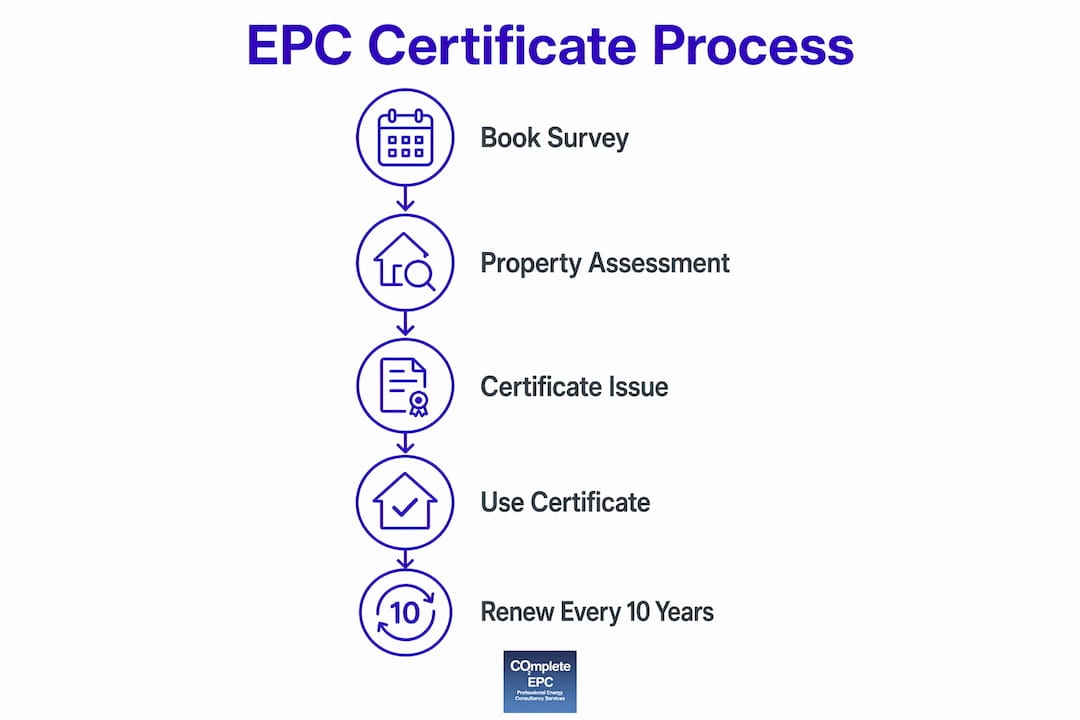
Obtaining a new energy performance certificate follows a clear sequence. Understanding each stage helps you prepare properly and avoid delays.
-
Gather your property documents. Collect any evidence of insulation (loft, cavity wall), heating system installation records, boiler service certificates, solar panel documentation, and window specifications. The more verifiable evidence you supply, the less the assessor relies on conservative default assumptions.
-
Book an accredited assessor. Contact an accredited assessor directly or through a service like Completeepc. Confirm the date, access arrangements, and what the assessor needs to inspect. For London properties, allow at least a few days’ notice for scheduling.
-
Prepare the property for inspection. Provide access to the loft, boiler cupboard, meter cupboard, and all rooms. Clear any obstructions to heating controls or ventilation units. If the property is tenanted, give your tenant proper notice.
-
The on-site survey. The assessor visits and inspects the property fabric and systems. A typical domestic assessment takes between 45 minutes and two hours depending on property size and complexity. The assessor records construction details, measures floor areas, and notes the heating and hot water systems.
-
Data processing and certificate production. The assessor enters collected data into approved software (typically RdSAP for existing dwellings). The software calculates the energy efficiency rating and produces the certificate along with a recommendations report.
-
Lodgement on the EPC register. The assessor lodges the completed certificate on the official national register. You receive a copy, and the certificate becomes publicly searchable. EPC validity runs for 10 years from the lodgement date.
The table below summarises typical timescales and costs for London properties:
| Stage | Typical timeframe | Typical cost (London) |
|---|---|---|
| Booking to survey | 1 to 5 days | Included in assessment fee |
| On-site survey | 45 minutes to 2 hours | £60 to £120 for domestic properties |
| Certificate issued | Same day to 24 hours post-survey | Included in assessment fee |
| Lodgement on register | Within 24 hours of issue | No additional charge |
Pro Tip: Commission your EPC immediately after completing energy upgrades such as a new boiler, loft insulation, or double glazing. Waiting means the certificate still reflects the old property condition, which could affect your rating and your marketing.
460,000 EPCs were lodged in England and Wales in Q1 2026 alone, with 368,000 covering existing dwellings. This volume confirms that EPC demand remains high and that assessors in London are in consistent demand. Booking ahead avoids delays when you are working to a tenancy or sale deadline.
When do you need a new EPC certificate?
EPCs are valid for 10 years from the date of lodgement. If your existing certificate is still within that window, you can reuse it for a new tenancy or sale without commissioning a fresh assessment. However, several situations require or strongly justify obtaining a new certificate before the 10 years expire.
You need a new EPC certificate when:
- Your existing certificate has expired (10 years have passed since lodgement)
- You are marketing a property for sale or rent and no valid certificate exists
- You have carried out significant energy improvements and want the rating to reflect current conditions
- Government policy deadlines require a minimum EPC rating that your current certificate does not meet
- You have converted or substantially altered the property
“Landlords should plan EPC commissioning ahead of policy deadlines to ensure legal alignment. A new EPC can lock in evidence of the current rating prior to regulatory changes or after property improvements, aiding compliance planning.” — Government response on improving privately rented homes energy performance
Using an expired EPC is a legal offence. Trading Standards can issue a penalty charge notice of up to £200 per property for failing to provide a valid EPC when marketing a property. For London landlords with multiple properties, this exposure multiplies quickly. You can check your EPC status on the official register by searching your postcode or address. The register displays the expiry date and current rating, so you know immediately whether a new certificate is required.
Government policy links EPC ratings with private rental energy efficiency standards. Timing your new EPC around planned refurbishment or upcoming policy milestones is a practical way to stay ahead of compliance requirements rather than reacting to them.
Common mistakes when obtaining a new EPC certificate
Most problems with EPC certificates are avoidable. The errors below are the ones Completeepc sees most frequently among London landlords.
-
Booking an unaccredited assessor. This is the most serious mistake. The certificate is invalid, the property cannot legally be marketed, and you will need to pay for a second assessment. Always verify accreditation before booking.
-
Failing to prepare supporting evidence. Small data gaps or unverifiable building features can suppress your EPC rating. If the assessor cannot verify your cavity wall insulation or boiler efficiency, they default to conservative assumptions that lower the score. Gather installation certificates, building control sign-offs, and manufacturer specifications before the survey.
-
Restricting access during the survey. An assessor who cannot access the loft, boiler cupboard, or all habitable rooms cannot complete a full assessment. Partial surveys lead to more default assumptions and less accurate ratings.
-
Ignoring the timing of the assessment. Getting an EPC just before a tenancy starts, without accounting for recent improvements, means the rating does not reflect the work you have done. Commissioning an EPC immediately after energy upgrades captures the benefit of those improvements in the rating.
-
Treating the certificate as a formality. Landlords who simply file the certificate and move on miss the recommendations report. This report identifies specific upgrades, their estimated cost, and the potential rating improvement. It is a practical planning tool, not a footnote.
Pro Tip: To maximise your EPC rating, provide supporting documentation for every installed system and insulation layer. This avoids conservative defaults that suppress your rating unjustly and can complicate future upgrades.
EPC assessments rely on modelling and default assumptions which can lead to inaccuracies. A 2026 government research project supports reform and dynamic updates when building changes occur. This means the accuracy of your certificate depends heavily on the quality of information you provide to the assessor.
Danny’s take: treat your EPC as a planning tool, not a compliance receipt
Most landlords I speak with view the EPC as something to obtain and forget. That mindset costs them money. The certificate’s recommendations report tells you precisely which upgrades will move the needle on your rating, and by how much. That is free consultancy built into a document you are legally required to have anyway.
The assessor interaction matters more than most landlords realise. Assessors provide evidence on what upgrades may improve real-world value, not just predicted efficiency. If you engage with the assessor during the survey, ask questions, and supply thorough documentation, you get a more accurate certificate and a clearer picture of where to invest next.
I have seen London landlords with Victorian terraces receive ratings two bands lower than they deserved, simply because they could not produce evidence of insulation that was clearly present. The assessor defaulted to “uninsulated” and the rating suffered. That is not the assessor’s fault. It is a preparation failure.
My advice: time your EPC around your refurbishment schedule, not the other way around. If you are planning a boiler replacement or loft insulation, commission the new certificate after the work is complete. You lock in the improved rating, satisfy compliance requirements, and give yourself a stronger marketing position. Landlords benefit most from EPCs when they use the evidence and recommendations to plan cost-effective energy upgrades rather than merely fulfilling legal formalities.
— Danny
Get your new EPC certificate with Completeepc
Completeepc provides accredited EPC assessments for domestic and commercial properties across London, carried out by qualified assessors with extensive experience of the capital’s diverse housing stock. Whether you need a certificate for a Victorian flat in Hackney or a new-build in Canary Wharf, the booking process is straightforward and turnaround is fast.
For landlords who want to understand the full process before booking, the EPC assessment process guide covers every stage from preparation to lodgement, tailored specifically for London properties. If your certificate has expired or you are approaching a policy deadline, the EPC renewal guide walks you through renewing your certificate with minimal disruption. Completeepc guarantees the lowest assessment rates in the UK market, so compliance does not have to be costly.
Key takeaways
A new EPC certificate is a legal requirement for marketing any property in London and must be produced by an accredited domestic energy assessor registered with an approved scheme.
| Point | Details |
|---|---|
| Accreditation is non-negotiable | Only assessors registered with approved schemes such as Elmhurst Energy or Stroma can produce valid certificates. |
| Validity runs for 10 years | An existing valid certificate can be reused within its 10-year window; a new one is required only on expiry or after significant changes. |
| Preparation improves your rating | Supplying verified documentation for insulation and heating systems prevents conservative defaults that suppress your score. |
| Time EPCs around improvements | Commissioning a new certificate immediately after energy upgrades locks in the improved rating for marketing and compliance. |
| The register confirms your status | Search by postcode on the official EPC register to confirm whether your certificate is current before marketing a property. |
FAQ
How much does a new EPC certificate cost in London?
A domestic EPC assessment in London typically costs between £60 and £120, depending on property size and type. Completeepc guarantees the lowest rates in the UK market, with no hidden fees.
How long does an EPC certificate last?
An EPC is valid for 10 years from the date it is lodged on the national register. You do not need a new certificate within that period unless the property has changed significantly or a policy requirement demands a higher rating.
Can I get an EPC certificate online?
You can book an EPC assessment online through accredited providers such as Completeepc, but the certificate itself requires a physical on-site inspection by an accredited domestic energy assessor. There is no fully remote EPC for existing dwellings.
What happens if I rent out a property without a valid EPC?
Renting a property without a valid EPC is a legal offence in England. Trading Standards can issue a penalty charge notice of up to £200 per property. For landlords with multiple properties, the cumulative risk is significant.
How do I check if my current EPC is still valid?
Search by postcode or address on the official EPC register. The register displays the certificate’s expiry date and current rating, confirming immediately whether you need a new assessment.