

TL;DR:
- The minimum EPC rating for rented homes in England and Wales is currently band E, with a goal to reach band C by 2030. Landlords should act early to improve properties, especially before the 2026 assessment system change and the 2029 grandparenting cutoff. Registering exemptions and prioritizing fabric improvements can help landlords meet regulations and protect asset value.
The legally mandated energy performance certificate minimum rating for privately rented homes in England and Wales is currently band E, with a government mandate to raise this to band C by 1 october 2030 under the Warm Homes Plan. For landlords, this is not a distant concern. The regulatory timeline is already moving, with a new multi-metric EPC assessment system arriving in october 2026 that will change how compliance is measured. Understanding where your property stands today, and what you need to do before 2030, is the most practical step you can take right now.
What is an EPC rating and how does the EPC rating scale work?
An Energy Performance Certificate, or EPC, is a formal document that records how energy efficient a property is. It is produced by an accredited domestic energy assessor following a physical inspection of the building. Every property sold or let in England and Wales must hold a valid EPC.

The EPC rating scale runs from A to G, where A is the most efficient and G is the least. Each band represents a progressively higher level of energy usage and associated costs for heating and lighting. In practical terms, a band A property costs significantly less to heat than a band F or G property, and that difference shows up directly in tenant energy bills.
For landlords, the rating carries weight beyond compliance. Tenants increasingly factor energy costs into rental decisions. A property sitting at band D or E will face growing competition from better-rated stock as the 2030 deadline approaches and more landlords upgrade their properties.
Here is what each band generally signals to landlords and tenants:
- Band A: Highest efficiency, very low running costs. Typically new builds with advanced insulation and heating systems.
- Band B: Excellent efficiency. Modern properties with good fabric performance and efficient heating.
- Band C: Good efficiency. The new legal minimum target for 2030. Achievable for most properties with targeted improvements.
- Band D: Average efficiency. Common in mid-century housing stock. Improvement is often straightforward.
- Band E: Below average. The current legal minimum for rental properties. Properties at this level are at risk of non-compliance after 2030.
- Band F and G: Poor efficiency. Letting these properties is already unlawful unless a valid exemption is registered.
Understanding your property’s current band is the starting point for every compliance decision you will make between now and 2030. You can find a detailed breakdown of what each band means for your property on the EPC rating guide from Completeepc.
What are the current minimum EPC requirements for rental properties?
The current legal baseline for privately rented homes in England and Wales is band E, a standard that has been in place since april 2020 under the Minimum Energy Efficiency Standards, known as MEES. Letting a property rated F or G is unlawful unless a valid exemption is registered on the PRS Exemptions Register. Failing to hold a valid EPC when one is required carries a fixed penalty of £200 per breach. That figure is modest compared to the reputational and legal risks of non-compliance.
The government’s Warm Homes Plan sets a clear trajectory. All privately rented properties must reach at least band C by 1 october 2030. This applies to all tenancies, not just new ones. The table below summarises the key compliance milestones landlords need to plan for.
| Milestone | Date | Requirement |
|---|---|---|
| MEES band E minimum | april 2020 | All new and existing tenancies must meet band E |
| New EPC assessment format | october 2026 | Multi-metric system replaces single energy cost rating |
| Band C deadline | 1 october 2030 | All privately rented properties must reach band C |
| Grandparenting cut-off | 1 october 2029 | Properties achieving band C before this date are compliant until certificate expiry |
The grandparenting provision is worth noting carefully. Properties holding a band C EPC before 1 october 2029 are deemed compliant until their certificates expire, potentially delaying new multi-metric compliance by up to ten years. This makes acting before the 2029 cut-off a genuinely worthwhile strategy for landlords who want to lock in compliance under the current simpler rating system.
Pro Tip: Commission your EPC assessment well before october 2026 if your property is close to band C. Achieving band C under the current single-metric system may be easier than meeting the new multi-metric standards introduced from that date.
What exemptions exist for landlords who cannot meet the minimum EPC rating?
Not every property can reach band E or band C without disproportionate cost. The MEES regulations recognise this and provide a structured exemption process. Landlords who qualify must register their exemption on the PRS Exemptions Register. Unregistered exemptions offer no legal protection.
The main exemptions available are:
- High-cost exemption. If the cost of all relevant energy efficiency improvements exceeds £3,500 including VAT, and the property still cannot reach the required band, a landlord may register this exemption. Evidence of at least three installer quotes is required.
- All improvements made exemption. Where all relevant improvements have been installed and the property still falls below the required band, this exemption applies. The landlord must demonstrate that every recommended measure has been completed.
- Wall insulation exemption. Some properties are unsuitable for cavity wall, external wall, or internal wall insulation due to structural or technical reasons. A written opinion from a relevant expert is required to support this exemption.
- Consent exemption. Where a landlord cannot obtain necessary consent from a tenant, superior landlord, or planning authority to carry out improvements, this exemption is available.
- Devaluation exemption. If a qualified surveyor confirms that the required improvements would reduce the market value of the property by more than five per cent, this exemption may be registered.
Exemptions last for five years. After that period, landlords must reassess the property and either carry out improvements or re-register a valid exemption with fresh evidence. The exemption process is not a permanent escape route. It is a structured pause that requires active management.
How will EPC assessment methods change from october 2026?
From october 2026, the way EPC compliance is measured will change significantly. The current single energy cost metric, which assigns a property a score based on estimated energy costs, will move to an advisory role only. Compliance will instead be assessed against a multi-metric system that evaluates a property across several dimensions simultaneously.
The new system works as follows:
- Primary metric: fabric performance. This measures the thermal efficiency of the building’s walls, roof, floors, windows, and doors. A property must meet a minimum fabric performance standard to achieve compliance. This cannot be offset by an efficient boiler alone.
- Secondary metric: heating system efficiency or smart readiness. Landlords must meet one of these two secondary standards. A highly efficient heat pump or gas boiler can satisfy the heating system metric. Alternatively, a property with smart controls and demand-response capability may qualify via the smart readiness route.
- Legacy energy cost metric: advisory only. The familiar A to G band will still appear on the certificate but will no longer determine legal compliance from october 2026 onwards.
The intent behind this shift is clear. The new multi-metric approach aims to eliminate superficial improvements that boost a rating without delivering genuine thermal performance gains. Fitting a more efficient boiler in a poorly insulated property will no longer be sufficient on its own.
Landlords should also be aware of the cost cap. The cost of commissioning EPCs, both before and after retrofit work, counts towards the £10,000 maximum investment cap for compliance costs. Planning your assessment and improvement programme carefully avoids unnecessary expenditure eating into that cap.
Pro Tip: Commission a new-format EPC before any retrofit work begins, and a second post-retrofit EPC to confirm compliance. Both costs count towards your £10,000 cap, so factor them into your improvement budget from the outset.
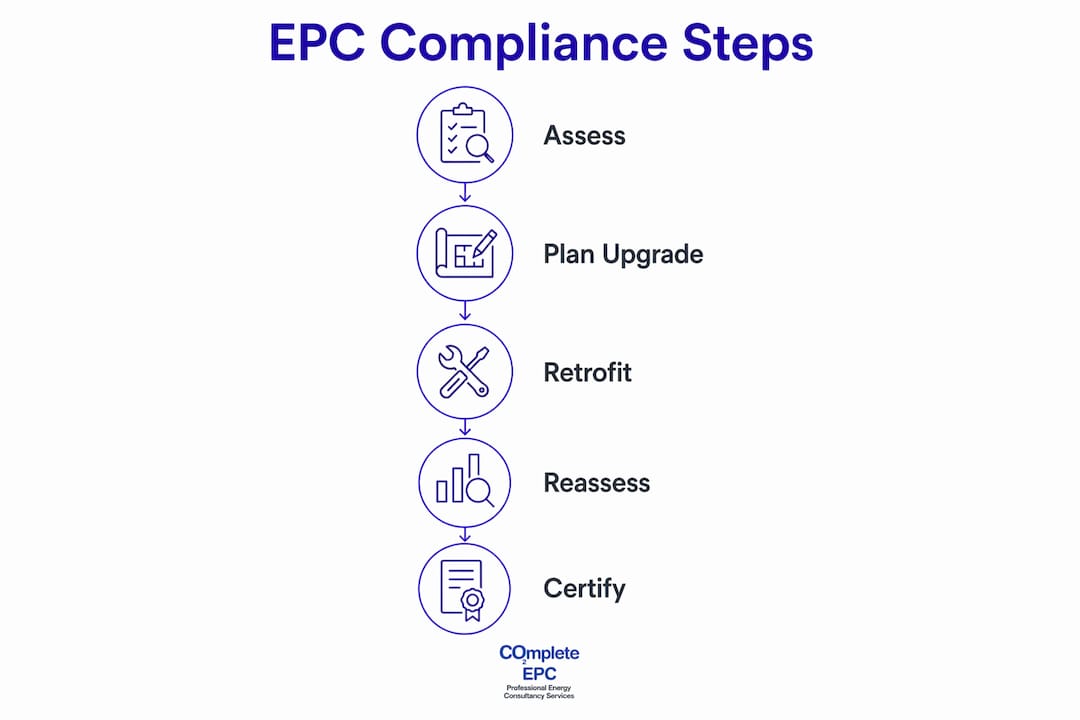
For a full walkthrough of the assessment process, the EPC assessment process guide from Completeepc covers each step in detail.
What are the benefits of meeting or exceeding the minimum EPC rating?
Compliance is the floor, not the ceiling. Landlords who treat their EPC rating as a strategic asset rather than a legal box to tick consistently see returns beyond regulatory safety.
A higher EPC rating reduces tenant energy bills directly. Lower running costs make a property more attractive to prospective tenants, particularly as energy prices remain a household concern. Properties rated C or above are easier to let and command stronger rental yields in competitive urban markets such as London.
The EPC report itself contains a list of recommended improvements ranked by cost-effectiveness. Using these recommendations as a guide means landlords spend money on upgrades that deliver the highest rating improvement per pound invested. This targeted approach avoids wasted expenditure on measures that have little impact on the final band.
“An EPC should be viewed not just as a legal requirement but as a strategic asset for landlords to improve energy efficiency, reduce costs, and increase property appeal.” — Energy Saving Trust
Property valuation is also affected. Buyers and mortgage lenders increasingly factor energy performance into their assessments. A band C or above property carries lower risk of future capital expenditure to meet regulations, which supports both sale price and mortgage availability. For landlords with portfolio ambitions, energy efficiency improvements protect long-term asset value in a market where regulatory standards will only tighten.
Key takeaways
The minimum EPC rating for privately rented properties in England and Wales is currently band E, rising to band C by 1 october 2030, with a new multi-metric assessment system taking effect from october 2026.
| Point | Details |
|---|---|
| Current legal minimum | Band E applies to all privately rented homes in England and Wales as of 2026. |
| 2030 band C deadline | All privately rented properties must reach band C by 1 october 2030 under the Warm Homes Plan. |
| Multi-metric change | From october 2026, compliance shifts to fabric performance plus heating or smart readiness metrics. |
| Grandparenting rule | Achieving band C before 1 october 2029 locks in compliance until the current certificate expires. |
| Exemption threshold | Landlords may register an exemption if improvement costs exceed £3,500 including VAT. |
Why landlords should act now, not in 2029
The most common mistake I see landlords make is treating the 2030 deadline as distant. It is not. The october 2026 assessment change alone means the rules for achieving band C will become more demanding in a matter of months. Landlords who act before that date have a genuine advantage: they can achieve compliance under the current, simpler single-metric system.
I have seen landlords spend money on boiler upgrades expecting a significant rating jump, only to find the improvement was marginal because the fabric of the building was the real problem. The new multi-metric system will make this kind of mismatch impossible to ignore. Insulation, glazing, and draught-proofing are where most properties need attention first.
The grandparenting provision is the most underused tool available right now. Securing a band C certificate before 1 october 2029 means you are not immediately subject to the new multi-metric standards, potentially deferring that compliance burden by up to a decade. That is a significant planning advantage for landlords managing multiple properties.
My advice is straightforward. Get a current EPC assessment done now. Read the recommendations section carefully. Prioritise fabric improvements. And treat the £10,000 cost cap as a budget to plan around, not a limit to fear. The landlords who will struggle in 2030 are the ones who waited.
— Danny
Completeepc can help you meet your EPC obligations
Completeepc provides professional EPC assessments for landlords across London, carried out by qualified assessors with extensive experience in both domestic and commercial properties. Whether you need a first-time certificate, a renewal ahead of the 2026 assessment changes, or a post-retrofit assessment to confirm band C compliance, Completeepc offers competitive pricing with a lowest-rate guarantee. Getting your domestic EPC arranged now means you have a clear picture of where your property stands before the new multi-metric standards arrive. For landlords managing HMOs or larger portfolios, Completeepc’s assessors understand the specific compliance requirements that apply to your properties. Check the 2018 MEES regulations guide for a full breakdown of your current legal obligations.
FAQ
What is the current minimum EPC rating for rental properties in England?
The current minimum EPC rating for privately rented homes in England and Wales is band E. Letting a property rated F or G is unlawful unless a valid exemption is registered on the PRS Exemptions Register.
When does the minimum EPC rating rise to band C?
All privately rented properties in England and Wales must reach at least band C by 1 october 2030 under the government’s Warm Homes Plan. Properties achieving band C before 1 october 2029 benefit from grandparenting provisions.
What happens if my property cannot reach the required EPC band?
Landlords may register an exemption on the PRS Exemptions Register if improvement costs exceed £3,500 including VAT or if other qualifying conditions apply. Exemptions last five years and require supporting evidence such as three installer quotes.
How much does an EPC assessment cost?
An EPC assessment typically costs between £65 and £120. These costs count towards the £10,000 maximum compliance investment cap when commissioning assessments before and after retrofit work.
What changes to EPC assessments are coming in october 2026?
From october 2026, EPC compliance will be assessed using a multi-metric system covering fabric performance as the primary metric and either heating system efficiency or smart readiness as a secondary metric. The familiar A to G energy cost rating will remain on certificates but will serve an advisory role only.