

TL;DR:
- An EPC is a legal requirement for selling homes in England and Wales, and sellers must obtain one before marketing. Most London homes are rated D or E, with improvements potentially increasing property value by up to 3% per rating band. Getting an EPC early and improving its rating can help sellers meet regulations, attract buyers, and maximize sale price.
An Energy Performance Certificate (EPC) is a legally required document that rates your home’s energy efficiency before you can market it for sale. Under the Energy Performance of Buildings Regulations, sellers in England and Wales must hold a valid EPC before listing a property. Fail to do so and Trading Standards can issue a £200 fine per dwelling. The certificate rates your home on a scale from A to G, costs between £60 and £120, and remains valid for 10 years. For London homeowners preparing to sell, getting the EPC for house sale right from the start avoids delays, protects your legal position, and increasingly affects your final sale price.
What is an EPC rating and how does it affect your house sale?
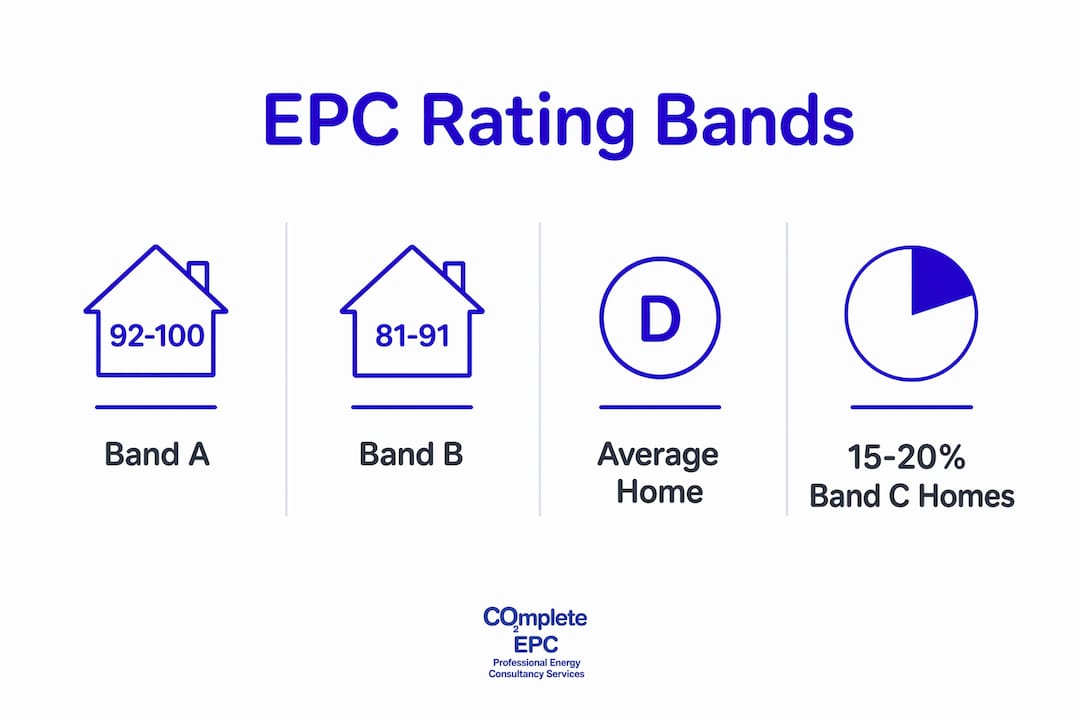
EPC ratings use the Standard Assessment Procedure (SAP) scoring system to grade a property’s energy efficiency. The bands run from A to G, with SAP scores assigned as follows:
| EPC Band | SAP Score | Energy Efficiency |
|---|---|---|
| A | 92–100 | Excellent |
| B | 81–91 | Very good |
| C | 69–80 | Good |
| D | 55–68 | Average |
| E | 39–54 | Below average |
| F | 21–38 | Poor |
| G | 1–20 | Very poor |
The average UK home is rated D, and only 15–20% of properties reach band C. That gap matters enormously in London’s competitive market, where buyers are increasingly comparing running costs alongside asking prices.
Most London homes fall within bands D or E, and government policy is pushing owner-occupiers to improve efficiency and meet higher standards. Energy efficiency is becoming a core valuation factor in London’s property market, not a secondary consideration. The government already targets a minimum band C for rental properties by 2030, and similar expectations are forming around owner-occupied sales.

The practical impact on your sale is direct. Buyers factor in projected energy bills when assessing affordability. A D-rated home competing against a C-rated property on the same street will often attract lower offers. EPC improvements can increase property values by 1–3% per rating band. In London, where average property values are high, even a 1% uplift represents a meaningful sum.
Key factors buyers consider when reviewing an energy performance certificate:
- Current rating band and the gap to band C or above
- Estimated annual energy costs listed on the certificate
- Recommended improvements and their projected cost
- Potential rating if all recommendations were implemented
- Validity date to confirm the certificate is current
How to get an EPC for your house sale in London
Getting an EPC starts with booking an accredited domestic energy assessor. Only assessors registered with an approved accreditation scheme can produce a legally valid certificate. You can verify credentials through the national EPC register before booking.
The assessment itself follows a clear process:
- Book an accredited assessor. Contact a qualified domestic energy assessor directly or through a service like Completeepc, which provides accredited assessors across London.
- Prepare your property. Give the assessor access to the loft, boiler, hot water cylinder, and all rooms. Having documentation for any recent improvements, such as insulation certificates or boiler installation records, speeds up the process.
- The onsite inspection takes place. A typical assessment lasts 45–60 minutes. The assessor records construction materials, heating systems, insulation levels, glazing type, and lighting.
- The assessor enters data into approved software. This calculates the SAP score and generates the EPC report.
- The certificate is lodged on the national register. This happens within 24 hours of the assessment. You receive a copy and can access it online.
- Provide the EPC to prospective buyers. Sellers must provide the certificate free of charge on or before exchange of contracts.
Timing is the detail most sellers get wrong. A valid EPC must be in place before marketing begins, not at the offer stage or exchange. Listing on Rightmove or Zoopla without a valid certificate puts you in breach of the regulations immediately.
Costs typically range from £60 to £120, depending on property size and location. London properties at the larger end of the scale, or those with complex heating systems, tend to sit at the higher end of that range.
Pro Tip: Book your EPC assessment at least two weeks before your intended listing date. This gives you time to review the certificate, act on any quick-win improvements, and request a reassessment if needed, all before your estate agent uploads the listing.
EPC exemptions and common pitfalls to avoid when selling
Not every property requires an EPC, but the exemptions are narrower than most sellers assume. Relying on a mistaken exemption is one of the most common and costly errors in the selling process.
Properties that may be exempt include:
- Listed buildings, but only where energy efficiency improvements would unacceptably alter their character or appearance. Most listed buildings still require an EPC.
- Temporary buildings with a planned use of two years or less
- Standalone buildings with a total floor area under 50m²
- Buildings due for demolition, where planning permission and relevant consents are already in place
The listed building exemption is widely misunderstood. Owners of listed buildings often obtain EPCs despite the narrow exemption because buyers and solicitors expect them. Skipping the certificate can stall conveyancing and deter buyers, even when an exemption technically applies.
The penalties for non-compliance fall primarily on estate agents, but private sellers also face fines. Trading Standards enforces these rules, and a £200 fine is the minimum consequence. A more serious risk is a delayed or collapsed sale if a buyer’s solicitor flags the missing certificate during conveyancing.
Pro Tip: If you believe your property qualifies for an exemption, get written confirmation from a qualified assessor or solicitor before listing. Do not rely on informal advice from your estate agent.
Two further pitfalls catch sellers out regularly. First, an existing EPC may have expired. Certificates are valid for 10 years, so if you bought your home more than a decade ago and the previous owner commissioned one, it will no longer be valid. Check the national EPC register before assuming you are covered. Second, if you have made significant improvements since the last certificate was issued, the existing rating may understate your home’s current efficiency. A fresh assessment could produce a better rating and strengthen your sale.
How to improve your EPC rating before selling
Improving your EPC rating before listing is one of the most cost-effective steps you can take as a seller. The EPC report includes specific recommendations for improving energy efficiency, ranked by impact and estimated cost. Acting on even a few of these can shift your rating by one or two bands.
The most impactful measures for London homes are:
- Loft insulation: Adding or topping up loft insulation to 270mm is typically low-cost and delivers a meaningful SAP score improvement.
- Cavity wall insulation: Applicable to many post-1930s London terraces and semi-detached homes. Costs vary but government grants are sometimes available.
- Boiler replacement: Upgrading from an old G-rated boiler to a modern A-rated condensing boiler can shift a property from band E to band D or higher.
- Double or triple glazing: Replacing single-glazed windows improves both the SAP score and buyer perception of the property.
- Smart heating controls: Adding a programmer, room thermostat, and thermostatic radiator valves is relatively inexpensive and contributes to the SAP calculation.
- Solar panels: A higher upfront cost, but solar photovoltaic panels can push a property into band B or even A territory, which is a strong selling point in 2026.
The financial case for improvements is clear. Property values can rise by 1–3% per rating band improvement. On a £500,000 London property, moving from band E to band C represents a potential value increase of £10,000–£30,000. That figure dwarfs the cost of most insulation or heating upgrades.
Once improvements are complete, commission a new EPC assessment. The updated certificate replaces the old one on the national register and gives buyers an accurate picture of the property’s efficiency. An updated EPC showing improved ratings adds market appeal and supports a stronger asking price. Buyer demand for energy-efficient homes is growing, and a certificate showing band C or above is increasingly a differentiator in London’s market.
Key takeaways
An EPC is a legal requirement for selling a home in England and Wales, and obtaining one before marketing begins is the single most time-sensitive compliance step for London sellers.
| Point | Details |
|---|---|
| Legal requirement | A valid EPC must be in place before marketing, or sellers risk a £200 fine from Trading Standards. |
| Rating bands | EPC ratings run from A to G using SAP scores; most London homes sit at band D or E. |
| Assessment process | A 45–60 minute inspection by an accredited assessor produces a certificate lodged within 24 hours. |
| Cost and validity | EPCs cost £60–£120 and remain valid for 10 years; check the national register before assuming yours is current. |
| Value impact | Improving your rating by one band can increase property value by 1–3%, making pre-sale upgrades worth considering. |
Why London sellers should treat the EPC as a sales tool, not a box-tick
Most sellers I speak to treat the EPC as an administrative hurdle. Get it done, file it away, move on. That approach leaves money on the table.
The EPC is the only document in a property sale that quantifies running costs in a standardised, comparable format. Buyers use it. Solicitors check it. Mortgage lenders are beginning to factor it into valuations. Treating it as a formality misses the point entirely.
London’s housing stock is old. A large proportion of the city’s terraced and Victorian properties sit at band E or below. That creates a genuine opportunity for sellers who invest in targeted improvements before listing. A band C certificate on a Victorian terrace in Hackney or Lewisham is a genuine differentiator. It signals to buyers that the property has been maintained and improved, not just listed.
The other mistake I see regularly is sellers discovering their EPC is out of date on the day their estate agent tries to list the property. The national register is publicly accessible. Check it before you do anything else. If the certificate is expired or was never commissioned, book an assessment immediately. Two weeks is a comfortable lead time. One week is tight. The day before listing is a problem.
Government policy is moving in one direction only. The 2030 minimum band C target for rentals will eventually extend its influence to sales. Sellers who improve their ratings now are ahead of that curve, not chasing it.
— Danny
How Completeepc can help you sell with confidence
Completeepc provides domestic EPC assessments across London, carried out by accredited assessors with extensive experience in the capital’s varied housing stock. Whether you own a Victorian terrace, a purpose-built flat, or a period conversion, Completeepc’s assessors understand the specific construction types and systems that affect London EPC ratings. Certificates are lodged on the national register promptly, so your listing timeline stays on track. Completeepc also offers guidance on improving your EPC rating before sale, helping you understand which upgrades deliver the best return. Arranging your assessment early gives you the flexibility to act on recommendations and list with a stronger certificate.
FAQ
Is an EPC legally required to sell a house in London?
Yes. Under the Energy Performance of Buildings Regulations, a valid EPC must be obtained before marketing a residential property for sale in England and Wales. Failure to comply can result in a £200 fine per dwelling from Trading Standards.
How much does an EPC cost for a house sale?
An EPC typically costs between £60 and £120, depending on the size and complexity of the property. London properties at the larger end of the scale tend to sit closer to the upper limit of that range.
How long does an EPC last?
An EPC is valid for 10 years from the date of issue. If you have an existing certificate, check the national EPC register to confirm it has not expired before listing your property.
What EPC rating do most London homes have?
Most London homes fall within bands D or E. Only 15–20% of UK properties achieve band C, which is increasingly the benchmark buyers and government policy treat as the efficiency standard.
Can I sell a listed building without an EPC?
Listed buildings may qualify for an exemption, but only where energy efficiency improvements would unacceptably alter the building’s character. In practice, most buyers and solicitors expect an EPC regardless, and skipping it can delay conveyancing.