

TL;DR:
- An EPC is a required document that rates a property’s energy efficiency from A to G. Most London homes fall below Band C, the 2030 compliance target, requiring upgrades starting with insulation and heating systems. Reassessments after improvements are essential to reflect higher ratings and comply with legal standards.
An Energy Performance Certificate (EPC) is a legally required document that rates a property’s energy efficiency on a scale from A to G, where A is the most efficient and G the least. This EPC rating guide covers everything London property owners and landlords need to know: how ratings are calculated using the Standard Assessment Procedure (SAP), what the law requires, and how to improve your score before the government’s 2030 deadline. The average UK home sits at Band D, which means most London landlords have real work to do before tighter rules take effect.
What does an EPC rating guide actually measure?
An EPC rating translates a property’s energy characteristics into a single letter grade, backed by a numerical score from 1 to 100+. EPC ratings run from A (92–100 points) to G (1–20 points), with Band C sitting at 69–80 points. That Band C threshold matters because it is the government’s minimum efficiency target for rental properties by 2030.

The certificate is valid for 10 years. A standard domestic EPC costs £65–£120 in the UK, making it one of the more affordable compliance documents a landlord will ever need. The certificate also serves a dual purpose: it satisfies legal requirements and acts as a practical roadmap for energy improvements.
Only about 4% of UK homes achieve an A or B rating, while roughly 8% sit at the lowest F or G bands. That distribution tells you the majority of London’s housing stock has genuine room to improve, and that acting early puts you well ahead of the compliance curve.
How is an EPC rating calculated?
EPC ratings are calculated using the Standard Assessment Procedure (SAP), the government’s official methodology for measuring residential energy performance. SAP evaluates insulation, heating systems, windows, ventilation, lighting, and renewable energy features to produce a numerical score. The result is a model of the property’s expected performance, not a record of actual energy bills.
That distinction matters. An EPC is a model, not a direct measurement of energy consumption; two identical properties receive similar ratings regardless of how their occupants behave. SAP uses standard assumptions about occupancy and heating controls, so your tenants’ habits do not affect your rating. What does affect it is the physical fabric of the building and its fixed systems.
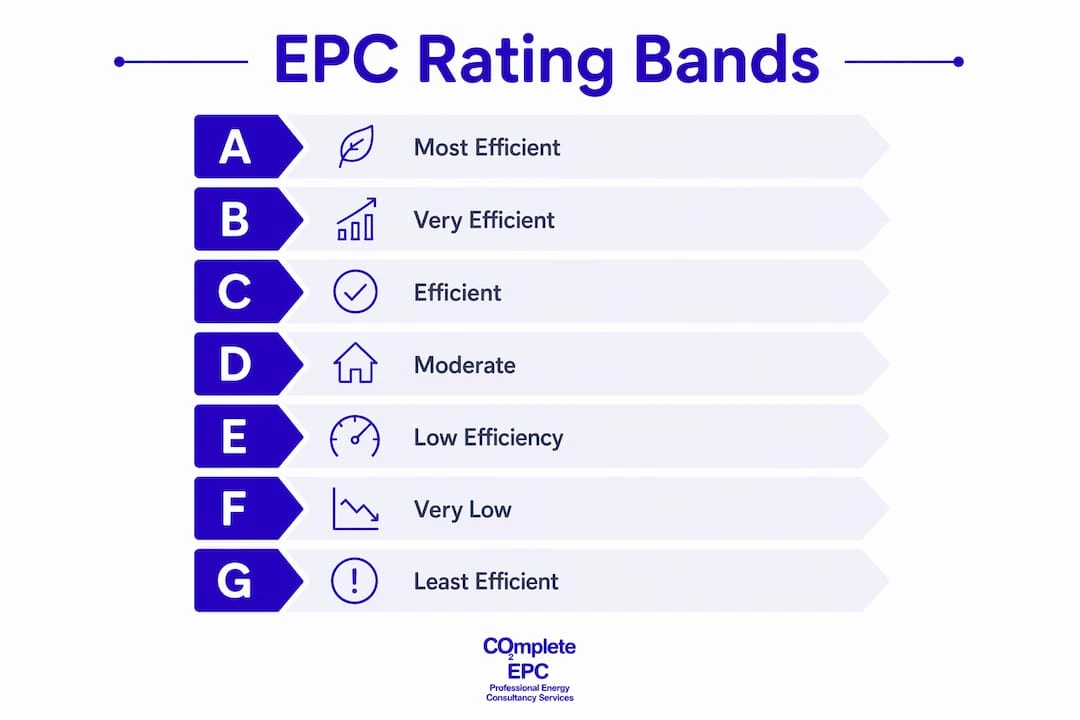
Every EPC report shows two scores: your current rating and your potential rating. The potential rating shows what the property could achieve if all recommended improvements were made. That gap between current and potential is your upgrade opportunity.
EPC rating bands at a glance
| Band | SAP score | Typical descriptor |
|---|---|---|
| A | 92–100+ | Most efficient |
| B | 81–91 | Very efficient |
| C | 69–80 | Good efficiency |
| D | 55–68 | Average |
| E | 39–54 | Below average |
| F | 21–38 | Poor |
| G | 1–20 | Least efficient |
Pro Tip: Ask your assessor to show you which individual factors are dragging your score down most. Fixing the two or three biggest contributors often moves a property up a full band without touching everything else.
What are the legal requirements for London landlords?
Every property in England and Wales must have a valid EPC before it is marketed for sale or let. The current legal minimum for rental properties is Band E. Failing to provide a valid EPC can result in a fixed penalty of £200. That penalty applies per property, so a portfolio landlord who overlooks several certificates faces a significant cumulative cost.
The rules are tightening. The government requires rental properties to reach at least Band C by october 2030. That deadline is closer than it appears when you factor in the time needed to plan, fund, and complete upgrades across a portfolio. London landlords who act now avoid the rush and the inflated contractor prices that tend to follow regulatory deadlines.
Key compliance points for London property owners:
- A valid EPC must be in place before a property is advertised for rent or sale.
- The minimum rating for lettings is currently Band E.
- Band C becomes the minimum for new tenancies and renewals from october 2030.
- EPCs are valid for 10 years; check the expiry date on any certificate you hold.
- Certain listed buildings and temporary structures may qualify for exemptions, but most standard London properties do not.
- Exemptions must be registered on the PRS Exemptions Register to be legally recognised.
The cost of non-compliance goes beyond the £200 fixed penalty. A property that cannot be legally let sits empty, generating no income while costs continue. Getting your EPC in order is straightforward when you plan ahead.
How can you improve your EPC rating effectively?
Improving your EPC rating is a structured process, not a guessing game. The most cost-effective place to start is always the building fabric, not expensive technology. Insulation upgrades provide the best return on investment for improving EPC ratings, ahead of renewable energy installations in properties that still lack basic fabric improvements.
Follow this sequence to get the best results:
- Get a current EPC assessment. You cannot plan improvements without knowing your baseline score and what the report recommends.
- Address loft insulation first. Loft insulation costs £300–£600 with a payback period of 2–5 years. It is the single most cost-effective upgrade for most London properties.
- Install cavity wall insulation. Costs typically run £400–£1,500 and deliver similar payback periods. Many London terraces and semis are suitable candidates.
- Upgrade the boiler. A modern condensing boiler can improve your rating by 1–2 bands, with installation costs between £2,000 and £4,000. Older G-rated boilers are a significant drag on any property’s score.
- Switch to LED lighting throughout. LED upgrades are low cost and quick to complete. They contribute a modest but measurable improvement to the SAP score.
- Consider double or triple glazing. Window upgrades improve both the energy score and tenant comfort, which supports rental appeal.
- Commission a reassessment. Once improvements are complete, book a new EPC inspection. Reassessments can capture previously undocumented improvements if properly evidenced during the visit.
Moving a property from Band D to Band C can save tenants £500–£700 annually in energy costs. That saving makes your property more attractive to prospective tenants and supports a stronger rental yield over time. You can read more about home efficiency upgrades to plan your improvement programme in detail.
Pro Tip: Keep receipts, installation certificates, and product specifications for every upgrade. Your assessor needs documented evidence to credit improvements during a reassessment. Without paperwork, valid upgrades may not be reflected in your new score.
How do you read an EPC report properly?
Most property owners glance at the letter grade and file the certificate away. That approach wastes the most useful part of the document. An EPC report is both a compliance document and a practical improvement roadmap, with recommended actions prioritised by cost and energy savings.
A full EPC report contains:
- Current energy efficiency rating and the numerical SAP score behind it.
- Potential rating showing what the property could achieve with all recommended improvements.
- Estimated energy costs broken down by heating, hot water, and lighting.
- CO2 emissions figure expressed in tonnes per year.
- Recommended improvements listed with estimated installation costs and projected annual savings.
- Environmental impact rating showing the property’s carbon footprint on the same A to G scale.
“The improvement recommendations in an EPC report are prioritised for cost-effectiveness. Reading them in order gives you a ready-made upgrade plan, not just a compliance tick.”
The estimated costs and savings in the report are based on standard assumptions, so treat them as indicative rather than exact. They are still reliable enough to compare the relative value of different upgrades. A landlord choosing between loft insulation and solar panels, for example, will find the report clearly shows which delivers faster payback for a typical property. For a deeper look at how EPC certificates benefit London properties, the improvement data in the report is the starting point.
After completing upgrades, request a new EPC. The updated certificate reflects your improvements, raises your compliance standing, and can be used in marketing materials to attract quality tenants.
Key takeaways
An EPC rating is a legal requirement and a practical tool: London landlords who treat it as both will be better placed for the 2030 Band C deadline and the rental market competition that follows.
| Point | Details |
|---|---|
| Band C is the 2030 target | Rental properties must reach Band C by october 2030; act now to avoid cost and compliance pressure. |
| SAP drives the score | The Standard Assessment Procedure evaluates insulation, heating, windows, and lighting to produce your rating. |
| Insulation first | Loft and cavity wall insulation deliver the fastest payback and the biggest score gains for most London properties. |
| Read the full report | EPC reports include estimated costs, CO2 figures, and prioritised improvements, not just a letter grade. |
| Reassess after upgrades | Book a new inspection once improvements are complete and evidenced to capture your higher rating officially. |
Why I think most London landlords are reading their EPC wrong
Most landlords I speak to treat the EPC as a box to tick before a tenancy starts. They check the band, confirm it meets the legal minimum, and move on. That is understandable, but it leaves real money on the table.
The improvement recommendations section of an EPC report is genuinely useful intelligence. It tells you, in plain terms, which upgrades will move your rating the most and at what approximate cost. A landlord with a Band D property who reads that section carefully will often find that two or three targeted measures, typically insulation and a boiler upgrade, are enough to reach Band C without a full retrofit programme.
The other thing I see overlooked is the reassessment step. Landlords complete upgrades and assume the new rating applies automatically. It does not. You need a fresh inspection with documented evidence of the work done. Without that, your improved property still carries the old certificate, which means no compliance benefit and no marketing advantage.
My honest view is that insulation is where London landlords should spend their attention first, not solar panels or heat pumps. The fabric of the building is the foundation. Get that right and the score follows. Expensive technology installed in a poorly insulated property is an inefficient use of capital. The EPC report will tell you the same thing if you read past the first page.
— Danny
How Completeepc helps London property owners stay compliant
Completeepc provides professional domestic EPC assessments for London properties, carried out by qualified assessors with extensive experience across the capital’s varied housing stock. Whether you need a certificate for a new tenancy, a sale, or a post-upgrade reassessment, the process is straightforward and priced competitively. Completeepc’s assessors produce detailed reports that go beyond the headline rating, giving you clear improvement recommendations you can act on. For landlords building towards the 2030 Band C requirement, that guidance is worth having early. Contact Completeepc to book your EPC assessment in London and get the certificate and the clarity your property needs.
FAQ
What is an EPC rating?
An EPC rating is a letter grade from A to G that shows how energy efficient a property is, based on a SAP score from 1 to 100+. Band A is the most efficient; Band G is the least.
How long is an EPC valid for?
An EPC is valid for 10 years from the date of issue. A new certificate is required if the existing one has expired before a property is marketed for sale or let.
What is the minimum EPC rating for renting a property in London?
The current legal minimum for rental properties in England, including London, is Band E. From october 2030, the minimum rises to Band C for new tenancies and renewals.
How much does it cost to get an EPC?
A standard domestic EPC in the UK typically costs between £65 and £120. Failing to provide a valid EPC when required carries a fixed penalty of £200.
What is the fastest way to improve an EPC rating?
Loft insulation and cavity wall insulation are the most cost-effective first steps, with costs of £300–£1,500 and payback periods of 2–5 years. Upgrading to a modern condensing boiler can raise a rating by 1–2 bands.