

You can obtain a compliant, affordable commercial EPC for many small UK units from around £150, with fees rising to several hundred pounds for larger or more complex premises. The exact figure depends on floor area, building complexity, and how well-prepared your documentation is before the assessor arrives. For most small retail units, offices, and light industrial spaces, the cost is well within reach of any property budget. Under GOV.UK regulations, a valid EPC must be in place before you market a commercial property for sale or rent, and the Minimum Energy Efficiency Standards (MEES) set the compliance floor. Completeepc offers accredited commercial EPC assessments at transparent, competitive rates across London. Get a quote today and know your cost before committing.
Table of Contents
- Who needs a commercial EPC and what does the law require?
- What does an affordable commercial EPC typically cost?
- How do you book a budget-friendly commercial EPC?
- What does the assessor inspect and what does the report contain?
- How long does the process take from booking to lodgement?
- Are there exemptions, and can you let without an EPC?
- What does the 2026 MEES update mean for your cost planning?
- Key takeaways
- Why price alone is not the right measure
- Completeepc: accredited assessments at competitive rates
- Useful sources
- FAQ
Who needs a commercial EPC and what does the law require?
A commercial EPC, formally called a non-domestic Energy Performance Certificate, rates a building’s energy efficiency on a scale from A (most efficient) to G (least efficient). Once issued, it remains valid for ten years, so you will not need to renew it for every transaction within that window.
The legal triggers are clear:
- Selling a commercial property: you must commission an EPC before marketing begins.
- Letting or re-letting: an EPC is required before a new tenancy is granted or an existing one is renewed or extended.
- New construction: the EPC must be produced on completion.
- Major services changes: significant alterations to heating, cooling, or ventilation systems can trigger a new requirement.
Since 1 April 2023, the EPC E minimum applies to all privately rented non-domestic properties, even where there has been no change in tenancy. Landlords, property owners, estate agents, and solicitors all share responsibility for making the certificate available.
Failure to comply carries real consequences. Fines range from £500 to £5,000, calculated by reference to rateable value. Beyond the financial penalty, non-compliance can attract enforcement action and reputational damage, including public listing on exemption registers in enforcement cases.
What does an affordable commercial EPC typically cost?
Commercial EPC pricing spans a wide range, from modest fees for small retail or office units to several hundred pounds for large or complex premises. The table below gives a practical guide to typical cost bands.

| Floor area | Typical complexity level | Indicative price range | When costs jump |
|---|---|---|---|
| — | Level 3 (SBEM) | £150–£300 | Rarely, unless access is difficult |
| — | Level 3–4 (SBEM) | £300–£500 | Multiple zones or complex services |
| 500–1,000 m² | Level 4 (SBEM/DSM) | £500–£800 | Mixed-use or specialist systems |
| Over 1,000 m² | Level 4–5 (DSM required) | £800+ | DSM modelling, specialist inputs |
The four principal cost drivers are:
- Floor area: larger buildings require more time on site and more data entry.
- Assessment level: Level 4–5 assessments, particularly those requiring Dynamic Simulation Modelling (DSM), cost significantly more than standard SBEM-based Level 3 work.
- Documentation availability: good documentation shortens site visit time and directly reduces assessor charges.
- Access and number of visits: restricted access or a need for return visits adds cost.
Pro Tip: Gather your floor plans, services schedules, and details of any recent works before requesting a quote. Assessors price partly on anticipated site time, so arriving well-prepared can meaningfully reduce your fee.
How do you book a budget-friendly commercial EPC?
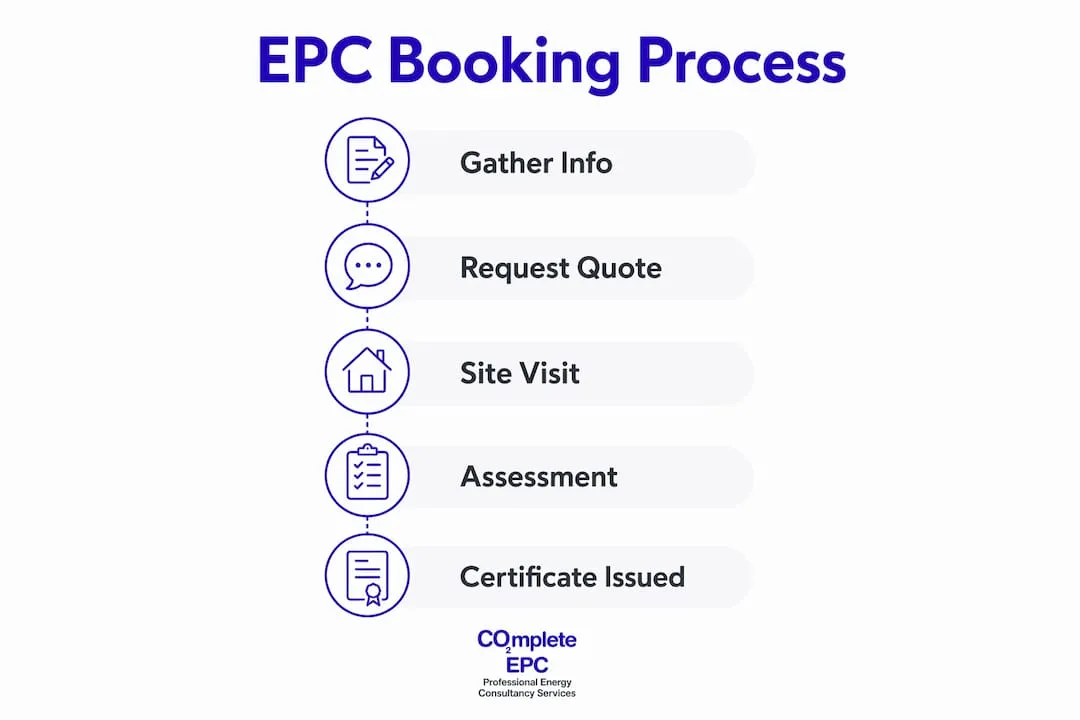
The booking process is straightforward when you know what to prepare. Follow these steps to keep costs down and avoid delays.
- Request quotes from accredited assessors. Provide the floor area, building type, and postcode at the outset. A reputable assessor will give you a fixed or clearly scoped fee, not a vague estimate.
- Confirm the assessment level. Ask whether your building requires a Level 3 SBEM assessment or a higher-level DSM assessment. The answer affects both cost and turnaround time.
- Prepare your documentation. Assemble floor plans, a list of fixed services (heating, cooling, lighting, ventilation), details of any recent energy-related works, and meter locations.
- Arrange site access. Confirm that all areas, plant rooms, and roof spaces are accessible on the day. A failed visit means a second call-out charge.
- Review the quote scope carefully. Check whether travel, lodgement to the national register, and the recommendation report are included in the price.
- Book and confirm the visit date. Reputable assessors typically schedule within a few working days for standard properties.
Before confirming, ask these questions:
- What accreditation scheme are you registered with?
- Is lodgement to the national register included?
- Are there any extra charges for additional visits or complex services?
- What is the expected turnaround from site visit to certificate delivery?
Red flags to avoid: a blanket lowest-price offer with no site visit, a vague scope that excludes lodgement, or an assessor who cannot name their accreditation scheme. These are signs of a non-compliant or incomplete service. You can verify assessor credentials through the EPC assessment process before committing.
What does the assessor inspect and what does the report contain?
On site, the assessor works through a structured inspection. They take measurements of the building’s floor area and geometry, photograph key fabric and services elements, and record details of:
- Heating and hot water systems
- Cooling and air conditioning
- Mechanical ventilation
- Lighting (type, controls, and zoning)
- Insulation in walls, roof, and glazing
- Any renewable energy systems
The final certificate shows the asset rating (A–G), the numerical score, the certificate reference number, and the ten-year expiry date. It is produced using either SBEM (Simplified Building Energy Model) for most standard commercial buildings, or DSM for larger or more complex properties where SBEM cannot adequately model the building’s systems. The recommendation report is attached and forms part of the lodged record.
How long does the process take from booking to lodgement?
For a straightforward small commercial unit, the timeline typically runs as follows:
- Quote response: same day to 48 hours after enquiry.
- Site visit: usually within two to five working days of booking.
- Report production: one to three working days after the site visit, depending on complexity.
- Lodgement: the assessor uploads the certificate to the national register immediately on completion, or within a short period thereafter.
Once lodged, the certificate is publicly searchable on the GOV.UK EPC register. You will receive the certificate as a PDF and a unique certificate number. Check on receipt that the expiry date is correct (ten years from the date of issue), the certificate number matches the lodged record, the assessor’s accreditation details are shown, and the recommendation report is attached. Keep a copy with your property records and provide one to any prospective buyer or tenant free of charge.
Are there exemptions, and can you let without an EPC?
Most commercial buildings require an EPC, but a limited set of exemption categories exists under GOV.UK guidance:
- Temporary buildings with a planned use of two years or less
- Certain industrial sites, workshops, and non-residential agricultural buildings with low energy demand
- Places of worship
- Stand-alone buildings with a total useful floor area of less than 50 m²
- Listed buildings, where compliance would unacceptably alter their character or appearance
Two important caveats apply. First, exemptions are not automatically transferable on sale. A new owner must re-check eligibility and, if required, re-apply or commission a fresh EPC. Second, the scope of each exemption is narrow; claiming one incorrectly exposes you to the same enforcement risk as having no certificate at all.
If an exemption applies, you must register it on the PRS Exemptions Register before letting. Even where a genuine exemption exists, obtaining an EPC voluntarily can support marketability and lender confidence, particularly for larger assets.

What does the 2026 MEES update mean for your cost planning?
The 2026 interim government response to the non-domestic MEES consultation has brought useful clarity for landlords and lenders. The key points are:
From 2031, all privately rented non-domestic buildings over 1,000 m² in England and Wales will be required to reach EPC B, where cost-effective. Buildings below 1,000 m² will continue to be subject to the existing EPC E minimum, with no set deadline to go beyond that level. The previously proposed interim EPC C milestone for 2027 has been dropped. — Pinsent Masons
For most landlords of smaller commercial properties, this removes the pressure to rush expensive interim upgrades. The seven-year payback test and existing exemptions remain in place, meaning only improvements that are practical and cost-effective will be required.
Practical planning steps in light of this update:
- Commission building surveys now to understand your current EPC rating and what improvements would cost.
- Plan any fabric or services upgrades during void periods to minimise disruption and cost.
- Apply the seven-year payback test before committing to any improvement works.
- For buildings over 1,000 m², begin modelling the path to EPC B ahead of the 2031 deadline.
Key takeaways
A compliant commercial EPC is both a legal requirement and a practical asset management tool; getting one affordably comes down to preparation, the right assessor, and understanding what drives cost.
| Point | Details |
|---|---|
| Legal requirement | You must have a valid EPC before marketing any commercial property for sale or rent in the UK. |
| Realistic price range | Small units typically cost £150–£300; larger or complex premises can cost £800 or more, especially where DSM modelling is needed. |
| Documentation saves money | Providing floor plans and services lists before the site visit reduces assessor time and lowers your fee. |
| 2026 MEES clarity | The EPC C interim milestone has been dropped; buildings under 1,000 m² remain subject to EPC E only. |
| Completeepc | Completeepc provides accredited commercial EPC assessments at transparent, competitive rates across London. |
Why price alone is not the right measure
The cheapest commercial EPC quote is not always the best value. An assessor who prices without visiting the site, or who excludes lodgement from the fee, can leave you with a certificate that does not hold up to scrutiny or, worse, one that is never lodged to the national register at all. A certificate that is not on the register is not a valid EPC for legal purposes.
What actually makes a commercial EPC affordable is the combination of a fair, transparent fee and a service that delivers a lodged, compliant certificate on time. The documentation you prepare beforehand is the single most controllable factor in your cost. Buildings assessed at Level 3 with good plans and a clear services schedule routinely come in at the lower end of the price range. The same building assessed with no documentation, requiring a second visit, and needing DSM modelling because the assessor could not gather enough data on the first visit, will cost considerably more.
The 2026 MEES update reinforces this point. With no immediate pressure to reach EPC C for smaller buildings, the priority is knowing your current rating accurately, not rushing to an expensive upgrade. A well-priced, properly lodged EPC gives you that baseline.
Completeepc: accredited assessments at competitive rates
Completeepc delivers commercial EPC assessments across London, carried out by qualified, accredited assessors with transparent, fixed-scope pricing. Every quote includes lodgement to the national register and the recommendation report, so there are no hidden extras after the site visit. The booking process is straightforward: contact Completeepc with your floor area and building type, receive a clear quote, and confirm a site visit date. For landlords managing multiple properties, combining assessments can reduce the per-unit cost further. Whether you need a certificate for a small retail unit or a larger office building, Completeepc’s pricing is structured to give you compliance without overpaying. Visit the commercial EPC page to request a quote or book your assessment today.
Useful sources
- GOV.UK: Energy Performance Certificates for business premises — the primary reference for legal requirements, fines, and when an EPC is required.
- GOV.UK: Non-domestic MEES landlord guidance — detailed guidance on the EPC E minimum standard, exemptions, and the seven-year payback test.
- GOV.UK: 2026 non-domestic MEES interim response — the official government position on EPC B targets and the dropped EPC C milestone.
- Elmhurst Energy: commercial EPC guidance — practical detail on assessment levels, SBEM vs DSM, and how documentation affects cost.
- Pinsent Masons: MEES announcement commentary — legal analysis of the 2026 interim response and its implications for landlords and lenders.
- Mayer Brown: MEES changes summary — concise overview of the policy changes and the retained flexibility mechanisms.
- Teamenergy: commercial EPC guide — market-facing guide covering costs, validity, and compliance considerations.
FAQ
How much does a commercial EPC cost in the UK?
Commercial EPC pricing varies by size and complexity: small units typically fall in the £150–£300 range, while larger or more complex premises can cost £800 or more, particularly where Dynamic Simulation Modelling is required.
Can you let a commercial property without an EPC?
No. Since 1 April 2023, all privately rented non-domestic properties must have a valid EPC rated at least E before they can be let, unless a registered exemption applies.
What is the minimum EPC rating for commercial property?
The current minimum is EPC band E. From 2031, buildings over 1,000 m² will be required to reach EPC B where cost-effective; buildings below that threshold remain subject to EPC E with no set deadline to go further.
Can I get a commercial EPC for free?
No. Commercial EPCs are priced by the market and must be carried out by an accredited assessor; there is no government-funded free scheme for non-domestic properties. Preparing good documentation before the site visit is the most practical way to keep the fee at the lower end of the range.
What happens if I do not have a commercial EPC when required?
Fines range from £500 to £5,000, calculated by reference to the property’s rateable value. Non-compliance can also lead to enforcement action and reputational consequences, including public listing on enforcement registers.
This article provides general information about commercial EPC requirements in England and Wales. It is not legal or professional advice. Always verify current regulations with GOV.UK or a qualified professional for your specific situation.