

TL;DR:
- Starting with heating controls and a smart meter can significantly lower a household’s energy costs at no initial expense.
- Implementing quick actions like lowering the thermostat by 1°C and switching appliances off standby can save up to £313 annually.
Start with your heating controls and get a smart meter fitted. Those two steps alone address the largest share of a typical UK household’s energy spend and cost nothing to begin. The Energy Saving Trust estimates that combining quick, low-cost actions can save a typical household up to £313 a year in Great Britain.
Your highest-impact actions to start today:
- Turn your thermostat down by 1°C (saves around £90 a year for a typical household)
- Switch off appliances at the plug rather than leaving them on standby
- Replace halogen bulbs with LEDs and wash laundry at 30°C
- Request a smart meter from your supplier to track exactly where your money goes
If you are struggling to pay your bills, contact your supplier immediately. Under Ofgem rules, suppliers must work with customers in difficulty and offer affordable payment plans.
Table of Contents
- How to reduce energy bills with ten quick wins today
- Heating and hot water: where to focus first
- Insulation and draught-proofing: quick fixes and bigger upgrades
- Appliances, laundry and lighting: small changes that add up
- How does a smart meter help you cut your bills?
- If you’re struggling to pay: who to contact and what to do
- How much could you realistically save? Worked examples
- When is a professional energy assessment worth booking?
- Key takeaways
- The home as a system: why order matters
- Get a professional EPC and know exactly where to invest
- Useful sources and further reading
- FAQ
How to reduce energy bills with ten quick wins today
These actions are ranked by impact and require little or no upfront cost. Pick the ones you have not done yet and work through the list.
- Turn the thermostat down by 1°C. Set it between 18–21°C for comfort. This adjustment can lead to noticeable savings on your heating bills. Effort: free.
- Switch appliances off standby. Unplug phone chargers, TVs and game consoles at the wall when not in use. Saving: a meaningful amount over the year. Effort: free.
- Replace halogens with LED bulbs. A single LED uses roughly 75% less electricity than a halogen equivalent. Saving: a meaningful amount from each bulb replaced. Effort: low-cost.
- Wash laundry at 30°C. Modern detergents work just as well at lower temperatures. Saving: meaningful reduction in electricity use per cycle. Effort: free.
- Take shorter showers. Cutting a daily shower from eight minutes to four saves both water heating costs and water usage. Effort: free.
- Only boil what you need in the kettle. Boiling a full kettle for one cup wastes energy every time. Effort: free.
- Run the dishwasher on a full load only. Half-loads use nearly the same energy as a full cycle. Effort: free.
- Line-dry clothes instead of using the tumble dryer. Tumble dryers are among the most energy-hungry appliances in the home. Effort: free.
- Draught-proof your letterbox and keyholes. Brush-type letterbox covers cost a few pounds and cut cold air infiltration noticeably. Effort: low-cost.
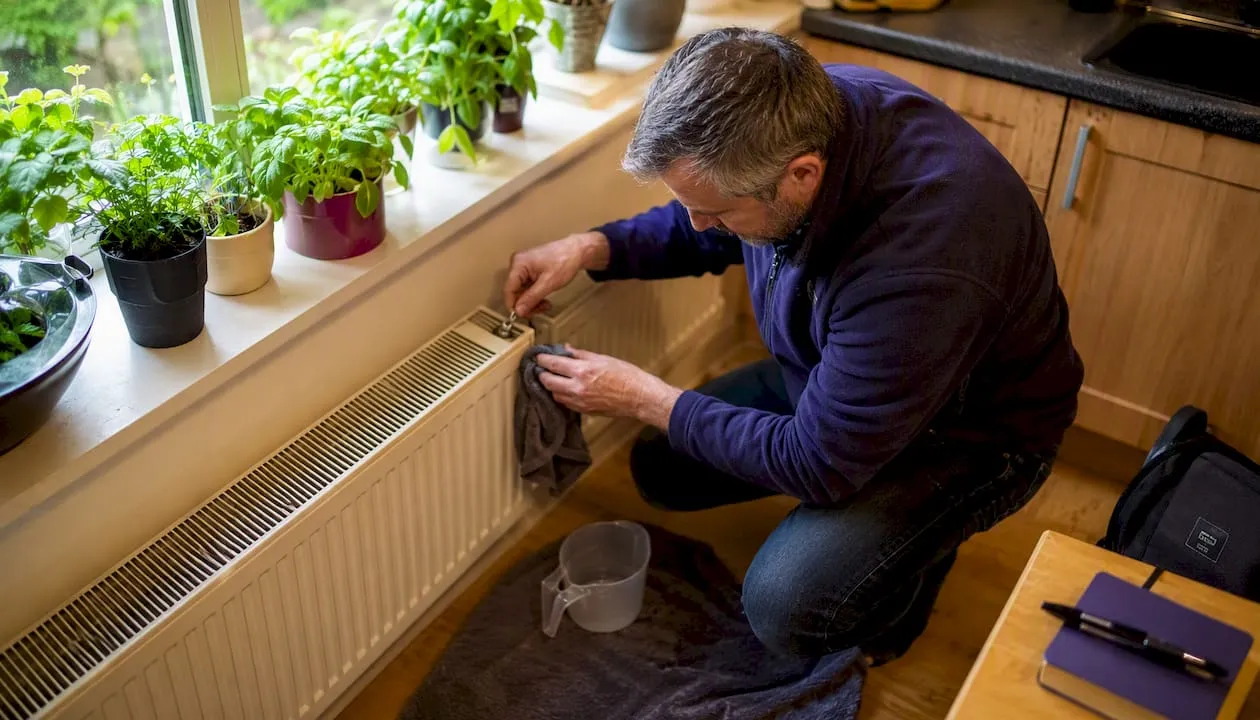
- Bleed your radiators. Trapped air reduces heating efficiency. Use a radiator key (under £5) and do it with the system cold for safety.
Pro Tip: Combine thermostat control, radiator bleeding and draught-proofing in a single afternoon. Each measure amplifies the others: a warmer, better-sealed room needs less heat to reach your target temperature, so your boiler runs for shorter periods.
Heating and hot water: where to focus first
Heating and hot water typically account for the largest share of a UK household’s energy bill, which is why changes here deliver the biggest returns. The most effective starting point is your thermostat setting. Cadent recommends keeping rooms between 18–21°C and confirms that dropping the thermostat by just 1°C saves around £90 a year for a typical household.
Beyond the thermostat, these steps make a measurable difference:
- Use a timer or programmer. Set the heating to come on 30 minutes before you need it rather than leaving it on all day. Most modern boilers heat up quickly.
- Install thermostatic radiator valves (TRVs). Fit them to individual radiators so you only heat rooms you use. Bedrooms, for example, can be kept cooler than living areas.
- Reduce your boiler flow temperature. Many combi boilers are factory-set too high. Lowering the flow temperature to around 60°C (or lower if your installer advises) can cut gas consumption without affecting comfort.
- Insulate your hot water cylinder. Topping up to an 80mm hot water jacket costs very little and delivers a short payback. Insulating exposed pipes adds to the saving.
- Bleed radiators with the system cold. Energy Saving Trust advises doing this in summer when the heating is off, so you can safely release all trapped air from the top of each unit.
Insulation and draught-proofing: quick fixes and bigger upgrades
Draught-proofing is the highest-return DIY job in most homes. Cold air entering through gaps around doors, windows, letterboxes and keyholes forces your heating system to work harder. Energy Saving Trust notes that professional draught-proofing can be relatively costly, but self-adhesive foam strips and brush-type covers deliver similar results for much less.
Tiered approach by cost and effort:
- Immediate DIY (under £20): Self-adhesive foam strips around door frames, brush-type letterbox excluders, keyhole covers, chimney draught excluders for unused fireplaces.
- Medium cost (£20–£100): Radiator reflector panels fitted behind radiators on external walls bounce heat back into the room. An 80mm hot water cylinder jacket typically costs under £20 and pays back within months.
- Larger investment: Loft insulation and cavity wall insulation require professional installation but carry significant long-term savings. For eligible households, the Great British Insulation Scheme and the Energy Company Obligation (ECO4) may cover part or all of the cost. Check eligibility on GOV.UK.
For retrofit and building-services perspective on insulation measures, Delta First Building Services provides practical guidance on what works in real UK properties.
Appliances, laundry and lighting: small changes that add up
Most households underestimate how much their appliances contribute to the bill. Lighting, laundry and kitchen habits are the easiest to change without spending anything.
- Wash at 30°C and always run full loads. A half-empty machine uses nearly the same electricity as a full one.
- Skip the tumble dryer whenever possible. It is one of the most power-hungry appliances in the home.
- Switch every halogen or incandescent bulb to LED. The upfront cost is low and the saving per bulb is substantial over its lifetime.
- Use the dishwasher’s eco setting and only run it full.
Appliance priority table
| Action | Est. annual saving (£) | Effort | Timescale | Who acts |
|---|---|---|---|---|
| Switch to LED bulbs | — | Low-cost | Immediate | DIY |
| Wash at 30°C, full loads | Meaningful per-cycle saving | Free | Immediate | DIY |
| Avoid tumble dryer | Significant (varies by use) | Free | Immediate | DIY |
| Switch off standby | £30 | Free | Immediate | DIY |
| Upgrade to A-rated appliance | Varies by appliance | One-off investment | On replacement | DIY / professional |

Pro Tip: When an old appliance needs replacing, buy one size smaller than you think you need. A fridge-freezer that is too large for a two-person household runs continuously and wastes energy. Check the EU energy label: A-rated models use significantly less electricity over their lifetime than older D or E-rated equivalents.
How does a smart meter help you cut your bills?
A smart meter paired with an in-home display shows your energy use in near real time, in pounds and pence. The Clean Energy Campaign’s guidance recommends monitoring usage before making upgrades, because it reveals which behaviours or systems account for the most energy in your specific home. Guessing which appliance is the culprit is far less effective than watching the display spike when you turn on the tumble dryer.
Smart meter vs plug-in monitor:
- Smart meter: Free from your supplier, covers whole-home gas and electricity, feeds data to your in-home display and supplier app. Request one by contacting your supplier directly.
- Plug-in energy monitor: Costs £10–£30, clips onto individual appliances, useful for identifying specific high-draw devices before a smart meter is installed.
Pro Tip: Spend one week reading your in-home display at the same time each day. Note which activities cause the biggest spikes. That single habit change, before you spend a penny on upgrades, often produces the fastest visible reduction in usage.
If you’re struggling to pay: who to contact and what to do
Contact your energy supplier before you miss a payment. Under Ofgem rules, suppliers are required to offer affordable payment plans to customers in difficulty, and acting early gives you more options.
- Call your supplier’s customer support line. Ask specifically for a payment plan or a review of your direct debit. Have a recent bill and your bank details to hand.
- Check eligibility for the Warm Home Discount. This is a one-off reduction on your electricity bill for eligible low-income households. Check GOV.UK for current eligibility criteria.
- Ask about Cold Weather Payments. These are automatic payments triggered by sustained cold spells for qualifying benefit recipients.
- Contact Citizens Advice. Their advisers provide free, step-by-step guidance on approaching suppliers, claiming benefits and accessing local support funds.
- Check devolved-nation schemes. Scottish households can contact Home Energy Scotland (0808 808 2282). Welsh households can contact Nest (0808 808 2244) for free advice and potential grant support.
When you call your supplier, say clearly: “I am struggling to pay my energy bills and I would like to discuss an affordable payment plan.” Suppliers must engage with this request under Ofgem’s consumer protection rules.
How much could you realistically save? Worked examples
The formula is straightforward: add up the estimated annual saving for each action you take. The figures below use conservative estimates from Energy Saving Trust and Cadent data.
| Scenario | Actions included | Est. annual saving |
|---|---|---|
| Basic low-cost package | Thermostat down 1°C, standby off, LED bulbs, 30°C washes | £150 |
| Medium upgrade | Above + draught-proofing, hot water jacket, bleed radiators, no tumble dryer | up to £313 |
| Full investment | Above + loft insulation, cavity wall insulation, TRVs, boiler flow temp optimised | — |
Your personal saving depends on your current habits, property type and tariff. A rough personal estimate: list every action you plan to take, note its conservative saving from the sources above, and total them. That figure is your realistic annual target.
When is a professional energy assessment worth booking?
A professional assessment becomes high-value in four situations: you are planning major upgrades and want to know which to prioritise; you are a landlord with a legal obligation to hold a valid EPC; your current EPC rating is E, F or G; or your property has unusual construction that makes standard advice unreliable.
An Energy Performance Certificate, whether domestic or commercial, does more than satisfy a legal requirement. GOV.UK confirms that an EPC includes tailored recommendations, estimated installation costs and projected annual savings, functioning as a practical roadmap for efficiency investment specific to your building.
What to expect and how to prepare:
- A qualified assessor visits the property and inspects insulation, heating systems, windows, lighting and construction type.
- The assessment typically takes 45–90 minutes for a domestic property.
- You receive a certificate rated A–G plus a detailed improvement report with costed recommendations.
- Have your boiler manual, any recent improvement receipts and your current EPC (if you have one) ready for the assessor.
- Get at least two quotes to compare pricing and turnaround times.
Key takeaways
Combining heating controls, draught-proofing, appliance habits and usage monitoring can save a typical UK household between £150 and £313 a year without major investment.
| Point | Details |
|---|---|
| Heating controls first | Turning the thermostat down 1°C saves around £90 a year for a typical household. |
| Draught-proof before you insulate | Foam strips and letterbox covers cost under £20 and deliver immediate savings. |
| Monitor before you spend | A smart meter or plug-in monitor reveals your biggest energy drains before you invest in upgrades. |
| Get support early if struggling | Contact your supplier immediately; Ofgem rules require them to offer affordable payment plans. |
| Book an EPC for a tailored plan | Completeepc provides domestic and commercial EPCs with costed improvement recommendations for London properties. |
The home as a system: why order matters
Most households approach energy saving as a list of isolated tasks. The more effective way to think about it is as a system: heat generated by your boiler is only as useful as your home’s ability to retain it. Draught-proofing and insulation are not alternatives to heating controls; they multiply the benefit of those controls.
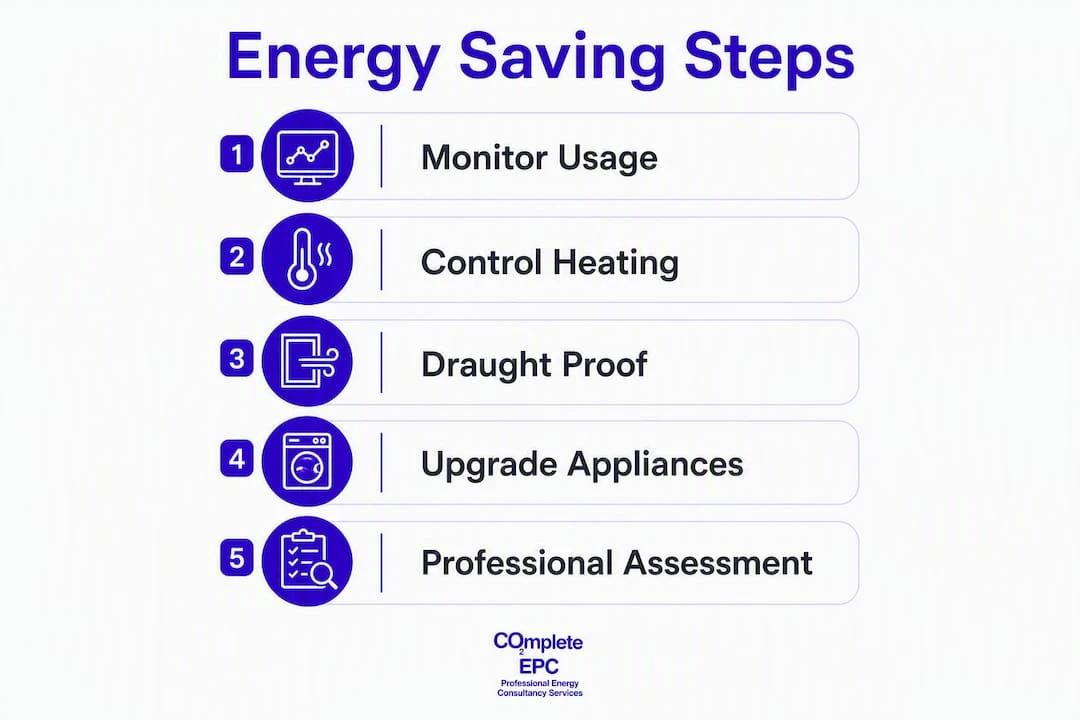
The sequence matters. Monitor first, so you know where the money is actually going. Fix the envelope next, meaning draughts and insulation, because every pound of heat you stop from escaping is a pound you did not have to generate. Then optimise the heating system itself: flow temperatures, TRVs, timers. Only after those steps does it make sense to consider larger capital investments like heat pumps or solar panels, and only then with a professional assessment to confirm the numbers stack up for your specific property.
The households that save the most are not the ones who spend the most. They are the ones who act in the right order.
Get a professional EPC and know exactly where to invest
A Domestic Energy Performance Certificate from Completeepc gives you a prioritised, costed list of improvements specific to your property, not generic advice that may not apply to your home’s construction or heating system. For landlords, a valid EPC is a legal requirement; for homeowners, it is the clearest way to identify which upgrades will deliver the best return before you commit to any spending.
Completeepc serves properties across London, with qualified assessors and competitive pricing. Turnaround is typically fast, and the improvement report that accompanies your certificate tells you precisely which measures to tackle first and what each one is likely to save. For commercial properties, a commercial EPC covers the same ground for business premises. Get a quote directly at completeepc.co.uk and have your improvement roadmap in hand before you spend a pound on upgrades.
Useful sources and further reading
- Ofgem: Save money on your energy bill — Ofgem’s consumer guidance on everyday actions and home improvements to cut bills.
- GOV.UK: Household energy — Central hub for Warm Home Discount, ECO4, the Great British Insulation Scheme and EPC guidance.
- GOV.UK: Improve energy efficiency — Official guidance on EPCs and what improvement recommendations include.
- Completeepc: Domestic EPC — Book a domestic Energy Performance Certificate for your London property.
- Completeepc: Home efficiency upgrades guide — Practical payback and funding information for UK home improvements.
FAQ
What uses the most electricity in a typical home?
Heating and hot water account for the largest share of most UK household energy bills, typically around 55%. After that, the biggest draws are tumble dryers, electric ovens, and older fridges or freezers running continuously.
What can I do right now to reduce my energy bill?
Turn your thermostat down by 1°C, switch appliances off standby, wash laundry at 30°C, and only boil as much water as you need. Combined, these free actions can save a typical household over £100 a year.
What is the 4pm rule on heating?
The 4pm rule is a general guideline suggesting you set your heating timer to come on around 4pm in winter rather than leaving it running all day. The idea is that your home retains enough warmth from the morning and the heating only needs to top it up in the late afternoon when temperatures drop.
What does Martin Lewis advise on energy bills?
Martin Lewis consistently recommends checking whether you are on the cheapest available tariff, switching off standby appliances, and contacting your supplier immediately if you cannot pay. He also highlights eligibility checks for the Warm Home Discount and other government support schemes as a priority for lower-income households.
Do I need an EPC to sell or let my property?
Yes. In England and Wales, a valid Energy Performance Certificate is a legal requirement before you market a property for sale or rent. Completeepc provides domestic EPCs for London properties, with a full improvement report included.