

Most private rented properties in England and Wales must hold a valid Energy Performance Certificate (EPC) rated E or above before a tenancy can be granted or continue. That is the current legal minimum under the Minimum Energy Efficiency Standards (MEES), and Gov makes clear that letting an F- or G-rated property without a registered exemption is a breach carrying financial penalties.
Here is what to do now:
- Check whether your property is covered by MEES (most assured and regulated tenancies are).
- Locate your current EPC on the Energy Performance of Buildings Register and confirm it has not expired.
- If the rating is F or G, commission a new domestic Energy Performance Certificate and implement low-cost improvements, or register a valid exemption on the PRS Exemptions Register.
- Start planning for the 2030 EPC C reforms now: the government’s confirmed response sets a single compliance date in late 2030, a dual-metric standard, and a raised cost cap of up to £10,000 per property.
Pro Tip: Keep dated EPC reports, contractor invoices, and exemption registration confirmations together in one folder. Local authority enforcement focuses on documentary evidence, and a missing receipt can undermine an otherwise valid exemption.
Key takeaways
Meeting EPC compliance obligations for rentals requires acting on the current E minimum today while planning for the reformed EPC C standard by 1 October 2030.
| Point | Details |
|---|---|
| Current legal minimum | Most private rented properties must be EPC E or above; letting below E without a registered exemption risks penalties that can be several thousand pounds. |
| 2030 compliance date | The single deadline for the new EPC C standard is 1 October 2030, assessed under a dual-metric approach using the Home Energy Model. |
| Cost cap rising to £10,000 | The reformed cost cap covers relevant measures installed from 1 October 2025 and reasonable EPC assessment fees, with specific exclusions. |
| Exemptions need evidence | Register exemptions on the PRS Exemptions Register with quotes, invoices, and EPC reports; most current exemptions last five years. |
| Completeepc | Completeepc provides domestic and commercial EPCs across London, supporting landlords with pre- and post-retrofit assessments and compliance documentation. |
Table of Contents
- Which rental properties do the MEES rules apply to?
- What are the current MEES deadlines you must meet today?
- How do you find, read and renew an EPC for a rental property?
- How to comply now: delivering relevant energy efficiency improvements
- What exemptions apply and how do you register them?
- What penalties can local authorities impose for non-compliance?
- A practical checklist: what to do in the next 3, 6 and 12 months
- What the 2030 EPC C reforms mean for landlords
- What landlords typically overlook about EPC compliance
- How Completeepc supports landlords with EPC compliance
- Sources
- FAQ
Which rental properties do the MEES rules apply to?
The Energy Efficiency (Private Rented Property) (England and Wales) Regulations 2015 set a two-part test. First, the property must be legally required to have an EPC. Second, it must be let on a covered tenancy type. Both conditions must be met for MEES to apply.
Tenancy types that trigger MEES duties:
- Assured tenancies and assured shorthold tenancies (the most common residential letting arrangements).
- Regulated tenancies under the Rent Act 1977.
- Domestic agricultural occupancies in certain circumstances.
Properties and situations that may be outside the current scope (but check carefully):
- Buildings officially listed or in a conservation area where compliance would unacceptably alter the character — although an EPC may still be required for the letting itself.
- Holiday lets and short-term lets have historically sat outside scope, but Pinsent Masons notes that the 2030 reforms widen scope to areas previously exempt, including heritage properties and rooms in HMOs. Audit every let property rather than assume a current exemption remains valid.
- Rooms let in a shared house (HMO) — the whole building requires an EPC, but individual rooms do not each need one.
- Genuinely temporary or emergency accommodation in some cases.
If you are unsure whether your property is covered, search by address on the EPC register to confirm whether a valid certificate exists and when it was issued. That check takes under two minutes and is the logical first step before anything else.
What are the current MEES deadlines you must meet today?
The compliance timeline has two firm historical triggers and one future date to plan for:
- 1 April 2018: Landlords could no longer grant a new tenancy for a domestic private rented property rated F or G.
- 1 April 2020: The prohibition extended to all continuing lets, including existing tenancies. Rent Smart Wales confirms that since this date most rental property in Wales must also be EPC E or above.
- Present: Most privately rented dwellings must be EPC E or above unless a valid exemption is registered. This applies whether you are granting a new tenancy or continuing an existing one.
- 1 October 2030: The single compliance date for the reformed EPC C standard under the new dual-metric approach.
EPC validity: A certificate is generally valid for 10 years. You need a new one when you sell or let a property, after major energy-related works, or — under the forthcoming reforms — at the point of marketing a property for let.
EPCs issued in 2015 or earlier are now expired. If your certificate is approaching its tenth year, commission a new assessment before you next market the property. Under the reformed rules, Pinsent Masons highlights that EPCs will be required at the point of marketing, reducing the scope for relying on older certificates.
How do you find, read and renew an EPC for a rental property?
Step 1: Search the register. Go to the official EPC search service and enter the property’s postcode or full address. The result shows the current rating, the certificate’s expiry date, and the recommended improvements listed by the assessor.
Step 2: Read the key data. On any Domestic Energy Performance Certificate, focus on three things: the Energy Efficiency Rating (EER) band (A–G), the current score versus the potential score after improvements, and the list of recommended measures with their estimated costs and savings.
Step 3: Commission a new assessment if needed. You need a fresh EPC if the existing one has expired, if the property has had significant energy-related works since the last assessment, or if you are preparing for the 2030 compliance check. A post-retrofit EPC is the standard way to demonstrate that improvements have been made and that the rating has changed.
Typical EPC cost: A domestic EPC assessment generally costs between £60 and £120 depending on property size and location, though prices vary. Under the reformed regime, reasonable EPC assessment fees — including pre- and post-retrofit assessments — can count towards the £10,000 cost cap.
Domestic vs. Commercial EPC: A Domestic Energy Performance Certificate applies to residential dwellings. If you own a mixed-use building or a non-domestic property, you need a Commercial EPC instead. The assessment methodology, metrics, and compliance rules differ between the two.
Choosing a qualified assessor: Only a Domestic Energy Assessor (DEA) accredited by an approved scheme can produce a valid domestic EPC. Check the assessor’s accreditation number on the certificate and confirm it matches the national register. For commercial properties, a Non-Domestic Energy Assessor (NDEA) is required.
How to comply now: delivering relevant energy efficiency improvements
“Relevant energy efficiency improvements” are measures recommended on the EPC that can be purchased and installed within the applicable cost cap. The 2020 MEES guidance sets out this definition and explains how landlords should work through the recommended list before claiming a cost-cap exemption.
Start with fabric measures. These deliver the most durable EPC gains and reduce heat loss directly:
- Loft insulation (one of the cheapest measures per EPC point gained).
- Cavity wall insulation where the wall construction allows it.
- Draught-proofing around doors, windows, and letterboxes.
- Floor insulation where accessible.
Then address heating and controls:
- Heating controls (programmable thermostats, thermostatic radiator valves).
- Hot water cylinder insulation.
- Efficient boiler replacement or low-carbon alternatives such as heat pumps where appropriate.
The rationale for this sequence is straightforward: insulating the fabric first means any heating system works more efficiently, so you avoid installing an expensive boiler or heat pump into a leaky building. Under the 2030 dual-metric standard, fabric performance is the primary metric, with heating efficiency or smart readiness as the secondary choice.
Use a pre-retrofit EPC to identify which measures appear on the recommended list and estimate their combined cost. A post-retrofit EPC then confirms the new rating and provides the evidence you need for compliance checks. Check GOV.UK’s guidance on energy efficiency grants to identify any funding that could reduce your outlay.

Pro Tip: Request written cost estimates from at least two contractors for each recommended measure, and keep those quotes alongside the EPC recommendations. If you later need to register a cost-cap exemption, matched quotes and invoices are the documentary evidence local authorities will expect to see.
What exemptions apply and how do you register them?
When a landlord cannot bring a property to EPC E despite spending up to the cost cap, a registered exemption allows continued letting. Exemptions are not automatic: you must register on the PRS Exemptions Register and upload supporting evidence.
Core exemption types under the current regime:
- All relevant improvements made: You have installed every measure on the EPC’s recommended list, but the property still falls below E.
- High-cost exemption: The cheapest recommended measure costs more than the applicable cost cap (currently £3,500 under the existing rules, rising to £10,000 under the reformed regime).
- Third-party consent refused: A freeholder, superior landlord, or planning authority has refused permission for the works.
- Wall insulation exemption: A qualified surveyor confirms that wall insulation would damage the property’s fabric.
- Property devaluation: An independent RICS surveyor confirms the works would reduce the property’s market value by more than 5%.
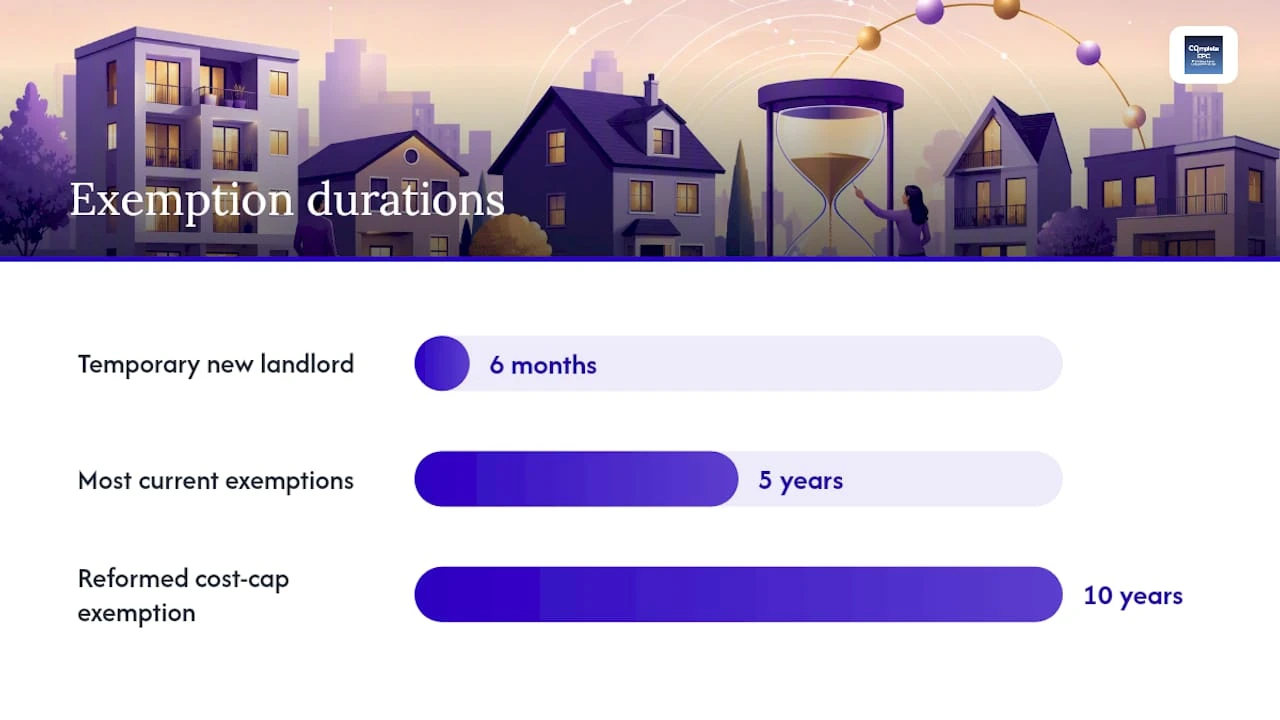
- Temporary new landlord exemption: Applies for six months when a landlord inherits a non-compliant tenancy (for example, through purchase or inheritance).
Cost cap rules:
Under the current regime, the cost cap is a few thousand pounds (inclusive of VAT) per property. The 2020 guidance explains how spending is calculated and what counts. Under the reformed regime confirmed for 2030, the cap rises to £10,000 per property, with a 10-year validity for the cost-cap exemption. Relevant measures installed from 1 October 2025 and reasonable EPC assessment fees can count towards this cap, with specific exclusions (such as the Boiler Upgrade Scheme) set out in the guidance.
How to register:
- Go to the PRS Exemptions Register (accessible via GOV.UK).
- Select the exemption type that applies.
- Upload the required evidence: EPC reports, contractor quotes, invoices, third-party refusal letters, surveyor reports, or a landlord declaration as appropriate.
- Confirm the tenancy details and property address.
Most exemptions under the current rules last five years. The cost-cap exemption under the reformed regime lasts 10 years. Exemptions are not transferable: a new owner must reassess and register their own exemption if needed.
Pro Tip: Do not register an exemption before you have gathered all the evidence. The register requires uploads at the point of registration, and an incomplete submission can be challenged by a local authority.
What penalties can local authorities impose for non-compliance?
Local authorities are the enforcement body for MEES. They can issue compliance notices requesting documents, investigate suspected breaches, and serve financial penalty notices. Confirmed breaches can also be published publicly, which can affect a landlord’s reputation with letting agents and mortgage lenders.
Penalty structure under the current regime:
Under the proposed PRS reforms, penalties are set to increase significantly, with the government consulting on maximums of up to £30,000 per property per breach. That figure is not yet in force, but it signals the direction of travel.
What authorities will check:
- A valid EPC at the relevant time (new tenancy or continuing let).
- Tenancy documentation confirming the tenancy type and start date.
- Evidence of works completed or a valid exemption registration.
- Accuracy of information on the Exemptions Register.
Keep copies of all EPCs, improvement invoices, exemption registrations, and written communications with tenants and contractors. A well-organised paper trail is your first line of defence.
A practical checklist: what to do in the next 3, 6 and 12 months
Next 3 months:
- Confirm whether each let property is covered by MEES.
- Retrieve the current EPC from the EPC register and note the expiry date and rating.
- If rated F or G, or if the EPC has expired, commission a new domestic EPC immediately.
- Implement any low-cost measures (draught-proofing, loft insulation top-up) that appear on the EPC’s recommended list.
- Gather contractor quotes for larger measures.
6–12 months:
- Schedule and complete priority fabric improvements (cavity wall insulation, loft insulation, floor insulation where accessible).
- Commission a post-retrofit EPC to confirm the new rating and document the improvement.
- Register any legitimate exemption on the PRS Exemptions Register with full supporting evidence.
- Begin budgeting for the £10,000 cost cap under the 2030 reforms.
Longer term (to 2030):
- Track the EPC reform timeline and the introduction of the Home Energy Model (HEM) metrics.
- Plan fabric performance improvements first, then choose the secondary metric (heating efficiency or smart readiness) that suits the property.
- Commission a pre-retrofit HEM-based EPC before large-scale works to map improvements to the new metrics.
- Retain all records: EPC certificates, invoices, exemption confirmations, and any grant or third-party funding receipts.
What the 2030 EPC C reforms mean for landlords
The government’s 2025 consultation and subsequent confirmed response set out three core decisions every landlord should understand.
1. Single compliance date: 1 October 2030. All covered private rented properties in England and Wales must meet the new standard by this date. There is no phased rollout by tenancy type.
2. Dual-metric standard. The new EPC C requirement is not simply a score on the legacy Energy Efficiency Rating. It requires meeting a primary fabric performance metric (measuring how well the building retains heat) plus a secondary metric: either heating system efficiency or smart readiness. The government chose this approach to drive genuine carbon and bill savings rather than paper compliance.
3. The Home Energy Model (HEM). New EPCs will be based on HEM rather than the legacy SAP methodology. This matters practically: a property that reaches C on the legacy EER before 1 October 2029 will be treated as compliant until that EPC expires. Landlords who have not achieved C under legacy EER by that date must commission a reformed HEM-based EPC to plan and evidence their works. Commissioning a pre-retrofit HEM EPC before large-scale works is the safest way to avoid spending money on measures that do not move the needle under the new metrics.
The £10,000 cost cap applies per property and covers relevant measures installed from 1 October 2025, plus reasonable EPC assessment fees. The Boiler Upgrade Scheme grant is among the specified exclusions that cannot be counted towards the cap.
The Warm Homes Plan sits alongside these reforms as the government’s broader programme to reduce energy bills and tackle fuel poverty, and it may bring additional grant funding for landlords undertaking fabric improvements.
Pro Tip: If you are planning significant works before 2030, commission a pre-retrofit HEM-based EPC first. It maps your property against the new metrics and tells you exactly which measures will count, preventing costly rework.
What landlords typically overlook about EPC compliance
The most common oversight assessors encounter is not a dramatic one. It is a landlord who has a valid EPC, knows the rating is borderline, and does nothing because the property is currently above E. Loft insulation and basic draught-proofing are cheap, often available with grant support, and can shift a D-rated property meaningfully closer to C. Leaving them undone means a larger, more expensive intervention later.
The second error is record-keeping. Landlords who have completed works but cannot produce the invoices, or who registered an exemption without uploading the contractor quotes, find themselves unable to defend a compliance notice. The exemption registration is only as strong as the evidence behind it.
The third, and least obvious, mistake is assuming the 2030 target is the same EPC C that appears on today’s certificates. It is not. The reformed HEM metrics will assess fabric performance differently from the legacy SAP-based EER. A property sitting at a high D today might reach C under legacy EER with modest works, but the same property assessed under HEM could tell a different story. Getting a pre-retrofit HEM EPC now, before committing to a heating system upgrade or window replacement, is the practical way to avoid that mismatch.
How Completeepc supports landlords with EPC compliance
Completeepc provides domestic EPC assessments for residential rental properties across London, carried out by qualified Domestic Energy Assessors with direct experience of MEES compliance requirements. Whether you need a pre-retrofit EPC to plan improvements, a post-retrofit certificate to evidence a rating change, or a fresh assessment because your current one has expired, Completeepc delivers accurate reports with clear improvement recommendations.
For landlords with mixed-use buildings or non-domestic properties, Completeepc also provides Commercial EPC assessments. Assessors can advise on which measures appear on the recommended list, how to document spending towards the cost cap, and what evidence to retain for the PRS Exemptions Register. Competitive pricing means assessment fees stay as low as possible, and those fees can count towards the £10,000 cap under the reformed regime. Get in touch with Completeepc to book an assessment or request a quote for your property.
Sources
These primary sources are the authoritative references for EPC compliance in England and Wales. Bookmark them rather than relying on secondary summaries.
- Domestic private rented property: minimum energy efficiency standard – landlord guidance
- The Energy Efficiency (Private Rented Property) (England and Wales) Regulations 2015
- EPC reforms MEES private rented property confirmed
- Energy efficiency standards – Rent Smart Wales
FAQ
What are the EPC rules for renting out a property?
Under MEES, most domestic private rented properties in England and Wales must have an EPC rated E or above before a tenancy is granted or continued. Letting a property rated F or G without a registered exemption on the PRS Exemptions Register is a legal breach.
What is the EPC minimum for rental properties by 2030?
The government has confirmed a single compliance date in late 2030, by which point covered private rented properties must meet the equivalent of EPC C under a new dual-metric standard assessed using the Home Energy Model (HEM).
Do I need to renew an EPC during a tenancy?
Not automatically. An EPC is generally valid for 10 years, and you do not need to renew it mid-tenancy unless you carry out significant energy-related works or the certificate expires. Under the forthcoming reforms, a new EPC will be required at the point of marketing a property for let.
How much does an EPC cost for a rental property?
A domestic EPC assessment typically costs between £60 and £120, depending on property size and location. Under the reformed regime, reasonable assessment fees can count towards the £10,000 cost cap, making early commissioning financially sensible.
Can I let a property while waiting for an exemption to be registered?
No. You must register the exemption on the PRS Exemptions Register before continuing to let a non-compliant property. Letting without a registered exemption in place is a breach of MEES regardless of whether you intend to register one.