

The single most effective thing most UK households can do right now is check their payment method and thermostat setting before touching anything else. Switching from standard credit to Direct Debit can save roughly £130 a year without changing a single behaviour, and dropping your thermostat by just 1°C typically saves around £80–£100 annually. These two moves alone often outperform months of switching off lights.
Here are the eight highest-impact tips to reduce electricity bill at home, ranked by typical annual saving for a UK household:
- Switch to Direct Debit payment — saves roughly £130/year with no change in consumption
- Drop thermostat by 1°C (to around 19–20°C) — saves approximately £80–£100/year
- Lower combi boiler flow temperature to 55–60°C — part of a targeted set of fixes saving around £100/year
- Fit LED bulbs throughout — saves around £40–£55/year versus old halogen fittings
- Wash at 30°C and run full loads — cuts washing machine electricity use noticeably
- Stop tumble drying where possible — one of the most power-hungry appliances in the home
- Draught-proof doors, windows and letterboxes — loft insulation alone can save up to £215/year for eligible homes
- Use your smart meter’s in-home display to identify which appliances are costing the most
Your next 24 hours: check your current payment method with your supplier, read your thermostat, and look up your EPC on the GOV.UK register.
Key takeaways
The highest-impact tips to reduce electricity bill at home combine a payment method check, a thermostat adjustment, and targeted fabric improvements, with a professional EPC providing the property-specific roadmap.
| Point | Details |
|---|---|
| Payment method first | Switching to Direct Debit can save roughly £130/year before changing any behaviour. |
| Thermostat and boiler flow | A 1°C thermostat drop saves ~£80–£100/year; lower combi flow to 55–60°C for additional gains. |
| Fabric improvements pay long-term | Loft insulation can save up to £215/year and is often grant-funded through ECO4. |
| Smart meter + tariff review | Real-time data saves £35–£50 initially; the bigger gain is enabling a time-of-use tariff. |
| Use your EPC as a roadmap | Completeepc’s domestic EPC assessment ranks improvements by cost and impact for your specific property. |
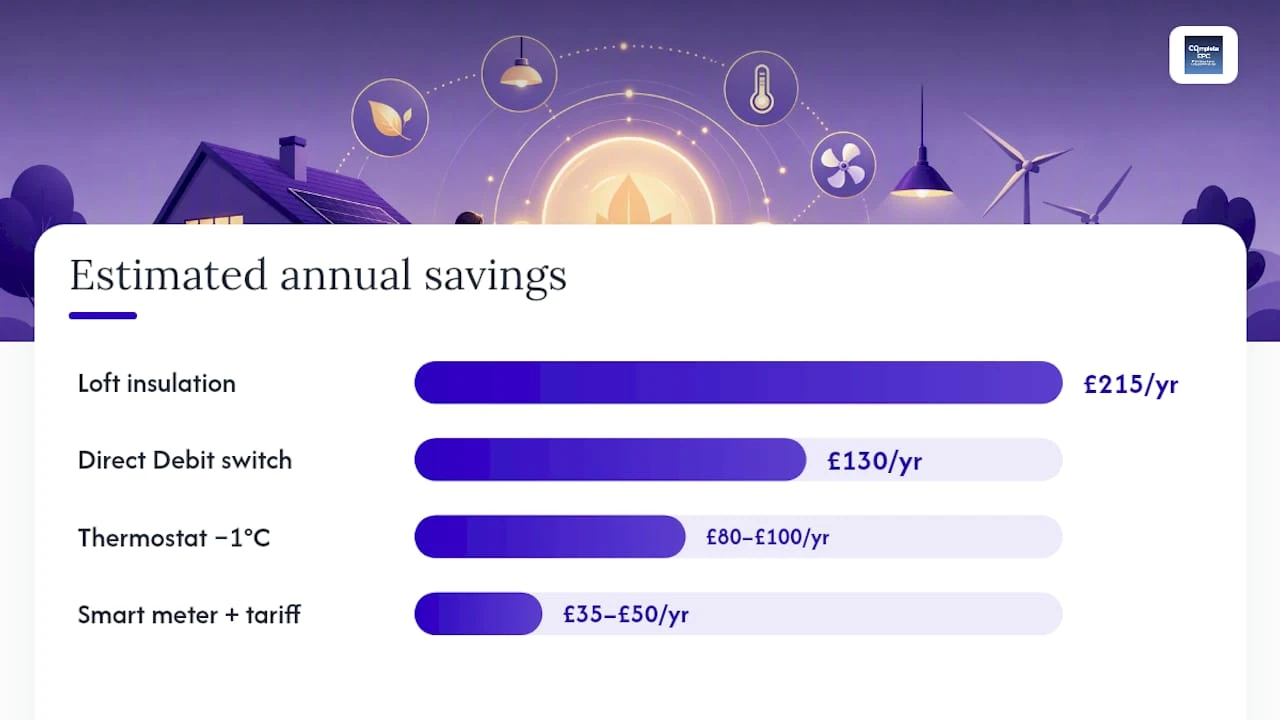
Table of Contents
- What are the best zero-cost and low-cost ways to cut your electricity bill today?
- Heating and hot water: where the biggest savings usually live
- Kitchen and cooking tips that cut electricity use without changing what you eat
- How to cut the cost of washing and drying clothes
- Which appliances and lighting choices save you the most electricity?
- How does stopping heat loss through insulation and draught-proofing save money?
- How can a smart meter and tariff review help you find hidden savings?
- How to use your Energy Performance Certificate as a savings roadmap
- Where to get help and grants if you’re struggling with energy bills
- A simple checklist for prioritising which energy-saving actions to do first
- What energy assessors actually see in UK homes
- A professional EPC gives you a property-specific savings plan
- Sources
- FAQ
What are the best zero-cost and low-cost ways to cut your electricity bill today?
The quickest wins cost nothing at all. Zero-cost behaviours such as turning off lights when you leave a room, setting your thermostat between 18–21°C, avoiding standby mode, and running full loads in the washing machine add up faster than most people expect. None of them require a purchase or a phone call.
A few low-cost buys pay back within months:
- LED bulbs: replacing remaining halogen or incandescent bulbs costs around £3–£5 per bulb and typically pays back within a year
- Draught excluders: a door draught excluder costs under £10 and reduces heat loss immediately
- Hot water cylinder jacket: if your home has a cylinder without insulation, a jacket costs around £20–£30 and can save noticeably on water-heating costs
- Only boil what you need: filling the kettle to the top for one cup wastes electricity every single time
- Use Eco settings on your dishwasher and washing machine — they use less water and lower temperatures
- Run full loads for both the washing machine and dishwasher rather than half loads
Pro Tip: Pick three of these actions in the first week and track your daily spend on your smart meter’s in-home display. Seeing the number drop is what keeps households motivated to tackle the bigger changes.
Heating and hot water: where the biggest savings usually live
Heating and hot water account for a large share of household energy use, which is why adjustments here tend to move the bill more than anything else. For most UK homes, this is the single most productive area to focus on.
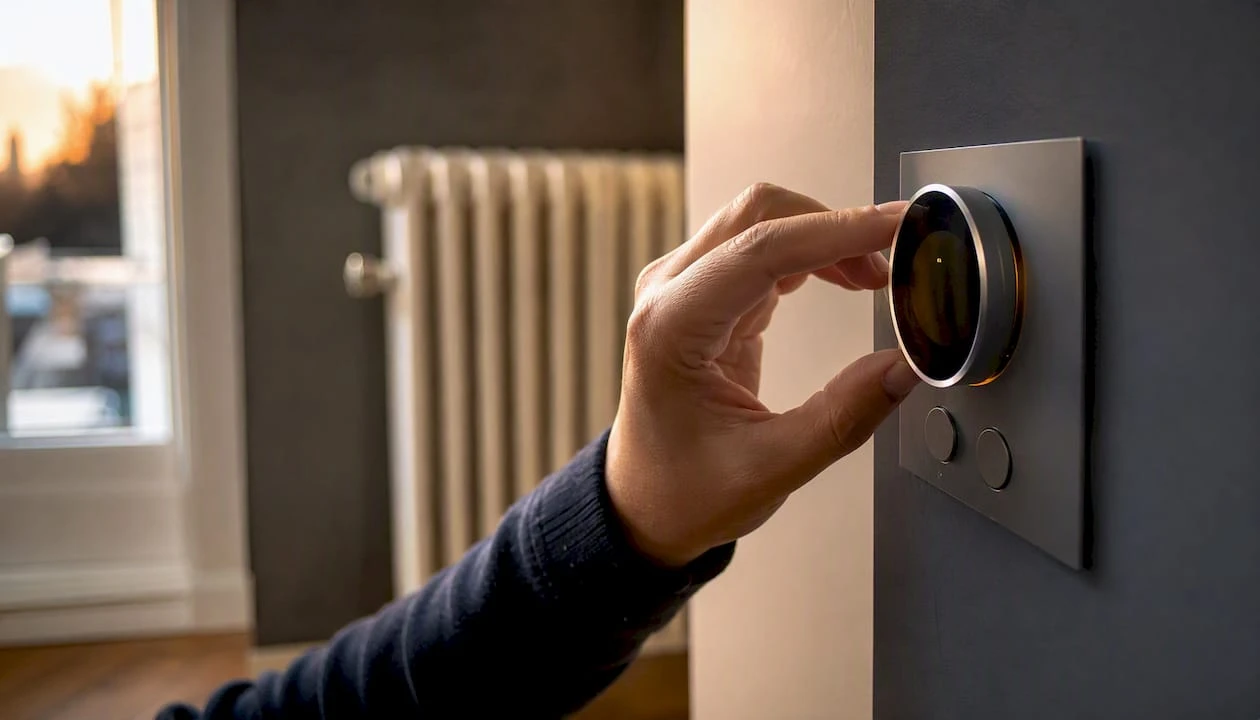
A 1°C reduction in your thermostat setting typically saves around £80–£100 per year. Set it to 19–20°C for living areas and consider dropping bedrooms to 16–18°C overnight. Programmable or smart thermostats make this automatic.
If you have a combi boiler, check the flow temperature. Many installers set it at 80°C by default, but lowering it to 55–60°C reduces gas or electricity use with no noticeable difference in comfort for most households. Look for the dial on the boiler’s front panel, usually labelled “CH” or with a radiator symbol.
Key adjustments to make:
- Combi boiler flow temperature: reduce to 55–60°C if currently higher
- Hot water cylinder thermostat: if you have a cylinder (not a combi), set it to 60°C to kill legionella bacteria while avoiding overheating
- Cylinder jacket: check whether your cylinder has an insulating jacket; a bare cylinder loses heat continuously
- Thermostatic radiator valves (TRVs): turn down or off in rooms you rarely use
- Heating timer: set it to come on 30 minutes before you need warmth rather than running all day
Safety note: If your household includes elderly residents, young children, or anyone with a medical condition, do not drop the thermostat below 18°C in living areas. The NHS recommends a minimum of 18°C for vulnerable people. For hot water cylinders, never set below 60°C due to legionella risk.
Kitchen and cooking tips that cut electricity use without changing what you eat
Cooking accounts for around 19% of electricity use in a typical GB home, making the kitchen a worthwhile place to focus. The changes here are mostly habitual rather than expensive.
Practical steps that make a real difference:
- Boil only what you need in the kettle — this is one of the most frequently wasted units of electricity in UK homes
- Use a lid on pans — water boils faster, cutting hob time
- Use a microwave or air fryer instead of a conventional oven for smaller meals; microwaves use roughly 70% less energy than an electric oven for the same task
- Defrost your freezer if ice has built up — thick ice forces the motor to work harder and raises running costs
- Keep your fridge at 3–5°C and freezer at -18°C — colder than necessary wastes electricity continuously
- Avoid preheating the oven for dishes that take longer than 30 minutes; the preheat phase is rarely necessary
Cold appliances (fridge and freezer) account for around 13% of a typical home’s electricity use and run 24 hours a day, so keeping them at the right temperature matters more than it might seem.
When it comes to replacing appliances, look for an A-rated model (under the new EU/UK energy label scale) and prioritise replacing appliances that run continuously, such as fridges and freezers, over those used occasionally.
How to cut the cost of washing and drying clothes
Wet appliances — washing machines, dishwashers, and tumble dryers — make up around 14% of a typical home’s electricity consumption. The tumble dryer is the most expensive of the three to run.
Steps that reduce laundry costs:
- Wash at 20–30°C rather than 40°C or higher; modern detergents clean effectively at lower temperatures and the saving per cycle is meaningful across a year
- Always run full loads — a half-full machine uses almost as much electricity as a full one
- Use the Eco programme when time allows; it uses less water and lower heat, even if the cycle is longer
- Air-dry wherever possible — a clothes airer or outdoor line costs nothing to run
- If you use a tumble dryer, a heat-pump model uses roughly half the electricity of a conventional condenser dryer; cleaning the filter before every load also improves efficiency
- Spin at a higher speed before tumble drying to remove more water mechanically, which reduces drying time
Switching from 40°C to 30°C washes and cutting tumble dryer use by half can produce a noticeable reduction in your annual electricity bill, particularly in households that wash frequently.
Which appliances and lighting choices save you the most electricity?
Lighting accounts for around 11% of a typical home’s electricity use, and LED bulbs are now so affordable that there is almost no reason to keep older fittings.
Standby power is real but often overstated. A TV on standby uses a small amount of electricity, but devices with large transformers or those that charge continuously — electric showers, immersion heaters, and older desktop computers — cost far more. The priority is not unplugging your TV remote receiver; it is identifying the genuinely high-draw devices.
Pro Tip: Plug a smart plug with energy monitoring (such as those compatible with the Tapo or TP-Link app) into one appliance at a time for a week. The kWh reading will tell you exactly what each device costs to run, which is far more useful than guessing.
Practical steps:
- Replace all remaining halogen and incandescent bulbs with LEDs
- Use smart plugs to monitor and schedule high-draw devices such as electric heaters or gaming consoles
- Set fridge and freezer temperatures correctly (3–5°C and -18°C respectively) rather than running them colder than needed
- When replacing any appliance, choose the highest energy rating you can afford; for appliances used daily, the running-cost saving over five years often exceeds the price premium
How does stopping heat loss through insulation and draught-proofing save money?
Reducing heat loss through the building fabric tends to give better long-term returns than replacing individual appliances, particularly for older UK homes. Loft insulation can save up to £215 per year for eligible homes, and draught-proofing is one of the cheapest improvements available.
Common fabric improvements to consider:
- Loft insulation: the most cost-effective fabric measure for most UK homes; government grants under the ECO scheme may cover the cost entirely for eligible households
- Cavity wall insulation: relevant for homes built between roughly 1920 and 1990 with unfilled cavities; requires a professional survey
- Draught-proofing: seal gaps around doors, windows, letterboxes, and floorboards using foam strips, brush seals, or silicone
- Double glazing or secondary glazing: higher upfront cost but meaningful heat retention, particularly for single-glazed older properties
- Thermal curtains: a lower-cost alternative to glazing upgrades for renters or those not ready for major works
Safety note: Never block purpose-built ventilation openings such as air bricks, trickle vents, or extractor fans. Adequate ventilation prevents condensation, damp, and carbon monoxide build-up. Draught-proofing targets uncontrolled gaps, not designed ventilation.
How can a smart meter and tariff review help you find hidden savings?
A smart meter’s primary value is accurate billing and access to time-of-use tariffs — the behavioural saving from watching the in-home display is a useful short-term gain, but the bigger opportunity lies in what the data enables. Real-time data typically produces an initial saving of £35–£50 through changed behaviour, with additional value where it supports a tariff or load-shifting change.
To use your smart meter effectively:
- Check your in-home display or supplier app at different times of day to identify which activities spike your consumption
- Look for overnight or off-peak patterns that could shift to a cheaper time-of-use tariff
- Compare your current tariff against available deals on Ofgem’s accredited comparison services
The payment method point is worth repeating: switching from standard credit to Direct Debit can save roughly £130 a year for many households, purely because standard credit customers pay a higher unit rate under Ofgem’s price cap bands. This is often the single highest-value administrative change available.
Pro Tip: If your supplier offers a time-of-use tariff (such as Octopus Agile or a similar off-peak product), run your dishwasher, washing machine, and EV charger overnight. The per-unit cost during off-peak hours can be significantly lower than the standard rate, and a self-consumption modelling tool can help you estimate how much you would save by shifting loads or adding storage.
How to use your Energy Performance Certificate as a savings roadmap
Your Energy Performance Certificate is not just a compliance document. It contains a ranked list of recommended improvements for your specific property, each with an estimated energy saving, a typical installation cost band, and a projected impact on your EPC rating. That makes it the most property-specific planning tool available to you.
How to read and act on your EPC:
- Find your current certificate on the GOV.UK EPC register (search by postcode); it is valid for ten years
- Read the recommendations table — improvements are listed with estimated savings and cost bands (low, medium, high)
- Pick your top three based on the combination of high saving and low cost; these are usually draught-proofing, heating controls, and loft insulation
- Check grant eligibility — the GOV.UK page links to ECO and Help to Heat schemes that may fund the top-ranked measures at no cost to you
- Book a new assessment if your certificate is more than five years old or if you have made significant changes since it was issued; an updated EPC reflects current conditions and gives you accurate figures for any grant application
For a domestic EPC or a commercial EPC, a qualified assessor visits the property, measures the building fabric, heating system, glazing, and lighting, and produces a report with specific, costed recommendations. That report is what lenders, local authorities, and grant schemes use to verify eligibility.
Where to get help and grants if you’re struggling with energy bills
Contact your energy supplier before you miss a payment. Ofgem requires suppliers to offer support to customers who are struggling, and acting early gives you more options. Suppliers typically offer payment plans, debt management, and access to hardship funds.
Key contacts and what they offer:
- Your energy supplier: payment plans, hardship funds, access to the Priority Services Register (free extra support for vulnerable customers including those with medical needs, disabilities, or young children)
- Citizens Advice: free, impartial advice on energy debt, switching, and grant eligibility; available by phone, online, or in person
- Ofgem: consumer guidance, complaint escalation, and signposting to accredited comparison services
- GOV.UK / Help to Heat: government-backed scheme funding insulation and heating upgrades for low-income and vulnerable households
- ECO4 scheme: supplier-funded energy efficiency improvements for eligible households; eligibility is based on income, benefits, and property EPC rating
- Local authority schemes: many councils run their own grant programmes for insulation and heating; check your council’s website or call their housing team
Before you call, have your account number, a recent bill, and details of any benefits you receive. Suppliers respond faster and more helpfully when you can confirm your circumstances clearly.
A simple checklist for prioritising which energy-saving actions to do first
Not every tip suits every home. The most useful approach is to sequence actions by cost and likely impact, starting with what costs nothing.
A practical sequence:
- Week 1 (free checks): Confirm payment method, set thermostat, read your EPC, check smart meter display
- Month 1 (low-cost buys): Fit LEDs, draught-proof, review tariff, fit cylinder jacket if needed
- Months 3–12 (installations): Book loft insulation, check ECO4 eligibility, consider cavity wall survey
- Year 1+ (major works): Double glazing, heat pump, or solar PV if fabric-first measures are complete
Safety caveats: Any work involving your electrical consumer unit, boiler internals, or gas pipework must be carried out by a qualified professional. Electrical work in the home requires a Part P-registered electrician; gas work requires a Gas Safe registered engineer. A room-by-room energy audit checklist can help you identify gaps before calling a professional.
What energy assessors actually see in UK homes
The pattern that comes up repeatedly in property assessments is a mismatch between where homeowners think their money is going and where it actually goes. Most people focus on lights and standby. The real culprits are almost always heating controls set too high, a bare hot water cylinder, and gaps around doors and loft hatches that have never been sealed.
One detail that is consistently overlooked: the hot water cylinder jacket. Many older properties have a jacket, but it is either too thin (under 75mm) or has slipped and left sections of the cylinder exposed. A properly fitted 80mm jacket makes a measurable difference to water-heating costs and costs almost nothing to fix.
The EPC recommendations table is the most underused tool available to homeowners. It ranks improvements by cost and impact for your specific property, not a generic average. Reading it takes ten minutes and can save you from spending money on the wrong upgrade first.
A professional EPC gives you a property-specific savings plan
Generic tips get you started, but a professional domestic EPC assessment tells you exactly which improvements will move the needle for your property, in order of cost-effectiveness. Completeepc’s qualified assessors visit your home, measure the building fabric, heating system, glazing, and lighting, and produce a report with specific, costed recommendations tied to your current EPC rating.
That report does more than satisfy compliance requirements. It supports applications for ECO4 funding, Help to Heat grants, and mortgage green add-ons, all of which require a current, accurate EPC. Assessments are typically completed within a few days of booking, and the resulting certificate is valid for ten years.
To get a tailored improvement plan for your home, book a domestic EPC with Completeepc and receive a ranked list of the measures most likely to reduce your bills.
Sources
These are the most reliable UK resources for checking your EPC, comparing tariffs, and finding grant support:
- Gov
- Energy advice for households | Ofgem
- How to Save Electricity in the UK 2026: Ranked by Real £ Impact – Selectra
- Top energy savings tips – NEA
- Save energy in your home – Clean Energy Campaign
FAQ
What is the simplest trick to cut your electric bill?
Switch your payment method to Direct Debit if you are currently paying by standard credit — this alone can save roughly £130 a year under Ofgem’s price cap bands, with no change to your energy use.
What runs up an electricity bill the most?
Electric showers and immersion heaters can also be significant, particularly in households without gas.
What is the 4pm rule on heating?
The 4pm rule is a consumer shorthand for turning your heating on earlier in the afternoon (around 4pm) at a lower thermostat setting rather than blasting it at a high temperature later in the evening. The principle is that a lower temperature sustained over a longer period uses less energy than a high-temperature spike, though the actual saving depends on your home’s insulation and heating system.
How does an EPC help you reduce your energy bills?
An Energy Performance Certificate lists recommended improvements for your specific property, ranked by estimated saving and cost band, giving you a clear, property-specific order of work rather than generic advice.
Where can you get help if you cannot afford your energy bills?
Contact your energy supplier directly — Ofgem requires suppliers to offer support including payment plans, hardship funds, and the Priority Services Register. Citizens Advice can also provide free guidance on debt management and grant eligibility.