

An EPC rating is a property’s A to G energy efficiency grade, and it directly determines whether that property can be legally marketed for sale or rent. Without a valid certificate, an estate agent cannot advertise the property at all, and landlords letting under the Minimum Energy Efficiency Standard (MEES) need at least an E rating unless they hold a registered exemption.
You can check any UK property’s certificate free of charge on the GOV.UK register, and accredited energy assessors, including teams like Completeepc, can issue a new one within days if none exists or the old one has expired.
Three immediate checks:
- Search the GOV.UK find an energy certificate service for the address
- Confirm the certificate date. It’s valid for 10 years from issue
- If there’s no valid EPC, commission an accredited assessor before marketing begins
Key Takeaways
A valid, accurate EPC is a legal prerequisite for marketing UK property, and rating improvements before listing consistently strengthen buyer and tenant interest.
| Point | Details |
|---|---|
| Check before you list | Search the Gov by postcode or certificate number before marketing a property. |
| Mind the MEES floor | Private rented homes need at least an E rating unless a registered exemption applies. |
| Validity runs 10 years | The most recent certificate on the register is the only legally valid one. |
| Prioritise cheap fixes first | Draught proofing, LED lighting and heating controls often move a rating before costlier work is needed. |
| Re-assess after upgrades | A fresh certificate reflecting completed works tends to market better than an outdated score. |
| Use an accredited assessor | Completeepc provides accredited domestic and commercial EPC assessments across London. |
Where to verify the rules and find an assessor
Cross-check anything in this guide against the primary sources directly: the GOV.UK register search, the MEES landlord guidance, and the 2026 reforms response. Energy Saving Trust offers a clear independent explainer that complements the official guidance well.
- GOV.UK: search or find an existing certificate
- GOV.UK: MEES guidance for landlords
- GOV.UK: partial government response on EPC reforms
- Energy Saving Trust: plain-English EPC explainer
This article is general information, not a substitute for advice from a qualified lawyer. Consult a qualified legal professional about your own circumstances before acting on anything here.
Table of Contents
- What does an EPC actually measure?
- How do you check a property’s EPC rating?
- When is an EPC legally required?
- How can you improve an EPC rating?
- What does an EPC cost, and who can issue one?
- What counts as a good EPC rating for buyers and tenants?
- What regulatory changes are coming to EPCs?
- Sources
- FAQ
What does an EPC actually measure?
An EPC assesses the building itself, not how the current occupants use it. Assessors record the fabric, heating system, ventilation, lighting and hot water setup, then calculate what’s called an asset rating, an estimate of energy performance based on the building’s fixed features rather than day-to-day habits.
That distinction matters more than most sellers realise. A meticulous household with poor loft insulation can still score badly, while an empty flat with modern double glazing and a decent boiler will often score well regardless of who lives there.
The A to G scale reflects this asset rating: A is the most efficient, G the least. Moving up even one band typically signals lower running costs and lower CO2 emissions, though the exact saving depends on the specific measures involved. This is a different concept entirely from the coloured appliance labels on fridges or washing machines, which measure a single unit’s consumption rather than a whole building. Energy Saving Trust makes the same point: EPCs guide long-term investment decisions, not quick product comparisons.
A standard certificate includes:
- The current and potential energy efficiency rating
- A recommendation report listing cost-effective improvements
- Estimated annual running costs for heating, hot water and lighting
- An environmental impact (CO2) rating, separate from the energy efficiency score
Non-domestic buildings work slightly differently. Commercial EPCs use a carbon-based Energy Index rather than the domestic Energy Efficiency Rating, and only an accredited non-domestic assessor can issue one.
How do you check a property’s EPC rating?
Finding a certificate takes minutes once you know where to look.
- Go to the GOV.UK find an energy certificate service
- Search by postcode and house number, full address, or the certificate reference number if you already have it
- Open the most recent result. Multiple certificates can exist for one property over the years, but only the latest is legally valid
- Check the issue date against the 10-year validity window
If a property has no certificate on record, or the one showing has expired, the assessment needs commissioning before any marketing starts. A typical domestic EPC assessment takes under an hour on site, with the certificate usually ready within a few working days. Until it’s lodged on the register, agents should hold off publishing listings, since marketing without a valid EPC is itself a compliance breach.
Bear in mind the register doesn’t capture every building in the country. Properties that haven’t changed hands or been let since the rules took effect may simply have no entry yet, which isn’t an error so much as a gap in coverage.
When is an EPC legally required?
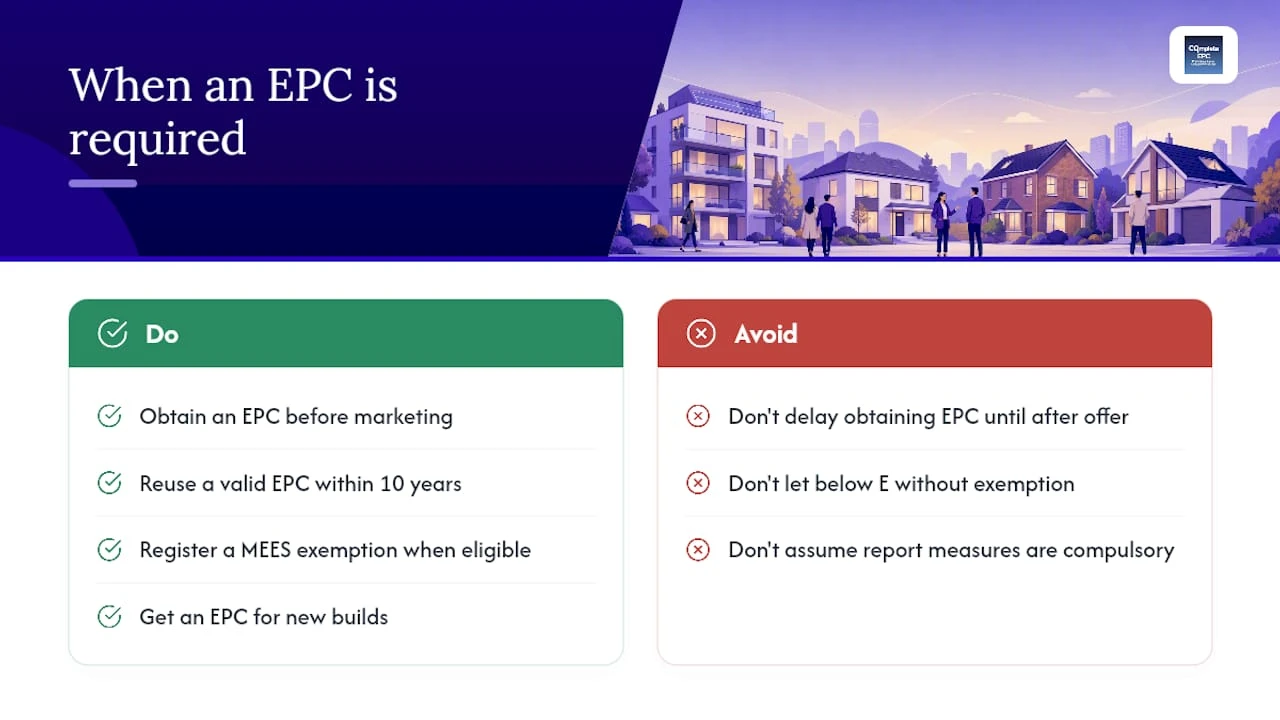
Three triggers create a legal duty to have a valid EPC: selling a property, granting a new tenancy, and constructing a new building. In each case, the certificate must exist before the property goes to market, not after an offer is accepted.
Once issued, an EPC remains valid for 10 years and can be reused across multiple sales or lettings within that window. If a property has changed hands twice in eight years, the same certificate can cover both transactions, provided it’s still within date.
Landlords face a stricter overlay through MEES. Private rented homes in England and Wales need a minimum E rating to be let legally, with limited exceptions registered through an official exemption process, covering cases like listed buildings where improvements would alter character, or situations where a third-party consent has been refused. Letting below an E without a registered exemption risks penalties from the local authority, and buildings that haven’t been sold, let or built since the regulations began may not need a certificate at all until one of those triggers occurs.
Pro Tip: There’s no legal duty to carry out every measure in the recommendation report. It’s advisory, not compulsory, though landlords still must hit the MEES minimum regardless of what the report suggests.
How can you improve an EPC rating?
Most properties can move up at least one band without major structural work, and the recommendation report ranks measures roughly by cost and impact.
- Start cheap. Draught proofing, thermostatic radiator valves, LED lighting and topping up loft insulation where it’s thin often deliver the quickest gains for the smallest outlay.
- Move to medium-cost work. Boiler servicing or replacement, cavity wall insulation, upgraded heating controls and cylinder insulation typically shift a rating by more than cosmetic fixes alone.
- Consider higher-cost measures where they make sense. External or internal wall insulation, double or triple glazing, and low-carbon heating such as heat pumps suit properties with solid walls or ageing single glazing, but the outlay needs weighing against how long you’ll own or let the property.
The recommendation report also estimates the potential rating achievable once cost-effective measures are complete, giving a realistic ceiling rather than a vague aspiration.
Pro Tip: If you’ve just insulated a loft or swapped the boiler, keep the invoices and commission a fresh EPC before listing. A certificate that reflects the upgrade, rather than the pre-works score, tends to perform better in marketing.
What does an EPC cost, and who can issue one?
Only an accredited energy assessor registered with an approved accreditation scheme can legally produce and lodge an EPC. For non-domestic buildings, that means a specifically accredited non-domestic assessor, since the assessment method and carbon-based index differ from residential surveys.
Domestic EPCs for a typical flat or house generally sit at the lower end of a modest price range, with commercial assessments costing more depending on the building’s size, complexity and number of separate zones.
On site, the assessor measures room dimensions, checks insulation, inspects the heating system and hot water setup, and photographs relevant fixtures. Having a boiler service record, glazing details and any recent insulation invoices ready speeds the visit up considerably.
- Assessors must lodge the finished certificate on the official register before it becomes valid
- A certificate produced outside an approved scheme carries no legal standing
- Larger or mixed-use commercial buildings usually take longer on site than a standard house
What counts as a good EPC rating for buyers and tenants?
Bands C and above are increasingly what cost-conscious buyers and tenants actively seek out, largely because a higher rating usually means lower energy bills and a smaller carbon footprint over time.
The average UK property currently sits around band D, which makes anything above that a genuine point of difference rather than a bare minimum. A D rating isn’t a failure; it’s simply typical, which is exactly why C or better stands out on a listing.
- Lenders increasingly factor energy performance into mortgage products and green finance criteria
- Commercial tenants and investors often screen leases against sustainability targets, particularly for larger portfolios
- A weak rating can slow a sale or let even where MEES compliance isn’t legally in question
What regulatory changes are coming to EPCs?
The government ran a consultation on reforming the Energy Performance of Buildings regime, and a partial response published in January 2026 sets out the likely direction of travel.
- New headline metrics are proposed. Rather than one single cost-based score, domestic EPCs may eventually show four figures: fabric performance, heating system, smart readiness and energy cost.
- The legacy rating survives the transition. The current Energy Efficiency Rating stays in place alongside any new metrics for now, so existing certificates won’t become meaningless overnight.
- Validity looks stable, for now. Some respondents pushed for shorter validity on poorly rated homes, but the response retains the 10-year rule while flagging scope for targeted future changes.
Owners and landlords planning improvements over the next couple of years should keep documentation of any works. Whatever the final metrics look like, dated evidence of insulation, glazing or heating upgrades will make re-assessment faster and cheaper.
Why accurate assessments matter more than the certificate itself
An EPC is only as useful as its accuracy. A rushed or poorly documented assessment can undervalue a property’s genuine efficiency, or worse, miss a compliance gap that surfaces later in a sale.
Completeepc’s assessors work across London properties day in, day out, and that repetition matters. Recognising a poorly performing heating system or an unrecorded insulation upgrade takes familiarity with hundreds of similar buildings, not just a checklist.
Get the certificate commissioned early in the sale or letting process. Chasing an assessor after you’ve already got a buyer or tenant lined up is the single most common cause of avoidable delay.
Book an accredited EPC assessment with Completeepc
Completeepc issues domestic EPCs and commercial EPCs across London, backed by accredited assessors who understand the building stock they’re rating, not just the paperwork. Landlords juggling MEES compliance across a portfolio can also get support checking existing certificates and registering exemptions where they genuinely apply.
Getting a quote takes a couple of minutes: have the property address, approximate size, and the reason you need the certificate (sale, letting or new build) ready. From there, request a fast local EPC quote and get an accredited assessor booked before your listing goes live, so nothing holds up marketing once a buyer or tenant shows interest.
Sources
- Domestic private rented property: minimum energy efficiency standard (MEES) – landlord guidance
- Find an energy certificate
- Guide to energy performance certificates (EPCs) – Energy Saving Trust
FAQ
What is a good EPC rating for a house?
Band C or above is generally seen as good, since it signals lower running costs and emissions than the UK average, which currently sits around band D.
Can I check the EPC rating of a property?
Yes. Search the GOV.UK find an energy certificate service by postcode, full address or certificate number to see the current valid rating.
How can I improve my EPC rating from D to C?
Start with low-cost measures like draught proofing, LED lighting and heating controls, then consider cavity wall insulation or a boiler upgrade if the recommendation report flags them as cost-effective.
Is EPC rating D good or bad?
A D rating is neither a failure nor exceptional. It matches the current UK average, which means it meets MEES requirements comfortably but leaves room to stand out against C-rated competitors on the market.