

You must already hold a valid Energy Performance Certificate rated at least band E to let a residential property. The government’s Warm Homes Plan will push that minimum to band C, with final compliance due by 1 October 2030 and early action before 1 October 2029 counted as meeting the standard ahead of schedule. If you don’t know your current rating, that’s the first job.
- Check you hold a valid EPC and confirm its rating today.
- If it’s F or G, book an assessment immediately or look into a registered exemption.
- Start planning now for the Warm Homes Plan target of band C.
A significant number of rented homes in England and Wales currently sit below band C, according to government estimates behind the Warm Homes Plan, which gives you a sense of scale before deadlines start to bite. The most useful step you can take this week is booking an accredited assessor through Complete EPC’s domestic EPC service to get a current rating and a clear list of what needs fixing.
Key Takeaways
Meeting the coming EPC C standard is cheaper and easier when landlords start with a fresh assessment and sequence low-cost measures before major fabric or heating work.
| Point | Details |
|---|---|
| Know your current rating | Check your EPC now; letting below band E without a registered exemption risks penalties up to £5,000. |
| Plan for band C early | Reach EPC C before 1 October 2029 for early compliance, with final deadline 1 October 2030. |
| Use the right cap | Budget against the £10,000 Warm Homes Plan cap, which also covers reasonable EPC assessment costs. |
| Sequence work sensibly | Do fabric and quick wins first, using the EPC recommendations report as a rough payback guide. |
| Book an accredited assessor | Complete EPC provides domestic and commercial EPCs with qualified assessors and lowest-rate pricing. |
Table of Contents
- What MEES and the Warm Homes Plan mean for landlords now
- Which practical measures actually raise an EPC rating?
- How much will compliance cost, and where can funding help?
- How do you book an EPC and what does the assessor deliver?
- Does energy efficiency actually affect returns and valuation?
- Why do efficient properties attract tenants and buyers faster?
- What happens if you ignore compliance beyond the MEES fine?
- Are there certifications beyond EPC worth knowing about?
- What do successful energy efficiency upgrades look like in practice?
- Complete EPC services: domestic and commercial assessments and how we help
- Sources
- FAQ
What MEES and the Warm Homes Plan mean for landlords now
The Minimum Energy Efficiency Standard already sets the floor. Under current MEES rules, you cannot grant a new tenancy, or continue an existing one past its review point, if the property sits at F or G without a registered exemption. Local authorities enforce this, and penalties run up to £5,000 per breach, applied per property rather than per portfolio.
The Warm Homes Plan changes the target rather than the enforcement mechanism. Here’s the sequence to plan around:
- The government has set an expectation that private rented homes reach band C.
- Landlords who hit band C before 1 October 2029 count as early compliers.
- Final compliance for all remaining properties falls due by 1 October 2030.
That gives you a genuine planning window rather than a cliff edge, provided you start now instead of in 2029.
Exemptions still exist, and they matter more once the bar rises to C. The main categories are:
- High cost exemption: the required works exceed the spending cap even after quotes.
- All improvements made: every relevant measure has already been installed.
- Third-party consent: a tenant, freeholder or planning authority refuses consent for necessary works.
- Devaluation: a qualified surveyor confirms the works would reduce the property’s market value by more than 5%.
The legacy spending cap sits at £3,500, but the Warm Homes Plan raises this to £10,000 for the new C standard, which changes the maths on what counts as “high cost” considerably.
Which practical measures actually raise an EPC rating?
Not every improvement moves the needle equally, and spending on the wrong measure first wastes money you’ll need later. Fabric improvements tend to deliver the biggest jump in rating because they address heat loss at source rather than compensating for it.
Fabric priorities:
- Loft insulation, typically the cheapest measure per point of improvement on older stock.
- Cavity or solid wall insulation, which carries a bigger price tag but a larger rating impact.
- Double or secondary glazing where windows are single-glazed.
- Draught-proofing around doors, floors and loft hatches, often overlooked despite low cost.
Heating systems come next. A modern condensing boiler still outperforms an ageing system on most EPC calculations, and it’s usually the sensible first heating upgrade. Heat pumps score well on the certificate itself, but they suit well-insulated properties better than draughty Victorian terraces, so sequence fabric work first where budgets are tight. Smart thermostatic controls and zoning add a smaller but real uplift, and solar panels can help where roof orientation and shading cooperate, though the payback horizon depends heavily on local incentive schemes and electricity prices.
Quick wins round out the list: LED bulbs throughout, thermostatic radiator valves (TRVs) on every radiator, hot water cylinder jacket or tank insulation, and a smart meter if one isn’t already fitted. None of these alone will shift a rating from E to C, but together they’re cheap enough to do immediately while you plan bigger works.
Pro Tip: Use your EPC’s recommendations report as a rough seven-year payback filter. If a measure’s likely cost, divided by its estimated annual saving, comes in under seven years, prioritise it. Anything longer can usually wait for the next refurbishment cycle.
How much will compliance cost, and where can funding help?
Cost caps exist specifically so you’re never forced into disproportionate spending. Under current MEES rules, the cap sits at £3,500 including VAT; once the Warm Homes Plan’s band C requirement takes effect, that rises to £10,000. If quotes for all necessary works exceed the relevant cap, you can register a high-cost exemption rather than paying beyond it.
Useful detail here: reasonable EPC assessment fees themselves count towards the £10,000 cap, so commissioning a certificate before works start isn’t a cost on top of your budget, it’s part of it. The same guidance recommends a fresh EPC after retrofit work to prove the improvement.
Funding routes worth checking before you self-fund everything:
- Local authority or national grant schemes, which change year to year and by region.
- Low or zero-interest green improvement loans offered by some lenders and councils.
- VAT relief windows on certain energy-saving materials, which apply only to specific installations, so confirm eligibility before you order materials.
Keep every invoice, EPC certificate and correspondence relating to consent refusals or quotes. Exemptions typically last five to ten years depending on type, and you’ll need that evidence trail if a local authority ever asks you to justify one.
How do you book an EPC and what does the assessor deliver?
Getting a certificate is more straightforward than most landlords expect, and it’s a legal requirement before you market a property for sale or rent in the first place.
- Find an accredited domestic energy assessor. Accreditation is what makes the certificate legally valid, so always confirm it before booking.
- The assessor visits and inspects the property, measuring room dimensions, checking insulation, glazing, heating systems and controls, and noting construction type.
- You receive a digital EPC and a recommendations report, valid for ten years, listing prioritised improvements with estimated impact.
Treat that recommendations list as your procurement brief. It’s also the evidence you’ll need if you end up registering an exemption rather than completing every listed measure.
Does energy efficiency actually affect returns and valuation?
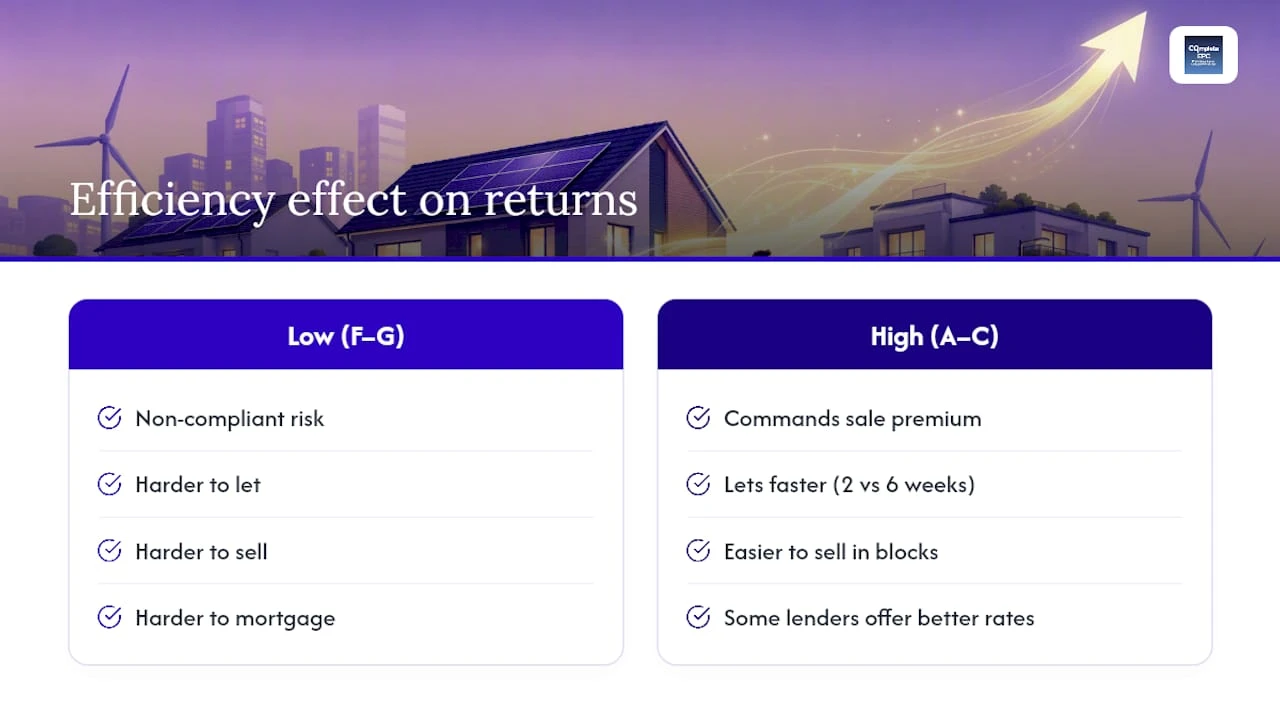
Yes, and the effect runs in both directions. A property stuck at F or G isn’t just non-compliant, it’s also harder to let, harder to sell, and harder to mortgage, since some lenders now factor EPC rating into buy-to-let affordability assessments. That compresses your pool of buyers and tenants before you’ve even discussed rent.
On the upside, efficient properties tend to command a premium at sale and let more quickly, because running costs form part of every serious buyer’s or tenant’s calculation now that energy bills are a bigger share of household spending than they were a decade ago. Void periods matter more to your annual yield than most landlords credit, and a property that lets in two weeks instead of six recovers an insulation bill faster than the insulation itself would in energy savings.
Valuation surveyors increasingly reference EPC rating explicitly, particularly on portfolios being sold as a block, where a mix of A to C ratings values noticeably differently to a mix weighted towards E and F. Mortgage lenders have begun differentiating too, with some offering marginally better rates on high-efficiency properties as green lending products expand. None of this replaces location or condition as the dominant driver of value, but on otherwise comparable stock, efficiency is no longer a rounding error in the sale price.
Why do efficient properties attract tenants and buyers faster?
Energy costs have become a genuine deciding factor in rental decisions, not an afterthought raised after viewing. Tenants comparing two otherwise similar flats will often ask about the EPC rating directly, because a G-rated Victorian conversion can cost hundreds of pounds more a year to heat than a well-insulated modern equivalent, and that difference lands on their budget, not yours.
For buyers, the calculation is similar but longer-term. Anyone purchasing to live in a property is pricing in future heating bills and the likely cost of eventual upgrades, which means a poorly rated home effectively carries a discount baked into offers, whether or not the seller frames it that way.
Estate agents report that efficient, well-presented properties generate stronger initial interest and fewer price negotiations tied to “the boiler’s ancient” or “it’s freezing in winter” objections. A strong EPC also gives you cleaner marketing material. Listing a verified C rating alongside photos removes a question that would otherwise surface at viewing.
There’s a reputational angle too, particularly for estate agents managing multiple instructions. A portfolio of well-rated properties is simply easier to market consistently, and it reduces the awkward conversation about why a specific unit can’t legally be re-let until works are done. Tenants staying longer in efficient, comfortable homes also reduces turnover costs, which is a return on efficiency that rarely appears in the headline yield calculation but shows up clearly in your annual accounts.
What happens if you ignore compliance beyond the MEES fine?
The £5,000 penalty is the headline figure, but it’s rarely the most expensive consequence of ignoring compliance. Letting an F or G property without a registered exemption can also expose you to enforcement notices, publication of the breach on a public register, and challenges to the validity of the tenancy itself in some circumstances.
Insurance is an underappreciated risk. Some landlord insurance policies now ask about EPC compliance at renewal, and a lapsed or non-existent certificate can complicate a claim if a dispute arises. Mortgage lenders can raise similar questions during remortgaging or refinancing, since buy-to-let lending increasingly treats compliance status as part of due diligence.
There’s also a slower-burning commercial risk: agents and portfolio managers who repeatedly market non-compliant stock risk their own professional reputation, not just the individual landlord’s exposure. A local authority that finds one breach on your books often looks more closely at the rest of your portfolio, turning a single oversight into a wider compliance review.
None of this requires drama to avoid. It requires an up-to-date certificate, an honest read of the recommendations report, and a plan for anything rated below the required band, whether that plan is works or a properly evidenced exemption.
Are there certifications beyond EPC worth knowing about?
EPC is the legal minimum you must hold, but it isn’t the only efficiency standard operating in UK property. For commercial buildings, BREEAM assessments go considerably further than an EPC, scoring management, water use, materials and ecology alongside energy performance, and they’re often required by institutional investors or larger corporate tenants rather than by law.
Passivhaus is a design and construction standard rather than a retrofit certification, aimed at new builds or deep retrofits that achieve very low heating demand through airtightness and ventilation design. It’s demanding and expensive to achieve on existing stock, but it sets a useful benchmark for what “genuinely efficient” looks like beyond a certificate band.
For landlords with larger commercial holdings, a Commercial EPC remains the statutory requirement, but many portfolios now pursue voluntary sustainability reporting alongside it, particularly where tenants or lenders ask for evidence beyond the legal minimum. None of these alternative standards replace your EPC obligation. They sit above it for landlords who want to differentiate a portfolio commercially rather than simply meet the legal floor.
What do successful energy efficiency upgrades look like in practice?
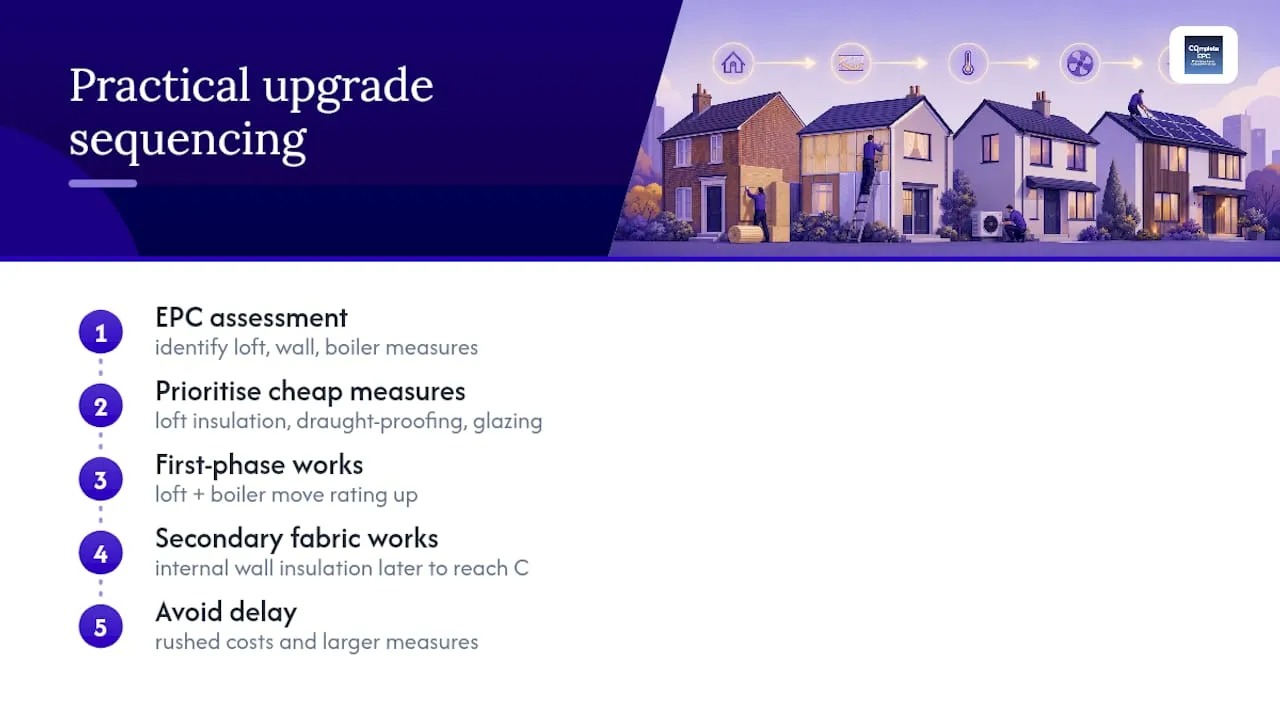
Consider a typical case pattern seen across older rental stock: a solid-walled Victorian terrace let as a two-bedroom flat, originally rated F. An EPC assessment identified loft insulation, internal wall insulation and a boiler replacement as the three highest-impact measures. Loft insulation alone, at relatively low cost, moved the rating a full band. Combined with the boiler upgrade, the property reached band D within a single round of works, and internal wall insulation completed later pushed it to C.
A different pattern shows up in ex-local-authority flats with solid floors and no cavity walls, where glazing upgrades and draught-proofing delivered a smaller but still meaningful jump, enough to clear the current E minimum comfortably while the landlord planned larger fabric work for the following financial year rather than rushing it.
The common thread across both cases is sequencing: cheap, high-impact measures first, funded partly by the money saved from not needing an emergency compliance fix later, followed by the larger fabric or heating project once cash flow allowed it. Landlords who left everything until a tenancy renewal forced their hand consistently paid more, both for rushed contractor availability and for the more expensive measures required to jump multiple bands at once rather than one at a time.
Author view: pragmatic sequencing to meet future standards
The mistake I see repeatedly is landlords treating the C target as a 2030 problem rather than a 2026 one. Start with a fresh EPC now. Do the cheap, high-impact work this year. Keep every invoice and certificate, because that paper trail is what an exemption registration or a mortgage lender will ask for later. Book your assessor early. Everyone else will be booking theirs in 2029, and premium pricing follows demand spikes exactly the way you’d expect.
Complete EPC services: domestic and commercial assessments and how we help
Getting from “I don’t know my rating” to “I have a compliance plan” doesn’t need to take weeks. Complete EPC delivers both domestic EPCs and Commercial EPC assessments across London, with an onsite visit followed by a digital certificate and a prioritised recommendations report you can hand straight to a contractor or use as exemption evidence.
Every assessment is carried out by a qualified, accredited assessor, and pricing is backed by a guarantee of the lowest rates in the UK market, so cost is never a reason to delay booking. Whether you’re checking a single rental ahead of a tenancy renewal or assessing a commercial unit before a lease review, the process is built to be quick rather than bureaucratic.
If your current certificate has lapsed, or you’ve never confirmed where a property sits against the coming band C requirement, book your assessment through Complete EPC’s domestic or commercial pages and get a clear works plan before deadlines start driving up demand.
Sources
- Gov
FAQ
What is the minimum EPC rating to legally let a property?
Band E, unless you hold a valid registered exemption. Letting a property rated F or G without one risks a penalty of up to £5,000.
When must rental properties reach EPC band C?
The Warm Homes Plan sets a final compliance deadline of 1 October 2030, with properties reaching band C before 1 October 2029 counted as early compliers.
How much can I be required to spend on improvements?
The current legacy cap is £3,500 including VAT; this rises to £10,000 under the Warm Homes Plan, and reasonable EPC assessment fees count towards that figure.
How long does an EPC last?
Ten years from the date of assessment, after which you’ll need a new certificate before marketing the property again.
How quickly can I get an EPC assessed?
Complete EPC arranges accredited assessments for domestic and commercial properties across London, typically delivering the digital certificate and recommendations report shortly after the site visit.
Can I claim an exemption instead of doing the works?
Yes, where high cost, third-party consent refusal, devaluation, or completion of all relevant improvements applies, though exemptions typically last five to ten years and require documented evidence.