

Start by measuring what you actually use, then fix the cheap things first. Turn off standby loads, drop your thermostat by 1°C, and swap in LED bulbs this week. After that, commission an Energy Performance Certificate or professional audit to sequence loft insulation, glazing, heating controls, and any renewables against genuine payback figures, not guesswork.
TL;DR:
- Measuring energy use with smart meters and tracking consumption against KPIs is essential before investing in fabric or system upgrades.
- Insulating the loft, sealing drafts, and upgrading to LED lighting offer the highest immediate returns and should be prioritized in retrofit plans.
- Controlling heating with programmable schedules, zoning, and lowered flow temperatures reduces energy waste more effectively than system replacements alone.
- Installing renewables such as solar panels or wind turbines should follow fabric and efficiency improvements to maximize overall savings.
- A property-specific EPC provides tailored, costed recommendations that help sequence upgrades for optimal payback and sustainability.
Table of Contents
- Quick wins and behavioural changes that cut energy now
- Which building fabric improvements save the most on heating?
- How should you control heating, hot water, and choose a heat pump?
- Where should lighting and appliance upgrades start?
- Why measurement comes before any efficiency plan
- Planning your retrofit sequence and finding funding
- Operational best practices for facilities managers
- How an EPC turns recommendations into a property-specific roadmap
- Seasonal strategies to optimise energy use throughout the year
- Bringing renewables into the picture: solar, wind, and battery storage
- Smart automation technologies worth considering
- Long-term maintenance plans that protect your gains
- Key resources and official guidance to consult next
- A practitioner’s view on where energy plans actually go wrong
- Get a property-specific roadmap instead of guesswork
- Sources
- FAQ
Quick wins and behavioural changes that cut energy now
You don’t need a contractor to start saving. Most households and small offices are losing money to habits, not hardware, and the fixes cost nothing beyond attention.
Standby power is the obvious starting point. Televisions, monitors, printers, and chargers left plugged in overnight can add up to a meaningful chunk of a bill that nobody notices because it never shows up as one big number. Businesses should formalise this with a switch-off policy: someone owns the last-out checklist, and it actually gets checked.
The thermostat question comes up constantly, and the answer is simpler than people expect. The so-called “30-minute heating rule” refers to giving your heating system time to reach a steady temperature rather than switching it on and off in short bursts, which wastes energy on repeated warm-up cycles. Set a stable schedule instead of chasing comfort minute by minute.
- Fit draught excluders on external doors and letterboxes
- Add a hot-water cylinder jacket if yours is uninsulated
- Fit radiator reflector panels behind radiators on external walls
- Swap remaining halogen or incandescent bulbs for LEDs
Pro Tip: A single degree off your thermostat setting is one of the cheapest changes available, and unlike insulation work, it costs nothing to try tonight.
Industry guidance consistently frames measurement plus quick wins as the sensible starting sequence before anyone reaches for a contractor.
Which building fabric improvements save the most on heating?
Heat leaves a building through its weakest points first, and for most UK properties that means the loft, then the walls, then windows and doors. Insulation and draught-proofing rank among the most cost-effective first moves because they address heat loss at its source rather than compensating for it with a bigger heating bill.
Sequence fabric work like this:
- Loft and roof insulation — usually the cheapest fix per unit of heat saved, since heat rises and an underinsulated loft leaks it straight out.
- Wall insulation — cavity walls take blown insulation relatively cheaply; solid walls need internal or external insulation, which costs more and disrupts more.
- Floor insulation and draught-proofing — lower priority than walls and roof for most properties, but worthwhile in older buildings with suspended timber floors.
- Glazing upgrades — often the last fabric measure to tackle, given the higher cost per degree of improvement compared with loft or wall work.
Fabric measures don’t sit in isolation. Sealing a house tightly without considering ventilation can trap moisture and cause condensation problems, which is why retrofit guidance recommends a whole-house approach rather than a single isolated upgrade. This is precisely where an EPC assessment earns its keep: the recommendations are property-specific, not generic, and they flag interactions a DIY approach might miss.
How should you control heating, hot water, and choose a heat pump?
Controls matter as much as the boiler itself. A well-specified system with poor controls wastes as much energy as an old boiler running efficiently.
- Set programmable schedules that match actual occupancy rather than a default factory pattern
- Use zonal control so unused rooms aren’t heated to the same temperature as living spaces
- Lower your boiler’s flow temperature where the system allows, which improves efficiency without sacrificing comfort
- Book an annual boiler service and bleed radiators to fix balancing issues that force the system to work harder
Heat pumps suit well-insulated properties best, since they run most efficiently at lower flow temperatures than a traditional gas boiler. The decision trigger is usually your existing boiler’s age and condition combined with your fabric performance. Replacing a heat pump into a draughty, uninsulated house before addressing the fabric tends to disappoint on running costs. CIBSE’s technical guidance on home design treats heating, ventilation, and fabric as one interconnected system rather than separate purchases.
Pro Tip: Smart thermostats with occupancy learning typically pay for themselves through reduced heating hours alone, before you factor in the comfort improvement.
Where should lighting and appliance upgrades start?
LED replacement is almost always the first retrofit worth doing for lighting. The upfront cost is low, the fitting is straightforward, and the running-cost difference against old halogen or incandescent bulbs is immediate rather than theoretical.
- Replace highest-use fittings first: hallways, kitchens, and communal areas that stay lit longest
- Choose appliances by lifecycle cost, not just purchase price, since a cheaper fridge can cost more over ten years of running
- Fit switched sockets or smart plugs on printers, kettles, and office equipment prone to standby drain
- Walk the building at night or after hours to spot equipment left running unnecessarily
Offices and commercial kitchens are particularly prone to plug-load waste because multiple people share equipment and nobody feels individually responsible for switching it off.
Why measurement comes before any efficiency plan
You can’t manage what you haven’t measured. Smart meters give you interval data rather than a single quarterly estimate, which means you can actually see when consumption spikes and match it against occupancy or equipment schedules.
- Install a smart meter or interval monitoring if you don’t already have one
- Track consumption against a simple monthly KPI rather than relying on memory
- Use submetering in multi-tenant or multi-system buildings to isolate which unit or system is driving costs — a service like LeakSense’s smart water metering shows how granular monitoring works for water, and the same logic applies to electricity submeters in shared buildings
An EPC turns raw consumption data into a structured plan. Properties are rated from A to G, with costed, property-specific recommendations, and the certificate remains valid for ten years, which makes it a durable reference document rather than a one-off snapshot you file and forget.
Planning your retrofit sequence and finding funding
Sequence upgrades for disruption and return, not enthusiasm. The order that tends to work: quick wins first, then fabric improvements, then heating systems, then renewables last, once demand is already reduced.
- Estimate payback using cost per kWh saved against the measure’s upfront price, so you can rank options honestly rather than by gut feel.
- Search for grants and incentives relevant to your property type and location, since national and local schemes vary significantly and change year to year.
- Commission a professional assessment — an EPC, SAP calculation, or retrofit assessor’s report — before committing capital to fabric or heating system changes.
- Expect a written deliverable with costed recommendations, not a verbal opinion, so you have something to compare against quotes.
Practitioners frequently see owners jump straight to solar panels because they’re visible and satisfying, without first addressing the heat loss that was driving the bill up in the first place.
Operational best practices for facilities managers
Businesses lose more to operational drift than most facilities managers realise. Nearly half of commercial electricity use can occur outside standard operating hours, which points squarely at automation as the fastest fix available.
- Automate HVAC and lighting schedules so out-of-hours use requires deliberate override, not default operation
- Check compressed air systems for leaks, since these are commonly overlooked and disproportionately costly once found
- Replace HVAC filters on schedule rather than reactively, since clogged filters force systems to work harder
- Specify energy performance requirements in procurement contracts, then measure installed performance against the spec
Pro Tip: Assign one named person per shift or floor responsible for the switch-off checklist. Shared responsibility usually means nobody’s responsibility.
How an EPC turns recommendations into a property-specific roadmap
An Energy Performance Certificate gives you something a checklist article can’t: a costed, property-specific set of recommendations tied to your actual building fabric, heating system, and glazing, not a generic template. That specificity is what makes an EPC useful to lenders, landlords, and surveyors, not just a compliance formality.
Danny, writing on behalf of Completeepc, draws on the firm’s day-to-day work assessing domestic and commercial properties across London to frame this roadmap. Complete EPC’s Domestic Energy Performance Certificate and Commercial EPC services both slot directly into the sequencing described above: the certificate identifies your highest-return measures before you spend on fabric or system upgrades, so capital goes where it earns the most back.
Seasonal strategies to optimise energy use throughout the year
Energy efficiency isn’t a one-season job. What saves money in January can be irrelevant or even counterproductive in July, so a sensible plan adjusts with the calendar rather than applying one fixed approach all year.
Winter is about retaining heat you’ve already paid for. Draught-proofing, thermostat scheduling, and boiler servicing matter most here, since heating typically accounts for the largest share of a UK property’s annual energy spend. Check loft insulation depth before the cold sets in, since compressed or displaced insulation loses much of its effectiveness.

Summer shifts the priority to avoiding unnecessary cooling demand. Shading windows, ventilating at night when air is cooler, and turning off heating-adjacent equipment like towel rails reduces waste. Commercial buildings with air conditioning should review setpoints seasonally rather than leaving them fixed year-round, since even a couple of degrees makes a measurable difference to compressor run-time.
Spring and autumn are the transition periods worth using for maintenance rather than active saving measures. Servicing boilers before the heating season starts means you’re not waiting for a breakdown in the first cold snap. Clearing gutters and checking external insulation for water damage protects the fabric work you’ve already invested in.
Businesses with seasonal occupancy patterns, such as retail with holiday trading spikes or schools with term-time gaps, should build these into their heating and lighting schedules directly rather than running a flat schedule year-round. A programmable control system that only has one setting misses most of the available saving.
Bringing renewables into the picture: solar, wind, and battery storage
Renewables work best as the last stage of a retrofit plan, not the first. Installing solar panels on a house that’s still losing significant heat through an underinsulated loft means you’re generating power to compensate for waste that a cheaper fabric fix would have eliminated.
Solar PV suits properties with a south-facing or unshaded roof and daytime consumption patterns that can absorb the generation directly, such as homes with someone in during the day or businesses running equipment during trading hours. Where daytime consumption is low, battery storage lets you shift generated solar power to evening use, improving the practical return on the installation.
Small-scale wind tends to suit rural properties with consistent wind exposure more than urban or suburban sites, where turbulence from surrounding buildings reduces output significantly.
Battery storage is increasingly paired with solar rather than installed alone, since it addresses the mismatch between when panels generate and when a household or business actually needs power. For businesses with variable tariffs, storage also opens the option of drawing from the battery during peak-rate periods and recharging during cheaper off-peak windows.
None of this replaces the fabric and controls work covered earlier. Renewables reduce your reliance on grid electricity or gas for the demand that remains after efficiency measures are in place, and that sequencing is exactly what a retrofit assessor or EPC report should confirm before you commit capital.
Smart automation technologies worth considering
Smart home and building automation has moved well beyond a single app controlling one thermostat. The genuine value comes from systems that respond to actual conditions rather than a fixed schedule.
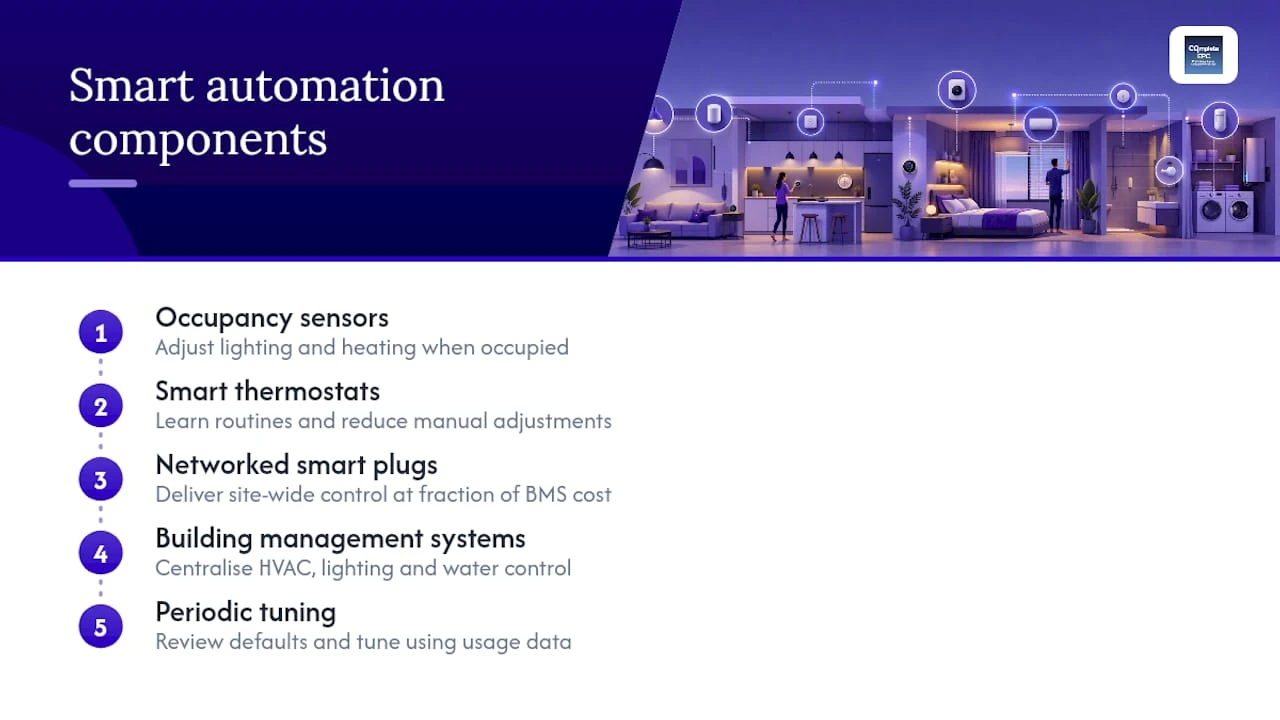
Occupancy sensors for lighting and heating adjust output based on whether a room is actually in use, which suits meeting rooms, corridors, and intermittently used spaces far better than a timer that runs regardless of occupancy. Smart thermostats that learn a household’s routine reduce the manual adjustment burden while still keeping energy use aligned with actual need.
For businesses, building management systems (BMS) centralise control of HVAC, lighting, and sometimes water systems across a whole site, giving facilities managers visibility they simply don’t get from individual thermostats and switches. Smaller sites can achieve much of the same benefit with networked smart plugs and sensors at a fraction of the cost of a full BMS install.
The common failure mode with automation isn’t the technology, it’s leaving default settings unreviewed. A smart system installed and never adjusted after the first month delivers a fraction of its potential saving. Treat automation as something to tune periodically against actual usage data, not a set-and-forget purchase.
Long-term maintenance plans that protect your gains
Efficiency measures degrade without upkeep, which is the part most guides skip. Insulation settles, boiler efficiency drifts, and smart controls get overridden and forgotten.
Build a simple annual maintenance calendar: boiler service before winter, filter changes on a fixed schedule rather than a reactive one, and a periodic check of loft insulation depth and condition. For businesses, this extends to reviewing BMS settings, recalibrating sensors, and auditing whether switch-off policies are still being followed six months after they were introduced, not just in the first enthusiastic week.
Revisit your EPC or retrofit assessment every few years, particularly after any building work, since new recommendations may apply once earlier measures are complete. A ten-year EPC validity period doesn’t mean nothing changes in between; it means the certificate remains your reference point until circumstances shift enough to warrant a fresh assessment.
Key resources and official guidance to consult next
For technical detail beyond this roadmap, a handful of sources are worth bookmarking. Approved Document L sets the building performance standards referenced throughout this article, covering calculation methods for new builds and major works. The Energy Saving Trust publishes practical retrofit and insulation guidance for homeowners. CIBSE offers more technical system-design guidance for professionals and informed homeowners alike. Grant schemes and incentives vary by country and even by local authority, so always check current local schemes before budgeting for a specific measure.
A practitioner’s view on where energy plans actually go wrong
Most energy advice fails not because it’s wrong, but because it’s sequenced backwards. Homeowners install solar panels before fixing loft insulation, or replace a boiler before addressing the draughts that make it work overtime. The technology gets the credit or blame; the sequencing rarely does.
The fix isn’t more information, it’s discipline: measure first, take the free wins, then let a proper assessment tell you what actually deserves capital. That’s the order that protects your money and your time.
— Danny
Get a property-specific roadmap instead of guesswork
Everything in this article points toward the same conclusion: generic advice only takes you so far, and the biggest wins come from recommendations matched to your actual building. That’s what separates a checklist from a plan.
Completeepc delivers exactly that specificity, with assessors who evaluate your property directly rather than applying a template, backed by a guarantee of competitive pricing against other London providers. Whether you need a Domestic Energy Performance Certificate for a rental property or house sale, or a Commercial EPC for a business premises, the resulting report gives you costed recommendations sequenced by return, not by guesswork.
Book your assessment through Completeepc and get a written, property-specific roadmap you can act on immediately, then revisit as your building work progresses.
Sources
- Conservation of fuel and power: Approved Document L (2026)
- Gov
- Energy efficiency for businesses — measurement and staged approach
- Home insulation to reduce home heat loss — Energy Saving Trust
FAQ
What are some effective practices for energy efficiency?
The most effective sequence is measuring your consumption with a smart meter, eliminating standby loads and adjusting thermostat settings, then commissioning an EPC to prioritise fabric and heating system upgrades based on your specific property.
What are some best practices for energy saving?
Draught-proofing, loft insulation, LED lighting, and programmable heating controls consistently deliver the strongest returns for the lowest upfront cost, particularly when tackled in that order.
What is the 30-minute heating rule?
It refers to letting your heating system run in a stable cycle rather than switching it on and off in short bursts, since repeated warm-up cycles waste more energy than a steady schedule.
What are some strategies for improving energy efficiency?
Pair immediate behavioural changes with a staged retrofit plan: quick wins now, fabric improvements next, heating system upgrades after that, and renewables once demand is already reduced. An EPC from a provider like Completeepc turns that sequence into a costed, property-specific plan rather than a generic checklist.