
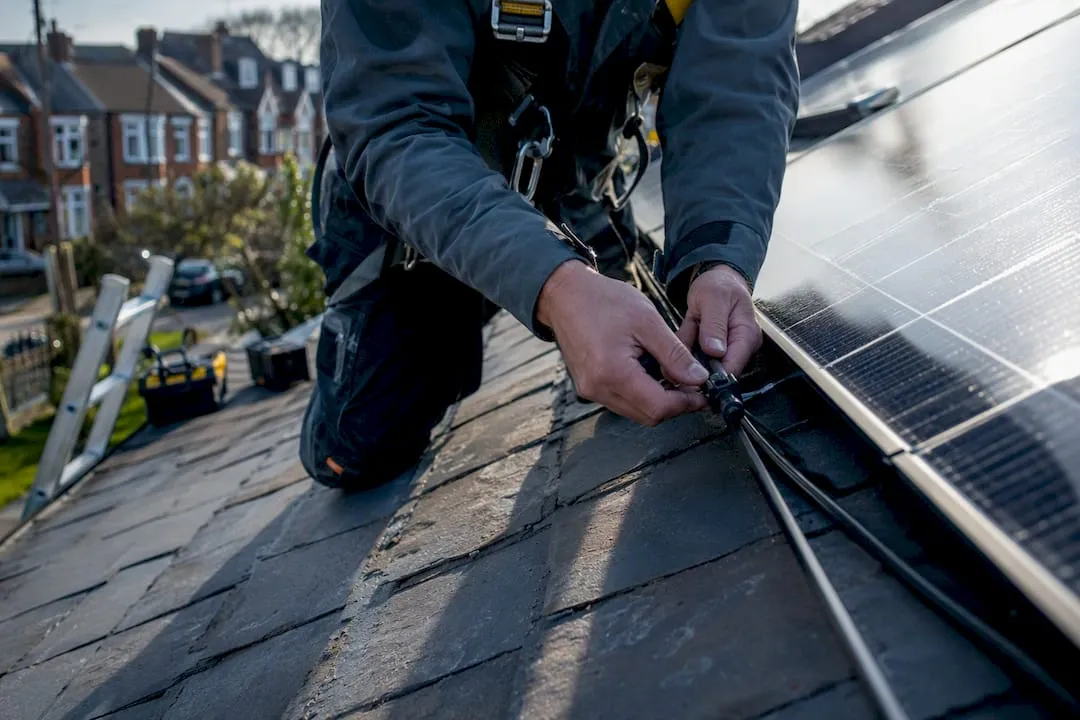
Yes, solar panels usually improve your EPC. Installing PV typically adds somewhere between 6 and 15 SAP points, which is enough to shift a borderline property up a full band. The exact figure depends on system size, orientation, whether your meter is export-capable, and how efficient the rest of your home already is, so treat any online estimate as a starting point rather than a promise.
TL;DR:
- The EPC uplift from installing solar panels generally ranges from 6 to 15 SAP points, depending on system size, orientation, and meter export capability.
- Reassessments can result in a lower EPC score if recent property improvements offset the solar benefit or if the old assessment used outdated or overly generous defaults.
- Accurate documentation, including MCS certificates, inverter details, and export-capable meter proof, is essential to ensure the assessor credits your actual solar system.
- The property type affects solar’s impact; detached houses benefit most, while flats with limited roof access or shared arrays see reduced or no direct EPC improvement.
- Solar panels can boost property value by around 6 to 7 percent, but this varies by region, ownership structure, and how well the system documentation is maintained.
Table of Contents
- Solar panels’ effect on EPC: how RdSAP actually scores your roof
- What SAP-point uplift can you realistically expect?
- Why your new EPC can come back lower after installing solar
- Key factors that change how much solar helps your EPC
- Do solar panels raise property value? The evidence and the caveats
- Assessor’s checklist: what to document so solar counts on your EPC
- Solar’s effect on EPC for flats versus detached houses
- How solar compares with heat pumps and other renewables in EPC scoring
- Latest regulatory changes affecting solar inclusion in EPCs
- Common misconceptions about solar panels and EPC improvements
- How maintenance and performance affect your EPC over time
- What the evidence actually tells property owners to prioritise
- Book a property-specific EPC assessment with Completeepc
- Sources
- FAQ
Solar panels’ effect on EPC: how RdSAP actually scores your roof
Every domestic EPC in England, Wales and Scotland runs on the Standard Assessment Procedure, known as SAP, or its reduced data variant for existing homes, RdSAP. Both are standardised models. They do not read your smart meter or your last quarterly bill. Instead, an assessor feeds in fixed inputs, wall type, floor area, glazing, heating system, and the model calculates a theoretical energy cost and carbon output for a “standard” occupancy pattern.
Solar PV enters that calculation as a generation source that offsets purchased grid electricity. The model assumes a proportion of what your panels generate gets used in the home immediately, with the rest exported or lost. If your meter is registered as export-capable, RdSAP credits the system more generously, because the model can account for the value of electricity sold back to the grid rather than treating unused generation as wasted. This is one of the most overlooked levers in the whole process: two identical arrays can score differently purely because one household never told their assessor the meter can export.
There’s a second distinction worth knowing. An assessor working from your MCS certificate and inverter specification sheet will use your actual system’s rated output. Without that paperwork, RdSAP falls back on conservative default assumptions, understating what your panels genuinely contribute. The technical annex governing EPC methodology confirms these are standardised assumptions, not live consumption data, which explains why your EPC and your actual electricity bill rarely match exactly.
What SAP-point uplift can you realistically expect?
Across the studies and worked examples assessors rely on, domestic solar installations add roughly 6 to 15 SAP points. A small, well-oriented system sits at the lower end of that range; a larger array on a south-facing roof pushes towards the upper end.
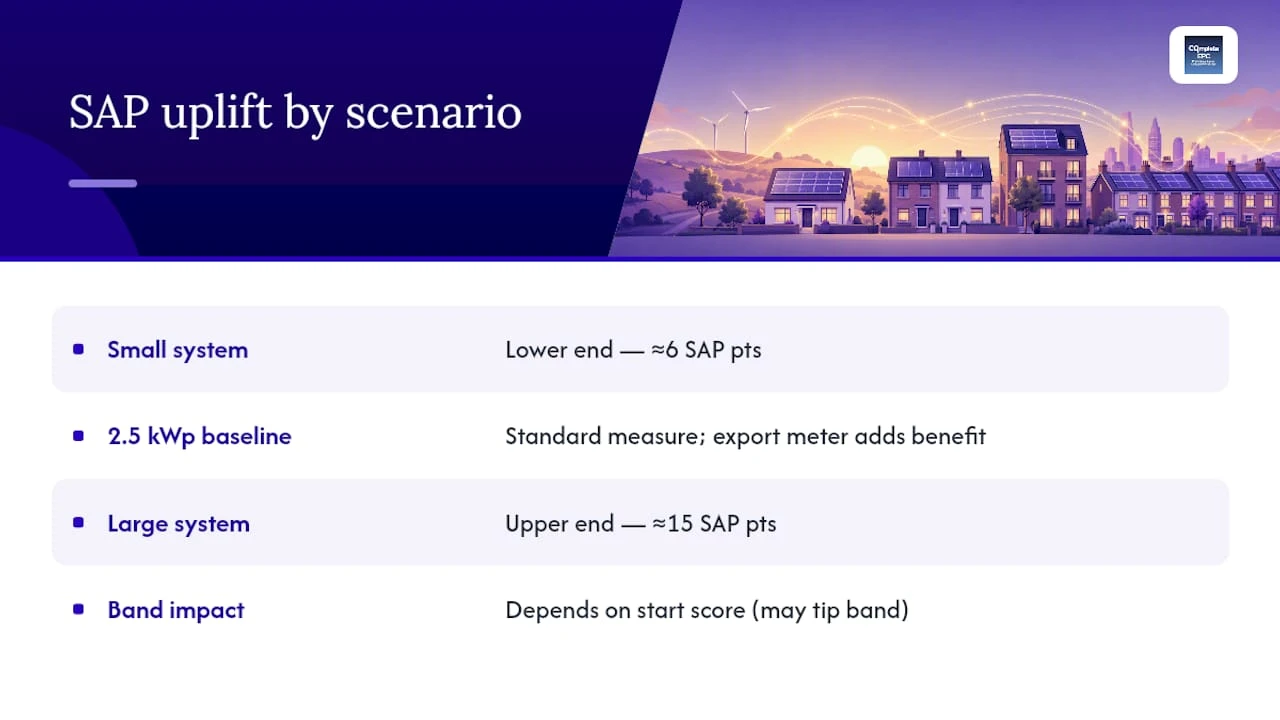
A useful reference point: worked EPC examples model a 2.5 kWp south-facing array as a standard improvement measure, and the presence of an export-capable meter noticeably increases the modelled benefit on top of that baseline. Scale the system up, say to 4 kWp on a large, unshaded roof, and the SAP contribution climbs further, though not in a straight line, because the model also weighs how much of that generation offsets the property’s existing demand.
Band changes depend on where you start. If your current SAP score sits close to a threshold, say a D at 68 points where C begins at 69, then even a modest 6-point uplift tips you over. If you’re sitting mid-band with a score of 60 in a D that runs 55 to 68, a 10 to 15-point gain might still leave you short of C. Ranges like these are illustrative only. Ask an assessor to model your specific roof, system size and existing fabric before assuming a particular outcome.
Why your new EPC can come back lower after installing solar
This catches people out more than almost anything else in the process. You install panels, book a fresh assessment expecting an uplift, and the certificate comes back lower than the old one. It isn’t a fault in the solar system. It’s what reassessment actually does.
A new EPC doesn’t bolt solar onto your previous certificate. It re-evaluates the entire property from scratch: insulation levels, glazing, heating controls, boiler efficiency, everything. If your last EPC was assessed under an older methodology version, used generous defaults, or simply recorded loft insulation that’s since degraded or was overestimated the first time round, those losses can outweigh whatever gain the solar array delivers. Different assessors also exercise professional judgement differently when photographic evidence is limited, which introduces variation between assessments that has nothing to do with your panels.
The fix is straightforward. Before the visit, gather documentation for anything that’s changed or that you suspect was underrecorded previously: loft insulation depth, cavity wall fill certificates, glazing specifications, boiler service records. Ask your assessor for a line-by-line breakdown of which elements moved and by how much. That breakdown tells you whether the drop came from the fabric assessment or genuinely reflects the solar model, and it gives you something concrete to challenge if a figure looks wrong.
Key factors that change how much solar helps your EPC
Not every installation delivers the same result, and the variables interact rather than acting independently.
- System size and roof coverage. Larger arrays generating a bigger share of the property’s electricity demand model larger SAP gains, up to a point of diminishing returns as self-consumption limits kick in.
- Orientation and shading. South-facing, unshaded roofs perform best in the model. East or west-facing arrays still help, but they generate less and so add fewer points; heavy shading from chimneys or neighbouring trees reduces the benefit further.
- Export-capable meter. A documented export-capable meter with generation figures on record materially increases the modelled benefit, because the assessor can account for exported electricity rather than defaulting to conservative assumptions.
- Battery storage. Adding a battery increases self-consumption, since more of what you generate gets used on-site rather than exported, and this can improve the EPC modelling further in some assessments.
- Roof coverage and access. Very large arrays that cover most of a roof can trigger fire-safety access requirements, sometimes referred to informally as the 33% rule, which is about escape routes for fire crews rather than electrical performance, but it can constrain how many panels actually fit.
Pro Tip: If your walls or loft are under-insulated, fix that first. A fabric-first approach often delivers more SAP points per pound spent than a small PV array bolted onto a leaky house, and it makes the eventual solar installation perform better too.
Do solar panels raise property value? The evidence and the caveats
A UK study using Zoopla data found houses with solar panels carried a selling-price premium in the region of 6.1% to 7.1% within the sample examined, though the researchers noted the effect varied by region and by market segment. That’s a meaningful uplift on a typical UK property, and it lines up with the general market view that solar improves saleability.
The caveats matter as much as the headline figure. The premium isn’t uniform across the country, and it can differ depending on whether the panels are owned outright or under a lease arrangement, since buyers and mortgage lenders often treat leased systems with more caution. System age, warranty status, and whether you can produce installation paperwork all influence how much a buyer’s surveyor and mortgage valuer will credit the array.
The practical conclusion: solar tends to help you sell, and it can add value, but it isn’t a guaranteed premium you can bank on. Don’t install panels purely as a resale strategy. Install them because they cut running costs and improve your EPC, and treat any uplift in sale price as a welcome bonus rather than the primary reason.
Assessor’s checklist: what to document so solar counts on your EPC
Assessors can only credit what they can verify. Turn up without paperwork and RdSAP defaults to conservative assumptions that understate your system. Have these ready:
- MCS certificate confirming the installation meets recognised standards.
- Commissioning certificate showing the system was signed off and dated.
- Inverter make and model, since capacity and efficiency ratings feed directly into the model.
- Evidence your meter is export-capable, ideally a supplier confirmation or smart meter registration.
- A generation estimate or output log, particularly useful if you’ve had the system a while.
- Guarantees and warranties, which support the assessor’s confidence in stated capacity.
Providing this evidence lets the assessor model your actual system rather than a generic placeholder, and it’s the difference between a realistic SAP uplift and a disappointing one. If you’re planning a solar installation on a commercial building and want a realistic pre-install estimate of the likely band change, Complete EPC’s commercial EPC service can model outcomes before you commit, so targets are grounded in your actual roof and system rather than guesswork.
Solar’s effect on EPC for flats versus detached houses
Property type changes what solar can realistically achieve on your certificate, largely because of roof access and shared ownership structures.
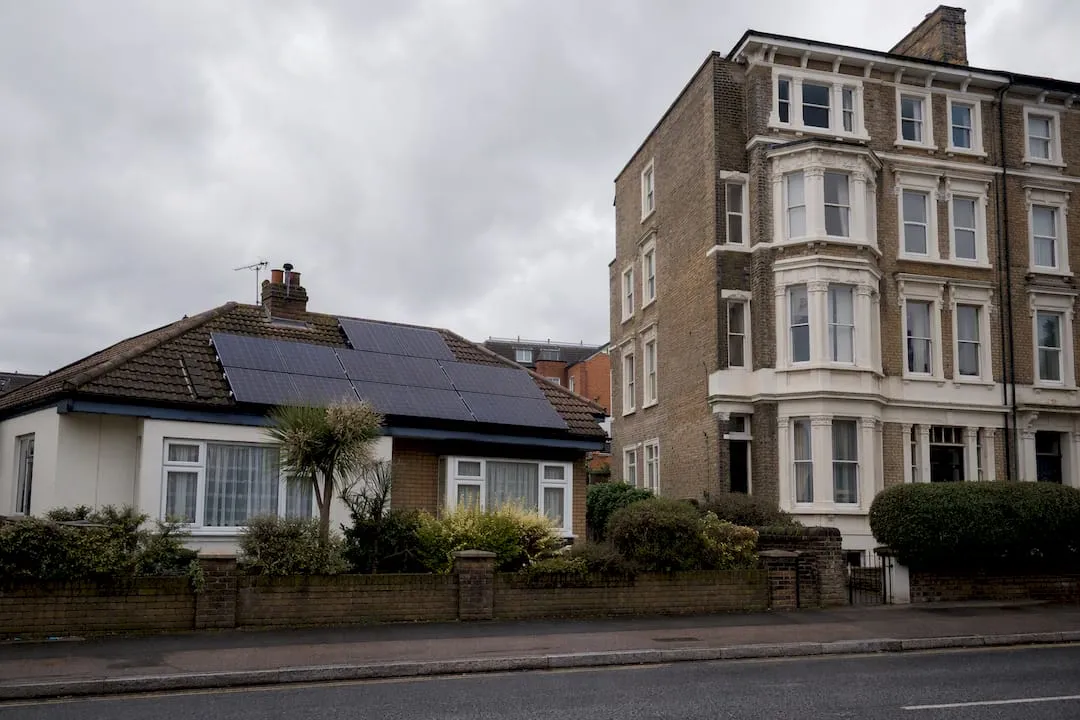
Detached houses generally see the clearest benefit. You control the whole roof, orientation choices are entirely yours, and the SAP model can attribute the full system to that single dwelling. This is where the 6 to 15-point range applies most cleanly, and where a well-sized south-facing array has the best chance of shifting a band.
Flats are a different proposition. If you own a top-floor flat with sole access to a section of roof, you can install panels much like a house, though the array is often smaller given the constrained space. Lower-floor flats in blocks usually have no roof access at all, which rules out individual installation entirely. Communal solar, where a whole block shares one array feeding individual flats, does exist, but it’s less common and the SAP treatment depends on how the supply is metered and apportioned to each unit. Terraced houses fall somewhere in between: roof space is usually adequate, but shared party walls and neighbouring extensions can introduce shading that a detached property wouldn’t face. If you’re assessing a flat or terrace, ask your assessor early whether roof access and metering arrangements will actually support a PV improvement measure before you commission an installer.
How solar compares with heat pumps and other renewables in EPC scoring
Solar PV and heat pumps address different parts of the SAP calculation, which is why comparing them directly on “points added” can mislead.
Solar generates electricity, offsetting what you buy from the grid. A heat pump replaces how you generate heat, typically swapping a gas boiler for an electrically-driven system with high efficiency. Because heating usually accounts for the largest share of a home’s modelled energy cost, replacing an inefficient gas boiler with an air source heat pump can produce a larger single-measure SAP uplift than adding solar, particularly in a home that’s already reasonably insulated. However, heat pumps carry substantially higher installation costs and can be disruptive to fit, especially in properties without existing wet underfloor heating or oversized radiators.
Small-scale wind turbines rarely feature in domestic EPCs. They’re modelled in RdSAP but need specific site conditions, exposure and consistent wind speeds that most urban and suburban plots simply don’t offer, so the practical uplift is negligible for the overwhelming majority of homes.
The strongest results tend to come from combining measures rather than picking one. Solar plus a heat pump plus decent loft insulation moves the needle far more than any single measure alone, because each addresses a different line in the SAP calculation. If your budget only stretches to one intervention, ask an assessor to model both options against your specific property before deciding, since the answer depends heavily on your current heating system and insulation standard.
Latest regulatory changes affecting solar inclusion in EPCs
EPC methodology isn’t static, and the version used to assess your property can shift how solar is credited over time. RdSAP has gone through periodic updates, and each revision refines assumptions around renewable generation, meter treatment and fabric defaults, which is partly why two assessments of the same house years apart can produce different results even with no physical changes.
For landlords, the regulatory picture carries extra weight. Minimum energy efficiency standards for rented properties are under continued review, and the government’s guidance for landlords sets out current compliance requirements and signals where thresholds may tighten. Solar PV won’t single-handedly guarantee compliance with a stricter future standard, but it’s frequently part of a package of measures landlords use to move a property towards a higher band before new rules bite.
The practical takeaway is to treat your EPC as a living document rather than a one-off certificate. If you installed solar several years ago under an older assessment methodology, a fresh EPC under current rules might score that same system differently, for better or worse. Landlords planning ahead of regulatory deadlines should get a current assessment rather than relying on a certificate that predates the latest methodology revision.
Common misconceptions about solar panels and EPC improvements
The biggest misconception is that panels alone guarantee a band jump. They don’t. The uplift depends entirely on where your score currently sits relative to the next threshold, so a property deep within its current band might see SAP points rise without ever crossing into the band above.
A second one: people assume any solar installation automatically counts fully in the assessment. It doesn’t, not without documentation. An assessor working without your MCS certificate, inverter details or meter export confirmation will fall back on cautious defaults that undersell your system’s actual output.
Third, some property owners believe a bigger system always means a proportionally bigger EPC gain. Self-consumption limits mean returns diminish once generation comfortably exceeds daytime demand, since the model can only credit what’s genuinely offsetting purchased electricity or being exported through a registered meter.
Finally, there’s a persistent belief that solar and battery storage are interchangeable in EPC terms. A battery increases self-consumption and can support a stronger modelled outcome, particularly in homes with irregular daytime occupancy, but it isn’t a substitute for the array itself and won’t feature meaningfully in the calculation without functioning PV generation behind it.
How maintenance and performance affect your EPC over time
An EPC reflects a snapshot at the time of assessment, based on the system specification an assessor is shown, not ongoing real-world output. That means a poorly maintained array with degraded panels or a failing inverter can still score well on paper if the documentation presented describes the system as originally installed.
In practice, performance does matter over the system’s lifetime, and it matters more at the point of reassessment. Panels typically degrade gradually, often losing a small percentage of output capacity per year, and a faulty inverter can silently cut generation for months before anyone notices a lower electricity bill. If you’re due a new EPC, whether for a sale, a remortgage or a rental renewal, and your system is several years old, it’s worth having generation logs checked against the original specification before the assessor visits. A significant shortfall against the panel’s rated output could mean the new assessment credits your system less generously than the last one, regardless of how well you documented it originally.
A well-maintained system supported by up-to-date generation records gives an assessor confidence to credit close to its full rated capacity rather than reaching for a conservative estimate.
What the evidence actually tells property owners to prioritise
Most advice on solar and EPCs focuses on installation, not paperwork, and that’s backwards. The SAP-point range you get, whether it’s a modest 6 points or a full 15, depends far more on what you hand your assessor than on the panels themselves. A well-specified system with no export-capable meter registration and no MCS certificate will score worse on paper than a smaller, properly documented one. That’s an uncomfortable truth for anyone who assumes the physical kit does all the talking.
The conventional wisdom that “solar equals a better EPC” also glosses over reassessment risk. Plenty of property owners get blindsided by a lower certificate after installing panels, purely because the rest of the property was reassessed under stricter or different assumptions than last time. That isn’t a solar problem. It’s a documentation and expectations problem, and it’s entirely avoidable with a pre-installation conversation about what evidence the assessment will need.
If there’s one thing worth prioritising above all else, it’s asking for property-specific modelling before you commit to a system size. Generic ranges are useful for setting expectations, but they can’t tell you whether your particular D-band property needs 6 points or 16 to cross into C.
— Danny
Book a property-specific EPC assessment with Completeepc
Generic SAP-point ranges only get you so far. Completeepc gives London property owners and landlords an assessor-led alternative to guesswork: a proper pre-installation and post-installation assessment that models your actual roof, system specification and meter setup, rather than relying on the conservative defaults you get without documentation. That matters most for commercial buildings, where band changes affect compliance obligations as well as running costs.
If you’re weighing up whether solar will genuinely move your certificate before you commission an installer, or you need a fresh assessment after installation to make the system count properly, Complete EPC’s commercial EPC service is built for exactly that. Get in touch to book an assessment and find out what your specific property is likely to score, rather than working from someone else’s average.
Sources
- How do solar panels affect property prices in the UK? (UBDC)
- Solar PV – Improve your EPC rating (EPC Works)
FAQ
Will solar panels increase my EPC rating?
In most cases, yes. Solar PV typically adds 6 to 15 SAP points, though whether that moves you into a new band depends on how close your current score is to the next threshold.
What is the 33% rule for solar panels?
It’s a fire-safety access guideline, not an electrical performance rule. Large arrays covering a big share of the roof can trigger required escape routes and access corridors for fire crews, which limits how much of the roof panels can practically cover.
Why don’t all new houses have solar panels?
Building regulations vary by nation and don’t universally mandate solar on every new build, and factors like roof orientation, shading, developer cost decisions and site-specific planning constraints all influence whether a new home gets panels fitted as standard.
Why is my electricity bill so high when I have solar panels in the UK?
Your EPC reflects a standardised model, not your actual consumption, so a good certificate doesn’t guarantee low bills. Panels only offset daytime generation against your usage; overnight demand, a poorly sized system, or high winter heating needs can still leave bills higher than expected.
Do solar panels always add value when I sell my home?
Not guaranteed, but often helpful. UK research found a price premium in the region of 6.1% to 7.1% in the sample studied, though the effect varies by region, ownership structure and system documentation.