

Any assessor issuing an EPC must belong to a government-approved accreditation scheme and lodge the certificate on the national register. Domestic assessors typically hold a Domestic Energy Assessor (DEA) qualification at Level 3; non-domestic and commercial work needs a Non-Domestic Energy Assessor (NDEA) at Level 4 or above. Before booking anyone, confirm their accreditation and any existing certificate on the government EPC register.
TL;DR:
- Verify that assessors hold the appropriate Level 3 or Level 4 qualification for the property type before booking; using the wrong level invalidates the certificate.
- Always confirm assessors’ accreditation scheme, membership number, and registration status through the government EPC register to ensure certification validity.
- Be cautious of rushed inspections, vague timelines, unusually low prices, or reluctance to disclose accreditation details, as these signals may indicate low-quality assessments.
- A valid EPC must be lodged on the national register; any certificate issued outside an accredited scheme has no legal standing.
- For commercial or complex properties, ask for evidence of experience with that property type or seek a second opinion before relying on the certificate.
Table of Contents
- What qualifications does an EPC assessor actually hold?
- How do you verify an assessor’s accreditation and registration?
- Why do these qualifications matter for your transaction?
- What red flags should you watch for when booking?
- How Complete EPC vets every assessor we send out
- Ready to book a qualified assessor?
- Sources
- FAQ
What qualifications does an EPC assessor actually hold?
Assessors don’t all carry the same credential, and the difference matters more than most property owners realise. The qualification level required depends entirely on what’s being assessed, from a two-bedroom terrace to a multi-storey office block.
A Domestic Energy Assessor (DEA) typically holds a Level 3 qualification covering standard house types: flats, terraces, semis and detached homes assessed using RdSAP methodology. The training covers measuring floor areas, identifying construction types, recording heating systems and inputting data into approved software to generate the certificate. A DEA is not qualified to assess commercial premises, and doing so would invalidate the certificate.
For commercial and complex buildings, you need a Non-Domestic Energy Assessor (NDEA), holding a Level 4 qualification or higher. These assessors work with SBEM (Simplified Building Energy Model) or, for larger or more complex buildings, dynamic simulation modelling. The step up from Level 3 to Level 4 reflects the added complexity of commercial building services, ventilation systems and mixed-use layouts.
Beyond the core DEA and NDEA routes, several specialist strands exist:
- Air-conditioning inspectors, qualified separately to assess and report on cooling systems over a certain capacity.
- Display Energy Certificate (DEC) assessors, required for public buildings that must show their operational energy rating.
- Low Carbon Energy Assessors (LCEAs), certified through schemes such as CIBSE Certification, who handle higher-complexity non-domestic reporting that a standard NDEA qualification doesn’t cover.
The City & Guilds Energy Assessment framework sets out the units behind both Level 3 and Level 4 qualifications, from property inspection technique to producing a compliant certificate using approved software. If you’re hiring for anything beyond a standard house or flat, ask which level the assessor holds before you agree a date.
How do you verify an assessor’s accreditation and registration?
Checking credentials takes minutes and saves you from a certificate that won’t stand up at completion. Here’s the sequence worth following every time.
- Ask for the accreditation body and membership number. A properly qualified assessor will give you this without hesitation, usually alongside their name and qualification level.
- Search the government EPC register. The find an energy certificate service confirms whether a certificate has genuinely been lodged and ties it to a real assessor identity, not just a name on an invoice.
- Cross-check with the accreditation body directly. Most bodies run an online “find an assessor” lookup, and a quick call or search confirms current membership, CPD status and whether any complaints are on file.
Regulation 30 of the Building Regulations 2010 is why this checking matters at all. It requires accreditation schemes to confirm members are “fit and proper,” to insist on register entry before a certificate is issued, and to maintain complaints and indemnity arrangements. That framework exists precisely so a buyer, tenant or solicitor has recourse if something goes wrong.
Pro Tip: Don’t just ask if the assessor is “accredited”. Ask which scheme, and then verify that scheme’s name against the accreditation bodies listed through the government service. A vague answer here is the first sign worth following up on.
Official guidance for sellers and landlords points to exactly this route: use an accredited assessor, and lean on the national register or accreditation-body lookup rather than taking a name at face value.
Why do these qualifications matter for your transaction?
An EPC produced by someone outside an accreditation scheme carries no legal standing. It cannot be lodged on the national register, which means it doesn’t satisfy the requirement to provide a certificate at marketing, sale or let. If a transaction later reveals the assessor wasn’t accredited, you’re back to square one, and potentially past a deadline.
Qualification level also affects suitability, not just legality:
- A DEA working on a standard semi is well within their competence. The same assessor attempting a warehouse or office block is not, regardless of how confident they sound.
- Listed buildings, HMOs and unusually constructed properties often need an assessor comfortable distinguishing “as built” from “as existing” values, a skill built into higher-level City & Guilds training rather than assumed at entry level.
- Competence shows up in the recommendations report too. An assessor who inspects thoroughly, checking the loft, the boiler, the glazing, tends to produce recommendations that actually help a landlord prioritise spending, rather than a generic list.
If you’re dealing with a listed building, a large HMO, or a commercial unit with mixed use, it’s worth asking for evidence of the assessor’s specific experience with that property type, or requesting a second opinion before you rely on the certificate for a major decision.
What red flags should you watch for when booking?
Most problems with EPCs trace back to corners cut at the booking stage. A handful of warning signs consistently precede a poor or invalid certificate.
- An inspection that feels rushed. A thorough domestic survey involves checking the loft, heating controls and glazing, not a five-minute walkthrough.
- Reluctance to name their accreditation scheme or give a membership number. A genuine assessor answers this instantly.
- A price that seems unusually low against everyone else you’ve called. This often signals corners being cut elsewhere, whether that’s time on site or the qualification level actually held.
- Vagueness about when the certificate will be lodged. A clear turnaround and a certificate number on delivery is standard practice.
Pro Tip: Before you agree a booking, ask directly: “What’s your accreditation scheme, and how long will the survey take?” A confident, specific answer to both is usually a good sign; hesitation on either is worth pressing further.
If you suspect a certificate is faulty or an assessor misrepresented their qualifications, raise it with the accreditation body directly. Every approved scheme is required to run a complaints procedure and can arrange a reassessment where warranted.
How Complete EPC vets every assessor we send out
Every assessor working with Completeepc holds current accreditation appropriate to the property type, whether that’s a DEA for a residential let or a higher-level qualification for commercial premises. We confirm accreditation status, CPD standing and indemnity cover before anyone is assigned a job, and every certificate we produce is lodged with a traceable number.
That said, don’t take our word alone. Whoever you book, domestic, commercial, or through us, run them through the same checks covered above: accreditation scheme, membership number, government register entry. A firm confident in its assessors will never mind you asking.
— Danny
Ready to book a qualified assessor?
If the checks above have you wanting a straightforward, verified route rather than chasing accreditation numbers yourself, Completeepc handles that vetting before an assessor ever reaches your door. Every survey is carried out by an accredited assessor matched to the correct qualification level, whether that’s a DEA for a rental flat or a Level 4 NDEA for an office fit-out, and every certificate is lodged on the national register with a certificate number supplied directly to you.
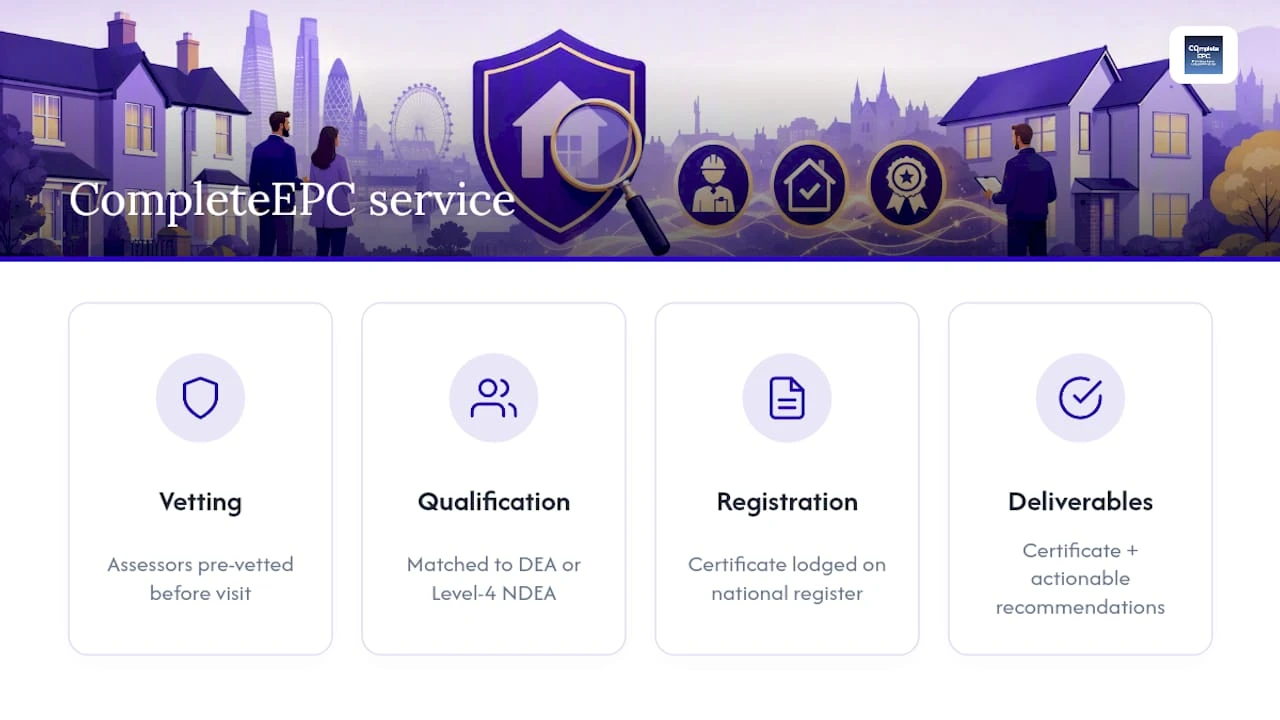
Turnaround is typically quick, and you’ll receive both the certificate and a recommendations report you can actually act on. For a residential sale or let, book through the domestic EPC page. For a commercial unit, warehouse or mixed-use building, start with the commercial EPC page and get a qualified assessor booked in.
Sources
- Gov
- Energy Assessment (6361) – City & Guilds
- The Building Regulations 2010 — Regulation 30: Energy assessors
FAQ
What qualification does a domestic EPC assessor need?
A Domestic Energy Assessor (DEA) typically holds a Level 3 qualification covering RdSAP assessment methods for standard house types, as set out in the City & Guilds framework.
What qualification is needed for a commercial EPC?
Commercial and non-domestic buildings need a Non-Domestic Energy Assessor (NDEA), qualified at a higher level to cover more complex buildings, with specialist strands like Low Carbon Energy Assessor status for the most complex cases.
How do I check if an EPC assessor is legitimate?
Ask for their accreditation body and membership number, then confirm the details on the government EPC register or through the accreditation body’s own lookup tool.
Can any energy assessor issue any type of EPC?
No. A DEA cannot legally assess commercial premises, and an unaccredited assessor of any kind cannot lodge a valid certificate under Regulation 30 of the Building Regulations 2010.
What should I do if I think my EPC was issued by an unqualified assessor?
Raise it with the assessor’s accreditation body, which is required to run a complaints procedure and can arrange a reassessment where the original certificate is found to be invalid.