

An EPC energy rating is the A to G band on a property’s Energy Performance Certificate, not the American ENERGY STAR appliance label. Band A means the most efficient building, band G the least, and the grade reflects likely fuel bills and carbon emissions rather than the current occupant’s habits. An accredited domestic energy assessor issues the certificate, and it stays valid for 10 years.
TL;DR:
- EPC ratings measure a building’s energy efficiency based on construction and fixed systems, not occupant behavior, with bands from A (most efficient) to G (least efficient).
- The calculation relies on data like floor area, construction type, glazing, heating, insulation, and hot water setup, with visually accessible features significantly impacting the score.
- A valid EPC is legally required for property sales and lettings and remains on the register for 10 years, with penalties applying for non-compliance especially for larger commercial buildings.
- The EPC front page shows current and potential ratings, with cost-effective improvement suggestions that owners can ignore without invalidating the certificate.
- Booking an assessment involves ensuring property access and documentation, with costs varying by size and location, and the certificate can be verified on the national register afterward.
Table of Contents
- What does the EPC rating actually measure?
- How is the rating calculated? SAP, RdSAP and the key inputs
- When is an EPC legally required, and what happens if you don’t have one?
- Reading the report: the band, the CO2 index and the recommendations
- How do you book an EPC, and what does it cost?
- What is the ENERGY STAR rating, and how does it differ from an EPC?
- How does the ENERGY STAR scale compare with the EPC’s A to G bands?
- Why UK property professionals shouldn’t confuse the two schemes
- Who benefits from an ENERGY STAR rating, and how does that compare?
- What products and buildings actually carry these ratings?
- How do you find and interpret an ENERGY STAR label?
- What assessors notice most often, and where the easy wins are
- Book a domestic EPC with Completeepc
- Sources
- FAQ
What does the EPC rating actually measure?
The EPC score is what assessors call an “asset rating.” It measures the building itself: the walls, roof, windows, heating system and hot water controls, rather than how the current owner or tenant actually uses the space. Two identical flats, one lived in by a family who never opens a window and one by a couple who works away most weeks, will get the same EPC score, because the rating is based on standard occupancy assumptions, not real behaviour.
That is different from an “operational rating,” which tracks actual metered energy use over time. Operational ratings suit large, complex buildings such as public offices or hospitals, where genuine consumption data is available and useful for benchmarking. Asset ratings suit domestic sales and lettings, where consistency and comparability between properties matter more than one household’s quirks.
In practical terms, the bands translate roughly like this:
- A to B: Very low running costs, typically newer builds or heavily retrofitted homes with excellent insulation.
- C to D: Reasonable efficiency, average bills for the property type, most common in the existing housing stock.
- E to G: Higher running costs and carbon output, often older properties with poor insulation or ageing heating systems.
The average English home sits in band D, so anything above that is already ahead of the pack, and anything below it flags a property that will cost more to heat and produce more carbon than most of its neighbours.
How is the rating calculated? SAP, RdSAP and the key inputs
Every EPC rating in the UK comes from a government-approved calculation, not a subjective walkthrough. New builds are assessed using the full Standard Assessment Procedure (SAP), while existing properties use the Reduced Data SAP (RdSAP), a streamlined version built for retrofitting a rating onto a building where some construction details are not fully known.
Both methodologies are approved under building regulations, and assessors must run them through certified software rather than calculating by hand. The inputs that move the score most are:
- Floor area of every habitable room, measured room by room rather than estimated from a floor plan.
- Construction type and age, since wall construction and build era carry assumptions about likely insulation levels.
- Glazing type, including whether windows are single, double or triple glazed (see energy-efficient window replacement in Potomac, MD for lower energy bills & boosted home value).
- Heating system and controls, covering the boiler type, age, and whether thermostats and zone controls are fitted.
- Insulation, particularly loft depth and cavity or solid wall treatment.
- Hot water provision, including cylinder insulation and any renewable contribution such as solar thermal.
Access matters more than most owners expect. If an assessor cannot get into the loft or reach the boiler cupboard, the software defaults to a conservative assumption, which nearly always drags the score down.
Pro Tip: Clear the loft hatch and unlock any cupboard housing the boiler or hot water tank before the assessor arrives. A five-minute tidy can be the difference between a defaulted assumption and an accurate, higher score.
When is an EPC legally required, and what happens if you don’t have one?
An EPC is a legal requirement whenever a property is constructed, sold or let, whether that’s a two-bedroom flat or a commercial warehouse. Larger public buildings face a related but distinct obligation to display a Display Energy Certificate (DEC), and any air conditioning system over 12kW requires regular inspection under separate rules.
The certificate itself is valid for 10 years from the date it’s lodged, and the assessor who carries out the assessment is responsible for lodging it on the national Energy Performance of Buildings register. That register is the definitive record: anyone can search it to confirm a certificate exists and check its expiry date before a transaction completes.
- Selling without a valid EPC available to buyers can delay or derail a sale.
- Letting without one exposes landlords to enforcement action from local authorities.
- Commercial property owners face penalties that scale with the building’s rateable value, making non-compliance considerably more expensive for larger premises.
- Complaints about an assessor’s conduct or accuracy go through that assessor’s accreditation scheme, not the local council.
For solicitors handling a sale, the safest approach is to confirm a valid EPC exists on the register at the outset of the transaction, not at exchange, when a missing or expired certificate becomes a genuine hold-up.
Reading the report: the band, the CO2 index and the recommendations
The front page of an EPC carries two numbers that matter most: the current energy efficiency band and a separate CO2 emissions indicator. Both are built from the same underlying SAP or RdSAP calculation, but the CO2 figure specifically flags the property’s environmental impact, which increasingly features in how buyers and tenants judge a home before viewing it in person.
Below the headline band sits the recommendations table, split into cost-effective measures and further improvements. Cost-effective measures are ones the calculation deems worth the outlay based on typical payback; further improvements are pricier changes with a longer payback period, listed for completeness rather than urgency. Each line includes an indicative installation cost and an estimated annual saving, so a reader can see roughly what loft insulation or a new boiler might cost against what it would save.
Crucially, none of this is compulsory. The potential rating shown alongside the current one assumes every cost-effective measure gets implemented, but an owner is free to ignore the list entirely and the certificate remains valid regardless.
For agents and solicitors, three things are worth flagging to a buyer or tenant early:
- The current band, since it affects mortgage products and, for landlords, MEES compliance thresholds.
- The gap between current and potential rating, which signals how much upside a buyer could unlock.
- Any recommendation with a short payback period, since those tend to interest cost-conscious buyers most.
A property sitting three or four bands below its potential rating is often a stronger negotiating point than the headline grade alone suggests.
How do you book an EPC, and what does it cost?
Booking an EPC is straightforward, but a little preparation speeds up the visit considerably.
- Book an accredited assessor for the property type, domestic or commercial, since the two require different accreditation.
- Confirm the property is accessible on the day, including any loft hatch, boiler cupboard, and outbuildings that form part of the assessed floor area.
- Gather existing documentation, such as boiler service records, glazing installation certificates, or insulation guarantees, since these can support a higher score than a visual inspection alone would assume.
- Attend or arrange access for the visit itself, which typically takes between 45 minutes and an hour for a standard house, longer for larger or more complex commercial premises.
- Receive the certificate, which the assessor lodges directly onto the national register, usually within a few working days of the visit.
Costs vary by property size and location, so treat any figure quoted online as guidance rather than a fixed price until you’ve had a like-for-like quote for your specific building.
Pro Tip: Once lodged, search the property’s postcode on the EPB register yourself to confirm the certificate is live and matches what you were told. It only takes a minute and removes any doubt before a sale or letting proceeds.
Assessors measure every habitable room individually) rather than relying on estimated square footage, which is part of why a rushed or restricted visit tends to produce a lower score than a thorough one.
What is the ENERGY STAR rating, and how does it differ from an EPC?
The ENERGY STAR rating is a separate scheme entirely, used mainly in the United States to label appliances and some commercial buildings as energy efficient against a benchmark set by the US Environmental Protection Agency. It exists to help consumers spot efficient washing machines, fridges or boilers at the point of purchase, using a recognisable label rather than a lettered band.
Property professionals in the UK occasionally encounter the term because international buyers, particularly from North America, sometimes ask whether a British property carries an “Energy Star rating.” It doesn’t, because the UK’s equivalent mechanism is the EPC, built on a completely different methodology and legal framework. Understanding this distinction matters practically: quoting the wrong scheme to a client, or assuming ENERGY STAR criteria apply to a UK asset rating, risks giving inaccurate compliance advice.
How does the ENERGY STAR scale compare with the EPC’s A to G bands?
ENERGY STAR does not use a lettered scale at all. Qualifying appliances simply carry the label if they meet the efficiency threshold for their category, a pass or fail system rather than a graded band. Some commercial buildings in the US receive a numerical score out of 100 benchmarked against similar buildings nationally, which is closer in spirit to the EPC’s comparative approach but still structurally different from the UK’s A to G format.
The EPC system, by contrast, always produces a graded band alongside a numerical score, letting a reader see at a glance not just whether a property passes some threshold, but roughly where it sits on a full spectrum from highly efficient to poor. That graded structure is part of why EPCs work well for property transactions: a buyer comparing two homes can immediately see one is band C and the other band F, without needing to interpret a pass/fail label.
Why UK property professionals shouldn’t confuse the two schemes
The core difference is jurisdiction and scope. ENERGY STAR certifies individual products and, in some cases, whole commercial buildings against a US federal benchmark. The EPC certifies the energy performance of UK domestic and non-domestic buildings against the SAP or RdSAP methodology, a legal requirement tied to sales, lettings and construction rather than a voluntary efficiency label.
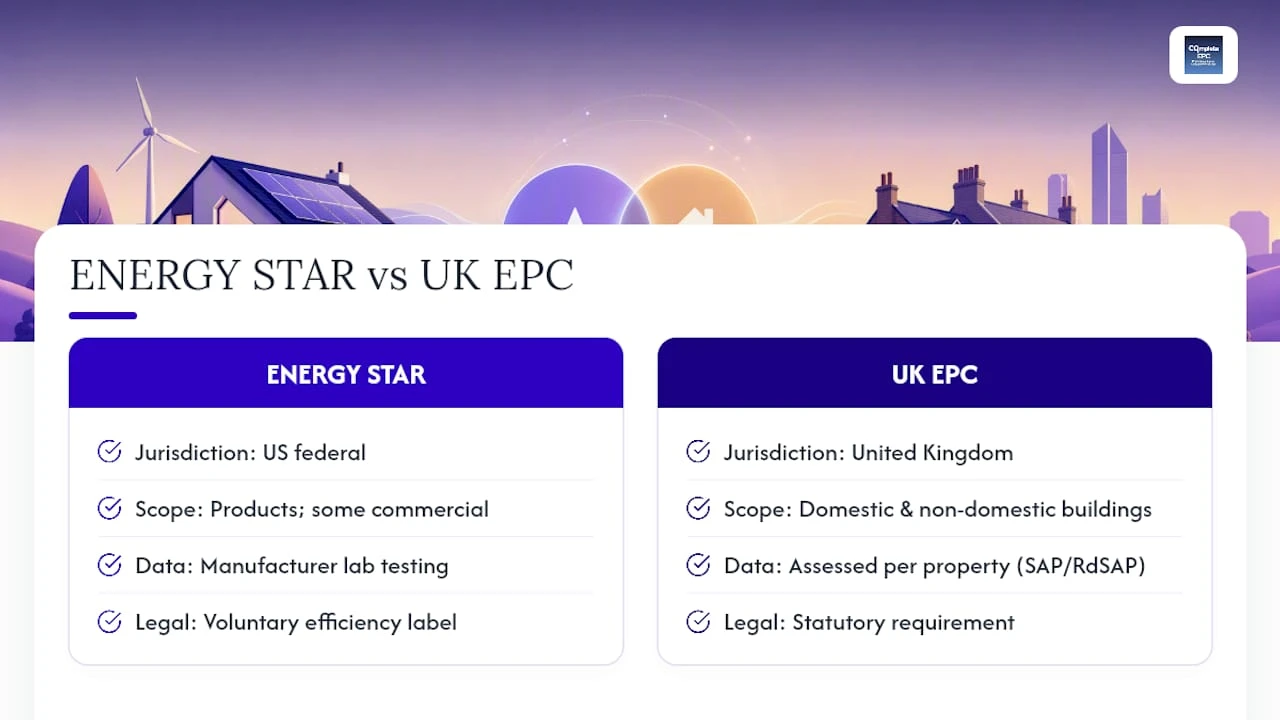
There’s also a data difference. ENERGY STAR ratings for appliances are typically set once, at manufacture, based on laboratory testing of that model. An EPC’s asset rating is recalculated per property, per visit, based on that specific building’s fabric and fixed services at the time of assessment. Two identical houses built from the same plans could still receive slightly different EPC scores if one has since had cavity wall insulation fitted and the other hasn’t.
For a UK solicitor, agent or landlord, the practical takeaway is simple: EPC compliance is what the law requires for property transactions, and no reference to ENERGY STAR labelling on a boiler or appliance substitutes for a valid, lodged EPC on the building itself.
Who benefits from an ENERGY STAR rating, and how does that compare?
For consumers, an ENERGY STAR label offers a quick shortcut when buying appliances, a signal that a fridge or washing machine sits among the more efficient options in its category without needing to compare technical specifications. For manufacturers, carrying the label supports marketing efforts and, in some US states, unlocks rebate schemes tied to energy efficiency targets.
The UK’s EPC system delivers a broadly similar benefit at the building level rather than the appliance level. A strong EPC rating helps buyers and tenants compare properties quickly, giving a consistent benchmark that sits alongside price and location when weighing up a purchase or letting. Landlords benefit directly too: improving a property’s EPC band can lower tenants’ running costs, support MEES compliance, and make a listing more attractive against competing properties nearby.
The parallel is useful conceptually, but the mechanisms diverge. ENERGY STAR rewards manufacturers for building efficient products; EPCs reward (and increasingly require) property owners for maintaining or improving efficient buildings. Both aim to reduce energy waste and carbon emissions, but through entirely separate regulatory routes, one voluntary and product-focused, the other statutory and building-focused.
What products and buildings actually carry these ratings?
ENERGY STAR labelling typically covers household appliances such as refrigerators, dishwashers, washing machines, and increasingly electronics and some commercial equipment, along with a subset of commercial buildings assessed under the US benchmarking programme.
EPCs, by contrast, apply far more broadly across the UK property market: houses, flats, offices, retail units, warehouses, schools and most other buildings that are constructed, sold or let. Domestic and non-domestic properties fall under slightly different guidance, but the underlying requirement, a valid, lodged certificate showing the asset rating, applies across both categories. New builds need a certificate before marketing begins; existing homes need one whenever they change hands or gain a new tenant; extensions and major renovations can trigger the need for an updated assessment too.
The breadth of the EPC requirement is part of what makes it such a persistent compliance issue for landlords with larger portfolios. A landlord with twenty flats across several buildings needs twenty valid, current certificates, not one blanket assessment, and each certificate expires on its own ten-year clock from the date it was lodged.
How do you find and interpret an ENERGY STAR label?
An ENERGY STAR label appears directly on the appliance itself, usually as a sticker or printed mark near the energy consumption details, sometimes alongside a separate national energy label depending on the product and market. It confirms the appliance meets the qualifying efficiency threshold for its category at the time of certification, though it offers no graded scale, comparative score, or ongoing recalculation the way an EPC does.
For UK property professionals, the more relevant skill is interpreting an EPC certificate correctly, and that starts with checking the Energy Performance of Buildings register directly rather than relying on a printed copy someone hands over during a transaction. The register confirms the certificate is genuine, current, and matches the property in question, which matters given how often outdated or mismatched paperwork surfaces during a sale.
Once you’ve confirmed validity, the interpretation itself is straightforward: check the current band against the potential band, scan the recommendations table for anything with a short payback period, and note the CO2 index if the buyer or tenant has expressed any interest in the property’s environmental footprint. That handful of checks covers what most transactions actually need from the certificate.
What assessors notice most often, and where the easy wins are
Across routine domestic assessments, a handful of small, cheap fixes come up again and again as the difference between a mediocre band and a genuinely good one. Topping up loft insulation to the recommended depth, fitting a programmable thermostat where an old dial-only control still exists, and sealing obvious draughts around doors and letterboxes rarely cost much, yet they consistently nudge a score upward.
Preparation matters just as much as the fixes themselves. A visit runs faster and produces a more accurate score when the loft hatch is clear, the boiler cupboard is unlocked, and any paperwork for recent glazing or insulation work is to hand. Assessors work from what they can see and measure; anything hidden or inaccessible gets a conservative assumption by default, and that assumption is rarely generous.
None of this is about gaming the system. It’s about making sure the certificate reflects what the property actually is, not what a locked door or a boxed-in loft hatch made it look like on the day.
— Danny
Book a domestic EPC with Completeepc
If you need a certificate rather than just an explanation of one, Domestic EPC assessments are carried out by accredited assessors, with the certificate lodged directly onto the national register once the visit is complete. Each booking includes an on-site assessment, the lodged certificate available for independent verification, and a written set of recommendations indicating where the property’s rating could realistically improve.
Booking takes a few minutes online, and once confirmed, an assessor will be in touch to arrange a convenient visit time. After the visit, expect your certificate within a few working days, ready to support a sale, a letting, or simply to confirm where a property currently stands. Start your booking on the domestic EPC page and get a valid certificate in hand before it becomes the thing holding up your transaction.
Sources
FAQ
What does an EPC A to G rating mean?
It shows a building’s energy efficiency on a graded scale, with A the most efficient and G the least, based on the fabric and fixed services rather than how the current occupant lives.
Is the ENERGY STAR rating the same as an EPC?
No. ENERGY STAR certifies appliances and some US commercial buildings against a separate American benchmark; EPCs are a UK legal requirement for domestic and commercial property transactions using the A to G band.
How long does an EPC certificate last?
An EPC is valid for 10 years from the date the accredited assessor lodges it on the national register.
Do I have to carry out the improvements listed on an EPC?
No. Recommendations on an EPC are advisory, and the certificate remains valid whether or not any measures are implemented.
What happens if I sell or let a property without a valid EPC?
You risk delays to the transaction and potential financial penalties, with commercial property fines scaled to the building’s rateable value.
How do I get a domestic EPC assessment?
Book an accredited assessor, prepare the property by clearing loft access and boiler cupboards, and expect the certificate within a few working days once the visit is complete. Completeepc’s domestic EPC service covers the assessment, lodging and recommendations in one booking.