

EPC process management is the workflow that takes a property from booking through inspection to a lodged certificate on the national register. Commission the assessment before you market or let the property, aim to have the certificate lodged within 7 days, and treat 21 days as the absolute backstop. The immediate action is simple: book an accredited assessor and gather your insulation, boiler, and PV paperwork now.
TL;DR:
- Verifying the existing certificate on the national register before booking can prevent delays or invalid assessments, especially with tenancy access issues.
- Collecting proof of insulation, boilers, and renewable energy system certificates beforehand reduces conservative assumptions that can unfairly lower the rating.
- Confirming the lodged certificate’s presence on the register within 24 to 48 hours is essential to ensure legal validity and avoid relying solely on emailed PDFs.
- Planning for a one-week window from initial enquiry to receiving a valid lodged certificate helps meet statutory deadlines for marketing or letting.
- Using direct booking services for assessment and lodgement accelerates compliance, minimizes paperwork delays, and ensures the certificate is ready before listing.
Table of Contents
- What does EPC process management actually involve?
- Step-by-step: preparing for and managing the assessor visit
- What goes wrong, and how to stop it
- Timing, costs, and compliance you need to plan around
- Why the process, not the rating, is where transactions actually fail
- Book your EPC assessment directly
- Sources
- FAQ
What does EPC process management actually involve?
Managing an EPC properly means tracking a fixed sequence of stages, each with its own output and owner. Skip a stage or lose an output, and you risk a delayed sale, a stalled letting, or an invalid certificate that will not stand up to a solicitor’s scrutiny.
The workflow runs in four stages:
- Commission — the property owner, landlord, or their agent instructs an accredited assessor before marketing begins.
- Inspection — the assessor visits, records the building’s fabric and services, and photographs key features.
- Data entry and lodgement — findings go into approved software (RdSAP for homes, SBEM or dynamic simulation modelling for commercial buildings), and the certificate is submitted to the register.
- Supply to buyer or tenant — a copy of the lodged certificate reaches the buyer or tenant, typically alongside the recommendation report.
Responsibility splits cleanly across these stages. The owner or agent commissions the work and arranges access. The assessor must hold accreditation through a recognised scheme and is responsible for the technical inputs, the lodgement, and the accuracy of the final rating.
Three outputs are worth tracking in any transaction file: the report reference number (RRN), the recommendation report listing improvement measures, and the certificate’s live URL on the register. Solicitors handling a sale should ask for the RRN specifically, since it is the fastest way to confirm a certificate exists and is current.
Step-by-step: preparing for and managing the assessor visit
A well-run visit is mostly about preparation. Assessors work from visible evidence, and gaps in documentation get filled with conservative default assumptions that can quietly lower your rating.
Before the visit:
- Check the register to see whether a valid certificate already exists for the property. Many transactions stall because nobody checked first.
- Collect certificates and invoices for loft or cavity insulation, boiler replacement, PV commissioning, and any building control completion certificates.
- If the property is tenanted, agree access with at least 24 hours’ notice and schedule the survey around the tenant’s availability.
On the day:
- Grant full access to lofts, boiler cupboards, and any plant rooms. Locked doors mean unrecorded features.
- Have paperwork and manufacturer plates ready to show, rather than relying on memory.
- Point out controls, renewable systems, and anything recently upgraded, then let the assessor photograph and note it.
After the visit:
- Confirm lodgement by checking the register 24 to 48 hours after the survey. A PDF sent by email is not proof of a valid certificate until it appears on the register.
- Keep the RRN in the sale or letting file. It is the single reference every party will ask for later.
- Attach the recommendation report to your marketing pack or compliance file, since agents and solicitors increasingly expect it upfront.
Pro Tip: Build a single digital folder before you even book the assessor. Photograph boiler data plates, scan insulation invoices, and save PV commissioning certificates in one place. It typically saves the assessor time on-site and gives you a ready-made evidence pack if the rating is ever queried.
What goes wrong, and how to stop it
Most EPC process failures trace back to four recurring mistakes.
- Missing documentary evidence. Without proof of insulation or boiler upgrades, RdSAP defaults to conservative assumptions, which can drag the rating down unfairly. Store installer invoices and building control certificates together before the visit.
- Restricted access. A locked loft hatch or an absent key holder wastes the appointment entirely and can push you past the statutory windows. Coordinate tenant access well ahead of the booking.
- Trusting the emailed PDF alone. Only a certificate that appears on the national register carries legal weight. Always verify the address on the register and record the RRN rather than filing the email and moving on.
- Incorrect inputs on the lodged certificate. Mistakes happen. If the recorded property details are wrong, supply evidence and request a re-lodgement rather than accepting a flawed record, or escalate through the assessor’s accreditation scheme if it is not resolved.
Trading standards enforce these duties directly, and non-compliance carries real financial consequences: failing to display the energy indicator in an advertisement can trigger a fixed penalty of £200 per advertisement, with further civil penalties for not providing a valid certificate at all. That single figure is usually enough to persuade agents to check the paperwork before the listing goes live.
Timing, costs, and compliance you need to plan around
Planning an EPC around a transaction deadline means knowing the real numbers, not estimates.
A domestic assessment typically takes 30 to 90 minutes, depending on the property’s size and complexity. Commercial assessments vary far more widely, since larger or more complex buildings using SBEM or dynamic simulation modelling need more detailed data collection. Lodgement onto the register usually happens within one to two days of the visit. Building in a week from initial enquiry to a valid, lodged certificate is a sensible planning assumption for most transactions.
| Item | Typical figure |
|---|---|
| Domestic assessment duration | 30–90 minutes |
| Lodgement turnaround | 24–48 hours |
| Domestic EPC fee | £60–£120 |
| Commercial EPC fee | Varies with modelling complexity |
| Certificate validity | 10 years |
| Statutory target to obtain EPC | usually within a week, with a possible three-week maximum |
Every EPC remains valid for 10 years from the date it is lodged, regardless of property type. For landlords of privately rented non-domestic property, the Minimum Energy Efficiency Standard sets a floor: the property must achieve at least an E rating unless a valid exemption is registered.
The legal sequence matters as much as the numbers. Regulations require the EPC to be commissioned before marketing begins, with reasonable efforts made to obtain it within 7 days and a 21-day backstop if that proves impossible. Commercial adverts must state the energy performance indicator, and failing to provide a valid certificate at the point of sale or letting exposes the responsible party to civil penalties.
Why the process, not the rating, is where transactions actually fail
Most guidance on EPCs fixates on the rating itself: how to get from a D to a C, which measures move the needle. That focus is not wrong, but it misses where deals actually stall in practice. It is rarely the rating that causes the problem. It is the process around it: nobody checked the register first, the assessor turned up to a locked loft hatch, or the certificate sat in an inbox for three weeks because nobody thought to verify it against the register.
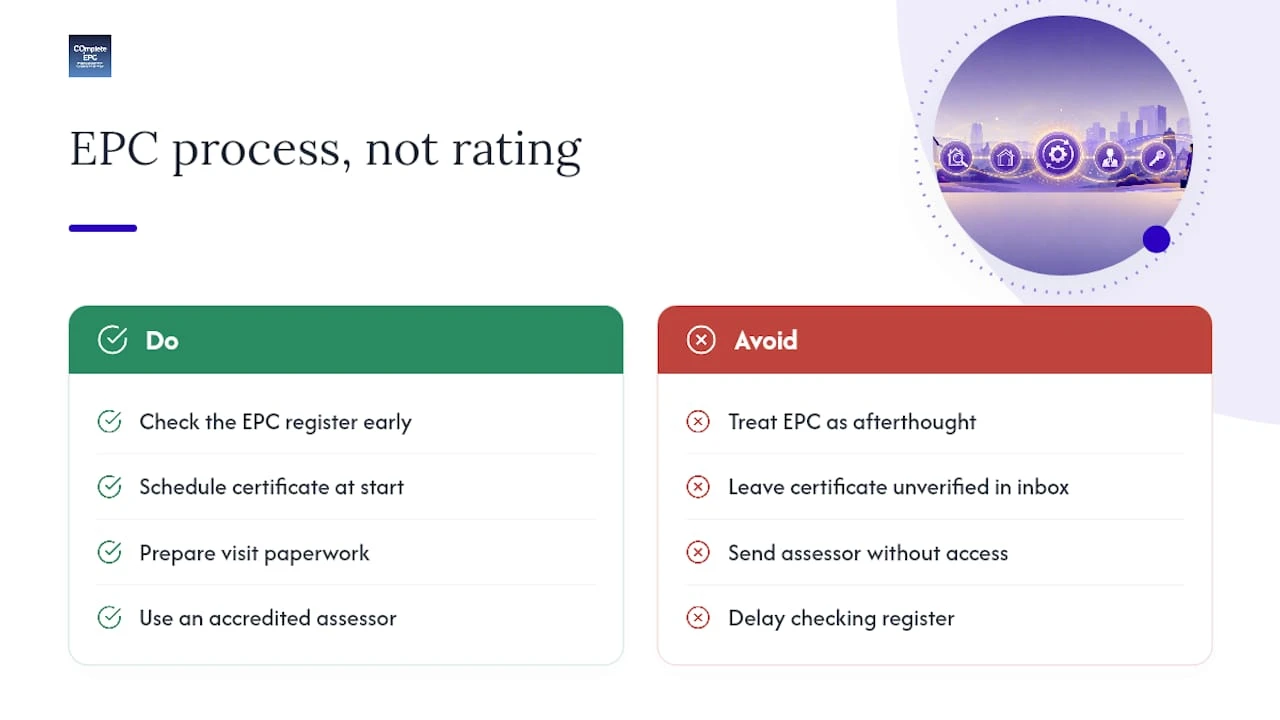
Accredited assessors reduce this risk in a way that is easy to underestimate. A prepared visit with insulation invoices, boiler data, and building control certificates on hand converts what would otherwise be a conservative, evidence-light assessment into an accurate one, and it usually shortens the time the assessor needs on site. That is the practical argument for treating documentation as seriously as the survey itself.
The uncomfortable truth for agents and solicitors is that the 7 and 21-day rules exist precisely because too many transactions used to treat the EPC as an afterthought. Building the certificate into the front of the timeline, not the back, is what actually prevents fines and delayed exchanges.
— Danny
Book your EPC assessment directly
There are services that provide a direct route to a lodged, legally valid certificate without chasing paperwork between multiple parties. For rental and sale properties, book through the domestic EPC service, where assessors handle the survey, the RdSAP inputs, and the lodgement. For offices, retail units, and larger buildings needing SBEM or dynamic simulation modelling, the commercial EPC service covers the more detailed data collection those assessments demand. Every booking includes the assessor visit, the lodged certificate, and the recommendation report as standard. Once the visit is complete, check the register within 24 to 48 hours to confirm your certificate is live, and keep the reference number in your transaction file. Booking early, well before marketing starts, helps stay clear of the statutory deadlines and any risk of a delayed listing.
Sources
FAQ
How long does the EPC process take from booking to certificate?
Allow around a week from initial enquiry to a valid, lodged certificate. The assessment itself takes 30 to 90 minutes for a domestic property, with lodgement following within 24 to 48 hours.
What documents should I prepare for the assessor?
Gather insulation invoices, boiler replacement certificates, PV commissioning paperwork, and any building control completion certificates. This evidence prevents the assessor defaulting to conservative assumptions that lower your rating.
How do I know my certificate is legally valid?
Check the property’s address on the national register 24 to 48 hours after the visit. A PDF emailed before lodgement does not count as a valid certificate until it appears there.
What happens if the certificate has incorrect information?
Supply supporting evidence and ask the assessor to re-lodge a corrected certificate, which usually does not require another site visit. Unresolved disputes can be escalated through the assessor’s accreditation scheme.