

Today, every domestic property let in England and Wales must hold an EPC of band E or higher, and landlords who let an F or G-rated home without a registered exemption are breaking the law. The government has confirmed its intention to raise that minimum to EPC C by 1 October 2030, but this remains policy, not statute. Your job now: get a current EPC, cost your fabric improvements, and plan against the confirmed target while complying with today’s rules.
TL;DR:
- Landlords must currently ensure their properties are at least EPC band E, with exemptions registered properly and evidence retained, avoiding penalties.
- The proposed EPC C standard by 2030 is policy-confirmed but not yet law, with a transitional easement allowing early compliance if achieved before October 2029.
- Cost caps for improvements are set at £3,500 now, rising to £10,000 in the proposed 2030 regime, with exemptions requiring detailed, retained documentation.
- Prioritize fabric improvements like insulation and draught-proofing over heating upgrades, as they provide better rating boosts under the new Home Energy Model.
- Early assessment and documentation, including pre- and post-works EPCs, help landlords avoid fines, with the process supported by trusted providers offering assessment services.
Table of Contents
- What does landlord energy regulations law require right now?
- Is EPC C by 2030 confirmed government policy or still a proposal?
- How do exemptions and cost caps actually work in practice?
- How do you commission an EPC and choose the right improvements?
- What happens if a landlord doesn’t comply?
- What’s the practical timeline for landlords to follow?
- How does Complete EPC support landlords through this process?
- How do energy rules fit with a landlord’s other legal duties?
- What trips landlords up most often when complying?
- A landlord’s honest read on where the real risk sits
- Get your EPC sorted before the compliance runway shortens
- Where to check the official position
- Sources
- FAQ
What does landlord energy regulations law require right now?
The current framework rests on two pieces of legislation: the Energy Performance of Buildings (England and Wales) Regulations 2012, which created the EPC system itself, and the Energy Efficiency (Private Rented Property) Regulations 2015, which introduced the Minimum Energy Efficiency Standard, known as MEES. MEES phased in gradually. From April 2018 it applied to new tenancies and renewals; from April 2020 it extended to all existing tenancies, closing the loophole that let some landlords sit on F and G-rated stock indefinitely.
The rule is straightforward: domestic private rented property must reach at least EPC band E before it’s legally lettable, unless a valid exemption is registered. This covers most tenancies under the Housing Act 1988, including assured and regulated tenancies, though certain lettings (some holiday lets, some listed buildings) sit outside scope. The practical test is simple. Check the current EPC. If it’s E or above, you’re compliant. If it’s F or G, you either improve the property or register an exemption before continuing to let it.
The cost cap that governs today’s obligation sits at £3,500 including VAT. If you’ve spent up to that amount on recommended improvements and the property still falls short of band E, you can register a high-cost exemption rather than keep spending. Common exemptions include:
- All improvements made: every measure recommended on the EPC has been installed and the property still can’t reach E.
- High-cost exemption: quotes for all relevant improvements exceed the £3,500 cap.
- Third-party consent refused: a tenant, freeholder, or planning authority has blocked the necessary work.
- Property devaluation: an independent surveyor confirms the improvement would cut the property’s market value by more than 5%.
- New landlord exemption: a short-term grace period for someone who has just become the landlord, typically through inheritance or a new letting.
Exemptions currently last five years and must be entered on the PRS Exemptions Register before you can rely on them. Skipping registration is one of the most common compliance failures. An unregistered exemption offers no legal protection, regardless of how genuine the underlying reason is.
Is EPC C by 2030 confirmed government policy or still a proposal?
This is where landlords most often confuse settled policy with enacted law, so it’s worth being precise. The government has confirmed its intention to lift the minimum EPC rating for domestic private rented property to band C by 1 October 2030, with a single compliance date rather than staggered tenancy start dates. That target has also been reframed around a new Home Energy Model, which measures fabric performance as the primary metric alongside a secondary indicator such as heating or smart readiness.
None of this is yet written into the 2015 Regulations. It’s a confirmed direction from the government’s response document, which still needs to pass through the parliamentary process before it binds landlords as law. That distinction matters for anyone deciding how urgently to act.
Key figures under the proposed 2030 regime:
- Cost cap rising to £10,000, roughly three times today’s £3,500 threshold.
- Maximum penalty proposed to rise substantially, well above the current cap.
- Government is working toward secondary legislation with an implementation window targeted around 2027, ahead of the 2030 compliance date.
The proposals also include a transitional easement worth knowing about now: a landlord who achieves EPC band C under the current assessment methodology before 1 October 2029 can be treated as compliant until that certificate expires, even after the new regime takes effect. For landlords planning improvements over the next few years, that’s a genuine incentive to act early rather than wait for the rules to firm up. Non-domestic landlords face a separate, less demanding trajectory: buildings over 1,000 square metres are proposed to reach EPC B by 2031, while smaller commercial premises stay at the existing E standard.
How do exemptions and cost caps actually work in practice?
Registering an exemption isn’t a box-ticking exercise. Local authorities can and do check the underlying evidence, and a poorly documented exemption can be rejected retrospectively, leaving you unprotected against enforcement.
- High-cost exemption: you need itemised quotes from installers for every improvement recommended on your EPC, showing the total exceeds the cost cap. Keep the quotes, not just a summary figure.
- All improvements made exemption: you need evidence that every recommendation has been actioned, typically confirmed through a post-works EPC or installer certification.
- Third-party consent exemption: written evidence of the refusal is essential, whether from a tenant, a superior landlord, a mortgage lender, or a planning authority.
- Devaluation exemption: an independent RICS-qualified surveyor’s report confirming the specific improvement would reduce value by more than 5%.
- New landlord exemption: proof of the date you became landlord, since this exemption is time-limited from that point.
Cost cap calculations generally include the price of the improvement work itself, and in many cases the cost of obtaining the EPC assessment can count too. Duration matters as much as evidence: exemptions currently run for five years under existing rules, though the proposed 2030 regime floats longer exemption periods for certain categories. Whichever duration applies, mark the expiry date somewhere you’ll actually see it. An exemption that lapses unnoticed puts you back in breach overnight.
Pro Tip: Photograph every stage of improvement work, not just the finished result. If an exemption claim is ever challenged, dated photos of insulation being fitted or a boiler being replaced are far more persuasive than an invoice alone.
How do you commission an EPC and choose the right improvements?
Start with an up-to-date domestic EPC if your current one has expired or you’re unsure of the rating. Certificates last ten years, but plenty of landlords are working from an assessment that predates recent works, which understates their actual position and wastes money on unnecessary improvements. An accurate pre-works EPC also gives you the specific list of recommended measures ranked by cost-effectiveness, rather than a generic checklist.
Fabric measures tend to deliver the best return for the effort involved. Energy Saving Trust guidance consistently points to loft insulation, cavity wall insulation, and draught-proofing as the measures that shift a rating the furthest per pound spent, because heat loss reduction is the largest single factor in most assessments. Heating system replacement, such as swapping a gas boiler for an air source heat pump, is often necessary eventually, but it’s rarely the most cost-effective first move, and the proposed Home Energy Model’s fabric-first weighting reinforces that order of operations.
Once works are complete, commission a post-works EPC. This isn’t optional box-ticking. It’s the evidential record that proves the improvement happened, protects you if a tenant or authority later queries the property’s rating, and is the document that can trigger the 2029 transitional easement if you reach band C early.
- Get quotes from at least two or three contractors before committing spend, particularly for anything approaching the cost cap.
- Ask installers for itemised invoices that separate labour and materials, since this detail matters for cost cap calculations.
- Where solar panels or battery storage are being considered as part of a smart-readiness upgrade, a specialist renewable energy installer can advise on what actually moves the secondary metric.
- Retain every certificate, warranty, and building control sign-off alongside the EPC itself.
Pro Tip: Ask your assessor for the EPC’s full recommendation report, not just the certificate. It ranks improvements by predicted rating impact, which is the fastest way to spend your cost cap on what actually moves the needle.
What happens if a landlord doesn’t comply?
Local authorities, usually through trading standards or private sector housing teams, hold the enforcement powers for MEES. They can issue compliance notices requiring landlords to provide evidence, demand information about a property’s rating and any exemption claimed, and impose civil penalties where a breach is confirmed.
Under the current regime, penalties are tiered by how long the breach has lasted, up to a maximum of £5,000 per property. The proposed 2030 framework would raise that ceiling considerably, to a maximum of £30,000 per property, which changes the calculation for landlords tempted to let non-compliant stock and hope enforcement never arrives.
Build a simple compliance defence pack for each property, containing:
- The current EPC and any prior versions showing improvement history.
- All contractor quotes and invoices for works carried out.
- Exemption registration confirmation, where applicable, with supporting evidence.
- Correspondence with tenants or third parties relevant to any consent-based exemption.
Local authorities have discretion in how aggressively they check compliance, but properties flagged through tenant complaints or routine licensing checks face the most scrutiny. Keeping this pack current, rather than assembling it reactively after a compliance notice lands, is the difference between a fast response and a stressful one.
What’s the practical timeline for landlords to follow?
Breaking the runway into phases keeps this manageable rather than overwhelming.
- Now: Check every property’s EPC status and expiry date. Where a certificate is missing or outdated, commission a new domestic EPC or commercial EPC depending on the premises type.
- Now to 2027: Get quotes for fabric improvements on any property below band C. Spend from 1 October 2025 is expected to count toward the proposed cost cap, so early quotes and early works aren’t wasted effort even before the law formally changes.
- 2027 to 2029: Schedule works with enough lead time to avoid the contractor bottleneck that typically hits as a statutory deadline approaches. Assessor and installer demand tends to spike in the final eighteen months before any compliance date.
- Before 1 October 2029: Where achievable, secure a post-works EPC showing band C under the current methodology to benefit from transitional grandfathering.
- Before 1 October 2030: Register any necessary exemption, finalise your evidence pack, and confirm every property in your portfolio has a compliant, current EPC on file.
| Timeframe | Priority action | Evidence to keep |
|---|---|---|
| Now | Check EPC status and rating | Current EPC certificate |
| Now to 2027 | Quote fabric improvements | Itemised contractor quotes |
| 2027 to 2029 | Complete works, book assessors early | Invoices, photos, warranties |
| Before Oct 2029 | Secure post-works EPC at band C or above | Post-works EPC certificate |
| Before Oct 2030 | Register exemptions if still short | PRS Exemptions Register confirmation |
How does Complete EPC support landlords through this process?
Complete EPC provides the certification and assessment services that sit at the centre of this compliance workflow, covering both domestic EPCs and commercial EPCs for landlords managing mixed portfolios across London. For landlords handling new builds, conversions, or extensions, SAP calculations establish the compliance modelling needed before a certificate can even be issued.
Beyond the certificate itself, wider compliance often overlaps with other assessments: SBEM calculations for new commercial developments, TM59 overheating and TM52 thermal comfort analysis where planning conditions demand it, and TM44 air conditioning inspections for larger commercial units.
Engaging a qualified assessor makes the most sense at two points: before works, to get an accurate baseline and a ranked list of recommendations, and after works, to produce the evidential post-works EPC that protects you if compliance is ever questioned. A DIY estimate of your rating is never a substitute for a proper assessment, since the underlying calculation methodology behind EPC ratings is not something a landlord can approximate accurately from a room measurement and a boiler age.
How do energy rules fit with a landlord’s other legal duties?
Energy compliance doesn’t sit in isolation. It overlaps constantly with the safety and tenancy obligations landlords already manage, and treating them separately is how gaps appear.
Gas Safety checks, electrical safety inspections, and MEES compliance often get scheduled independently, but they frequently touch the same fabric of the property. A boiler replacement done to improve an EPC rating also needs to satisfy Gas Safety Regulations, and rewiring work carried out alongside insulation upgrades should be captured in an Electrical Installation Condition Report rather than left undocumented. Bundling these inspections when major works happen saves both cost and admin.
Tenancy agreements matter too, particularly around the third-party consent exemption. If a tenancy agreement gives a sitting tenant strong rights over alterations to the property, and that tenant refuses access for improvement works, this becomes your documented evidence for an exemption claim, not just an inconvenience. Equally, Section 21 and Section 8 possession routes under the Housing Act 1988 can be affected where a landlord has failed to provide a valid EPC to the tenant at the start of the tenancy, since this is one of the prescribed documents required for a valid Section 21 notice.
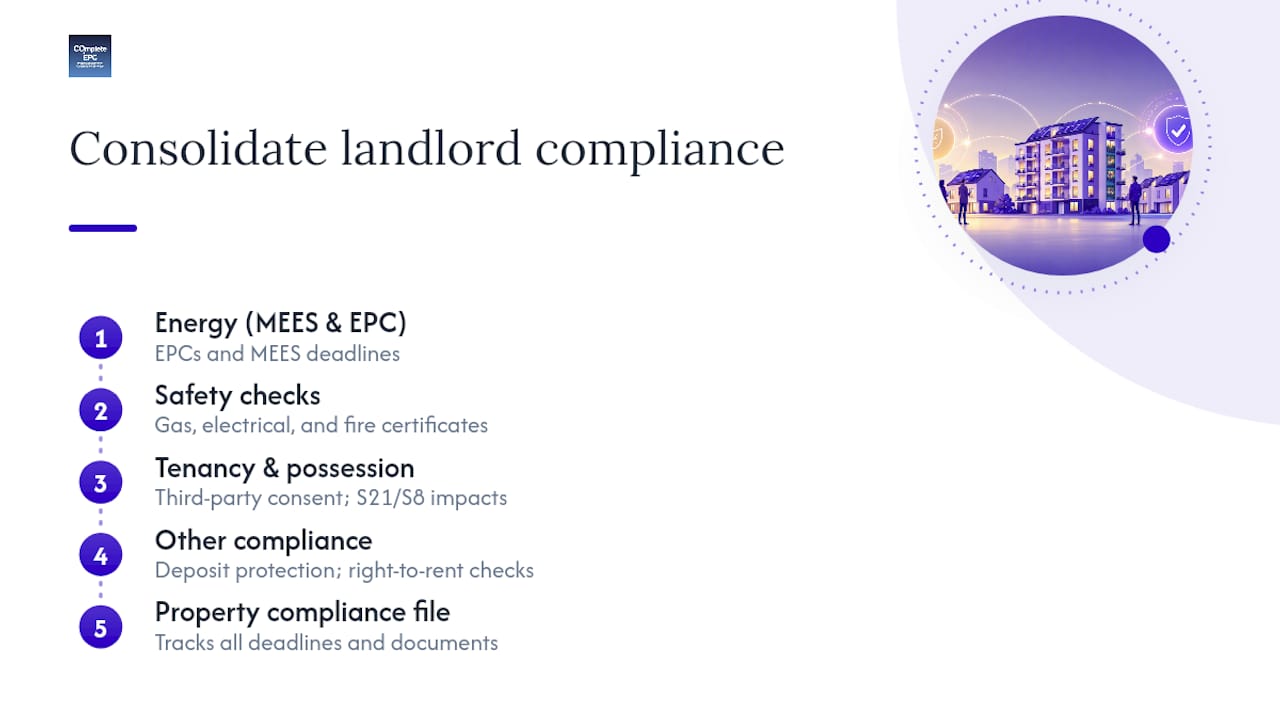
Fire safety, deposit protection, and right-to-rent checks all sit on the same compliance calendar as MEES. Building a single property file that tracks every legal deadline together, rather than one system for energy and another for safety, is the only way to avoid a compliant EPC sitting alongside an expired gas certificate.
What trips landlords up most often when complying?
Most compliance failures aren’t wilful. They’re the result of timing mistakes, poor recordkeeping, or misunderstanding what actually counts as evidence.
The most frequent pitfall is relying on an outdated EPC and assuming it still reflects the property. Certificates last ten years, so a landlord who improved a property in 2019 might still be working from a 2016 assessment that doesn’t reflect the current rating, either understating compliance or missing an opportunity to demonstrate it.
The second is registering an exemption without adequate evidence, then discovering under a local authority information request that the quotes, surveyor reports, or refusal letters weren’t retained. An exemption claim without paperwork is functionally worthless if challenged.
A third common error is spending against the cost cap inefficiently, chasing a heating system upgrade before addressing basic insulation, which usually costs less and moves the rating further. Given the confirmed fabric-first weighting in the Home Energy Model, this mistake is likely to get more expensive, not less, as the 2030 deadline approaches.
Finally, many landlords underestimate lead times. Assessors and retrofit contractors get busier as statutory deadlines near, and last-minute bookings in 2029 are likely to cost more and move slower than the same work arranged years ahead. Addressing all four issues comes down to the same habit: treat energy compliance as an ongoing file to maintain, not a one-off task to complete and forget.
A landlord’s honest read on where the real risk sits
The conventional advice on this topic tends to flatten “EPC C by 2030” into a simple deadline, as though landlords have years to think about it. That’s a mistake. The real risk isn’t the 2030 date itself. It’s the compressed window between confirmed policy becoming enacted law, likely around 2027, and the deadline itself, when every landlord who delayed will be competing for the same assessors and the same insulation contractors.
What’s underrated is the transitional easement. A landlord who reaches band C under today’s methodology before 1 October 2029 buys genuine breathing room, and very few landlords seem to be planning around that date deliberately. Most are still treating 2030 as the only number that matters.
What’s overrated is chasing heating system upgrades as the first move. Given the fabric-first weighting in the proposed Home Energy Model, insulation and draught-proofing usually deliver more rating improvement per pound than a boiler swap, and they’re rarely blocked by third-party consent issues the way heating changes sometimes are. Prioritise the boring fabric work first. The certificate, the evidence trail, and the cost cap arithmetic all follow from getting that sequence right.
— Danny
Get your EPC sorted before the compliance runway shortens
Complete EPC offers a straightforward alternative to piecing together compliance evidence yourself: a booked assessment, a qualified assessor, and a detailed report with ranked recommendations. Whether you need a baseline EPC before commissioning improvements or a post-works certificate to lock in the 2029 transitional benefit, the process runs the same way. Book online, an assessor visits the property, and you receive the certificate along with the recommendation report that tells you exactly which measures to prioritise against your cost cap.
For residential lettings, start with a domestic EPC assessment. For commercial or mixed-use premises, the commercial EPC service covers the equivalent requirement. If you’re planning a conversion or new build, a SAP calculation gets your compliance modelling sorted before construction finishes, not after. Book your assessment now and get ahead of the 2027 to 2029 bottleneck before every landlord on your street has the same idea.
Where to check the official position
MEES policy details continue to evolve as secondary legislation progresses, so treat GOV.UK as the final word on anything time-sensitive.
- Domestic MEES landlord guidance, for the current legal minimum and exemption rules.
- Government response on privately rented homes energy performance, for the confirmed 2030 policy direction.
- Find an EPC, to check or retrieve a property’s existing certificate.
Sources
- Domestic private rented property: minimum energy efficiency standard – landlord guidance
- Improving the energy performance of privately rented homes: government response (Warm Homes Plan)
FAQ
What are the new rules for landlords in 2026?
No new statutory rules have taken effect recently. Landlords must still meet the current EPC band E minimum under MEES, while the proposed EPC C by 2030 standard remains confirmed government policy awaiting secondary legislation.
What is the EPC deadline for landlords in 2030?
The government has confirmed an intention for domestic private rented properties to reach EPC band C by 1 October 2030. This isn’t yet law, but landlords achieving band C before 1 October 2029 under current methodology may be treated as compliant until that certificate expires.
Do landlords have to decorate every 5 years?
No, there’s no statutory decoration requirement tied to a five-year cycle. Redecoration typically falls under the tenancy agreement or landlord discretion, separate from energy efficiency obligations, though PRS exemptions currently run on a five-year registration period, which is often confused with a decoration cycle.
What are the landlord’s heating requirements in the UK?
There’s no separate standalone heating regulation beyond MEES and Gas Safety Regulations, but heating performance feeds into a property’s overall EPC rating. Under proposed reforms, heating and smart readiness would sit as a secondary metric alongside fabric performance as the primary measure, per the Home Energy Model impact assessment.
How much does an EPC cost from Complete EPC?
Pricing for domestic and commercial EPC assessments is available on request through Complete EPC’s domestic EPC and commercial EPC pages.