

Yes, you can find an EPC by postcode using the official GOV.UK register, which also lets you search by address or certificate number. Before trusting the result, confirm three things: the exact unit or flat identifier, the certificate reference number, and the lodging date. An EPC is normally valid for 10 years, so an old result may no longer reflect the property’s current rating.
TL;DR:
- An EPC score can be verified by matching the property’s certificate reference number, issue date, and assessor’s accreditation, as older certificates may no longer be valid.
- Postcode searches are most effective for quiet streets but can return too many results for blocks of flats, requiring additional unit-specific details for accuracy.
- When a search yields no results, checking alternative address formats, certificate references, or commissioning a new assessment ensures current and valid certification.
- Most rental properties in England and Wales must meet at least band E to be let legally, and outdated certificates can mislead compliance decisions.
- Using the open-data API or booking a professional assessment through completeepc.co.uk offers the most reliable method to update or obtain a valid EPC.
Table of Contents
- How to search the EPC register by postcode
- What an EPC shows, and how to check it’s the right one
- Validity, expiry and the UK’s different registers
- No result, an expired certificate, or a withheld record: what to do next
- MEES checklist for landlords and agents
- How Completeepc supports EPC checks and new assessments
- Practitioner perspective: the mistakes people repeat
- Get an EPC sorted through Completeepc
- Sources
- FAQ
How to search the EPC register by postcode
Finding a certificate takes a couple of minutes if you use the right search terms. The Find an energy certificate service on GOV.UK covers England, Wales and Northern Ireland. It accepts three types of search.
- Postcode search. Enter the full postcode to see every certificate lodged for addresses within it. This works well on quiet streets but returns a longer list on blocks of flats or converted terraces.
- Street and town search. Useful when a postcode search returns too many results or when you only have a partial address.
- Certificate reference number. The most reliable method when you already hold paperwork from a previous transaction, since it pulls up exactly one record.
Property professionals handling several assessments at once should use the open-data service and API rather than repeating manual postcode searches. When a postcode search returns multiple addresses, check the unit number or flat description against the certificate reference before treating any single result as the correct one, since flats, annexes and converted units frequently share a postcode.
What an EPC shows, and how to check it’s the right one
Every certificate carries the same core fields, and knowing what they mean makes verification straightforward. The rating itself runs from A, the most efficient, to G, the least efficient, and the technical notes published by GOV.UK set out exactly how assessors calculate it.
A certificate also states the property’s potential rating (what it could achieve with recommended upgrades), a list of improvement recommendations, the assessor’s name and accreditation number, the issue date, and the floor area used in the calculation.
Statistic Callout: The A to G scale is the same scale used across every domestic and commercial certificate in England, Wales and Northern Ireland, which is what makes a postcode lookup useful for comparing similar properties on the same street.
Before relying on any figure, run through this quick check:
- Match the certificate reference number shown online against any paperwork you already hold.
- Confirm the lodging or issue date, since an old certificate may have been superseded by a newer one.
- Check the assessor’s accreditation scheme is listed and current.
Remember that an EPC rates the building’s fabric and fixed systems, not the occupants’ habits, so two similar flats can carry different scores for reasons that have nothing to do with how efficiently anyone lives in them.
Validity, expiry and the UK’s different registers
An EPC is normally valid for 10 years from its issue date, but the register itself keeps far older records on file. That distinction catches people out constantly: a certificate can still appear in a postcode search years after it has technically expired, so the date field matters more than the fact that a result exists at all.
Jurisdiction matters too. England and Wales share one register and one open-data service. Scotland runs its own separate system entirely, so a London postcode search tool will never return a Scottish property. Northern Ireland has its own arrangements as well.
- Always check whether a later certificate exists for the same unit before acting on an older one.
- Non-domestic certificates use a different assessment process to domestic EPCs, and the non-domestic search API filters by property type, energy band and lodging date separately, so never compare a commercial score directly against a house next door.
No result, an expired certificate, or a withheld record: what to do next
A blank search result is not proof that a property has no valid EPC, and treating it that way is one of the most common mistakes buyers and tenants make. Owners can opt out of public disclosure in some circumstances, and a mistyped address format hides results just as effectively as a genuine gap in the register.
- Try alternative address formats. Drop the flat number, try the building name instead of the number, or search by street and town if the postcode search comes up empty.
- Search by certificate reference if you have any old paperwork, since this bypasses address-matching issues entirely.
- Check whether the certificate has expired. A result that once existed can fall outside the useful 10-year window.
- Commission a new assessment with an accredited assessor if none of the above produces a valid, current certificate, following the process GOV.UK sets out for getting a new energy certificate.
Pro Tip: Keep the certificate reference number and lodging date in your transaction file the moment you find a valid result. Estate agents and solicitors ask for this exact pairing repeatedly during a sale or letting, and having it ready saves a second search later.
MEES checklist for landlords and agents
A postcode lookup is only useful to a landlord if it’s read against the letting rules, not just the rating on its own. In England and Wales, most domestic rental properties need a band of E or above to be let legally, under the minimum energy efficiency standard.
- Confirm the band shown and cross-check the issue date, since a certificate lodged years ago may no longer represent the property accurately.
- If the property falls below band E, check whether a valid exemption applies and what evidence the exemption register requires.
- Keep documentary evidence of any exemption or improvement work alongside the certificate reference, since enforcement bodies can ask for it during checks.
Landlords planning fabric upgrades to move a property out of a low band, such as insulation or window replacements carried out through a specialist like EvoStruct Design & Build, should book a fresh assessment once the work finishes rather than relying on the pre-works certificate.
How Completeepc supports EPC checks and new assessments
When a postcode search leaves you short of a usable, current certificate, the fastest route is booking a fresh assessment rather than chasing an outdated record. Completeepc carries out both the Domestic Energy Performance Certificate and Commercial EPC assessments, alongside SAP and SBEM calculations for new-build or planning-stage projects.
Before an assessor visits, have the following ready:
- Access to every room, loft space and any outbuildings the assessor needs to inspect.
- Building particulars: construction date, extensions, glazing type and heating system.
- Any existing exemption evidence if the property previously fell below the required band.
Qualified assessors work through this checklist methodically, which keeps the audit trail intact for landlords who later need to prove compliance or justify an exemption.
Practitioner perspective: the mistakes people repeat
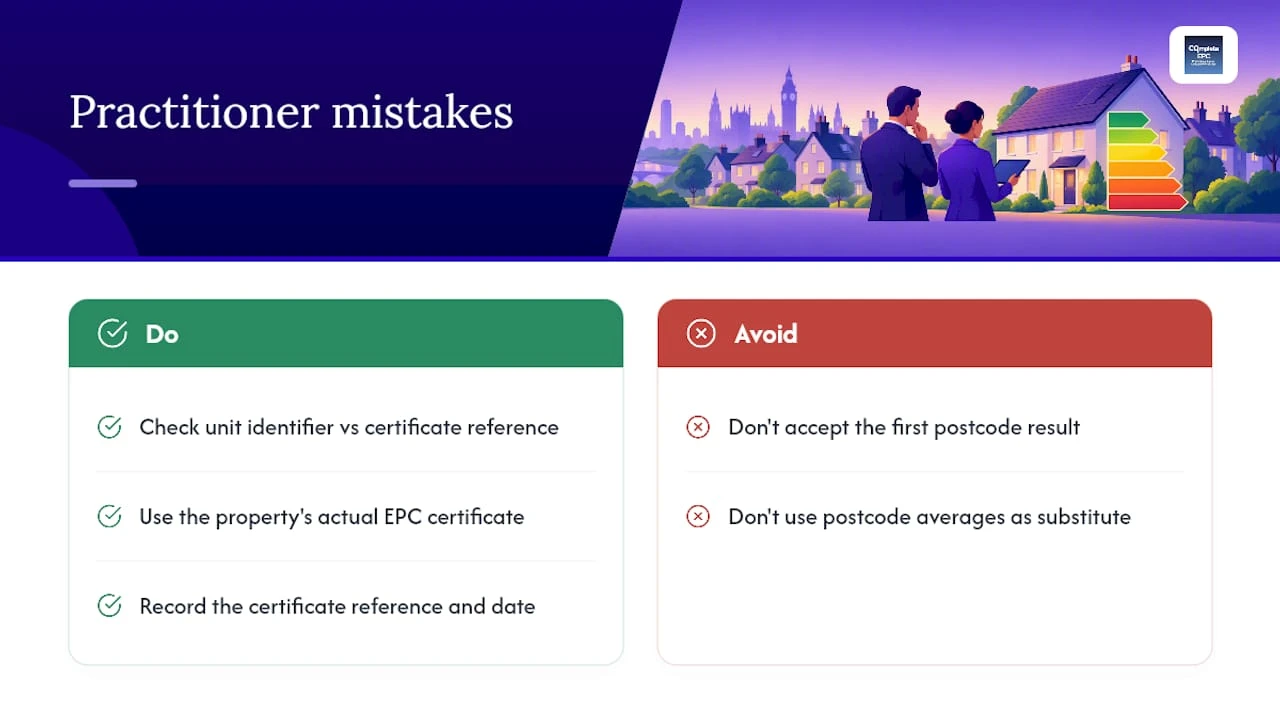
The single most common error is picking the first address a postcode search returns without checking the unit identifier against the certificate reference. Flats and converted terraces routinely share a postcode, and grabbing the wrong record means relying on a rating that belongs to a different property entirely.
The second mistake is treating a postcode’s average energy performance as a stand-in for one property’s actual certificate. Neighbourhood figures are indicative at best, never a substitute for the specific document tied to the address in question. Whatever the search turns up, keep the reference number and date on file. That habit alone resolves most disputes before they start.
— Danny
Get an EPC sorted through Completeepc
There are other ways to hunt down a missing or outdated certificate, from repeated manual postcode searches to chasing paperwork through a previous agent. Completeepc offers a more direct route: book a qualified assessor for a Domestic Energy Performance Certificate or Commercial EPC assessment and get a new, current certificate lodged rather than relying on a record you can’t fully verify. Completeepc offers pricing claimed to be competitive, and its assessors handle the paperwork end to end, including exemption evidence for landlords who need it. If your search has turned up nothing usable, or the property needs works before it can hit band E, request a quote through the relevant service page and get a firm date booked in.
Sources
FAQ
Can I find an EPC by address instead of postcode?
Yes. The GOV.UK Find an energy certificate tool accepts a full address, a street and town combination, or a certificate reference number as alternatives to a postcode search.
What is my property’s EPC rating?
Search your postcode or address on the official register and match the certificate reference and issue date to your property before reading off the A to G rating shown on the technical notes scale. If no valid certificate exists, Completeepc can carry out a Domestic EPC assessment to establish one.
Is it a legal requirement to have an EPC?
Yes, most properties being sold, let or newly built in the UK need a valid EPC, and rental properties in England and Wales generally need to reach band E or above under minimum energy efficiency standard rules unless a registered exemption applies.
What is a good EPC rating?
Bands A and B represent the most efficient properties, while C is generally considered a solid, above-average result for most existing housing stock. Anything at E or below should prompt a landlord to check letting eligibility and exemption status straight away.