
The fastest gains come from cutting waste before adding technology: fix draughts, dial in heating controls, and switch to LED lighting this week. Loft top-ups and cavity wall insulation follow as the next-best investment, since roughly 70% of heat loss in an uninsulated house escapes through the roof, walls and floors. Solar panels and heat pumps come later, once an EPC or home energy audit tells you which upgrades actually pay off in your property.
TL;DR:
- Insulating the roof and cavity walls offers the highest return on investment since about 70% of heat loss in uninsulated homes occurs through these areas.
- Quick wins, such as switching to LED bulbs, sealing drafts, and using thermostatic radiator valves, can significantly cut energy use within weeks at minimal cost.
- Proper heating controls, including smart thermostats and annual boiler servicing, can prevent energy waste caused by poor settings or equipment inefficiency.
- Conducting an EPC or professional audit is essential before major upgrades, as it provides a property-specific list of the most effective measures and prevents costly missteps.
- Combining fabric improvements with renewables like solar panels or heat pumps is most effective after addressing basic insulation and controls.
Table of Contents
- Quick wins: low- and no-cost actions to cut consumption this week
- Heating and hot-water controls: set up for comfort and efficiency
- Insulation and building fabric: where to spend for biggest effect
- Renewables and low-carbon heating: when solar or a heat pump is the right next step
- Start with an EPC or professional audit: targeted diagnostics save money
- Costs, grants and typical payback expectations
- A simple starter plan: week 1 → months → 12 months
- What years of EPC assessments teach you about real savings
- How energy performance assessments help you plan the right upgrades
- Sources
- FAQ
Quick wins: low- and no-cost actions to cut consumption this week
You don’t need a tradesperson for the first round of savings. Most of it is habit and a few cheap parts from a hardware shop.
- Swap to LED bulbs throughout the house, and add motion sensors in hallways, landings and outdoor spaces where lights get left on.
- Kill phantom load. Chargers, set-top boxes and games consoles draw power on standby, so route them through a switched extension strip you can flick off at night.
- Run full loads only. Washing machines and dishwashers use similar energy whether half full or full, so batch laundry and switch to a 30°C cycle where the fabric allows.
- Shift heavy appliances to off-peak hours if your tariff rewards it, rather than running them during the evening peak.
- Stop draughts at the source. Threshold strips under doors, a letterbox brush, and keyhole covers close the small gaps that let heat escape all winter.
- Use curtains and thermal blinds properly. Close them at dusk to trap heat, but open them during sunny winter days to let free warmth in.
Pro Tip: Draught-proofing a single external door with a £5 brush strip and a letterbox cover often pays for itself within a fortnight of winter heating.
Heating and hot-water controls: set up for comfort and efficiency
Your boiler and thermostat do more damage to a bill through poor settings than through poor equipment. Carbon Trust’s guidance on heating systems recommends a sensible thermostat dead band, a gap of several degrees between your heating and cooling set points, to stop a system fighting itself and wasting energy on simultaneous heating and cooling. Try dropping your central thermostat by 1°C for a week and see whether anyone notices.
- Fit a programmable timer or smart thermostat so the heating never runs in an empty house.
- Install thermostatic radiator valves (TRVs) on each radiator to heat only the rooms you use.
- Book an annual boiler service. A well-tuned boiler burns less gas for the same output.
- Lag your hot-water cylinder and any exposed pipework in the loft or under the floor.
None of this costs much, and it compounds with everything else you do to the fabric of the building.
Insulation and building fabric: where to spend for biggest effect
Insulation is where a homeowner’s budget works hardest, because it addresses the biggest source of loss rather than a symptom of it. Government figures put heat loss through an uninsulated roof, walls and floors at around 70% of the total, which is why loft top-ups and cavity wall insulation sit at the top of most retrofit plans.
- Start with the loft. Check the existing depth; anything below the recommended level is worth topping up, and it is usually the cheapest fix per degree saved.
- Move to cavity wall insulation next if your property has an unfilled cavity.
- Consider solid wall or floor insulation only where the building type calls for it, since these jobs cost more and need proper detailing.
- Pair any airtightness work with ventilation. Extract fans in kitchens and bathrooms, or mechanical ventilation with heat recovery (MVHR) in very airtight homes, stop the condensation and mould that can follow sealing up a draughty house.
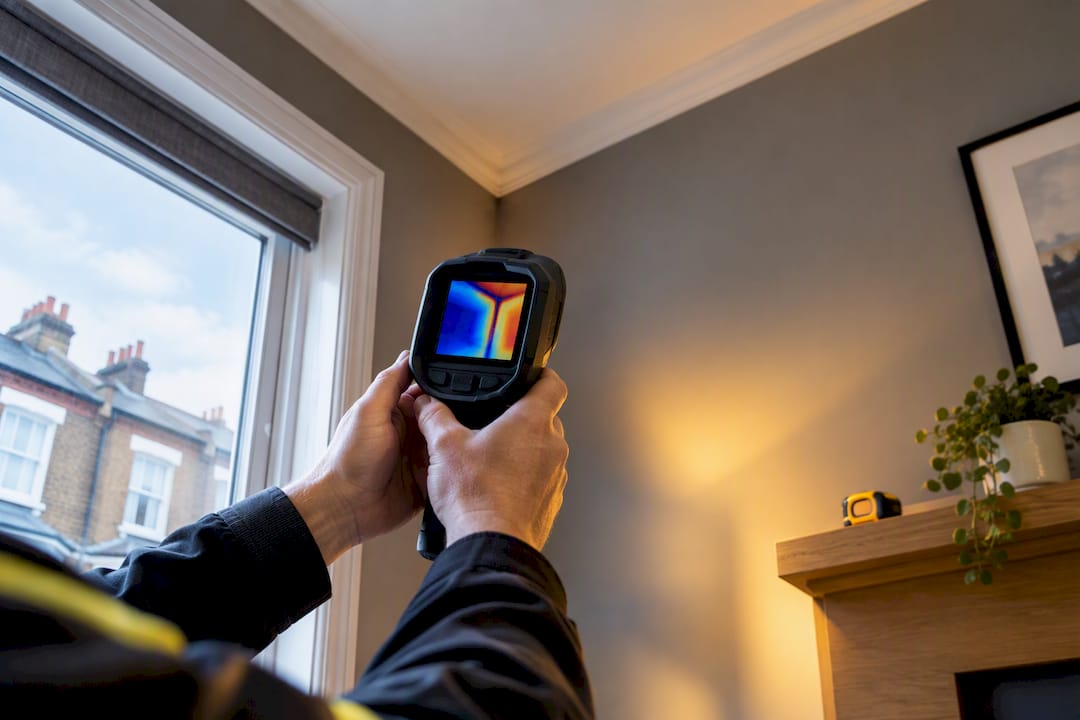
Verifying the work matters as much as doing it. Thermography, an infrared camera survey, can reveal thermal bridging, air leaks and hidden moisture that a visual inspection misses, both before insulation goes in and after it’s finished. Roof condition plays into this too. A well-specified roof surface can reduce heat gain and ease the load on cooling in warmer months, something covered in detail in this guide to cool roofing.
Renewables and low-carbon heating: when solar or a heat pump is the right next step
Solar panels and heat pumps sit at the top of the efficiency ladder, not the bottom. They’re worth serious money, and they work best once the fabric and controls above are sorted.
Solar PV performs best on an unshaded, south-facing roof. East or west-facing roofs are still viable, but the Energy Saving Trust notes they typically generate around 15 to 20% less energy than an equivalent south-facing array, so factor that into your payback sums before committing.
- Check whether your home is genuinely “heat pump ready.” Many properties need fabric upgrades, larger radiators, or extra electrical capacity before a heat pump runs efficiently.
- Pair solar with battery storage and a time-of-use tariff if you want to capture more of the value from what you generate.
- Get at least three quotes from MCS-registered installers for both solar and heat pump work; this is standard advice from the Energy Saving Trust for any major energy investment.
Start with an EPC or professional audit: targeted diagnostics save money
Guessing at improvements wastes money. An Energy Performance Certificate, whether a Domestic Energy Performance Certificate for a house or flat or a Commercial EPC for business premises, ranks the measures most likely to cut your specific property’s energy use, in order of cost-effectiveness. A proper audit takes a whole-house view, so a loft top-up doesn’t create a damp problem two rooms over, and it improves the payback on every measure that follows because the sequence is right.
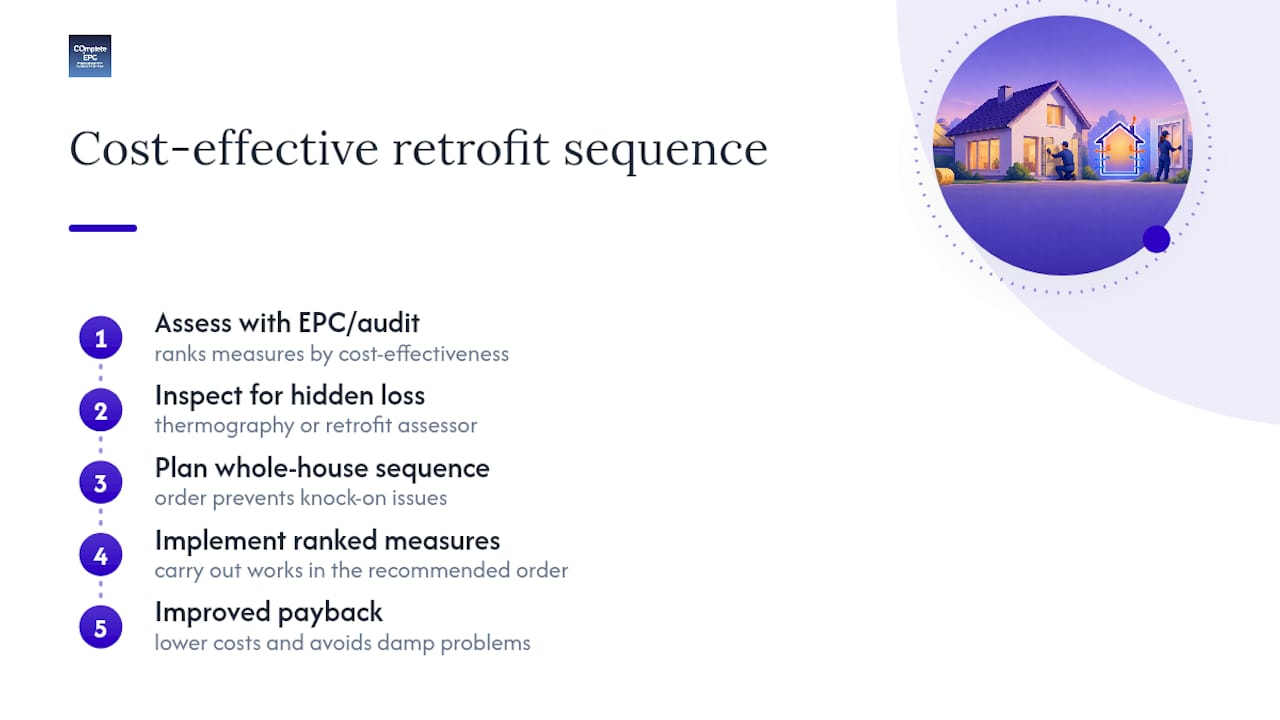
Energy Saving Trust’s own retrofit guidance backs this approach: start with the assessment, then plan works around what it finds. Ask for a thermographic survey alongside the assessment if you suspect hidden heat loss, or bring in a retrofit-specific assessor for older or unusually built properties.
Costs, grants and typical payback expectations
Costs vary by property, but rough brackets help with planning. Loft top-ups typically run to a few hundred pounds; cavity wall insulation usually sits in the low thousands; heat pumps carry a considerably higher capital cost than a boiler swap.
- Check whether you qualify for a supplier obligation scheme; programmes such as ECO4 fund a range of measures for eligible households under a whole-house approach.
- Ask your local authority about area-based grants, since eligibility rules shift by region.
- Bundle measures where you can. A whole-house package generally improves overall payback compared with tackling one fix at a time.
A simple starter plan: week 1 → months → 12 months
You don’t need to do everything at once. A staged plan keeps costs manageable and lets each step inform the next.
- This week: draught-proof doors and windows, switch to LED bulbs, unplug or switch off standby devices.
- Within a month: book your annual boiler service, fit TRVs, and check your loft insulation depth.
- Within three months: book a Domestic EPC or home energy audit to get a property-specific priority list.
- Within 12 months: collect installer quotes for the top-ranked measures, schedule the works, and verify the results with a thermographic check where insulation or airtightness work was involved.
Pro Tip: Book your EPC before you commit to any big-ticket upgrade. It costs far less than a heat pump quote and tells you whether that heat pump is even the right next move.
What years of EPC assessments teach you about real savings
Years of writing EPC recommendations and retrofit reports show the same pattern on repeat: the households that save the most aren’t the ones who buy the flashiest kit, they’re the ones who fix the boring stuff first. Draught-proofing and a loft top-up routinely deliver a payback inside a couple of years, long before a heat pump or solar array even gets a look-in. Professional assessment doesn’t slow you down. It stops you spending on the wrong thing.
— Danny
How energy performance assessments help you plan the right upgrades
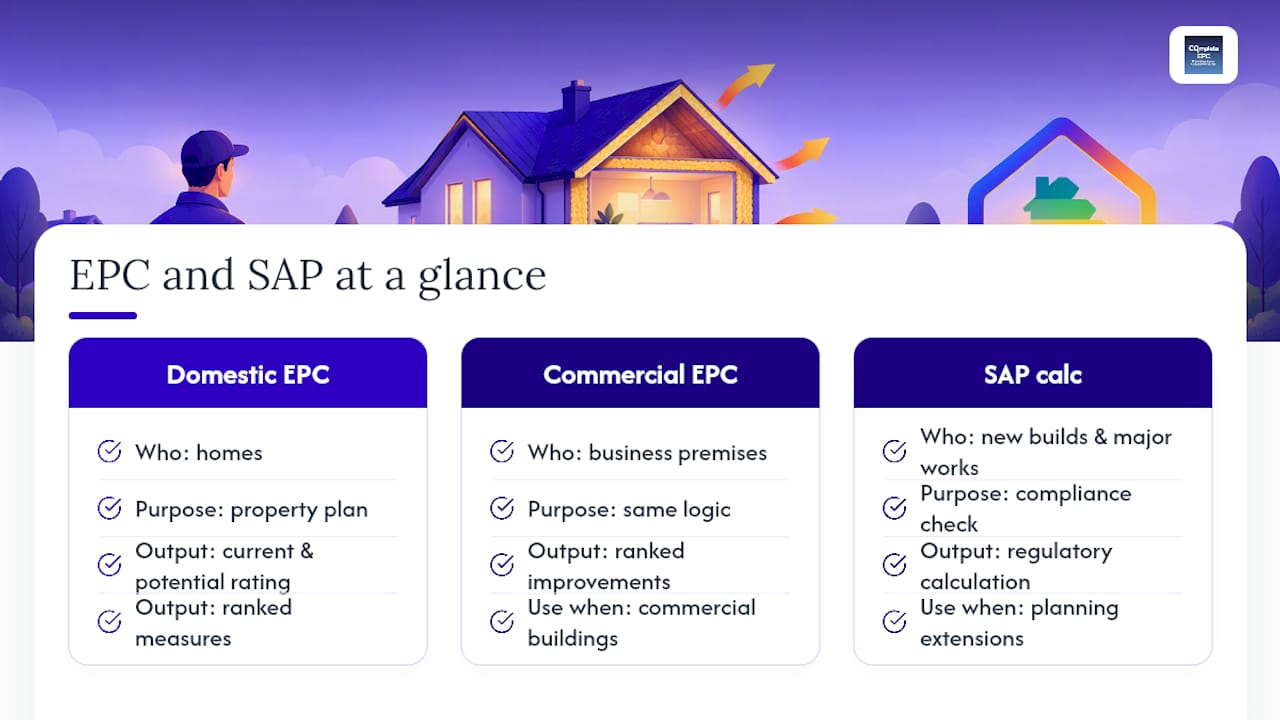
A Domestic Energy Performance Certificate provides a property-specific, ranked list of improvements rather than generic advice, so you spend on what actually moves the needle in your home. Book an assessment and a qualified assessor visits, surveys the property, and returns a report with your current rating, your potential rating, and the measures that get you there in order of cost-effectiveness.
If you manage a business premises rather than a home, the same logic applies through a Commercial EPC, and anyone planning a new build, extension, or major alteration will also need a SAP calculation to demonstrate compliance with building regulations. Start with a Domestic Energy Performance Certificate if you’re not sure where to begin. It’s the cheapest way to find out exactly what your property needs before you spend a penny on the bigger jobs.
Sources
For official guidance, consult the Energy Saving Trust’s retrofit advice, the Carbon Trust’s building fabric guide, and current government energy efficiency scheme statistics.
- Heating, ventilation and air conditioning guide | Carbon Trust
- Solar panels advice | Energy Saving Trust
- Energy Innovation Needs Assessment: Heat and buildings (EINAs 2025)
FAQ
How can I improve energy efficiency at home?
Start by cutting waste: draught-proof doors and windows, switch to LED bulbs, and set your heating with a programmable thermostat or TRVs. Once the quick wins are done, get a Domestic Energy Performance Certificate to identify which insulation or heating upgrades will save the most in your specific property.
What are 10 ways to save energy at home?
The highest-impact actions include draught-proofing, switching to LED lighting, fitting TRVs, servicing your boiler annually, insulating the hot-water cylinder, topping up loft insulation, running full laundry loads, cutting standby power, using thermal curtains, and lowering your thermostat by a degree. Layer them in that rough order for the fastest payback.
What are 20 ways to conserve energy?
Beyond the basics above, consider cavity wall insulation, solar panels on a south-facing roof, a heat pump once your home is fabric-ready, motion-sensor lighting, off-peak appliance scheduling, and battery storage paired with a time-of-use tariff. A whole-house audit is the quickest way to see which of these apply to your property and in what order.
Is 100% energy efficiency possible?
No system converts all its input energy into useful output with zero loss, so 100% efficiency isn’t achievable in a real home. The realistic goal is reducing unnecessary waste through better insulation, controls and habits, which is exactly what an EPC assessment is designed to prioritise.
Do I need an EPC before making energy improvements?
You don’t legally need one to start small jobs like draught-proofing, but it’s the most reliable way to know which bigger measures will actually pay off. A Domestic Energy Performance Certificate ranks improvements by cost-effectiveness for your specific property, so you avoid spending on the wrong upgrade first.