

Property investors should plan for an effective EPC of C by 2030, not the current minimum of E. Commission a current EPC now, and budget an average of around £5,400 per property for upgrades. Skipping this check before exchange or bidding risks buying a compliance liability rather than an asset.
TL;DR:
- Most properties will need upgrades costing around £5,400 on average to meet the new EPC C standard before 2030.
- Reassessments under the new Home Energy Model may reduce EPC ratings for poorly insulated homes, even without physical changes.
- The legal EPC minimum for letting will rise from band E to an equivalent of band C by October 2030, with a £10,000 spending cap per property.
- Exemptions are measure-specific, time-limited, and enforceable by local authorities, making non-compliance a real liability risk for landlords.
- Higher EPC ratings can significantly boost property values and rental income, with premiums of up to 10.9% for A or B rated buy-to-let homes.
Table of Contents
- What an EPC rating means for a property investor
- MEES rules, cost caps and exemptions landlords need to track
- Does a better EPC rating actually increase rent and value?
- Investor checklist: what to verify before you make an offer
- Financing the upgrade and modelling your return
- Why a qualified assessor matters for compliance evidence
- Retrofit measures that actually move the needle by property type
- What typical EPC upgrade journeys look like for investors
- How EPC ratings affect landlord insurance and liability
- Tracking legislation beyond the 2030 deadline
- Author’s strategic view: prioritising action across a portfolio
- Book a compliant EPC before your next purchase or renewal
- Sources
- FAQ
What an EPC rating means for a property investor
An EPC score is calculated using the Standard Assessment Procedure (SAP) for homes, or the equivalent Energy Efficiency Rating (EER) methodology, producing a band from A to G. The certificate isn’t a beauty contest score. It’s a proxy for running costs, comfort, and (increasingly) how easily a property will let or sell.
A band G property might cost a tenant three or four times more to heat than a band B equivalent of the same size. That’s the number that should be driving your offer price, not the asking price alone. For a property investor, the EPC rating tells you three things at once: your compliance exposure under the Minimum Energy Efficiency Standards (MEES), your likely rent and value premium against comparable stock, and the retrofit bill waiting for you after completion.
The rules are changing underneath this familiar scale. The government’s proposed reform introduces the Home Energy Model (HEM), which splits the assessment into a primary fabric metric and a secondary heating or smart-readiness metric. In practice, this means:
- Fabric performance (insulation, glazing, air-tightness) becomes the dominant driver of your headline rating, rather than a blend with heating system efficiency.
- A property that scored well on an old-style EPC because it had a new boiler, but has poor insulation, may see its rating fall under the reformed metric.
- Some properties will need re-testing under HEM even if nothing physical has changed, simply because the calculation method has moved.
- Landlords retain some discretion over which secondary measures they prioritise, according to the government’s own response to the private rented sector consultation.
There’s a transitional safety net worth knowing. Properties that already hold an EER of C under the current methodology will have that rating recognised until the certificate itself expires, provided this happens before 1 October 2029. After that date, reassessment under the new model becomes unavoidable for anyone renewing or issuing a fresh certificate. If you’re buying a property with an EPC dated 2021 or earlier, don’t assume the banding still reflects reality. The ONS Data Science Campus found the median SAP score for certified properties sat around 66, solidly in band D, in 2021, and a large share of the housing stock has no current certificate at all. Order a fresh assessment before you rely on an old number.
MEES rules, cost caps and exemptions landlords need to track
The current legal floor for letting a residential property in England and Wales is EPC band E. Below that, you cannot lawfully let unless you hold a valid exemption. The government’s proposed reform would raise that floor to the equivalent of band C, with a compliance date in 2030, officially set as 1 October 2030 [gov.uk] for most tenancies.
That’s not a distant deadline for anyone building or holding a portfolio now. A property bought this year with a five-year hold plan will hit that deadline mid-tenancy, and mortgage terms, refurbishment schedules and rent reviews should all be planned around it.
The cost cap works like this:
- Landlords will be expected to spend up to a maximum of £10,000 per property to reach the new standard, under the government’s current proposal.
- The average spend required across affected properties is estimated at around £5,400, though this varies significantly by property age, construction type and existing insulation.
- Spend incurred from 1 October 2025 onward can count toward that cap, so early movers don’t lose credit for work done ahead of the deadline.
- If reaching band C would cost more than the cap even after spending the maximum, an exemption becomes available, but it must be registered and evidenced, not simply assumed.
Statistic callout: Government modelling puts the average per-property cost of reaching the proposed EPC C standard at roughly £5,400, with a hard ceiling of £10,000 for any single property under the current proposal.
Exemptions aren’t a permanent escape route. They’re typically measure-specific (tied to a particular improvement that genuinely can’t be installed, such as cavity wall insulation on an unsuitable wall type) and time-limited, usually running for a fixed period before requiring re-registration or re-assessment. The GOV.UK exemptions guidance is clear that landlords shouldn’t treat an exemption as a one-off fix. It expires, and the underlying obligation returns.
Enforcement sits with local authorities, who hold powers to investigate, demand evidence of compliance or exemption, and issue civil penalties where landlords let non-compliant properties without a valid exemption. Under the existing MEES regime, that meant fines that could run into thousands of pounds per breach, and the direction of travel under the 2030 reform is toward stronger, not weaker, enforcement. If you’re underwriting a purchase, treat non-compliance risk as a real liability line, not a footnote.
Does a better EPC rating actually increase rent and value?
Yes, and the premium is measurable, not theoretical. The Mortgage Works found that buy-to-let properties rated A or B commanded a price premium of around 10.9% compared with equivalent D-rated stock, while C-rated properties carried a premium of roughly 3.4%. Regional variation is significant, with the premium tending to run higher in the North and Midlands than in London, where other value drivers dominate.
Commercial landlords see a similar pattern. A UCL study of the UK office market found A and B-rated buildings attracting rental premiums of 10 to 15% over lower-rated comparables in some regional models. That’s a meaningful gap for anyone weighing a commercial acquisition against a residential one.
Statistic callout: An A/B-rated buy-to-let property attracts roughly a 10.9% price premium over an equivalent D-rated property; a C-rated property attracts around 3.4%.
Lenders are responding too. The Bank of England’s working paper on green mortgages notes that energy-efficient homes are associated with lower mortgage default risk, and that lenders are innovating with products that price this in. Practically, this shows up as:
- Preferential rates or cashback incentives on mortgages secured against A to C-rated properties.
- Stricter underwriting scrutiny (or rate loading) for properties at the bottom of the scale, particularly F and G.
- Insurers beginning to factor energy efficiency into risk pricing, since poorly insulated properties often carry higher damp, condensation and subsidence-adjacent claims.
Here’s a worked example. That payback maths changes property by property, but the direction is consistent across the evidence: better-rated stock earns more and costs less to finance.
Investor checklist: what to verify before you make an offer
Before any offer goes in, run this sequence. It takes twenty minutes and can save a five-figure retrofit surprise.
- Pull the EPC register entry. Confirm the certificate’s date, its current band, and whether it predates the 2021 methodology changes that make older ratings less reliable.
- Read the recommendations report, not just the headline score. Every EPC includes suggested improvements with indicative costs and savings; this is your rough retrofit shopping list before you’ve even viewed the loft.
- Cross-check against the property’s construction era. Pre-1930s solid-wall properties behave very differently from 1990s cavity-wall builds, and standard insulation measures don’t transfer cleanly between them.
- Get a specialist quote for anything beyond loft top-up or draught-proofing. Rules of thumb are useful for screening, not for offer prices.
- Check for existing exemptions on the register, and if one exists, establish exactly when it expires and what triggered it.
On cost-effectiveness, the order rarely changes: loft insulation and cavity wall insulation tend to deliver the fastest payback, often within a few years, because material and labour costs are low relative to the energy savings. Boiler replacement and heating controls come next, particularly where the existing system is more than fifteen years old. Double glazing and solid-wall insulation carry higher upfront costs and longer payback periods, and PV panels tend to make sense only where roof orientation, tenant type and local incentives align.
Pro Tip: Don’t rely on the EPC’s own indicative costs for anything beyond a rough screening figure. Get a proper SAP calculation or a specialist survey before you commit capital, particularly on solid-wall or non-standard construction where generic figures rarely hold.
Red flags that should make you pause rather than proceed: a certificate more than eight years old on a property you suspect has had no work done, an existing exemption close to expiry with no clear plan behind it, or a seller who can’t produce the recommendations report at all. Exemptions don’t transfer automatically with a sale in every case, and inheriting someone else’s unresolved compliance problem is a poor way to start a tenancy.
Financing the upgrade and modelling your return
Several routes exist to fund the work, and not all of it needs to come from your own cash reserves. Green mortgages, now more widely available following lender innovation flagged in the Bank of England’s research, can offer preferential rates tied to a property’s EPC band. Remortgaging to release equity for retrofit works is common among portfolio landlords, as are dedicated landlord improvement loans. Government-backed schemes referenced under the Warm Homes Plan may also offer grant support for specific measures, though eligibility varies and should be checked directly rather than assumed.
Spend from 1 October 2025 counts toward your £10,000 cost cap, which matters if you’re financing works over several tax years rather than in one go. A simple modelling framework looks like this:
- Start with current annual rent, then add any realistic rent uplift from moving up a band (2 to 4% is a reasonable planning range based on the market data above).
- Add the estimated capital uplift on sale or refinance, using 3.4% for a D to C move or up to 10.9% for reaching A or B, adjusted for your region.
- Add energy bill savings, where relevant to your tenancy structure (this matters more where you cover utilities or market to bill-inclusive tenants).
- Subtract the total upgrade cost, then divide by annual gain to get a simple payback period in years.
For many properties, that payback lands somewhere between four and nine years depending on how much of the gain is capital versus rent. But be honest about which upgrades are compliance-driven rather than yield-driven. Some measures, like meeting the minimum standard on a property you plan to hold for two years before selling, exist purely to keep you lettable and legally exposed to nothing. Don’t force a yield justification onto spend that’s really a licence-to-operate cost.
Commission an EPC before you buy, and a fresh one after retrofit work completes. Without the post-works certificate, you have no formal evidence the upgrade achieved compliance, which matters both for enforcement and for any lender or buyer checking your paperwork later.
Why a qualified assessor matters for compliance evidence
An EPC produced by an accredited domestic energy assessor carries legal standing that a DIY energy audit or a rough online estimate does not. If a local authority ever queries your compliance status, or an exemption’s evidence base, the certificate and its underlying assessment methodology are what get scrutinised, not your best guess at a U-value.
EPC assessments are available across residential and commercial property, carried out by assessors working to the recognised methodology behind each certificate type. For investors, the services that map most directly onto the decisions covered in this article include:
- A Commercial EPC for mixed-use buildings, offices, or any non-domestic element within a portfolio.
- SAP Calculations where a property is undergoing significant retrofit, conversion, or extension and needs accurate modelling rather than an off-the-shelf estimate.
- Follow-up assessment once retrofit works complete, giving you the documentary evidence a lender, buyer, or local authority may later ask for.
A properly evidenced report does three practical things for an investor: it supports any exemption application with a defensible technical basis, it gives you costed improvement recommendations rather than generic checklist items, and it satisfies the paperwork lenders increasingly want to see before releasing funds against green mortgage terms. The service includes a lowest-rate guarantee against UK market pricing, alongside assessors experienced across both residential and commercial energy compliance work.
Retrofit measures that actually move the needle by property type
Not every property responds to the same fix, and spending on the wrong measure wastes both money and the limited window before 2030.
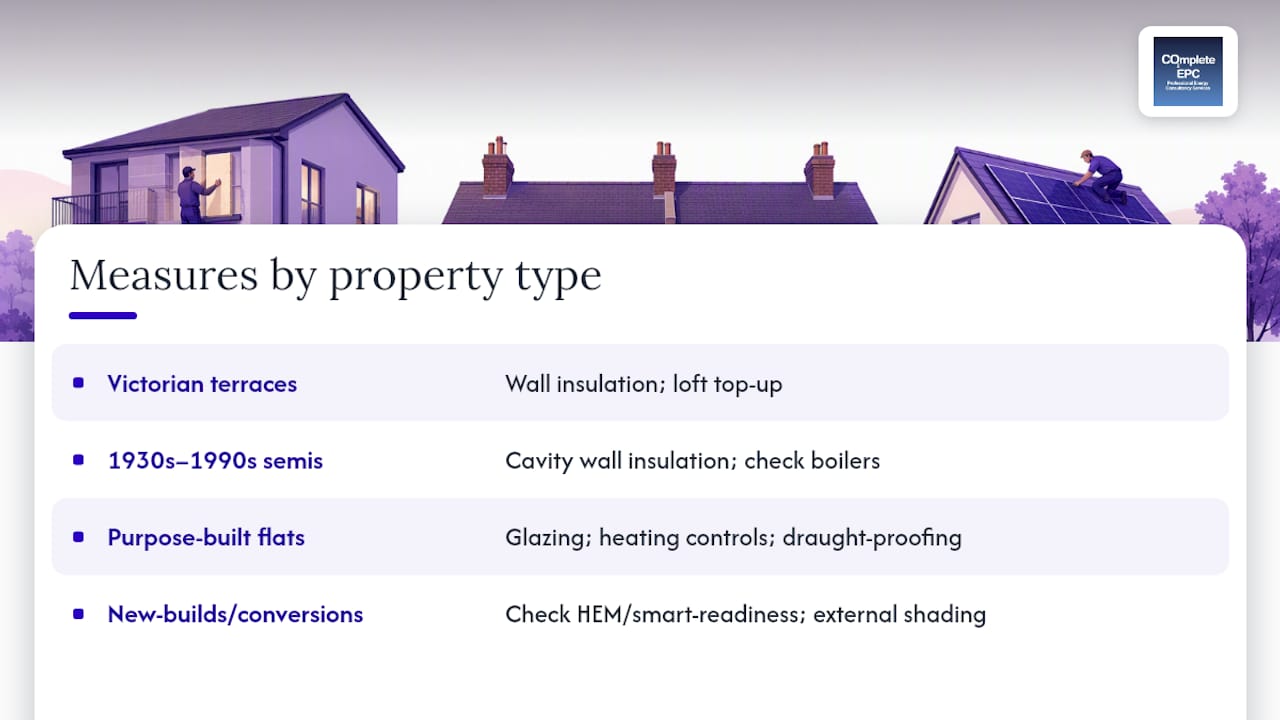
Victorian and Edwardian terraces (solid brick, no cavity) respond best to internal or external wall insulation, though this is the costliest measure on the list and disruptive if done internally on an occupied let. Loft insulation top-up is nearly always worthwhile first, since many older properties still run below the recommended depth.
1930s to 1990s semis and detached houses with cavity walls see the fastest payback from cavity wall insulation, often costing a fraction of solid-wall equivalents for a comparable EPC uplift. Boiler age matters here too; a system over fifteen years old is frequently the single biggest lever on the heating half of the assessment.
Purpose-built flats, particularly in blocks with communal heating, present a different challenge. Individual landlords often have limited control over building-wide systems, so the practical levers shrink to glazing, in-unit heating controls, and draught-proofing, with fabric improvements sometimes requiring freeholder or management company agreement.
New-build and recent conversions typically start from a strong baseline, but reformed HEM metrics mean even these should be re-checked rather than assumed compliant, particularly where smart-readiness or secondary heating metrics apply differently to the original assessment basis. For shading and passive cooling measures on south-facing glazing, simple additions like external shading can meaningfully cut cooling and heating demand without touching the building fabric itself.
What typical EPC upgrade journeys look like for investors
A common pattern among portfolio landlords starts with a D-rated 1930s semi, bought below market value precisely because of its rating. Loft top-up and cavity wall insulation, the lowest-cost measures available, move the fabric score meaningfully with minimal disruption to a sitting tenant. A boiler replacement follows within the same financing round if the existing unit is ageing, pushing the property from D toward C.
The pattern differs for solid-wall Victorian stock, where insulation costs run higher and payback periods stretch. Investors here often sequence works across a refinance cycle, using released equity to fund internal wall insulation in phases rather than as a single capital outlay, keeping void periods short by working room by room between tenancies.
A third pattern shows up in portfolios approaching the 2030 deadline with several F and G-rated properties acquired years ago at a discount. Rather than upgrading every unit, some landlords choose to sell the least compliant stock now, before the wider market fully prices in the 2030 deadline, and redeploy capital into C-and-above properties that already qualify for green mortgage terms. Both routes, upgrade or sell, can be rational. The determining factor is usually whether the retrofit cost on a specific property, weighed against its remaining hold period, produces a payback shorter than the time left before you’d sell anyway.
How EPC ratings affect landlord insurance and liability
Insurers are starting to treat energy efficiency as a risk signal, not just a compliance footnote. Poorly insulated properties run higher condensation and damp risk, which correlates with higher claims for mould-related repairs and, in older solid-wall stock, structural issues tied to trapped moisture. Some insurers now ask for EPC band information at quote stage, and pricing can reflect it.

Liability exposure runs deeper than the insurance premium itself. Letting a property below the legal minimum standard without a valid, registered exemption exposes a landlord to civil penalties from the local authority, and in some circumstances can affect a landlord’s ability to serve a valid Section 21 notice, since certain compliance failures restrict eviction routes under existing housing law. That’s a liability that sits entirely outside the insurance policy and can’t be underwritten away.
Practically, this means your EPC compliance status isn’t just a cost line for retrofit works. It’s a factor in your insurance renewal conversation and a determinant of whether your tenancy paperwork holds up if a dispute ever reaches a tribunal. Keeping your certificate current, and your exemption evidence (where applicable) properly filed, protects you on both fronts at once.
Tracking legislation beyond the 2030 deadline
The 1 October 2030 target is a floor, not a ceiling on ambition. Government policy documents make clear the equivalent-C standard is a staging point, with further tightening plausible as the wider net zero timeline progresses. Treating 2030 as the finish line risks under-investing in fabric measures that would future-proof a property against a subsequent tightening to band B or beyond.
The most useful early-warning signals sit in three places: the GOV.UK consultations and guidance pages on private rented sector energy performance, which flag proposed changes well ahead of legal force; local authority enforcement announcements, which often signal how aggressively a given region intends to police the new standard; and lender policy updates, since mortgage underwriting criteria tend to shift ahead of statutory deadlines as lenders price in future compliance risk.
Building a habit of checking these sources twice a year, rather than only when renewing a certificate, keeps you ahead of a market that’s likely to keep tightening rather than relax. Investors who treat the 2030 deadline as one data point in a longer trajectory, not a one-off hurdle, tend to make retrofit decisions that hold up regardless of exactly where the bar sits in 2035.
Author’s strategic view: prioritising action across a portfolio
Small buy-to-let owners with one or two properties should treat every EPC below C as a live decision, not a future problem. If the retrofit cost is modest relative to the property’s value and hold period, do the work now while the cost cap and transitional rules are generous. If the numbers don’t stack up, selling before the wider market fully prices in 2030 is often the better move.
Professional landlords with larger portfolios should triage by cost-to-value ratio across every unit, not by acquisition date or sentiment. Sell your worst-performing F and G stock where retrofit cost exceeds likely uplift, and reinvest in fabric improvements across your strongest assets.
The dividing line is rarely the EPC score alone. It’s the score set against remaining hold period, tenant demand, and how close a property already sits to the cost cap. Commission EPCs early, budget realistically, and don’t let 2030 arrive as a surprise.
— Danny
Book a compliant EPC before your next purchase or renewal
Completeepc is the practical route to a defensible EPC when the deadline, not the paperwork, is what keeps you up at night. Where DIY estimators and generic online calculators leave you guessing at compliance risk, a proper assessment gives you a certificate with legal standing, backed by recommendations you can actually cost against the £10,000 cap.
For a single buy-to-let unit, book a Domestic Energy Performance Certificate ahead of your next letting, sale, or remortgage. For mixed-use or non-residential elements in your portfolio, the Commercial EPC service covers the same ground under the correct methodology. If you’re planning a conversion or significant fabric upgrade, SAP Calculations give you accurate modelling before you spend, not after. Completeepc states it offers the lowest rates in the UK market alongside qualified assessors experienced across residential and commercial compliance work. Get a quote today and have your certificate, and your compliance evidence, in hand before your next offer or renewal date.
Sources
For the regulatory detail behind everything above, go straight to the government’s 2025 consultation update and the fuller government response document, both of which carry legal weight the moment they take effect. The Mortgage Works report is the clearest market evidence on rent and value premia. The Bank of England working paper explains lender behaviour, while GOV.UK’s MEES landlord guidance covers your existing obligations in full.
This article is general information, not a substitute for advice from a qualified financial advisor. Consult a qualified financial professional about your own circumstances before acting on anything here.
- Gov
- Improving the energy performance of privately rented homes: government response
- Private rented sector report (The Mortgage Works) — Autumn 2024
- Product innovation in the UK mortgage market: the case of green mortgages — Bank of England working paper
- Predicting the energy performance certificates (EPC) of properties — ONS Data Science Campus
- Does energy performance rating affect office rents? — UCL study
FAQ
What EPC changes are coming for UK landlords in 2026?
Landlords should expect confirmation of the proposed shift from the current minimum of band E to an equivalent of band C, with a compliance date of 1 October 2030. The government’s 2025 consultation update sets out the cost cap and transitional rules landlords should plan around now, ahead of the standard taking legal effect.
What is the 2% rule for property investment?
It’s a quick filter used mainly in higher-yield markets and doesn’t account for retrofit costs or EPC compliance risk, so it should be paired with proper due diligence rather than used alone.
What EPC rating should a rental property have?
Under current MEES rules, band E is the legal minimum for letting most residential properties. Given the proposed move to an equivalent of band C by 2030, and the measurable rent and value premium attached to higher bands, C should be treated as the practical target for any property you intend to hold beyond the next few years.
Can I do an EPC on my own property?
No. An EPC must be produced by an accredited domestic or non-domestic energy assessor using the approved methodology; a self-assessment or online estimate has no legal standing. Booking a Domestic Energy Performance Certificate through a qualified assessor ensures the certificate is valid for lettings, sales, and compliance evidence.
How much should I budget to upgrade a property to EPC C?
Government modelling puts the average cost at around £5,400 per property, with a maximum cap of £10,000 where reaching C would otherwise cost more. Actual costs vary significantly by construction type, with solid-wall Victorian stock typically costing more than cavity-wall 1930s to 1990s properties.