

Check your property’s Energy Performance Certificate using the free find an energy certificate service on GOV.UK, searching by postcode, street name or certificate number. If the register shows a valid EPC, you can view the band and download the full certificate immediately. If nothing appears, or the certificate has expired, you will need to book an assessment with an accredited energy assessor before you can market, let or sell the property.
TL;DR:
- An existing EPC can show an outdated or missing record, requiring a new assessment if it has expired or is not listed.
- Accurate information about insulation and heating systems before assessment improves the certificate’s reliability and impact of recommended upgrades.
- Costs for an EPC assessment vary based on property size and complexity, with no fixed national fee, and should be verified through a qualified assessor’s accreditation.
- Landlords must meet minimum standards (EPC band E) and may apply for exemptions if improvements are impractical, with plans aiming for EPC C by 2030.
- Booking a new assessment directly with a professional is the fastest way to obtain or update an EPC, especially if the current certificate is missing or expired.
Table of Contents
- Step by step: how to look up and download an EPC on the official register
- What an EPC actually shows and how to interpret the A-G band
- If your property has no valid EPC or it’s expired, here’s how to arrange a new one
- How much an EPC typically costs and how to choose a reliable assessor
- Landlord obligations now, and the reforms to plan for
- Complete EPC’s view on getting an accurate assessment
- What the EPC process gets wrong, and what actually matters
- Need an EPC now? Book a domestic or commercial assessment
- Sources
- FAQ
Step by step: how to look up and download an EPC on the official register
Finding an existing certificate takes a few minutes if you use the right search terms. England, Wales and Northern Ireland share one register, accessible through the official EPC search. Scotland runs its own separate system, so a property north of the border will not appear on the England and Wales database.
- Enter the postcode first. This usually returns every certificate registered at that address, including old ones.
- If the postcode search returns nothing, try the street name alone. Formatting differences (flat numbers, house names) sometimes hide a result.
- If you already have a certificate reference number from a previous transaction, search by that instead. It is the fastest route to the exact record.
- Once you find the listing, check the report reference, issue date and expiry date before downloading the PDF.
New builds sometimes take a few weeks to appear after completion, since the certificate has to be lodged by the developer’s assessor. If a property genuinely has no record and you believe one should exist, contact the selling agent or the assessor who carried out the original survey. When the register is unclear or shows conflicting entries, it is worth asking an accredited assessor to check the register directly. They can often spot lodging errors that are not obvious to a homeowner searching alone.
What an EPC actually shows and how to interpret the A-G band
An EPC gives you two related figures: a letter band from A to G and a numerical asset rating that sits behind it. The band is the headline, but the number matters too, since two properties in the same band can sit at opposite ends of it. According to government technical guidance, certificates lodged on the central register last 10 years and show the band, estimated running costs and a list of recommended improvement measures.
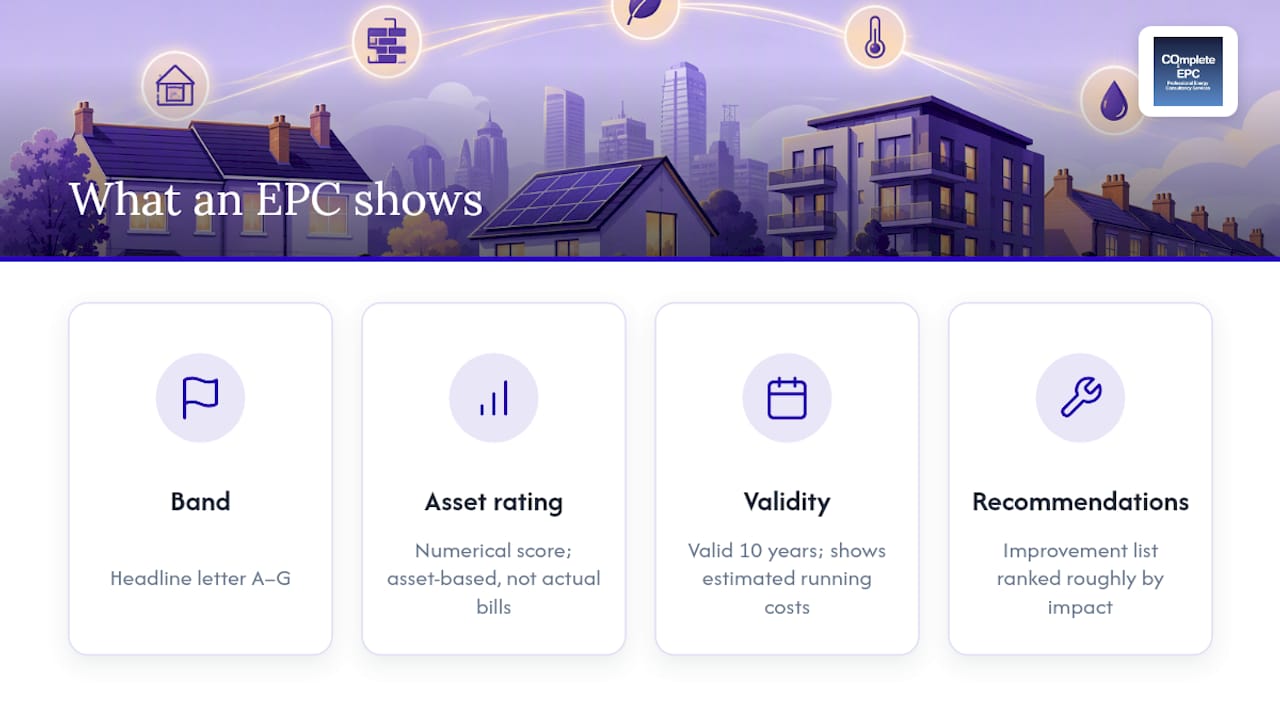
It helps to remember that an EPC is asset-based. It reflects the building’s fabric, insulation and fixed services under standardised assumptions, not your actual fuel bills or how you use the heating. Two identical houses can receive different EPCs if the assessors made different assumptions about loft insulation depth or boiler efficiency, which is one reason certificates occasionally seem to disagree with each other. Reducing that variance comes down to giving the assessor accurate, documented information rather than leaving them to estimate. The recommended measures section is where the practical value lies: it lists the upgrades most likely to move you up a band, ranked roughly by impact.
If your property has no valid EPC or it’s expired, here’s how to arrange a new one
Once an EPC has lapsed, or never existed for the property, you are legally required to commission a new one before selling, letting or, in some cases, before certain planning applications. Only an accredited energy assessor can issue a valid certificate, and GOV.UK’s guidance on getting a new energy certificate confirms there is no fixed national price: cost depends on the assessor and the property itself.
Before the visit, gather anything that helps the assessor record your home accurately rather than defaulting to standard assumptions:
- Boiler manuals or service records showing the make, model and age.
- Evidence of loft, wall or floor insulation, including thickness where known.
- Building plans or extension paperwork, especially for altered properties.
- Any previous EPC, which gives the assessor a useful comparison point.
On the day, expect a walk-through survey covering room dimensions, glazing, heating controls and insulation. Most domestic assessments take under an hour, and the certificate is typically issued and lodged on the register within a few working days.
Pro Tip: Photograph loft insulation and boiler nameplates before the visit. It saves time and stops the assessor from having to assume the worst-case figure.
How much an EPC typically costs and how to choose a reliable assessor
There is no single national price list for an EPC. Cost varies with floor area, construction complexity, the number of heating systems and whether the property is domestic or commercial. A small flat with one heating zone is quicker and cheaper to assess than a large period house with an extension, multiple boilers or mixed-use commercial space, which is why assessor guidance points to size and complexity as the main cost drivers rather than a fixed fee.
When choosing an assessor, a short checklist helps you avoid a poor-quality certificate:
- Confirm accreditation. The scheme details should appear on any certificate they issue.
- Ask whether they regularly assess your property type, since domestic and commercial buildings need different expertise.
- Expect a clear explanation of timings, from booking to certificate delivery.
- Be wary of anyone who cannot explain their accreditation, gives vague reporting, or pushes unrelated upsells before the survey has even happened.
Landlord obligations now, and the reforms to plan for
Under the current Minimum Energy Efficiency Standards, most privately rented properties in England and Wales must hold an EPC of at least band E to be let legally. Where genuine improvements are impractical, landlords can register a valid exemption rather than face enforcement, but the exemption has to be evidenced and logged.
- Check the register first to confirm your current EPC band and expiry date.
- If you fall below the minimum standard, look at whether cost-effective improvements can move you into compliance.
- If improvements are genuinely not viable, apply for the relevant exemption, such as the high-cost exemption, which under PRS exemption guidance requires three independent quotes showing the cost of works exceeds three thousand five hundred pounds including VAT. Exemptions typically last five years.
- Log your EPC dates and exemption expiry in a simple diary system so nothing lapses unnoticed.
Beyond current rules, government has signalled a move toward requiring EPC C for privately rented homes, with a 2030 target discussed in the consultation response on privately rented homes. Landlords planning retrofit work should commission a new EPC afterwards, since completing improvements without updating the certificate does nothing to evidence compliance on the register. Property management platforms such as Rezone’s guidance on zero-emission buildings cover similar preparation steps for landlords tracking multiple properties ahead of these standards.
Complete EPC’s view on getting an accurate assessment
Complete EPC provides Domestic Energy Performance Certificate and Commercial EPC assessments delivered by qualified assessors across London, covering both residential lettings and commercial premises. The most useful thing a homeowner or landlord can do before any visit is straightforward: collate boiler manuals, insulation records, installation receipts and a short history of any building work. That paperwork consistently produces a more accurate certificate, because the assessor is working from evidence rather than a default assumption.
What the EPC process gets wrong, and what actually matters
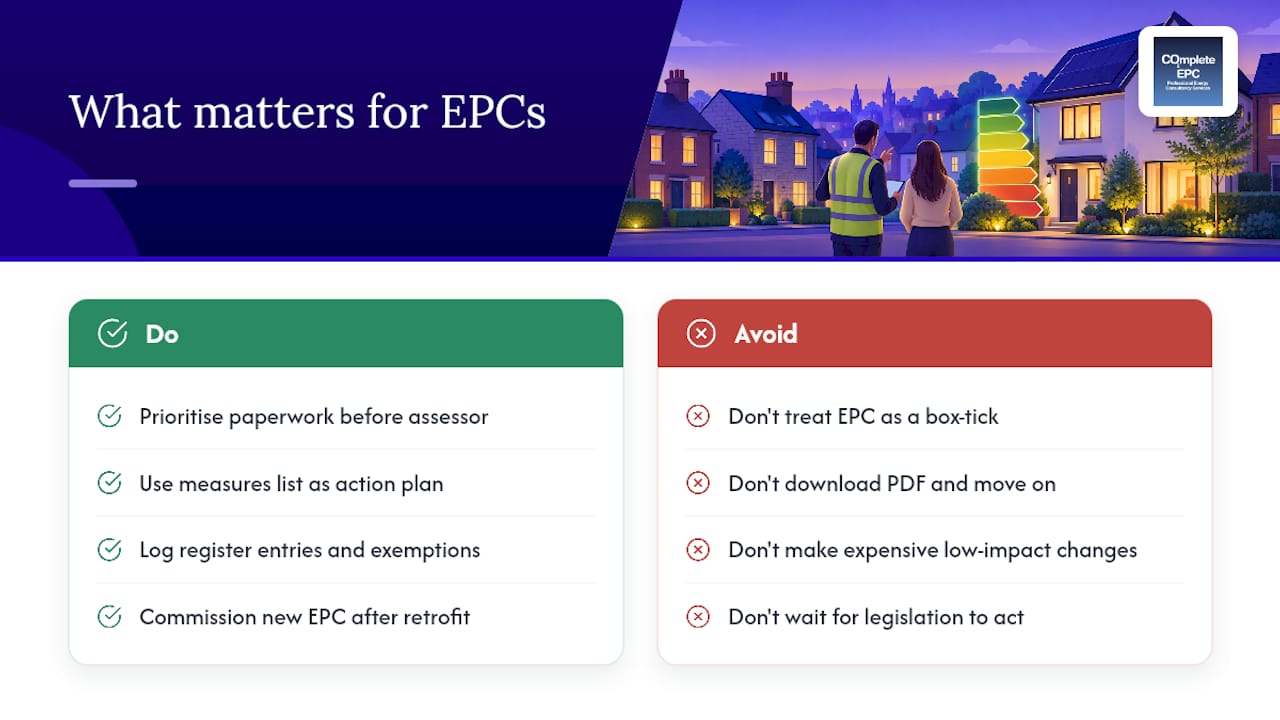
The conventional advice treats an EPC as a box to tick: search the register, download the PDF, move on. That misses the point for most landlords. The band on the certificate is only as good as the information behind it, and a certificate built on assumed insulation levels or an unrecorded boiler upgrade can understate a property’s real performance by a full band.
Prioritise the paperwork before the assessor arrives, not after. Homeowners who treat the recommended-measures list as background reading, rather than a prioritised action plan, tend to make expensive, low-impact changes while ignoring the cheap ones that actually shift the number. And landlords watching the move toward EPC C should stop waiting for the legislation to finalise before acting. The properties that struggle to comply in future will be the ones where nobody checked the register, logged an exemption, or commissioned a fresh certificate after retrofit work.
— Danny
Need an EPC now? Book a domestic or commercial assessment
If your certificate has expired or the register shows nothing at all, the fastest route to compliance is booking directly with a qualified assessor rather than working through the search process alone. They cover these needs across London.
- Domestic Energy Performance Certificate assessments for homes, flats and rental properties.
- Commercial EPC assessments for offices, retail units and other business premises.
- A clear report on booking, with an accredited assessor and a list of improvement suggestions specific to your property.
Get in touch to book a visit or request a quote, and you will have a valid certificate lodged on the register without chasing the process yourself.
FAQ
How do I get an EPC rating from D to C?
Moving from D to C usually means tackling the recommendations listed on your current certificate, such as improving loft or cavity wall insulation, upgrading heating controls or replacing an inefficient boiler. The exact improvements that will help depend on your property, so the recommended measures section of your existing EPC is the right starting point. A new EPC is needed afterwards to show the improved band on the register.
How much does an EPC assessor cost?
There is no fixed national price for an EPC assessment, since cost depends on property size, complexity and whether it is domestic or commercial. GOV.UK’s guidance confirms pricing varies by assessor rather than following a set fee.
What does an EPC rating of D mean for a home?
A D rating sits in the middle of the A to G scale and generally indicates moderate energy efficiency with room for practical improvement. The certificate itself, valid for 10 years from issue, lists specific measures that could move the property towards a higher band.
What EPC changes are planned for landlords?
Government proposals under discussion would require privately rented homes in England and Wales to reach EPC band C, with 2030 mentioned as a target date in the consultation response. Landlords planning retrofit work should commission a new EPC afterwards to evidence the improved band on the register.