

The current minimum for most let properties is EPC E, and that stays the working baseline today. The government has confirmed that domestic private rented homes must reach a C-equivalent standard by 1 October 2030, backed by a £10,000 cost cap and new dual metrics for how homes are scored. The priority for every landlord right now is simple: check your EPC’s validity and band, then start planning which fabric improvements you’ll need before the deadline arrives.
TL;DR:
- Landlords should assess their EPC status immediately, as properties with EPCs below band C will need significant fabric improvements before October 2030.
- Exemptions require detailed evidence from three independent quotes and specific supporting documents, and they last five years before renewal is needed.
- The move to a dual-metric evaluation based on fabric performance and secondary criteria will prioritize insulation, glazing, and air-tightness over heating upgrades.
- Commercial properties are also subject to MEES rules with a seven-year payback test, and breaches can incur higher penalties than domestic ones.
- Starting retrofit planning early can reduce costs and complications, especially for older solid-wall buildings with limited access for works closer to the 2030 deadline.
Table of Contents
- Current domestic MEES: the E standard, cost caps and exemptions
- Current commercial MEES: the E standard and the 7-year payback test
- What’s confirmed for 2030, and the timeline you need to track
- How to register an exemption and what evidence you’ll need
- How enforcement works and what it means for your records
- A practical checklist from now until 2030
- How Complete EPC supports landlords through this transition
- Why fabric-first, early action beats waiting for 2030
- Book an EPC assessment or SAP calculation with Complete EPC
- Where these figures and rules come from
- Sources
- FAQ
Current domestic MEES: the E standard, cost caps and exemptions
The Minimum Energy Efficiency Standard for domestic private rented properties has applied since 2018 for new tenancies and since 2020 for all existing ones, covering any home let on an assured, regulated or domestic agricultural tenancy in England and Wales. If your property’s EPC falls below band E, you cannot lawfully grant a new tenancy or continue an existing one unless you hold a valid exemption.
Historically, the regime included a cost cap that limited landlord spending on energy efficiency measures to a moderate amount, and if the property still failed to reach band E after spending up to that cap, a high-cost exemption could be registered. That cap has shaped a decade of retrofit decisions, though it sits well below the £10,000 figure attached to the incoming C standard.
Common exemptions available under the current regime include:
- All improvements made exemption: you’ve installed everything relevant and cost-effective, but the property still can’t reach E.
- High-cost exemption: the cheapest measure needed would exceed the cost cap.
- Third-party consent exemption: a tenant, freeholder or planning authority has refused consent for the works.
- Property value exemption: the cost of measures would reduce the property’s market value by more than 5%.
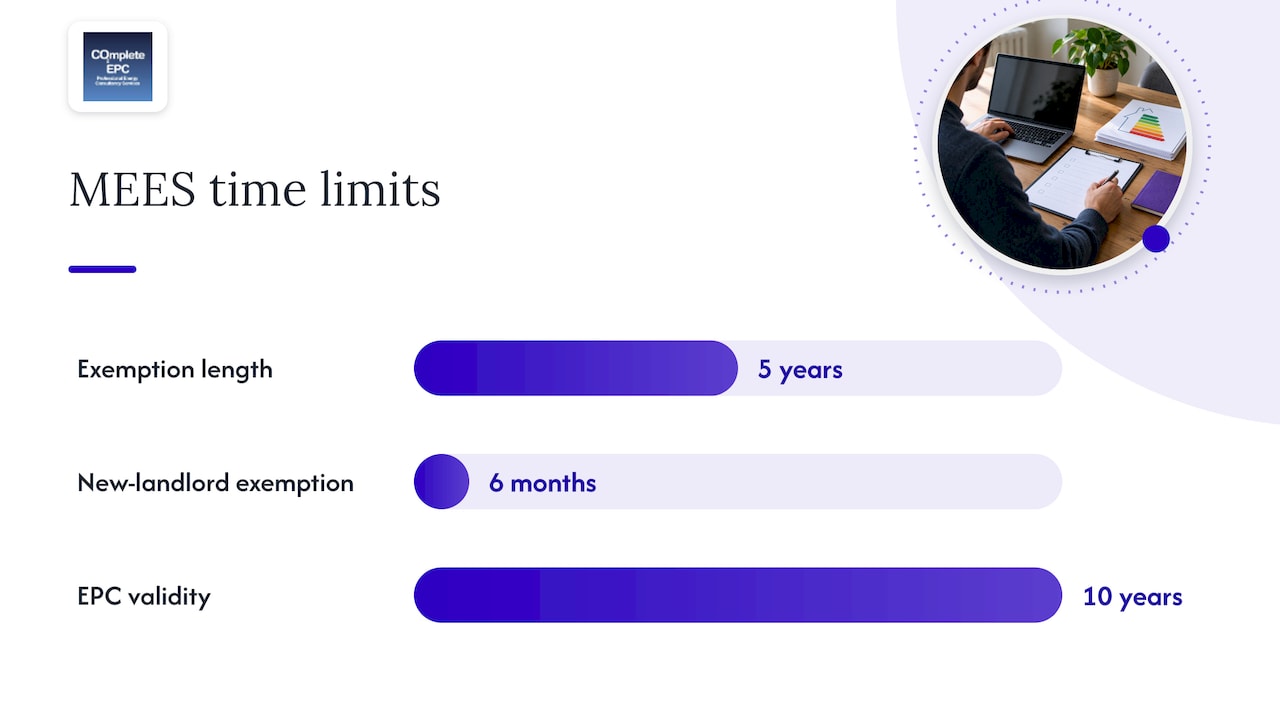
- New landlord exemption: a temporary six-month exemption for landlords who have recently acquired the property.
Exemptions registered under the current rules typically last five years and must be renewed if they’re still needed, so it’s worth checking the expiry date on any exemption you’re relying on. If your last EPC assessment is more than ten years old, or you’re unsure which exemption (if any) is attached to your property, that’s the first thing to resolve, before anything else on this list.
Current commercial MEES: the E standard and the 7-year payback test
Non-domestic private rented buildings, from offices and shops to warehouses and industrial units, are covered by their own version of MEES. Any non-domestic building that is let, and legally required to have an EPC, must currently meet a minimum of band E at the point a new lease is granted or an existing lease is renewed. Government’s interim response on non-domestic MEES confirms this E floor remains the current requirement, with proposals to push larger buildings, those over 1,000 square metres, towards EPC B by 2031 where the works are cost-effective.
The main flexibility mechanism for commercial landlords is the 7-year payback test. Rather than a flat cost cap, a measure only becomes mandatory if the projected energy cost savings would repay its installation cost within seven years. Landlords calculate this using assumptions about energy prices, expected savings and the building’s operating pattern, and the exemption stands or falls on how well those assumptions are documented, including the software or calculator used to produce the payback figures.
Points worth flagging for commercial owners:
- Scope: the requirement applies at the point of letting, sub-letting or lease renewal, not continuously through the tenancy.
- Documentation: a defensible payback calculation needs stated assumptions, not just a final number.
- Enforcement exposure: commercial breaches can carry higher penalties than domestic ones, reflecting the larger asset values and rental incomes typically involved.
- Retained flexibility: the payback test, along with other exemption routes, remains part of the proposed EPC B trajectory, so it isn’t being phased out alongside the tightening standard.
What’s confirmed for 2030, and the timeline you need to track
The headline change is now settled policy rather than proposal. In its 2026 response to the 2025 consultation, government confirmed that domestic private rented homes in England and Wales must reach an EPC C-equivalent standard by 1 October 2030, with a £10,000 cost cap per property and the option to register a cost-cap exemption if a property still falls short after that spend.
One figure worth sitting with: the government’s own impact assessment put average estimated spend at around £5,400 per property to reach the new standard, which is roughly half the £10,000 cap. That gap matters for budgeting: most properties won’t need to spend anywhere near the maximum.
The new standard also comes with a different way of measuring energy performance. Rather than a single letter grade driven by one calculation, the incoming approach uses a dual-metric structure: a fabric performance metric as the primary measure, alongside a secondary metric that’s either smart readiness or heating system performance. This sits within the wider Home Energy Model consultation, which is replacing the old Standard Assessment Procedure with a more detailed, data-driven model. New-style EPCs built on this model are expected to start appearing from the second half of 2026.

The practical effect is a fabric-first approach: insulation, glazing and air-tightness now carry more weight than swapping a boiler for a heat pump alone. A property that loses heat quickly will struggle on the primary metric no matter how efficient its heating system is.
Transitional arrangements soften the switch. Old-style EPCs rated C or above remain acceptable for compliance purposes until October 2029, giving landlords time before every property needs reassessing under the new model. Once new-style EPCs become available, though, landlords planning retrofit work should commission one before starting, since the post-works EPC needs to demonstrate the improvement against the new metrics, and both EPC costs count towards the £10,000 cap.
Key dates to put in your calendar:
- From H2 2026: new-style EPCs based on the Home Energy Model begin rolling out.
- October 2029: the last point at which an old-style EPC rated C or above is accepted for compliance.
- 1 October 2030: the deadline for domestic PRS properties to meet the C-equivalent standard or hold a registered exemption.
None of these dates leave much room for a last-minute scramble, particularly for properties with solid walls, single glazing or poor loft insulation, where fabric work tends to take longer to plan and price than a heating swap.
How to register an exemption and what evidence you’ll need
Exemptions under MEES aren’t a way round the rules. They’re a formal, time-limited acknowledgement that a specific property can’t yet meet the standard, and they only hold up if the paperwork behind them does too.
For a cost-cap exemption, whether under the current £3,500 threshold or the future £10,000 limit, the guidance on exemptions evidence sets out what the Exemptions Register expects to see:
- Three independent installer quotes, each itemising labour, materials and VAT separately.
- A scope of works that links each proposed measure back to the specific recommendation on the EPC.
- Confirmation of the property’s current EPC, showing the band and the date of assessment.
- Supporting documents specific to the exemption type, such as third-party consent refusals or valuation evidence for a property value exemption.
The three-quote requirement catches out more landlords than any other part of the process. Quotes need to come from genuinely separate installers, not three prices from the same firm for different options, and each one should be recent enough to reflect current material and labour costs.
Pro Tip: Ask your EPC assessor to convert the certificate’s recommendations into a scoped works document before you approach installers. Quotes priced against a clear scope are far more defensible under audit than quotes gathered informally.
Exemptions currently last five years and expire automatically. If the underlying problem hasn’t been resolved by then, you’ll need to reapply with fresh evidence, not simply renew the old submission. The most common pitfalls are letting an exemption lapse unnoticed, submitting quotes that don’t match the EPC’s actual recommendations and assuming a high-cost exemption from the old £3,500 regime will carry over unchanged into the £10,000 framework once it applies.
How enforcement works and what it means for your records
Local authorities enforce MEES by cross-referencing the national EPC register against the Exemptions Register, which lets them identify properties let below band E with no registered exemption on file. This isn’t a manual spot-check system: it’s a data-matching exercise, which means gaps in your paperwork are more likely to surface than they were a decade ago.
Non-compliant landlords can face financial penalties, and breaches can be published, a consequence that carries reputational as well as financial weight for letting agents and portfolio landlords. Domestic penalties are generally lower than commercial ones, reflecting the difference in asset value and rental income between the two sectors, though both regimes allow for compliance notices ahead of any fine.
Recommended recordkeeping to have ready if a local authority queries a property:
- Current, valid EPC showing the assessment date and rating.
- Any registered exemption, with its evidence pack and expiry date.
- Correspondence with tenants regarding consent requests, where relevant.
- Installer quotes and invoices for any retrofit work already completed.
If a compliance notice arrives, the fastest way through it is producing this file intact rather than reconstructing it after the fact. Landlords who keep EPC and exemption paperwork in one place, updated whenever a tenancy changes, tend to clear enforcement queries without further escalation.
A practical checklist from now until 2030
The distance to October 2030 feels comfortable until you map out how long fabric works actually take to plan, price and complete. Breaking the run-up into three phases keeps the workload manageable.
- Now to 3 months: pull the EPC for every let property, note the band and expiry date, and flag anything below C as at risk. Get indicative retrofit costs from a qualified assessor so you know roughly where each property sits against the £10,000 cap.
- 3 to 18 months: commission new-style EPCs once they’re available in your area, and gather three independent installer quotes for any fabric work identified. Phase works around tenancy breaks where possible, since vacant periods make insulation and glazing work far easier to schedule.
- 18 months to 2030: prioritise fabric measures first, insulation, glazing, air-tightness, before considering heating system changes, since the new metrics reward reduced heat loss regardless of what’s providing the heat. Keep every quote, invoice and EPC as evidence, and commission a post-retrofit EPC to formally demonstrate the improved rating.
Pro Tip: Budget against the £5,400 average, not the £10,000 cap. Treat the cap as a ceiling for the hardest cases, not a target figure for every property in your portfolio.
Properties with older construction, solid brick walls, no cavity insulation, single glazing, will generally need more time and a larger share of the cost cap than post-1990s builds. Starting the assessment now, rather than in 2029, is what keeps the eventual bill closer to the average than the maximum.
How Complete EPC supports landlords through this transition
Complete EPC provides domestic and commercial energy performance certificates across London, along with the supporting reports landlords need to plan retrofit work with confidence. Its Domestic Energy Performance Certificate service covers the assessments landlords need both to confirm current compliance and to establish a baseline before fabric works begin, while its Commercial EPC service handles the equivalent requirement for offices, retail and industrial premises under the non-domestic regime.
Beyond the certificate itself, Complete EPC offers SAP Calculations for new builds, conversions and extensions, and SBEM Calculations for new commercial developments, both of which feed into the same energy modelling that underpins EPC ratings. Its assessors can also translate an EPC’s recommendations into the scoped, itemised detail that installer quotes need to be defensible for exemption evidence, and can issue the post-retrofit EPC required once works are complete.
Complete EPC provides energy performance assessment services through qualified assessors experienced in residential and commercial compliance work.
Why fabric-first, early action beats waiting for 2030
Landlords who treat 2030 as a distant deadline usually end up paying more, not less, because fabric work has a habit of taking longer than expected once you factor in scaffolding, tenant access and the sheer physical time insulation and glazing installations take. The properties that will struggle most, older solid-wall stock with no cavity insulation, are exactly the ones where quotes and installer availability get tighter the closer you get to the deadline.
The cost cap is a genuine safety net, not a target. Most properties will land closer to the government’s own average estimate than to the £10,000 ceiling, and treating the cap as a worst-case figure rather than a starting assumption keeps budgeting realistic. Exemptions exist for a reason too: if a property genuinely can’t reach the standard within reasonable cost, that’s a legitimate outcome, provided the evidence behind it is solid.
My honest view is that landlords who commission a proper EPC assessment before spending a pound on retrofit work end up making better decisions than those who guess at what their property needs. A scoped, professional assessment turns a vague sense of “the boiler’s old” into a prioritised list that actually moves the fabric metric.
— Danny
Book an EPC assessment or SAP calculation with Complete EPC
Whether you need to confirm where a property currently stands or you’re ready to commission the pre-works assessment for a retrofit project, Complete EPC handles both sides of the process across London. Start with the Domestic Energy Performance Certificate page for residential lettings, or the Commercial EPC page for offices, retail and industrial premises.
For new builds, conversions or planning applications, the SAP Calculations and Energy Statements for Planning services cover the modelling local authorities expect to see. When you book, expect a qualified assessor and a report with clear recommendations tied to your property’s actual construction.
- Domestic lettings: book a Domestic Energy Performance Certificate to confirm your current band and expiry date.
- Commercial premises: book a Commercial EPC assessment ahead of a lease renewal or new letting.
- New builds and extensions: request SAP Calculations or SBEM Calculations to support building regulations approval.
- Overheating and comfort compliance: Complete EPC also offers TM59 Overheating Assessment & TM52 Thermal Comfort Analysis alongside Dynamic Simulation Modelling for planning-stage projects.
Where these figures and rules come from
The facts in this article are drawn directly from government policy documents and guidance, rather than secondary summaries, so you can check the detail that applies to your own property.
- The 2026 government response on privately rented homes confirms the C-equivalent standard, the £10,000 cost cap and the 1 October 2030 deadline.
- The non-domestic MEES interim response sets out the current commercial E standard and the proposed EPC B trajectory.
- The PRS exemptions evidence guidance details exactly what documentation the Exemptions Register requires.
- The domestic MEES landlord guidance explains how local authorities enforce the rules and the consequences of a breach.
Sources
- Improving the energy performance of privately rented homes: government response
- Minimum energy efficiency standards (non-domestic) – interim response
- Guidance on PRS exemptions and Exemptions Register evidence requirements
- Domestic private rented property: minimum energy efficiency standard – landlord guidance
FAQ
What are EPC changes in 2026 for UK landlords?
From the second half of 2026, new-style EPCs based on the Home Energy Model begin rolling out, replacing the single letter grade with a dual-metric system covering fabric performance and either smart readiness or heating performance. Landlords don’t need to reassess every property immediately, since old-style EPCs rated C or above remain valid for compliance until October 2029.
Will the new EPC rules become law?
The C-equivalent standard for domestic private rented homes is confirmed government policy, set out in the 2026 response to the 2025 consultation, with a compliance date of 1 October 2030 and a £10,000 cost cap. It follows the same regulatory route as the existing MEES rules, which are already enforceable law for domestic and commercial private rented properties.
What makes a property exempt from EPC minimum standards?
A property can qualify for an exemption if the cheapest required measure would exceed the relevant cost cap, if a tenant or third party has refused consent for the works, or if the works would reduce the property’s value by more than 5%. Each exemption type needs specific documentary evidence, including independent installer quotes, before it can be registered.
What are the EPC C requirements for landlords in 2030?
By 1 October 2030, domestic private rented properties in England and Wales must reach an EPC C-equivalent standard, or hold a registered exemption if the property still doesn’t meet it after spending. The government’s impact assessment estimated average spend at around £5,400 per property, well under the £10,000 cost cap that limits landlords’ maximum exposure.