
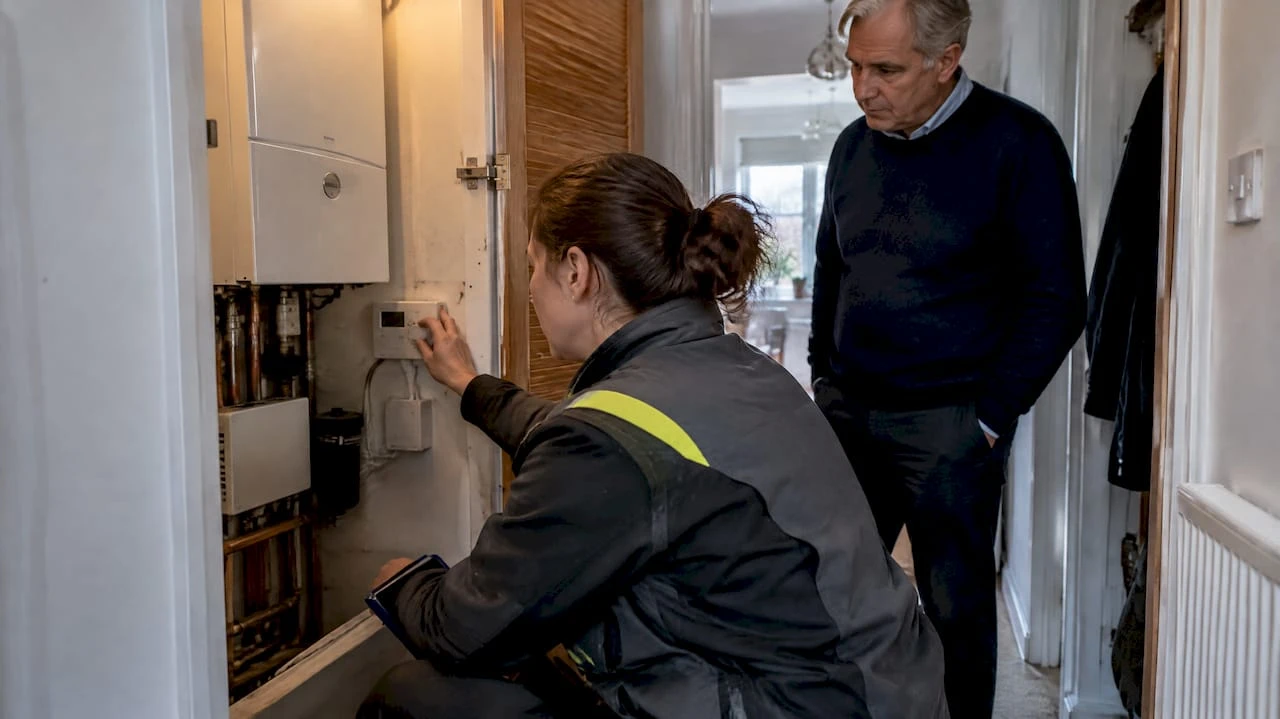
The fastest way to raise most UK properties’ EPC is to prioritise fabric and low-cost heating controls. Start with loft or cylinder insulation, heating controls, and LED lighting, then commission an EPC or retrofit audit. Landlords should check where their property sits against the MEES minimum and the proposed cost-cap before committing to bigger works. Some measures lift the score within days; others need planning and budget.
TL;DR:
- Insulation improvements and heating controls provide the fastest and most cost-effective ways to improve EPC scores, often visible within days.
- Providing proof of previous work, such as certificates and receipts, can raise the assessed score without additional work, especially if insulation or boiler upgrades are verified.
- Starting with low-cost measures and fabric upgrades ensures compliance with the £10,000 spending cap before investing in larger, more complex interventions.
- Proper planning should include assessing default assumptions, gathering evidence, and considering dynamic modeling for complex or solid-wall properties.
- A new EPC after improvements verifies the progress and helps ensure compliance, with exemption options available if the cost cap is exceeded without reaching the target rating.
Table of Contents
- What an EPC rating actually measures
- Finding your current EPC and preparing for an assessment
- Measures that most reliably lift your EPC score
- Prioritising works: payback logic and the landlord cost-cap
- Avoiding retrofit mistakes: ventilation, sizing and installer quality
- How assessor defaults and real evidence shape your score
- Landlord checklist: from EPC check to compliance
- What experience with EPCs teaches about getting it right
- Book an EPC assessment or retrofit advice with Complete EPC
- FAQ
- Sources
What an EPC rating actually measures
An EPC band runs from A to G, but the number behind that letter is a modelled score, not a reading from your meter. Assessors use RdSAP (or SAP for new builds) to calculate what a property should use under standard conditions, based on fabric, systems and fixed assumptions about occupant behaviour.
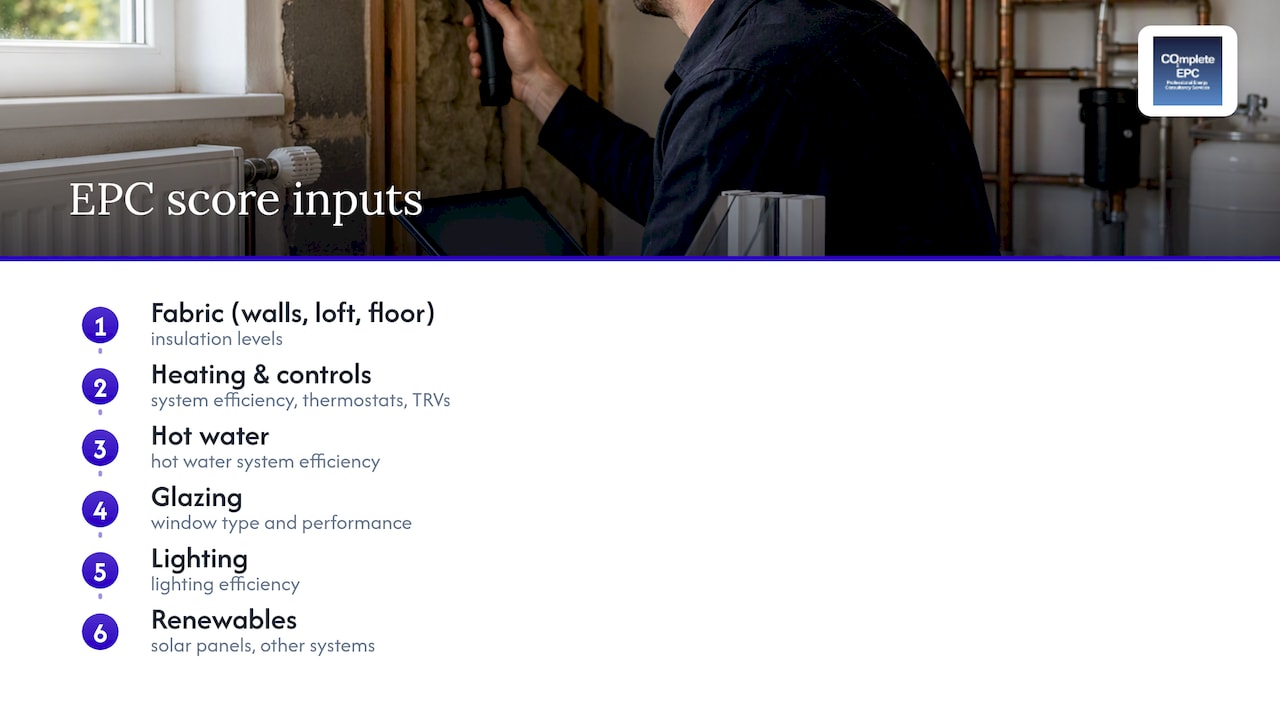
The inputs that drive that score include wall, loft and floor insulation levels, the efficiency of the heating system and hot water provision, glazing type, lighting, and any renewables such as solar panels. Heating controls, including thermostats and thermostatic radiator valves, also feed into the calculation.
This matters because two identical-looking houses can score very differently depending on what the assessor can verify. When an assessor cannot confirm insulation behind a wall or under a floor, the software falls back to a conservative default, often assuming the worst case. That single assumption can cost several points on the final score, which is why evidence matters as much as the physical work itself, something we return to later in this guide.
Finding your current EPC and preparing for an assessment
Before planning any works, check your property’s existing rating through the Gov, which shows the current band, the recommendation list the assessor generated, and the asset rating used for compliance and letting decisions. This tells you exactly what the last assessor recorded, including any default assumptions that might be pulling your score down unfairly.
If you have had insulation, boiler replacements or window upgrades done since that certificate was issued, gather the paperwork before booking a new assessment:
- Installer certificates for cavity wall, loft or solid wall insulation.
- Boiler service records or manufacturer documentation showing efficiency ratings.
- FENSA or equivalent certificates for replacement windows and doors.
- Receipts or specification sheets for heating controls and cylinder insulation.
A pre-works EPC gives you a baseline to measure improvement against, and a post-works EPC is usually what you need to demonstrate compliance to a local authority or prospective tenant.
Measures that most reliably lift your EPC score
Not every upgrade earns its cost back in points or pounds, so it helps to think in tiers rather than tackling whatever seems most visible.
Quick wins, usually completed within a day or two:
- Swap remaining bulbs for LEDs throughout the property.
- Insulate the hot water cylinder if it is not already fitted with a jacket.
- Draught-proof doors, windows and letterboxes.
- Fit or upgrade heating controls, including room thermostats and TRVs.
These measures are among the cost-effective improvements the Energy Saving Trust lists as common EPC recommendations, alongside condensing boilers and loft or wall insulation.
Moderate interventions cost more and take longer to plan:
- Top up loft insulation to 300mm where it is currently thinner.
- Install cavity wall insulation where the property has an unfilled cavity.
- Replace an old, inefficient boiler with a modern condensing model.
Major fabric works carry the biggest price tags and the most complexity:
- Internal or external wall insulation for solid-wall properties.
- Suspended floor insulation.
- Full window replacement where glazing is single-glazed or badly worn.
Listed buildings and conservation areas often restrict external insulation and window replacement, so check planning constraints before committing to a specification.
Low-carbon options sit at the top of the ladder: heat pumps, solar PV and battery storage. These can transform a rating but only once the fabric and electrical supply are ready to support them, something covered in more detail further on.
Pro Tip: Don’t replace a working boiler purely to chase a small EPC uplift; spend first on fabric measures that cut heat loss, then let the heating system size and cost reflect the smaller building you’ve created.
Prioritising works: payback logic and the landlord cost-cap
Private rented properties in England and Wales currently need a minimum EPC rating of E, and the government has confirmed a target of EPC C for all tenancies by 1 October 2030, alongside a proposed cost-cap of £10,000 per property to reach that standard. The government’s response on PRS reforms confirms a dual-metric approach, keeps the £10,000 cap, and recognises existing EPC C compliance until 2029.
That cap shapes how you should sequence spending:
- Fund low-cost, high-impact measures first, since they rarely threaten the cap.
- Treat fabric improvements as the long-term foundation, since they reduce heat demand before you size any heating system.
- Look at the property as a whole rather than fixing single items in isolation, since insulation, ventilation and heating interact.
- Keep every invoice and certificate, since they form the evidence for a cost-cap exemption if you reach £10,000 without hitting the target band.
Landlords can combine Boiler Upgrade Scheme grants with private spend without the grant counting towards that £10,000 cap, which makes low-carbon heating more achievable within budget. Where costs genuinely exceed the cap, you can register an exemption rather than overspend chasing a rating the property cannot reach affordably.
Avoiding retrofit mistakes: ventilation, sizing and installer quality
Fabric and ventilation have to be planned together. Tightening a building’s airtightness without adequate ventilation traps moisture and can cause condensation and mould, so mechanical ventilation, including MVHR in more airtight homes, often needs to go in alongside insulation rather than afterwards.
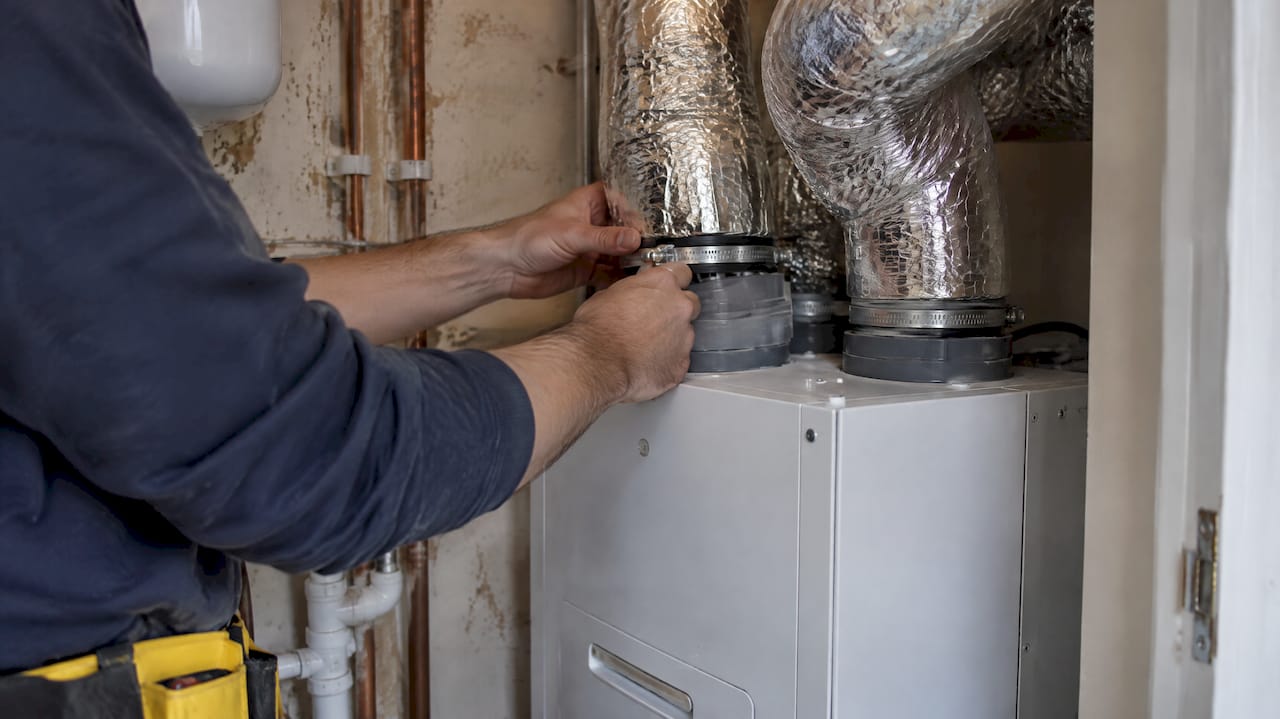
Heat pumps raise similar issues. Older radiators sized for a hot-water boiler are often too small to deliver comfortable heat at the lower flow temperatures a heat pump uses, and local guidance recommends checking electrical supply capacity and emitter sizing before installation. Many homes need enabling works, larger radiators or an upgraded electrical supply, before a heat pump performs efficiently.
Choose certified installers, get more than one quote, and insist on manufacturer warranties and a proper commissioning report.
Pro Tip: Ask any installer quoting for a heat pump to show their heat-loss calculation for your property, not just a like-for-like swap of your old boiler’s output.
How assessor defaults and real evidence shape your score
RdSAP relies on default U-values and airtightness figures when an assessor cannot physically inspect an element, and assessors using the approved methodology often fall back to conservative assumptions for hidden insulation, treating it as absent unless proven otherwise.
Supplying the right evidence can shift this without any further building work:
- Installer certificates for insulation, boilers or glazing already fitted.
- Measured U-values or a short specialist survey report for solid-wall or unusual constructions.
- Airtightness test results where available.
Case-study evidence from retrofit projects shows that simplified models can over or underestimate real savings, and that measured or dynamic simulation modelling often produces different results from RdSAP predictions. For complex or solid-wall properties, commissioning a dynamic simulation model or a specialist retrofit designer is often worth the extra cost before committing to major works.
Landlord checklist: from EPC check to compliance
Working through compliance in order saves money and avoids wasted works.
- Check your current EPC band and recommendation list on the GOV.UK register.
- Gather certificates and receipts for any improvements already carried out.
- Complete the quick wins, LEDs, cylinder insulation, draught-proofing and heating controls, since these rarely approach the cost-cap.
- Get quotes for moderate and major works, and check eligibility for grants such as the Boiler Upgrade Scheme.
- Commission a retrofit design or dynamic simulation model if the property is solid-wall, listed, or otherwise unusual.
- Carry out the agreed works using certified installers and keep every commissioning report.
- Commission a new EPC once works are complete to demonstrate the improved band.
- If spending reaches the £10,000 cap before hitting the target rating, register the exemption and keep full records for the PRS Exemptions Register.
Following this order means you spend on the measures most likely to move your score before committing budget to anything bigger.
What experience with EPCs teaches about getting it right
Working through assessments and retrofit advice day to day, the pattern that stands out most is how often a property’s recorded rating has little to do with its real performance. A poorly documented insulation job can leave a home stuck on a default assumption for years, while the same property with the right paperwork in hand jumps several points at the next assessment.
That is why sequencing matters as much as the works themselves. Modelled savings from an EPC recommendation are a starting point, not a guarantee, and measured performance after works often differs from the prediction. Treat the certificate as a planning tool, gather your evidence properly, and expect the real benefit to show up gradually in lower bills rather than overnight.
— Danny
Book an EPC assessment or retrofit advice with Complete EPC
Raising your rating starts with an accurate assessment, not guesswork about which measures will help. We provide Domestic Energy Performance Certificates and Commercial EPC assessments across London, carried out by qualified assessors who record the evidence you supply rather than defaulting to the worst-case assumption.
Where a property needs more than a standard assessment, we also offer SAP calculations for new builds and extensions, and Dynamic Simulation Modelling for complex or solid-wall retrofits where RdSAP defaults understate real performance. Book an assessment and you will get a clear recommendation list with practical next steps. Current prices are available on the pricing page of our website.
If electrical safety is part of your compliance checklist, our EICR and PAT testing services cover that alongside your EPC booking, and for landlords working through wider safety deadlines, this EICR compliance checklist is a useful companion reference.
FAQ
How do you change the energy rating of your home?
You change your EPC rating by carrying out recognised improvements, such as insulation, heating controls or LED lighting, and then booking a new assessment so the assessor records the upgraded fabric and systems. Supplying certificates for work already completed can also raise the score without further building work, since it replaces a conservative default with verified evidence.
What are 10 ways to save energy at home?
Common EPC-linked measures include LED lighting, hot water cylinder insulation, heating controls such as thermostats and TRVs, loft insulation, cavity wall insulation, condensing boilers, draught-proofing, floor insulation, window upgrades and solar panels, as listed by the Energy Saving Trust. These are generated by a national model and typically ordered by cost-effectiveness for a typical home, so a property-specific plan may prioritise differently.
What is the 30 minute heating rule?
This refers to a common heating-control practice of running a boiler in shorter, more frequent bursts rather than one long cycle, aimed at matching heat output to how quickly a home loses warmth. It is a behavioural habit rather than a documented EPC requirement, so its effect on your certificate depends on the heating controls already recorded on your assessment.
How much does an EPC certificate cost?
Pricing for a Domestic EPC or Commercial EPC assessment is available on request, since costs depend on property type and size. You can check current requirements and book an assessment directly through our Domestic EPC or Commercial EPC service pages.
What is the MEES cost-cap for landlords?
The proposed cost-cap limits landlord spending to £10,000 per property when working towards the target EPC band, and landlords can register an exemption if they reach that cap without hitting the required rating. Grants such as the Boiler Upgrade Scheme can be combined with private spend without counting towards that cap.