

We’re required to have an EPC in place whenever a property is marketed for sale or rent, and landlords currently need to meet the minimum E rating under MEES while preparing for the move to a C rating by 2030. An EPC stays valid for 10 years. If a property cannot reach the required band, a valid exemption must be registered rather than ignored.
TL;DR:
- Only the newest EPC is legally valid, and the seller or landlord must commission it before marketing begins, even if an older certificate remains on file.
- By October 1, 2030, private rentals must meet C through fabric performance and either heating efficiency or smart readiness; the cap is £10,000 per property.
- Homes that achieved a C under the existing EER before October 1, 2029, count as compliant until that EPC expires, even under the transition.
- D to C upgrades often combine two or three measures; prioritize insulation and controls before heating, then commission an EPC to verify the result.
- If improvements cannot reach the required rating, register an eligible exemption with evidence such as quotes, reports, or written refusals, and track its renewal date.
Table of Contents
- What an EPC is and how ratings work
- When you need an EPC: legal triggers and key differences
- MEES, recent reforms and the 2030 C target for private rented homes
- How to get an EPC: assessors, methods and costs
- Reading your EPC and making realistic improvements
- Exemptions, the PRS Exemptions Register and how to evidence them
- Enforcement, penalties and what local authorities check
- Your compliance checklist and timeline
- Why Complete EPC: proof points and how our services support compliance
- Treat EPCs as asset management, not paperwork
- Book an EPC or compliance review with us
- FAQ
- Sources
What an EPC is and how ratings work
An Energy Performance Certificate rates a building’s energy efficiency, not its running costs for a specific household. It gives a standardised snapshot so buyers, tenants and landlords can compare properties fairly, using fixed assumptions about occupancy and heating patterns rather than how the current occupants actually live.
The familiar A to G scale sits alongside two figures: the Energy Efficiency Rating (EER) and the Environmental Impact Rating (EIR). The EER is the one landlords live and die by for compliance purposes. Government proposals for reformed EPC metrics would add separate scores for fabric performance, heating system and smart readiness, while keeping the familiar EER during the transition.
- Existing homes are assessed using RdSAP, a reduced data method suited to surveys of properties already built.
- New builds, conversions and complex developments typically use SAP or dynamic simulation modelling instead.
- A certificate is generally valid for 10 years, and reformed EPCs are expected to keep that 10-year validity in the near term.
- Only one lodged certificate is legally valid at any time, so a newer assessment supersedes an older one even if both appear on file.
When you need an EPC: legal triggers and key differences
An EPC becomes a legal requirement at specific moments, not as a background formality. Knowing these trigger points keeps a transaction or tenancy moving instead of stalling at the last minute.
- Marketing a property for sale or rent requires a valid EPC to be available to prospective buyers or tenants.
- Completing a new build triggers the need for a certificate before occupation.
- Larger public and commercial buildings often face display requirements in addition to the standard certificate.
- Non-domestic buildings follow their own technical guidance on accreditation, advertising and the 10-year validity period.
Responsibility for commissioning the assessment sits with the seller or landlord, not the buyer or tenant, and it needs to happen before marketing starts. Because certificates run for a decade, it’s easy to let one lapse mid-tenancy. Landlords who track expiry dates across a portfolio avoid finding out an EPC has quietly expired just as a lease renewal or sale comes up.
MEES, recent reforms and the 2030 C target for private rented homes
The current legal floor is an E rating for most let properties, with specific exemptions available where that standard genuinely cannot be reached. That baseline hasn’t gone anywhere, but it’s being superseded by a far more demanding target.
Following consultation, the government confirmed its decision to require privately rented homes to reach an EPC-equivalent C by 1 October 2030, as set out in the government response on PRS reforms. This isn’t a single-number test any more.
- A primary fabric performance metric assesses the physical building, insulation and glazing.
- A secondary metric, chosen from either heating system efficiency or smart readiness, sits alongside it.
- Properties that already achieved a C by EER before 1 October 2029 are recognised as compliant until that EPC expires.
The landlord-funded investment cap is set at a level per property, as according to the government’s own response. Eligible spend made before 2025 may count towards that cap, which rewards landlords who started upgrading early rather than waiting for the deadline. Transitional rules running to 2029 and 2030 give a window to plan works, but a new-style EPC showing the post-works rating will be the evidence that actually demonstrates compliance, so an old certificate won’t do the job once works are finished.
How to get an EPC: assessors, methods and costs
An EPC can only be produced by an assessor accredited through a government-approved accreditation scheme, and the assessor physically inspects the property rather than relying on a questionnaire. They record construction type, insulation, glazing, heating system, controls and lighting, then feed that data into RdSAP for existing homes or full SAP and dynamic simulation modelling for new or complex buildings.
- Search an accreditation scheme’s register or book through a consultancy that employs accredited assessors directly.
- Expect a site visit lasting roughly 30 to 90 minutes depending on property size and complexity.
- The assessor lodges the certificate on the national register, where it becomes the single legally valid version.
- Alongside the rating, you receive a recommendations report listing specific improvement measures.
Costs and turnaround vary by property type and region, and are generally confirmed when booking rather than fixed nationally. Assessment fees themselves are a legitimate cost that can count towards the MEES investment cap, so keeping the invoice matters as much as keeping the certificate.
Pro Tip: Book your EPC assessor before listing a property, not after an offer or applicant is already in hand, since a missing certificate can delay marketing entirely.
Reading your EPC and making realistic improvements
The recommendations report that comes with every EPC lists specific measures, roughly costed, along with the potential rating the property could reach if they were carried out. That potential rating is a modelled estimate rather than a guarantee, since two similar properties can score differently depending on assessor judgement and the data available on site.
- Loft and cavity wall insulation remain among the lowest-cost, highest-impact measures for older housing stock.
- Replacing an ageing boiler with a modern condensing model or heat pump typically moves the heating-efficiency element significantly.
- Heating controls, such as thermostatic radiator valves and smart programmers, are often inexpensive wins.
- Double or secondary glazing helps fabric performance but usually costs more per SAP point gained than insulation work.
An evaluation of the regulations found very high compliance among the sample of privately rented dwellings studied by August 2023, with retrofit work linked to measurable CO2 and bill savings in some of those properties. A typical D to C pathway often combines two or three of the measures above rather than one dramatic upgrade, though homes with solid walls or no cavity may need specialist modelling to find a realistic route. Once works are finished, commission a fresh EPC. The old certificate, even if still technically valid, won’t show the improved rating that proves compliance.
Exemptions, the PRS Exemptions Register and how to evidence them
Not every property can reach the required standard, and the regulations allow for that through registered exemptions rather than silent non-compliance.
- All relevant improvements made: every cost-effective measure within the cap has been installed, yet the property still falls short.
- Third-party consent refused: a tenant, freeholder or planning authority has withheld consent needed for the work.
- Devaluation exemption: an accredited surveyor confirms the improvement would reduce the property’s market value by more than 5%.
- New landlord exemption: recently acquired properties get a short grace period before compliance is enforced.
- Wall insulation exemption: certain wall insulation measures are exempted where independent expert advice says they would negatively affect the building’s fabric.
Each exemption needs supporting evidence, such as quotes, surveyor reports or written refusals, and must be registered on the PRS Exemptions Register rather than simply held on file. Registration is time-limited, and exemption guidance notes that landlords commonly misjudge renewal dates, which is one of the more avoidable routes into enforcement trouble.
Enforcement, penalties and what local authorities check
Local authorities, often through trading standards teams, are responsible for enforcing MEES. They cross-reference the EPC register and the PRS Exemptions Register against live tenancies, so a lapsed certificate or an unregistered exemption is exactly the kind of gap they’re set up to catch.
- Breaches typically result in financial penalties, with the scale depending on how long the property has been non-compliant and whether it’s domestic or non-domestic.
- Local authorities can publish details of non-compliance, which carries its own reputational cost beyond the fine.
- Landlords have a right to appeal a penalty notice through the proper channels rather than simply paying or ignoring it.
- A common trigger for enforcement is an expired EPC discovered mid-tenancy, rather than a fresh failure at the point of letting.
Landlord guidance on MEES sets out the mechanics of this enforcement approach, including how the cost cap and exemptions interact with penalty decisions.
Your compliance checklist and timeline
Treat the next few years as a planning window rather than a single deadline, and work through this roughly in order.
- Audit every property’s current EPC rating and expiry date, flagging anything below C or close to lapsing.
- Get quotes for the retrofit measures most likely to move each property towards C, and check what spend counts towards the £10,000 cap.
- Carry out works in a sensible order, insulation and controls first, heating system upgrades next, keeping every invoice.
- Commission a post-works EPC to evidence the new rating rather than relying on the recommendations report.
- Register any genuine exemption promptly, with full supporting evidence, and set a reminder well before it expires.
- Keep a simple register across your portfolio of ratings, expiry dates and exemption status so enforcement checks hold no surprises.
Pro Tip: Start with the properties furthest from C, since those are the ones most likely to need the full £10,000 and the longest lead time for works.
Why Complete EPC: proof points and how our services support compliance
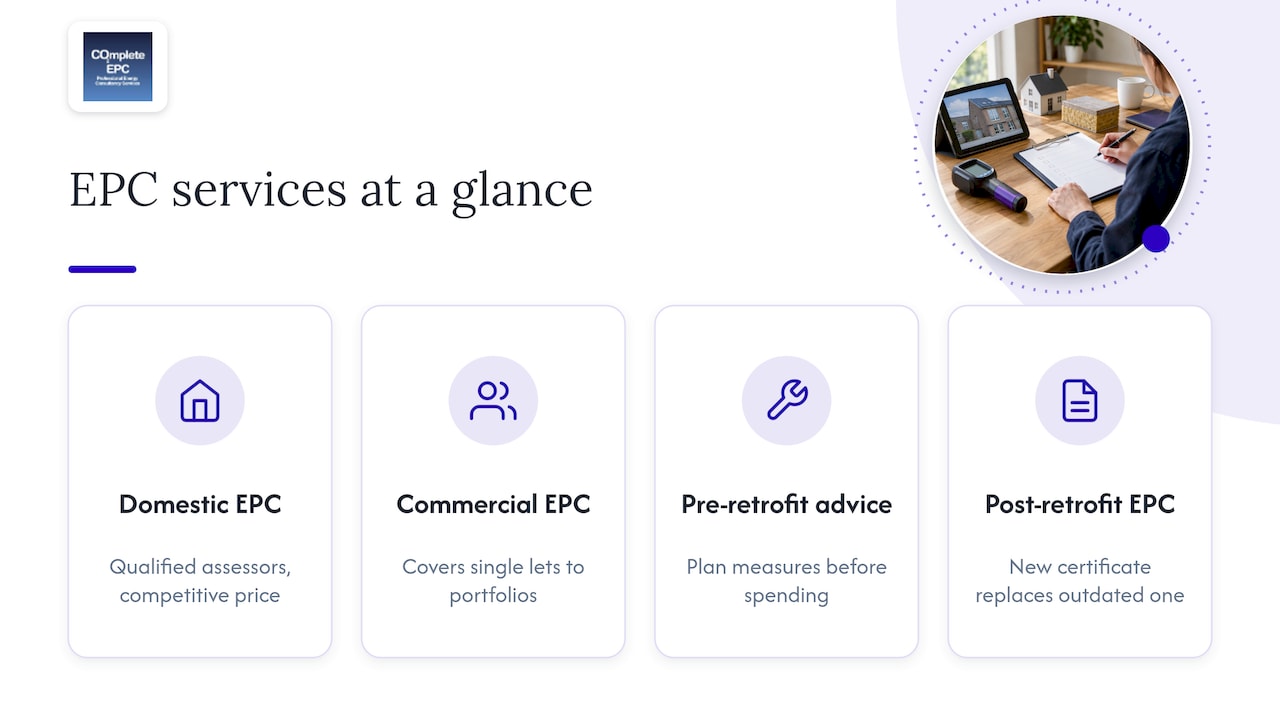
We provide Domestic Energy Performance Certificate and Commercial EPC assessments, carried out by qualified assessors and priced competitively. Whether you’re certifying a single let property or a commercial portfolio, we handle both sides of the same compliance problem.
Beyond the certificate itself, we offer pre-retrofit advice to help you plan which measures move the needle before you spend, and we issue post-retrofit EPCs that give you the evidence a lapsed or outdated certificate can’t. When you book, it helps to have your current EPC, any previous recommendations report and details of planned or completed works ready to hand.
Treat EPCs as asset management, not paperwork
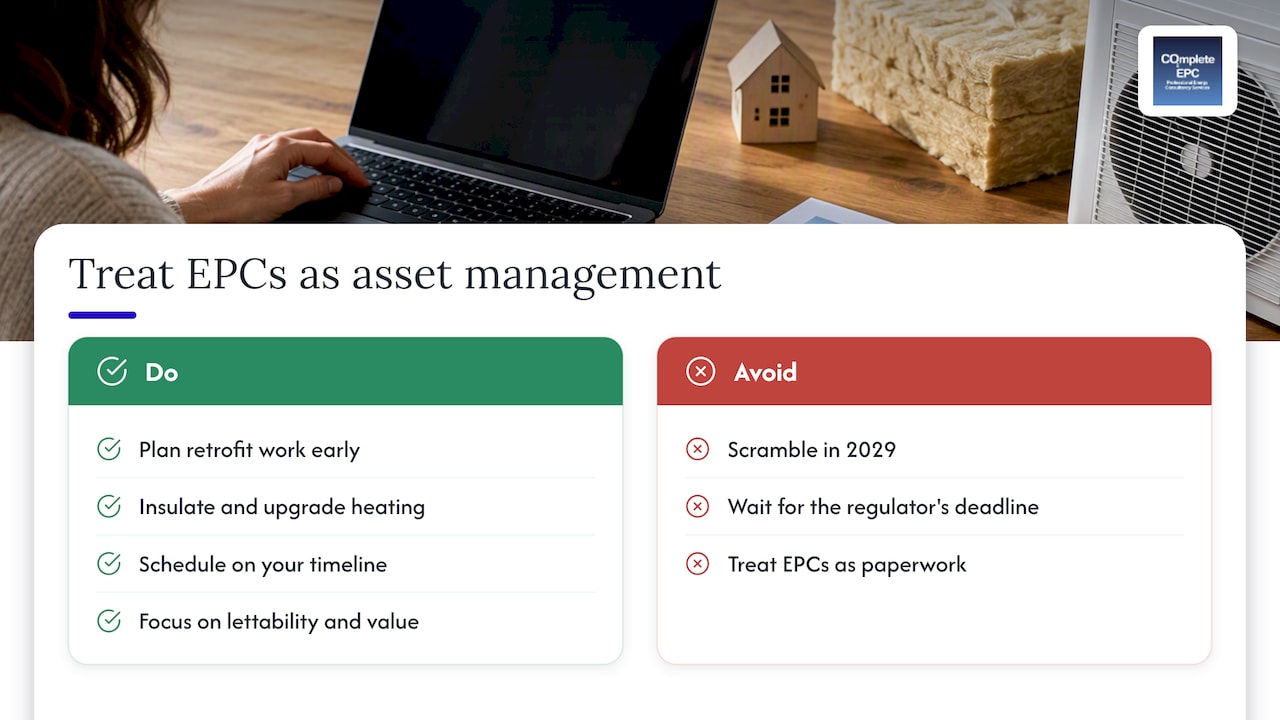
The landlords who come out ahead of the 2030 deadline aren’t the ones scrambling in 2029 and often benefit from understanding wat is energieprestatie to help plan their upgrades early. They’re the ones who started insulating and upgrading heating systems years earlier, often because it also made their properties easier to let and hold their value better.
Planning retrofit work on your own timeline, rather than the regulator’s, tends to cost less and disrupt tenants far less.
— Danny
Book an EPC or compliance review with us
Whether you need a Domestic Energy Performance Certificate for a single let or a Commercial EPC for a larger building, we handle the assessment and the paperwork so you have evidence ready for a sale, a letting or a MEES check. If your project involves a new build or extension, our SAP Calculations service covers the building regulations side as well.
- Domestic lets: book a Domestic Energy Performance Certificate assessment and get your rating plus a recommendations report.
- Commercial buildings: our Commercial EPC service covers offices, retail and other non-domestic premises.
- Planning retrofit works: get a pre-works assessment so you know which measures to prioritise before spending against the cap.
The assessment fee itself can count towards your MEES investment cap, so booking early is rarely money spent twice. Get in touch for a quote on your property or portfolio.
FAQ
Is an EPC rating compulsory?
Yes. An EPC is legally required whenever a property is marketed for sale or rent, and landlords must also meet the current minimum MEES standard or hold a registered exemption. The certificate needs to be valid, since an expired one doesn’t satisfy either requirement.
How can I improve my EPC rating from D to C?
Most D to C improvements combine two or three measures, commonly loft or cavity wall insulation, upgraded heating controls and sometimes a more efficient boiler. The recommendations report issued with your EPC lists costed options specific to your property, and a post-works EPC is needed to confirm the new rating.
Is an EPC rating of D good or bad?
A D rating currently meets the minimum E standard for lets, so it isn’t a compliance problem today. It will fall short of the C standard required for privately rented homes by 1 October 2030, so landlords with a D should start planning improvements rather than waiting.
What are the new rules for EPC compliance?
The government has confirmed that privately rented homes must reach an EPC-equivalent C by 1 October 2030, assessed through a primary fabric metric and a secondary heating or smart-readiness metric, with a landlord-funded investment cap raised to £10,000 per property. Properties already rated C by EER before 1 October 2029 are treated as compliant until that certificate expires.