

An EPC rating of D means your property scores between 55 and 68 on the government’s energy efficiency scale, placing it in the middle of the A to G bands and signalling moderate energy efficiency. In most cases, a D rating is perfectly lettable under current landlord rules. Below, we explain what drives the score, what it means legally, and how to move from D to C.
TL;DR:
- The score reflects fixed heating, hot water, lighting, and insulation features per square meter, not household behavior or actual energy bills.
- Landlords can generally let a D rated property because restrictions target bands F and G, but rules vary by jurisdiction and should be checked.
- Two or three measures, including loft insulation or heating controls, may be enough to move a D rated home into band C.
- Get tailored advice before changing walls or ventilation, because poor sequencing can cause damp or ventilation problems that the EPC model does not flag.
- Some grants target homes in bands E, F, or G and may exclude D rated properties, so check each scheme’s current eligibility rules.
Table of Contents
- The numeric score range and how the A to G scale works
- What a D rating means for homeowners and landlords
- Common building types and typical causes behind a D rating
- Practical upgrades that typically lift a property from D to C
- Typical costs and timescales for moving from D to C
- How to check your EPC and read the report
- How to treat EPC recommendations and when to get further advice
- Differences between a D rating on domestic and commercial properties
- Legal obligations for landlords and sellers beyond minimum standards
- Where a D rating limits grant or incentive eligibility
- Why a D rating is a plan, not a judgement
- How we can help with your EPC
- FAQ
- Sources
The numeric score range and how the A to G scale works
The EPC scale runs from A to G and maps onto a numeric score out of 100. Band A covers scores of 92 and above, while band D sits in the middle at 55 to 68 points.
- Band A: 92 and above, the most efficient homes
- Band B: 81 to 91
- Band C: 69 to 80
- Band D: 55 to 68
- Band E: 39 to 54
- Band F: 21 to 38
- Band G: 1 to 20, the least efficient homes
The score itself is modelled, not measured from your actual bills. An assessor calculates it from the building’s heating system, hot water provision, lighting and insulation levels, all standardised per square metre of floor area. This is why two identical semi-detached houses with different occupants can score the same: the EPC rates the building, not the people living in it.
Once issued, an EPC remains valid for 10 years, so a certificate from several years ago may still apply to your property today unless you have made significant changes or need a fresh version for a sale or letting.
What a D rating means for homeowners and landlords
A D rating generally causes no legal problems for selling or letting a home. The rules that restrict lettings target the bottom of the scale, not the middle.
Under the Domestic Minimum Energy Efficiency Standard, landlords are generally barred from letting properties rated F or G, with certain exemptions applying in specific circumstances. A D sits comfortably above that threshold, so you can usually let the property without any MEES intervention. Rules and timelines for minimum standards have shifted over the years and vary between jurisdictions, so it is worth checking current guidance before assuming your certificate meets the bar for your specific case.
A D rating places your property in some of the most common housing stock in the country. ONS analysis shows that a large share of existing dwellings cluster within bands C and D, while newer builds tend to perform better, often landing in band B.
Practically, a D rating is unlikely to put off buyers or tenants on its own, though many now compare certificates when weighing up similar properties. Some funding and support schemes set a minimum band of D or better as an eligibility condition, so holding a D rather than an E, F or G can occasionally open doors that would otherwise stay shut.
- Selling: a D rating rarely blocks a sale but may factor into buyer negotiations
- Letting: a D rating generally satisfies current minimum standards
- Grants: certain schemes use band D as a qualifying threshold, so check scheme rules directly
Common building types and typical causes behind a D rating
Properties landing in band D tend to share recognisable features. Mid-century terraces, converted flats and older semi-detached houses are frequent examples, often built before cavity wall insulation became standard or before modern boiler efficiency rules existed.
The usual culprits behind a D score are straightforward:
- Gaps or absence of loft and cavity wall insulation
- Older, less efficient boilers or heating controls
- Single glazing or ageing double glazing units
- Draughts around doors, windows and floors
It is worth understanding that the EPC produces an asset rating: a theoretical score based on the building’s fixed features, not how efficiently the current occupants actually behave. A meticulous household and a wasteful one living in the same D-rated house would receive identical certificates, because the rating ignores lifestyle and measures only the fabric and fixed systems.
Given how common band D is across the existing housing stock, a D rating is rarely a sign of a poorly maintained property. It is often simply a reflection of when the building was constructed and what retrofit work has or has not been done since.
Practical upgrades that typically lift a property from D to C
Moving from D to C usually comes down to a handful of well-understood measures, tackled in a sensible order rather than all at once.
- Loft insulation. Topping up to the recommended depth is often the cheapest way to cut heat loss through the roof.
- Cavity wall insulation. Where the wall type allows it, this measure typically delivers one of the largest score improvements for the outlay.
- Hot water tank jacket. A simple, low-cost fix that reduces standing heat loss from the cylinder.
- Heating controls. Thermostatic radiator valves and a programmable thermostat improve how efficiently the existing boiler is used.
- Low-energy lighting. Swapping remaining bulbs for LEDs is inexpensive and contributes a small but genuine uplift.
- Draught-proofing. Sealing gaps around doors, windows and floorboards reduces unwanted heat loss at minimal cost.
Insulation measures generally give the largest score uplift per pound spent, which is why the Energy Saving Trust recommends treating the EPC’s recommendations as a prioritised roadmap rather than a single to-do list tackled in no particular order.
Before committing to solid wall insulation or other fabric-level work, check whether your wall type is actually suitable, since solid walls need different treatment from cavity walls and getting this wrong can cause damp or ventilation issues. Readers weighing up broader, contractor-led upgrade work may also find it useful to see how envelope-first improvements are sequenced on larger renovation projects.
Pro Tip: Start with the cheapest, highest-impact measures first, loft insulation, tank jackets and draught-proofing, before considering anything that involves opening up walls or floors.
Typical costs and timescales for moving from D to C
Costs vary by measure and by property, but some patterns hold fairly consistently. Low-cost measures such as draught-proofing, a tank jacket and LED bulbs sit at the cheap end, while loft and cavity wall insulation sit in the medium range, and replacing an old boiler or installing new glazing sits at the higher end.
- Low cost: draught-proofing, hot water tank jacket, LED lighting
- Medium cost: loft insulation, cavity wall insulation, improved heating controls
- Higher cost: boiler replacement, window upgrades, more extensive fabric work
Government regulatory impact modelling on minimum energy efficiency standards sets out typical measures used to move a property up a band, including loft insulation, low energy lighting, tank jackets and cavity wall insulation, alongside estimated upgrade costs used in that assessment.
Combining two or three low and medium-cost measures is often enough to push a D rating into band C, according to the pattern of improvements referenced in government modelling on minimum standards.
Once the work is done, you will need a new certificate to reflect the improved rating. Many owners choose to commission both a pre-work and a post-work assessment, so budget for two EPC visits rather than one if you want documented proof of the change.
How to check your EPC and read the report
Checking your current certificate takes only a few minutes if you know where to look.
- Search the official EPC register using your postcode or the property’s address.
- Locate the current rating and potential rating. The potential rating shows what score you could reach if recommended measures were installed.
- Read the summary of recommendations, which lists specific measures in the order likely to give the best improvement.
- Check the issue date. Certificates remain valid for 10 years from the date of assessment.
If your certificate has expired, or you cannot find one listed for the property, you will need a new assessment before selling, letting or applying for most grant schemes. The current and potential ratings sit side by side on the certificate, giving you a quick sense of how much headroom exists for improvement without reading the full report in detail.
How to treat EPC recommendations and when to get further advice
EPC recommendations come from a standardised model, not from a bespoke survey of your home’s quirks. Assessors record what is there and run it through the scoring software, so the suggestions are a sensible starting point rather than a finished retrofit plan.
For straightforward measures like loft top-ups or a tank jacket, the EPC’s suggestions are usually sufficient on their own. For anything touching the building’s fabric, solid wall insulation, ventilation changes or significant glazing work, it is worth getting bespoke retrofit advice before proceeding, since poorly sequenced work can create damp or ventilation problems that the EPC model does not flag.
A staged approach, tackling cheap wins first and reassessing before bigger spend, tends to produce better outcomes than following every recommendation at once. Once work is finished, a post-work certificate confirms the new band officially.
Pro Tip: Treat the EPC’s recommendation list as a starting conversation with an assessor, not a finished specification for a builder.
Differences between a D rating on domestic and commercial properties
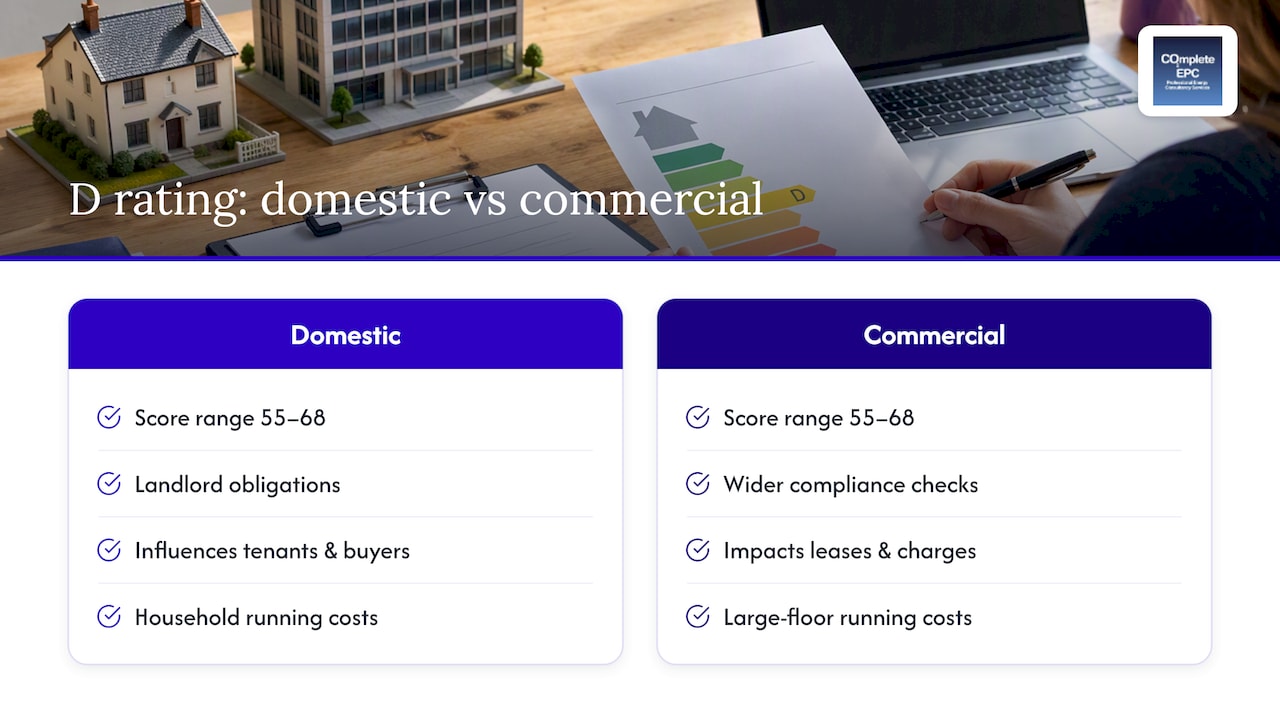
A D rating means something slightly different depending on whether the certificate covers a home or a commercial building. Domestic EPCs feed into landlord obligations such as minimum standards for private rented housing, and they influence buyer and tenant decisions in a fairly direct way.
Commercial EPCs operate alongside a wider set of obligations, including air conditioning inspection requirements and, for larger or more complex buildings, considerations that domestic properties rarely face. A commercial D rating can affect lease negotiations, service charge discussions and planning conditions in ways that rarely apply to a family home.
The underlying scoring principle, an asset-based rating from 55 to 68 for band D, stays consistent across both property types. What changes is the context: a commercial tenant assessing a D-rated office may weigh it against running costs for a much larger floor area, while a landlord assessing a single flat weighs it against one household’s bills. Businesses occupying larger or more complex buildings sometimes need supporting documentation such as SBEM calculations or dynamic simulation modelling to understand how a rating was reached, something rarely required for a domestic certificate.
Anyone managing a mixed portfolio of residential and commercial property should treat each certificate on its own terms rather than assuming domestic rules automatically apply to a commercial unit, or vice versa.
Legal obligations for landlords and sellers beyond minimum standards
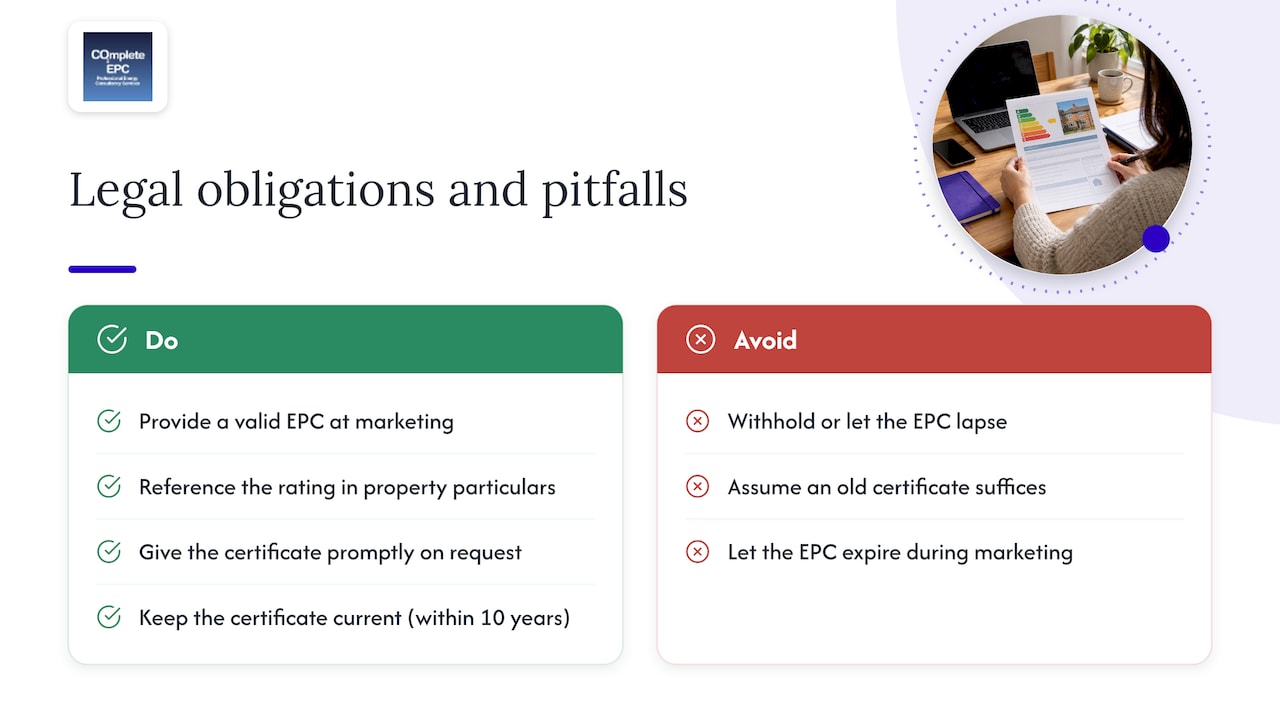
Beyond the minimum energy efficiency standard itself, landlords and sellers carry a general duty to make a valid EPC available at the point of marketing. An estate agent or letting agent is generally expected to reference the rating in property particulars, and a valid certificate should be provided to a prospective buyer or tenant without unreasonable delay once they request it.
For a D rating specifically, there is no additional restriction beyond what MEES already covers, since D sits above the bands that trigger letting prohibitions. The obligation that does apply universally is disclosure: a seller or landlord cannot simply withhold the certificate or let it lapse without consequence, because marketing a property without a valid EPC in place is itself a compliance issue, separate from whatever band the property falls into.
Sellers should also be aware that the certificate shown to a buyer needs to be current, not simply the most recent one on file if it predates the 10 year validity window. Letting the certificate expire during a long marketing period is a common oversight that creates avoidable delay at the point of sale or tenancy agreement.
Keeping a valid, in-date certificate on hand, and making sure it is referenced correctly in marketing materials, covers the bulk of what is legally expected around a D-rated property, regardless of whether you are selling or letting.
Where a D rating limits grant or incentive eligibility
Some energy efficiency grants and support schemes set a minimum EPC band as a qualifying condition, and the details vary considerably between schemes and over time. Certain historical schemes, including some linked to feed-in tariff and solar support rules, have used band D as a reference point for eligibility, either as a minimum standard to qualify or as a factor in calculating support levels.
The practical limitation for a D-rated property is that some schemes aimed specifically at the least efficient homes, typically those in bands E, F or G, are designed to help properties below D reach it, rather than to fund further improvement once a property has already reached band D. If your property sits at D, you may find yourself just outside the target group for some lower-band support schemes, even though you would benefit from further upgrades.
This makes it worth checking the specific rules of any scheme you are considering rather than assuming a D rating automatically qualifies or automatically disqualifies you. Eligibility criteria change between funding rounds, and a scheme that excluded D-rated homes last year may include them this year, or vice versa.
Why a D rating is a plan, not a judgement
A D rating is one of the most common outcomes in the existing housing stock, and treating it as a starting point rather than a problem makes far more sense than treating it as a failing grade. Most homes built before modern insulation standards land here, which is exactly why the scale has room above it.
The sensible approach is to confirm your certificate is still valid, then work through the cheapest, highest-impact measures before considering anything structural. A D rating with a clear upgrade plan is in a stronger position than an expired certificate with no plan at all.
— Danny
How we can help with your EPC
We provide Domestic Energy Performance Certificates and Commercial EPC assessments across London, carried out by qualified assessors who can confirm your current band and set out which measures would move you from D to C fastest. Once upgrade work is finished, we can carry out a post-work assessment to certify the new rating officially.
We also handle related compliance work, including SAP calculations, EICR and PAT testing, and MEES advice for landlords managing multiple properties. Book an assessment with us to get a clear, accurate starting point before you spend a penny on upgrades.
FAQ
Is an EPC rating D good?
A D rating represents moderate energy efficiency and sits in the middle of the scale, so it is neither excellent nor poor. It is one of the most common bands across existing housing stock, and it generally satisfies current minimum standards for letting.
How can I increase my EPC rating from D to C?
Loft insulation, cavity wall insulation, a hot water tank jacket and improved heating controls are among the measures most likely to push a D rating into band C. Tackling cheap, high-impact fixes first before considering structural work tends to give the best return.
Can I rent a property with an EPC rating of D?
Yes, in most cases. The minimum energy efficiency standard generally restricts letting properties rated F or G, and a D sits well above that threshold.
How much does EPC D cost?
There is no published fixed fee for the assessment itself, as pricing depends on the property, and we can confirm the cost for your Domestic EPC or Commercial EPC on request. If you are upgrading from D to C, budget separately for the works themselves and for a post-work assessment to confirm the new band.