

The effect runs through both buyer perception and genuine running-cost savings, and because an EPC stays valid for 10 years, a good rating keeps working for a property long after the certificate lands on the file.
TL;DR:
- Transaction research found homes with stronger EPC ratings sold for roughly 1% to 3% more nationally, with London premiums reaching 3% to 6.5%.
- Analysis found flat owners recoup a larger share of retrofit costs in sale prices than house owners, changing the financial case for upgrading.
- Landlords near the minimum letting standard risk work before a new tenancy, while low ratings may prompt valuation deductions but do not automatically block mortgages.
- Owners are not legally required to follow EPC recommendations, so compare quoted retrofit costs with likely local uplift before deciding to improve ahead of marketing.
Table of Contents
- Empirical evidence and official stats on EPC premiums
- How EPCs are produced and what the bands mean
- Typical retrofit costs to improve an EPC and how to judge payback
- How EPCs change buyer behaviour and sale speed
- What EPCs mean for landlords: lettings and compliance
- How valuers and mortgage lenders may reflect EPC ratings
- How a professional EPC assessment helps
- Impact of EPC ratings on commercial property valuations
- Case studies and empirical data on EPC-linked price increases
- Influence of EPC ratings on rental yields and tenant demand
- Future regulatory trends affecting EPC standards
- Interaction between EPC ratings and property insurance premiums
- A practical way to decide whether to invest now
- Get an accurate EPC and a clear improvement plan
- FAQ
- Sources
Empirical evidence and official stats on EPC premiums
The clearest signal comes from large-scale research that compares transaction prices against EPC bands across thousands of sales. One such study of information disclosure and the valuation of energy efficiency finds a national premium of roughly 1 to 3% for higher-rated homes, rising to between 3% and 6.5% in London. We read that gap as a reflection of London’s tighter housing supply and higher energy costs, where an efficient home stands out more sharply against the alternatives.
A national price premium of 1 to 3%, and up to 3 to 6.5% in London, has been measured for higher-rated homes. The same research notes that these premiums often exceed what buyers would save on energy bills alone, which suggests an investment or asset-value motive sits alongside the practical appeal of lower running costs.
The effect is not uniform across property types. A hedonic analysis of energy efficiency improvements estimates that flats capitalise a higher share of retrofit costs into their sale price compared with semi-detached, terraced, and detached homes. Flat owners, in other words, tend to see a larger share of what they spend on upgrades reflected back in the eventual sale price, which matters when weighing whether a retrofit is worth doing before marketing a property.
Government data gives a sense of how much of the national stock still needs work. The English Housing Survey headline report found that a little over half of homes now sit in bands A to C, and that the mean cost to bring a dwelling up to band C is about seven thousand pounds. The distribution behind that average spreads widely:
- A significant minority need a few thousand pounds to reach band C.
- Many need a mid-range investment to upgrade.
- A smaller portion face costs well above ten thousand pounds.
That spread matters for decision-making. A property close to band C already may need a modest, quick win, while an older or solid-wall home could face a far larger bill before it clears the threshold that buyers and lenders increasingly notice.
How EPCs are produced and what the bands mean
An EPC is an asset rating, meaning it assesses the building’s fabric and fixed services rather than how any particular household happens to use them. Domestic assessments use the Reduced Data Standard Assessment Procedure (RdSAP), a simplified version of the full SAP methodology used for new builds, and the result is a score translated into a band from A (most efficient) to G (least efficient). According to government technical guidance on EPCs, the certificate is valid for 10 years and the assessment considers factors such as insulation, heating systems, glazing and ventilation rather than the occupants’ habits.
A certificate includes more than just the letter grade. It typically shows:
- The current and potential energy efficiency rating, expressed as both a score and a band.
- Estimated running costs for heating, hot water and lighting.
- A list of recommended improvement measures, ranked by likely impact.
- Indicative costs and payback periods for each recommended measure.
There is no legal requirement to carry out the recommendations, a point confirmed in the government guide to EPCs for marketing, sale and let. A property needs a fresh assessment once the existing certificate lapses after 10 years, or sooner if the owner wants an updated rating following improvement works.
Typical retrofit costs to improve an EPC and how to judge payback
Deciding whether to invest before a sale or letting comes down to comparing the likely cost against the likely uplift. The English Housing Survey figures on reaching band C give a useful starting point, but the measures themselves vary widely in cost and effect:
- Loft and cavity wall insulation are usually the cheapest measures and often produce a noticeable band jump on an older property, making energielabel verbeteren via dakrenovatie a practical route to savings and value increase.
- Boiler upgrades cost more but can shift both the efficiency score and the running-cost estimate meaningfully.
- Double or secondary glazing improvements tend to sit at the higher end of the cost range for a smaller band movement.
Pro Tip: Ask your assessor which single measure moves the band furthest for the least outlay, since not all recommended works carry equal weight in the score.
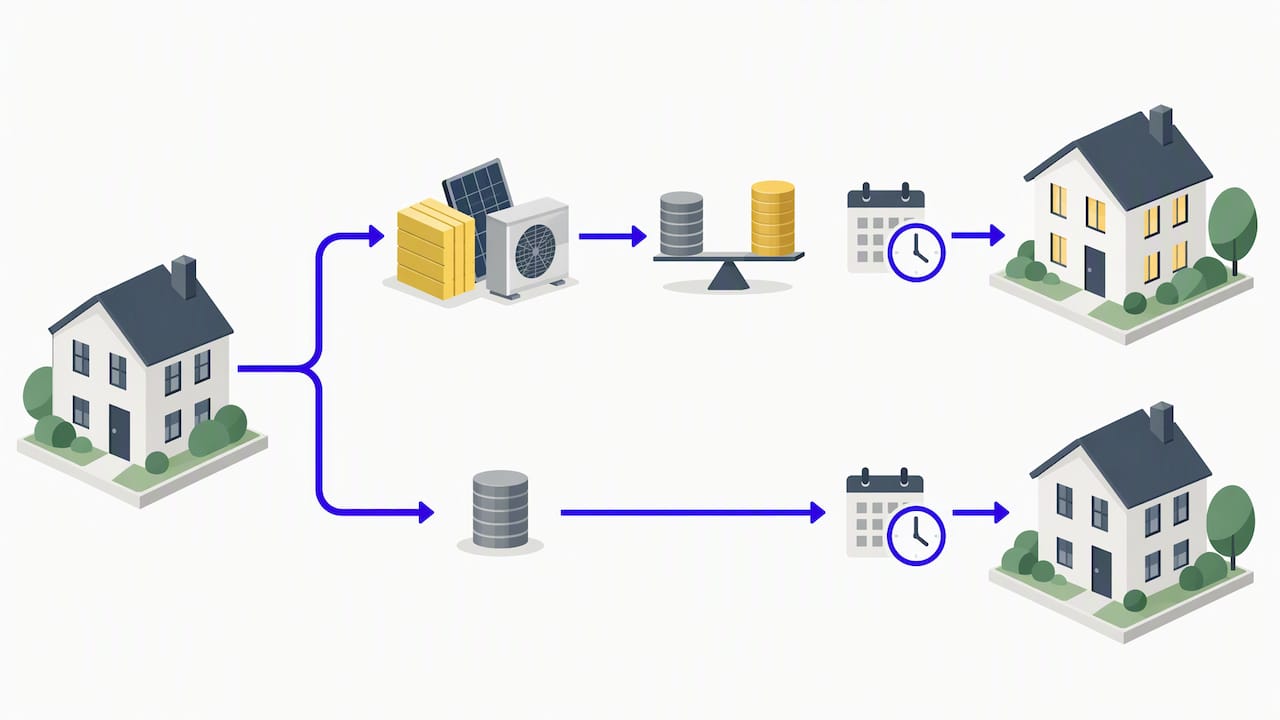
A simple framework helps here: estimate the expected price uplift using the national or London premium ranges, set that against the quoted retrofit cost, and check how long the property will likely sit on the market before a sale or new tenancy. Where the retrofit cost is a small fraction of the expected uplift and the local market is tight, the case for improving before marketing is strong. Where the cost is close to or exceeds the expected uplift, it may be more sensible to market the property as is and let a buyer factor in the works themselves.
How EPCs change buyer behaviour and sale speed
Because EPC ratings appear directly on property listings, they function as a visible signal long before a buyer sets foot inside. Research into information disclosure around energy ratings points to a salience effect: buyers respond more strongly to what is visible at the point of search than to the technical detail buried inside the certificate itself. A clear A to C banding on a listing can draw more interest than the same property with a poorly explained E or F rating, even before viewings begin.
This shows up in practical terms for sellers and agents:
- Higher-rated homes tend to attract a larger pool of interested buyers, simply because more buyers filter listings by energy rating.
- A strong EPC can support faster marketing, since buyers spend less time weighing hidden running costs.
- A weaker rating does not rule out a sale, but it often invites more questions about future costs during negotiation.
For most sellers, the practical choice sits between two approaches: invest in the measures that move the band before listing, or market the property clearly with the EPC’s existing recommendations and indicative costs visible, so buyers can factor the numbers in themselves rather than guessing.
What EPCs mean for landlords: lettings and compliance
For landlords, an EPC is not just a marketing tool, it ties directly into minimum energy efficiency standards (MEES) that govern what can legally be let. We would encourage any landlord reviewing a portfolio to treat the rating as a forward-looking compliance signal rather than a one-off certificate to file away.
- Properties sitting close to the regulatory minimum face a higher chance of needing work before a tenancy can be renewed or a new one started.
- Valuers and buyers increasingly price in the future cost of compliance when a property’s rating sits near that threshold, which can show up as a lower offer rather than an outright refusal to purchase.
- Prioritising the measures with the fastest payback, such as loft insulation or draught-proofing, tends to make more sense than tackling every recommendation at once.
Landlords weighing a portfolio-wide upgrade programme benefit from sequencing works by cost-effectiveness, starting with properties furthest from compliance.
How valuers and mortgage lenders may reflect EPC ratings
RICS guidance on MEES and valuation indicates that valuers are increasingly expected to reflect energy efficiency in their assessments, and may apply a deduction or a higher capitalisation rate to properties that face future upgrade costs, particularly in the private rented sector.
- Where a valuation cites likely upgrade costs, it is worth requesting the breakdown so you can compare it against your own retrofit estimates.
- A low rating does not automatically block a mortgage, but it can factor into a lender’s risk assessment or a valuer’s figure.
- Specialist green mortgage products exist for highly efficient homes, though these sit alongside standard underwriting rather than replacing it.
How a professional EPC assessment helps
An accurate assessment starts with a qualified assessor who understands which fabric and service details genuinely move the score, rather than guessing from a generic checklist. We carry out Domestic Energy Performance Certificate assessments and Commercial EPC inspections across London, alongside SAP Calculations for new builds, conversions and extensions.
- A proper assessment identifies which improvements will shift the band fastest for the lowest spend.
- A clear, costed improvement plan gives sellers and landlords a basis for deciding whether to act before marketing.
- Having an up-to-date, accurate certificate avoids the risk of a buyer or tenant questioning the figures later.
Booking an assessment early gives you time to act on the recommendations before a listing goes live, rather than reacting to a low rating under time pressure.
Impact of EPC ratings on commercial property valuations
Commercial valuations reflect energy efficiency in a more structural way than most residential sales, largely because commercial MEES rules restrict what can be let at all once a property falls below a set threshold. A commercial building with a weak rating carries the risk of becoming unlettable without works, and RICS guidance on MEES confirms that valuers increasingly build this risk into their capitalisation rates and remediation allowances.
For investors, that means a low commercial EPC rating is less about buyer perception and more about cash flow risk: a tenant default or lease break on a non-compliant unit can leave an owner unable to re-let without spending first. We see this reflected in how commercial valuers treat buildings near the compliance threshold, applying a more cautious yield or an explicit deduction for anticipated works.
Booking a Commercial EPC assessment early in a transaction gives an investor or occupier clarity on where a building sits against the compliance threshold, and what a remediation programme might cost before that figure gets baked into a lower offer. For larger or more complex buildings, pairing an EPC with SBEM Calculations or Dynamic Simulation Modelling can give a more detailed picture of where the energy performance gap actually lies.
Case studies and empirical data on EPC-linked price increases
The strongest evidence here comes from large transaction-level studies rather than individual anecdotes. The study on information disclosure and energy valuation draws on thousands of sales to isolate the price effect of EPC bands after controlling for location, size and other property characteristics, finding the 1 to 3% national premium and the larger London premium described earlier.
What makes this research useful for individual owners is the consistency of the pattern once spatial and property-type controls are applied: the premium persists even after accounting for the kind of area and property type that might otherwise explain a price difference. That persistence is what lets us treat the figures as a genuine EPC effect rather than a coincidence of where efficient homes happen to be built.
The hedonic analysis of retrofit capitalisation adds a practical layer by breaking the effect down by property type, showing flats capitalising a far higher share of retrofit spend than detached houses. For an owner deciding whether a loft insulation job or a boiler swap is worth doing before sale, that distinction between property types is often more useful than the headline national average alone.
Influence of EPC ratings on rental yields and tenant demand
Tenant demand responds to running costs in a way that is harder to hide than in a sale, since tenants pay the energy bills directly and often compare several properties before signing a tenancy. A property with a strong EPC rating can support a higher achievable rent where tenants factor lower bills into their overall cost of living, and it reduces the risk of void periods tied to compliance issues under MEES.
For landlords, the yield calculation is not just about the rent achieved but about the cost of staying lettable. A property that falls behind the compliance threshold risks being pulled from the market until works are completed, which translates directly into lost rental income on top of the retrofit cost itself. We would treat a property’s EPC trajectory, not just its current band, as part of any yield forecast for a rented home.
Prioritising measures with the fastest payback, as outlined earlier for improving a band, applies just as much to rented stock as owner-occupied homes, since the same pound spent on insulation tends to produce a faster return in reduced void risk than in pure resale uplift.
Future regulatory trends affecting EPC standards
EPC standards and the policy environment around them continue to shift, and owners planning works now should expect the bar to move rather than stay fixed. Government guidance on the certificate methodology itself has already evolved over recent years, and minimum standards for rented property have tightened in stages rather than all at once.
For landlords and investors, the practical implication is to plan improvements with some headroom rather than the bare minimum needed to clear today’s threshold, since a property brought just up to the current standard risks falling behind again if the bar moves during the 10-year life of its certificate. We see this as a reason to treat an EPC improvement programme as an ongoing position rather than a single transaction cost tied to one sale or letting.
Interaction between EPC ratings and property insurance premiums
Energy efficiency and insurance are connected through the physical condition of a building rather than the certificate itself. Measures that improve an EPC rating, such as new insulation, upgraded glazing or a modern heating system, often address the same fabric issues that insurers assess when pricing risk, including damp, poor ventilation and ageing systems prone to failure.
A property with a well-maintained, efficient fabric is generally a lower risk from a structural perspective, which can support more favourable terms when an insurer reviews the building’s condition. We would not suggest that an EPC band directly sets an insurance premium, since insurers price on their own criteria, but the underlying improvements behind a better rating frequently overlap with the factors insurers consider when assessing a property.
A practical way to decide whether to invest now
We think most owners overthink this decision. If the retrofit cost is a small fraction of the likely uplift (using the national 1 to 3% or London 3 to 6.5% premium ranges as a guide) and the local market is tight, act before listing. If costs are high relative to uplift, market the property with the figures visible instead.
A quick checklist before deciding:
- Likely price uplift based on your local market and property type.
- Realistic retrofit cost estimate for the specific measures needed.
- How tight the local market is for similar, better-rated homes.
- How much time you have before you need to list or re-let.
— Danny
Get an accurate EPC and a clear improvement plan
Knowing your EPC band is only useful once you know exactly what it would take to improve it, and that is where a proper assessment earns its cost. We carry out Domestic Energy Performance Certificate assessments for houses and flats and Commercial EPC inspections for offices, retail units and larger buildings across London, using qualified assessors who flag exactly which measures move the band and by how much.
Beyond the certificate itself, we also handle SAP Calculations for new builds and extensions, TM44 Inspection of Air Conditioning Systems, and Energy Statements for Planning where a project needs them. If you are weighing whether to improve a rating before a sale or a letting, the first step is simply getting an accurate picture of where the property stands. Book a Domestic EPC assessment with us to get that picture and a costed list of what would move the needle.
FAQ
What is a poor EPC rating?
A poor EPC rating generally means a property sits in band E, F or G, where running costs are higher and the building may fall below the minimum standard required for letting under MEES rules. Properties in these bands often need insulation, heating or glazing upgrades to reach a more marketable band C or above.
How much does an EPC rating cost?
The cost of an EPC assessment depends on the property type and size, and we do not publish a fixed figure since pricing varies by job. You can get a quote for a Domestic EPC or Commercial EPC assessment directly through us.
Does EPC rating affect mortgages?
A low EPC rating does not automatically block a mortgage application, but RICS guidance indicates valuers increasingly factor energy efficiency and potential upgrade costs into their assessments. Some lenders also offer specialist green mortgage products for highly efficient homes, though these sit alongside standard underwriting rather than replacing it.
Is a D EPC rating good?
A D rating sits in the middle of the scale and is neither the strongest nor the weakest position for marketing a property. Properties in band D often have straightforward routes to band C, and given that homes in bands A to C carry measured price premiums of roughly 1 to 3% nationally, moving up from D can be worth exploring before a sale.