

An EPC assessment is a visit by an accredited energy assessor, who records how your building is built and heated and uses that data to produce an energy performance certificate rated from A (most efficient) to G (least efficient). You need one to sell, let or construct most buildings in England and Wales, and the certificate lasts 10 years. This guide explains the process step by step, what it costs in London, and what landlords and commercial owners need to know about the rules.
TL;DR
- An EPC assessment must be done by a government-accredited assessor. It produces a certificate rated A to G plus a report of recommended improvements.
- The certificate is valid for 10 years and must be available to buyers or tenants before a property is marketed.
- Privately rented homes and commercial premises in England and Wales must currently reach at least band E. Landlords should plan now for the proposed band C standard from 1 October 2030.
- Typical London prices for a home sit in the range of £80 to £120 according to one 2026 market guide, but assessors set their own fees.
- Commercial EPCs, SAP calculations for new builds and related compliance reports are separate pieces of work, so book the one your project needs.
Table of Contents
- What an EPC assessment actually is
- Who can carry out an EPC assessment
- The EPC assessment process step by step
- Preparing for the visit
- Understanding EPC ratings
- When you need an EPC
- EPC assessments for landlords
- EPC assessments for commercial properties
- EPC assessment cost in London
- Using the recommendation report
- Our perspective: treat the EPC as a plan, not a form
- Booking an EPC assessment with us
- Related assessments that often go with an EPC
- FAQ
- Sources
What an EPC assessment actually is
An EPC assessment is the survey and calculation behind the certificate. The assessor gathers facts about the building, enters them into approved software and the software produces the rating. The rating reflects the building’s energy efficiency and estimated running costs, not the opinion of the person who visited.
It is not a structural survey. RICS guidance makes the point that an EPC is an asset-rating tool focused on energy efficiency, not a check of physical condition. The assessor will not tell you whether your roof is sound or your damp course has failed. They will tell you how much heat the building is likely to lose and how efficiently it is heated and lit.
The assessment produces two things:
- The certificate, showing the rating, the estimated energy costs and a summary of the main features.
- The recommendation report, listing cost-effective improvements and the rating you could reach by making them.
According to GOV.UK guidance on getting a new certificate, the assessor provides both after the visit. Most owners file the certificate and forget the report. That is a missed opportunity, which we come back to below.
Who can carry out an EPC assessment
Only an accredited energy assessor can issue a valid EPC. They must belong to an approved accreditation scheme, and you can verify an assessor through the official register.
This answers two questions readers often ask:
- Can I do my own EPC assessment? No. You can look up your existing certificate online and work out improvements yourself, but a valid new certificate needs an accredited assessor.
- Can any electrician do an EPC? No. Electrical qualifications do not make someone an energy assessor. Some firms offer both services, but the assessor’s accreditation is what counts. Electrical safety certificates such as an EICR are a different document with a different purpose.
Before you book, ask for the assessor’s accreditation details and check them. A certificate from an unaccredited person will not be lodged on the register and is of no use when you sell or let.
The EPC assessment process step by step
The process for a home or a commercial unit follows the same broad pattern.
1. Booking and access
You give the address, the property type and the number of bedrooms (for a home) or the approximate floor area (for commercial premises). Agree a time when the assessor can get into every room, including lofts, cupboards and plant rooms.
2. The site visit
The assessor measures the rooms to work out floor area and sketches a basic plan. The method is based on heat loss, so they record:
- wall construction and whether walls are insulated;
- loft and roof insulation depth;
- window type, glazing and frame material;
- the heating system, controls, boiler type and hot water cylinder;
- the proportion of low-energy lighting;
- any renewable technology such as solar panels.
Evidence helps. If you have fitted cavity wall insulation, a new boiler or solar panels, keep the invoices, installation certificates and guarantees. Without evidence, an assessor generally has to assume the least favourable option, which can lower your rating.
3. The calculation
For existing homes, the standard method is RdSAP, a reduced-data version of the SAP methodology that relies on observable features rather than opening up the structure. The RICS has noted that for retrofit work, assessors are increasingly using more detailed standards such as BS 40104, because standard RdSAP rests on generalised assumptions. For a standard certificate this does not change what you need to do, but it explains why a detailed retrofit plan can be more precise than the EPC’s recommendations.
4. Lodging and delivery
The assessor lodges the data on the national register, and you receive the certificate and report digitally. Once it is lodged, anyone can look up the property’s rating. Check the address, floor area and property type on the certificate. Errors in these details are common and easy to correct at this stage.
Preparing for the visit
A little preparation makes the assessment quicker and the result fairer.
- Clear access to the loft hatch, boiler cupboard and any hot water cylinder.
- Gather paperwork for insulation, glazing, boilers and solar installations.
- Unlock all rooms, including outbuildings that are heated.
- For commercial premises, have details of heating, cooling, ventilation and lighting systems to hand, plus any plant room access.
- Tell the assessor about any extensions or conversions, with dates.
Do not make cosmetic changes in the hope of lifting the rating. Fresh paint does nothing. Insulation, heating controls, glazing and lighting do.
Understanding EPC ratings
The certificate uses a scale from A to G. A is the most efficient and G the least. The rating is derived from a points score, with the band showing where that score falls.
A few practical points:
- The rating is relative to running costs, not size. A large, well-insulated house can outscore a small, leaky flat.
- Older London housing stock tends to score lower. Solid brick walls, sash windows and period roofs lose heat, and the improvement options are more limited.
- The recommendations come with indicative costs and savings. Treat them as a starting point and get quotes before committing.
The EPC also sets out the typical energy costs for the property. These are modelled on standard occupancy, so your actual bills will differ.
When you need an EPC
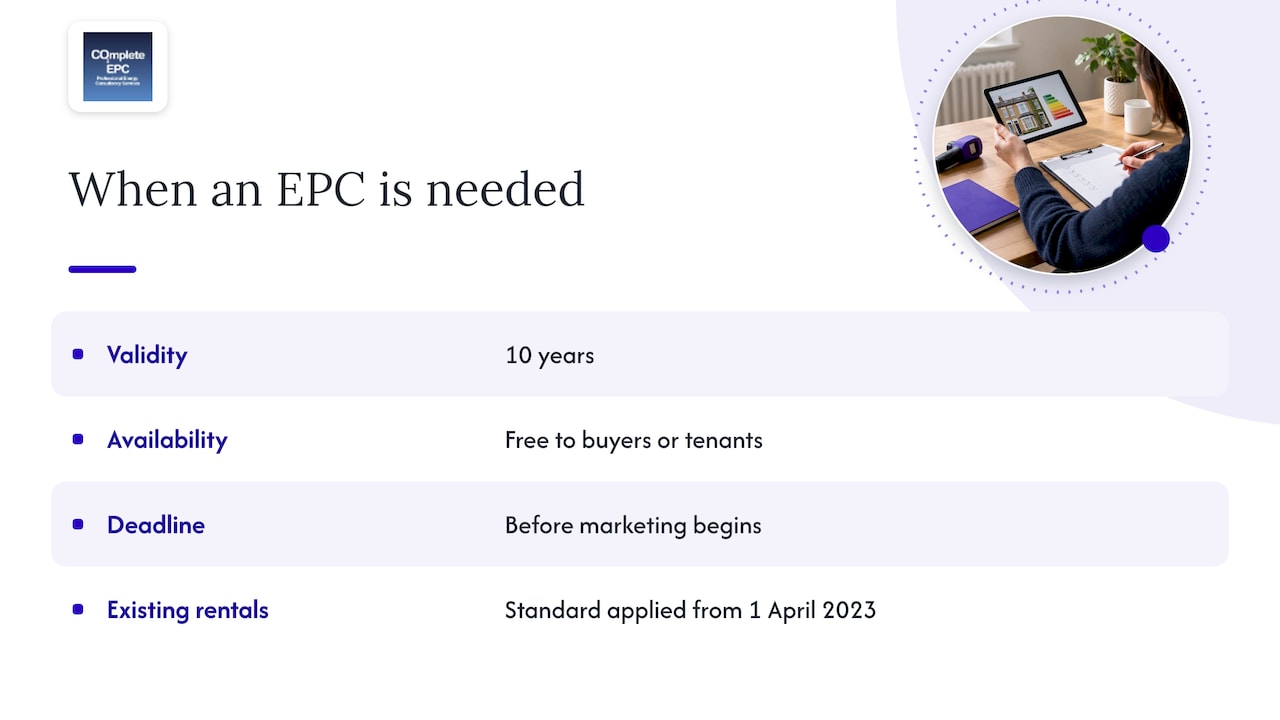
The GOV.UK guide to EPCs for dwellings states that in England, Wales and Northern Ireland an EPC is needed when a property is constructed, sold or rented. It must be valid for 10 years and made available free of charge to prospective buyers or tenants before the property is marketed. The 10 years apply regardless of how many times the property is sold or let during that time.
So can you sell a house without an EPC? In practice, no. You must have one commissioned before marketing begins, and a missing certificate can hold up a sale or letting.
For non-domestic premises, GOV.UK says you need an EPC if you rent out or sell the premises, or when a building is constructed. Exemptions exist for certain building types, so check before assuming you need or do not need one.
A note on dates: if you searched for the 2023 regulations, the main change that year was that the minimum standard for non-domestic lettings applied to all existing privately rented premises from 1 April 2023. We cover that below.
EPC assessments for landlords
This is where the rules bite hardest, and where mistakes cost money.
The current minimum standard
Under the Minimum Energy Efficiency Standards (MEES), privately rented properties in England and Wales must hold an EPC rating of at least E. Properties rated F or G cannot be legally let unless a valid exemption is registered. For non-domestic property, the requirement has applied to all privately rented premises since 1 April 2023. Domestic landlords have their own landlord guidance on the band E standard.
What is coming next
On 21 January 2026 the government confirmed that private landlords in England and Wales will need to meet the equivalent of EPC band C by 1 October 2030 for all tenancies, unless they hold an exemption, as summarised by The Independent Landlord. The detail of how the new EPC metrics will work was still being consulted on, so check current government guidance before making large spending decisions.
The practical message for a London landlord: a band E today is not a safe place to stay. If a property is on E or D, the recommendation report is your starting point for a staged plan.
Exemptions are temporary
Exemptions exist, but they are not a permanent bypass. Government guidance describes them as a temporary solution for circumstances where improvements are unfeasible, and landlords are expected to use that time to plan upgrades. Exemptions generally need to be registered on the PRS Exemptions Register and are time-limited, typically five years.
Listed buildings are a common source of confusion. They are not automatically exempt. The exemption applies only where meeting the standard would unacceptably alter the building’s character or appearance, and you need to hold proof, such as declined consent applications. Many period properties across London fall into this grey area, so take advice before relying on it.
A landlord’s checklist
- Check the current rating on the public register.
- Confirm the certificate is under 10 years old.
- If the rating is F or G, do not let the property until it is improved or exempt.
- If it is E or D, read the recommendation report and cost the route to band C.
- Keep invoices and evidence of every improvement for the next assessment.
EPC assessments for commercial properties
Commercial assessments work differently from home ones. There is no standard floor plan and no one-size method: offices, shops, warehouses, restaurants and mixed-use buildings are modelled using approved non-domestic software, and the assessor needs details of the building fabric, heating, cooling, ventilation, hot water and lighting.
Three things matter most for commercial owners and tenants:
- Size and complexity drive the work. A single small shop unit is a short job. A multi-floor office with several heating zones takes longer.
- MEES applies to lettings. If you rent out premises with an F or G rating, you need to improve them or register a valid exemption.
- Related regulations may apply. Air conditioning systems above a certain size need periodic inspection under TM44, and new commercial buildings need SBEM calculations for Building Regulations.
If you are letting a commercial unit in London, our commercial EPC service covers the certificate, and we can also advise on TM44 air conditioning inspections and SBEM calculations for new commercial buildings.
EPC assessment cost in London
There is no fixed national price. Assessors set their own fees, and the cost depends on the size and complexity of the property. A 2026 market guide puts typical domestic prices at £60 to £120, with London at £80 to £120, and notes that studios and small flats cost less than large detached houses.
What pushes the price up:
- more bedrooms or a larger floor area;
- unusual construction, extensions or conversions;
- mixed-use buildings or multi-unit blocks;
- awkward access or missing paperwork;
- same-day or urgent bookings.
Commercial EPCs are priced by floor area and complexity, so a quote needs the address and basic details. We do not publish fixed prices on our site, and we quote per property. Our offer includes a lowest-rate guarantee, so if you have a written like-for-like quote, send it to us.
Beware of the cheapest quote without checks. Ask whether the assessor is accredited, whether the certificate is lodged on the register, and whether the recommendation report is included.
Using the recommendation report
The report is the most valuable part of the assessment and the most overlooked. RICS experts advise landlords to treat it as a planning document for long-term asset maintenance rather than a compliance checklist.
In practice:
- Sort by cost and effect. Loft insulation, heating controls and low-energy lighting are usually cheaper than wall insulation or heating system replacement.
- Match works to events. Do insulation when you are already redecorating, and boiler replacement when the old one fails.
- Look beyond the building. For commercial sites, external works can form part of a wider cost-cutting plan. One example is these ideas for eco-friendly exterior upgrades on business premises, although the EPC itself rates the building rather than its surroundings.
- Re-assess after the work. A new EPC after improvements records the better rating and gives you evidence for lettings and sales.
For flat blocks, the Mayor of London’s Flats Retrofit Toolkit explains why you should understand the current condition and performance of your block before assessing upgrade options.
Our perspective: treat the EPC as a plan, not a form
We assess homes and commercial buildings across London, and a pattern repeats. Owners book an EPC when a sale or letting forces them to, glance at the letter on the front page and file it. The recommendation report, which is where the value lies, goes unread.
Our advice is to book earlier than you think you need to. A landlord who gets an assessment 12 months before a tenancy ends has time to plan works around void periods. A seller who knows the rating before marketing can fix an easy error, such as missing evidence for insulation, instead of losing time mid-sale.
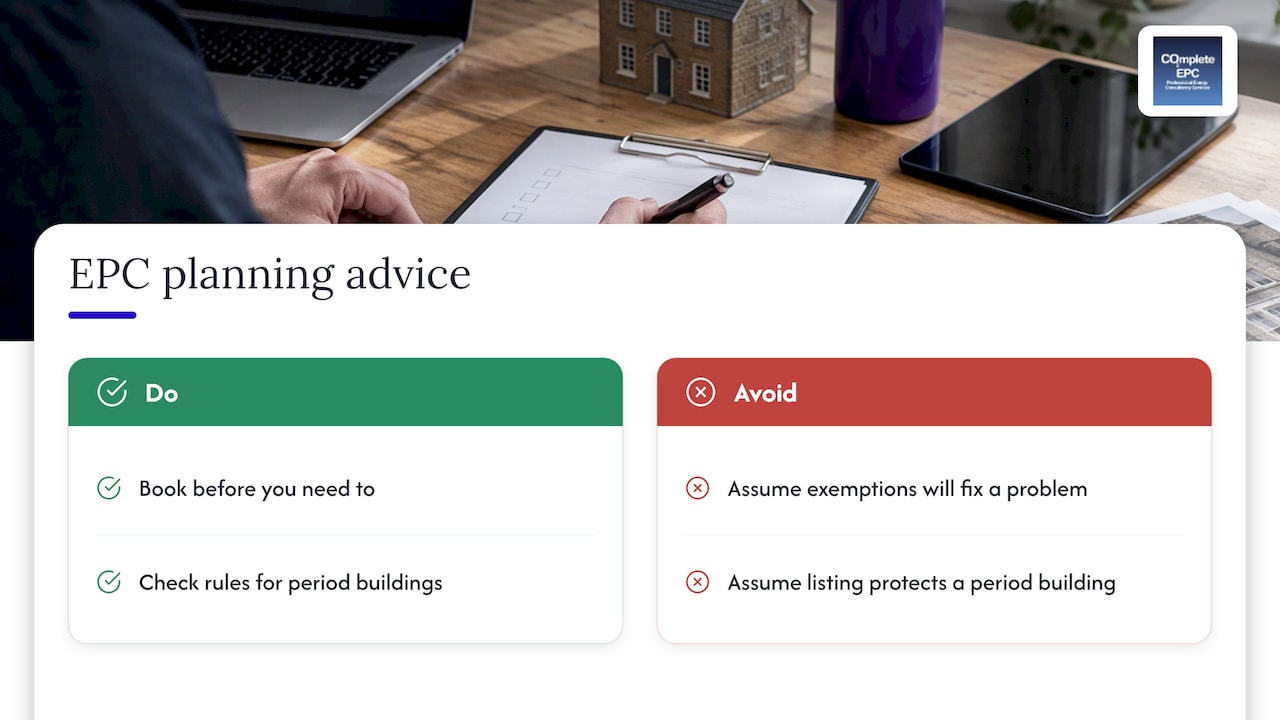
We also see mistakes caused by assuming exemptions will fix a problem. They are temporary and need evidence. If you hold a period building in London, do not assume the listing protects you. Check what the rules actually say.
We use qualified assessors and aim for a smooth booking. Beyond certificates, we provide SAP calculations, overheating analysis and other compliance reports, so if your project goes from assessment to building regulations, the work stays with one team.
— Danny
Booking an EPC assessment with us
If you own, let or manage property in London, we can arrange an assessment for a home or commercial premises. Send us the address and property type and we will quote for the job.
- For homes, see our domestic EPC service.
- For offices, shops and other premises, see our commercial EPC service.
- For new builds, conversions and extensions, we provide SAP calculations.
- For anything else, including EICR, PAT and water calculations, start from our main site.
Related assessments that often go with an EPC
An EPC is only one of several compliance documents a London project can need.
- SAP calculations are for new dwellings, conversions and extensions, and are part of showing Building Regulations compliance.
- Energy statements support planning applications. See our page on energy statements for planning.
- Overheating assessments (TM52 and TM59) matter for dense urban housing and are covered by our overheating assessment service.
- Dynamic simulation modelling gives a more detailed picture for complex buildings, and we explain it on our DSM page.
If you are not sure which applies to you, describe your project and we will tell you which reports are required and which are optional.
FAQ
What does an EPC assessment involve?
An accredited assessor visits the property, measures the rooms and records the walls, roof, windows, heating, hot water and lighting. They enter the data into approved software, lodge the result on the national register and send you the certificate with a recommendation report.
How long is an EPC valid for?
An EPC is valid for 10 years in England, Wales and Northern Ireland, whatever the number of sales or lettings in that period. You can commission a new one sooner if you have made improvements and want the better rating recorded.
Do landlords in London need an EPC?
Yes. A privately rented property in England and Wales needs a valid EPC, and properties rated F or G cannot be let without a registered exemption. The government has confirmed a move to band C for all tenancies by 1 October 2030, so plan upgrades now.
How much does an EPC assessment cost?
Prices are set by the assessor and depend on the size and type of property. One 2026 guide gives a London range of £80 to £120 for a typical home, and commercial premises are quoted individually. Always check the assessor is accredited before you pay.
Sources
- GOV.UK: Get a new energy certificate
- GOV.UK: A guide to Energy Performance Certificates for the marketing, sale and let of dwellings
- GOV.UK: Energy Performance Certificates for your business premises
- GOV.UK: Non-domestic private rented property, minimum energy efficiency standard
- GOV.UK: Domestic private rented property, minimum energy efficiency standard
- GOV.UK: Guidance on PRS exemptions and Exemptions Register evidence requirements
- GOV.UK: Register an exemption from private rented sector energy standards
- Bath and North East Somerset Council: EPCs and MEES for listed buildings
- RICS: ESG and sustainability in commercial property valuation
- RICS: BS 40104 and retrofit assessment
- The Independent Landlord: New EPC rules for landlords
- EPC Advisor: How much does an EPC cost in 2026
- London City Hall: Flats Retrofit Toolkit