

To check the EPC of a property, search the official Find an energy certificate service by postcode, street and town, or certificate reference number. Open the result and note the headline band and the report reference number first. The GOV.UK service covers England, Wales and Northern Ireland. A newer certificate replaces an older one.
TL;DR:
- The GOV.UK register covers England, Wales, and Northern Ireland; domestic and commercial searches differ, while Scottish properties require Scotland’s separate register.
- An EPC lasts up to 10 years, but a newly lodged certificate replaces its predecessor, even when the older report has not expired.
- The band alone can hide errors: compare floor area, heating, and insulation records, and challenge features marked assumed when you have proof of upgrades.
- A valid EPC must be in place before sale or rental marketing, and only an accredited assessor can produce and lodge a replacement.
- Recommendations are advisory for most owners, but landlords should plan around the government’s stated EPC C target for privately rented homes by 2030.
Table of Contents
- How do you search the register and open the certificate?
- How do you read the band, score and recommendations?
- How long does an EPC last and when do you need one?
- What should you do if there is no EPC, or it has been replaced?
- Which register should you use in Scotland, England, Wales and Northern Ireland?
- How do you use an EPC when buying, letting or negotiating?
- Why does Complete EPC deliver registered certificates reliably?
- Our view: start with the search, not the survey
- How can we help you get an EPC quickly?
- FAQ
- Sources
How do you search the register and open the certificate?
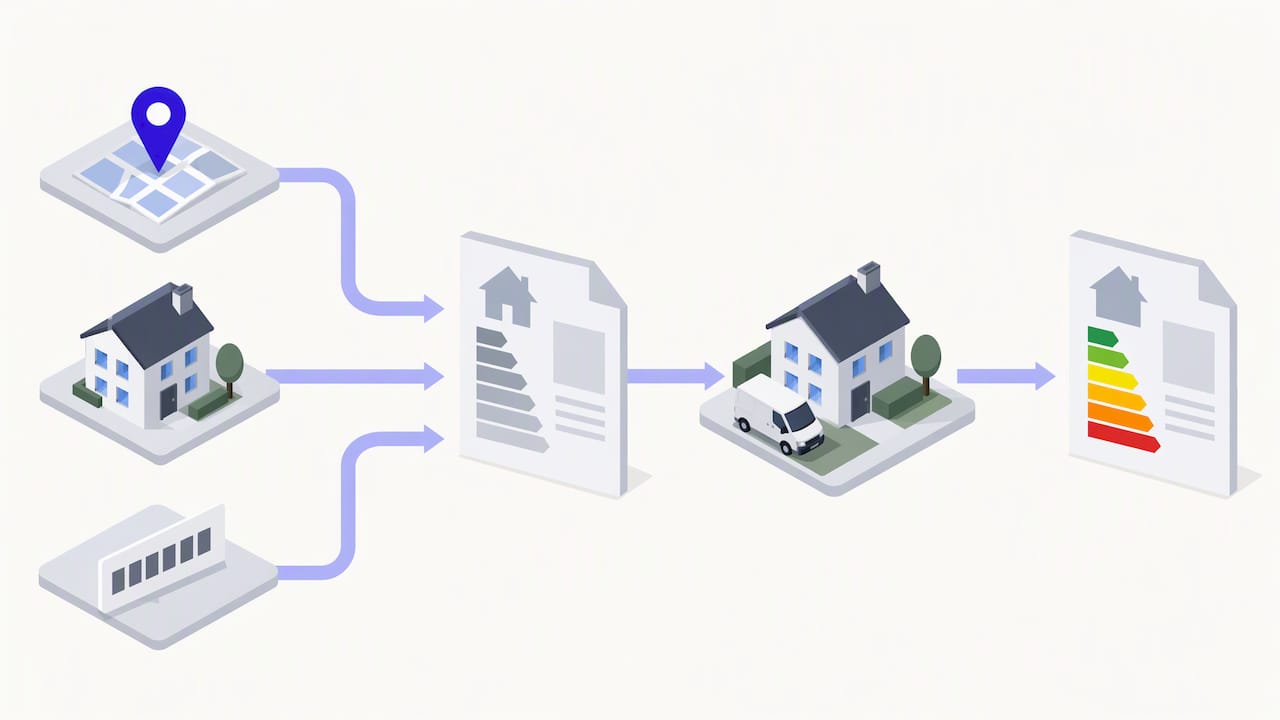
The fastest route is the government’s own service, and it costs nothing. Domestic and commercial properties use separate search pages, so pick the right one before you start. Follow these steps:
- Open the domestic search page for a home, or the non-domestic search page for a shop, office or other commercial unit.
- Enter the full postcode. Add the house or building number if the form asks for it.
- If the postcode returns nothing useful, switch to street name and post town.
- If you already hold a report reference number, use the search by reference number page. Commercial certificates have their own reference number search.
- Pick the correct address from the list of results. Flats and converted houses often share a postcode, so check the flat or unit number carefully.
- Open the entry and read the headline band, the issue date and the expiry date at the top of the page.
- Write down the report reference number, which is usually a long string of digits and dashes. You will need it to quote the certificate to a solicitor, agent or tenant.
- Download the PDF if you need a copy to send on or keep with your property file.
The same service also gives access to Display Energy Certificates and air conditioning inspection reports, so a commercial search may return more than one type of document. Check the title of each result before opening it.
Pro Tip: If a property returns several certificates, sort by date and open the most recent one. Older entries may still appear on the register, but only the latest is the one that counts.
Some properties simply have no certificate. A building that has never been sold, let or newly built may not have been assessed. If a search returns nothing after you have tried the postcode, the street name and any reference number you hold, assume no valid certificate is lodged and move to the commissioning steps further down.
How do you read the band, score and recommendations?
An EPC is easier to read than it looks, provided you know which lines matter. At the top you will see a band from A (most efficient) to G (least efficient) alongside a numeric score. The band is the quick signal. The score tells you where in that band the property sits, so two homes both rated D can be some way apart.
The government guide to EPCs explains that the recommendation report usually lists cost-effective measures to improve efficiency, but owners are not legally required to carry them out unless specific landlord regulations apply.
Take the recommendations as advice, not an instruction: owners are not legally obliged to act on them unless landlord rules apply.
Beyond the headline, these are the lines worth checking:
- Property type and total floor area: a wrong floor area skews the whole score, so compare it with what you know of the building.
- Main heating and hot water: the type of boiler or system drives much of the result.
- Wall and roof construction: look at how each element is described and whether insulation is recorded.
- Windows and lighting: glazing type and the share of efficient lighting feed into the rating.
- Recommendations: the list of suggested improvements, with the likely effect on your band.
Pay close attention to entries marked as “assumed”. Where an assessor cannot see inside a wall or roof, the software applies a default based on the age of the building. That is reasonable for a quick assessment, but it may understate insulation that was added later. If you know a loft has been topped up or cavity walls were filled, and the certificate does not reflect it, the rating may be harsher than the real performance.
Treat the recommendations as indicative for the same reason. They are built on the data the assessor recorded, so a surveyor reading the certificate will often cross-check them against the building in front of them. If something looks off, such as a floor area that does not match the layout, raise it before relying on the score.
How long does an EPC last and when do you need one?
An EPC is valid for up to 10 years. The Gov states it lasts a maximum of 10 years from the date it is entered on the register, and can be reused for selling or letting during that period. After that, you need a fresh one to market or let the property.
There is one catch that catches people out. A certificate can be inside its 10 years and still be out of date, because only the most recent certificate is treated as valid. If a new EPC is commissioned, it replaces the earlier one, even if the old one had years left to run.
The essentials in plain terms:
- Before marketing: an EPC must be in place before you market a building for sale or rent. The seller or landlord is responsible for commissioning it.
- Who can lodge it: only an accredited assessor can lodge a certificate on the register, as set out in the government’s notes and definitions.
- Landlords: since 1 October 2008, landlords must provide an EPC when they rent out a home, and prospective tenants should receive it free of charge at the earliest opportunity, according to one council’s landlord guide.
- Enforcement: keep a copy to hand for any buyer or tenant who asks.
Looking ahead, the government’s response on privately rented homes points towards higher minimum standards, with an EPC C target for private rented homes by 2030 and a cost cap on landlord investment. If you let property, factor that into how you plan upgrades and when you commission your next certificate.
What should you do if there is no EPC, or it has been replaced?
If the register shows nothing, or the certificate has expired, you need a new one. Only an accredited energy assessor can produce and lodge it, so the process is straightforward but not something you can do yourself.
- Confirm that no valid certificate exists by repeating the search with the postcode, the street and town, and any reference number you hold.
- Decide whether the property is domestic or commercial, because the assessment type differs.
- Book an accredited assessor. You can find one through the official service, or book direct with us for a Domestic Energy Performance Certificate or a Commercial EPC.
- Arrange access for the visit and gather anything that helps, such as boiler details, loft insulation records and window installation paperwork.
- The assessor visits, measures the property and records its construction, heating and hot water.
- The assessor lodges the data on the register. The certificate then receives a report reference number and becomes available to download.
- Search the register yourself to confirm it is live, and save the PDF.
At the visit, the assessor takes measurements, notes wall, roof and floor types, and records the heating system, controls and hot water arrangements. Accuracy here matters because the software relies on what is recorded, and anything the assessor cannot verify is assumed. Having documents ready for insulation work, new windows or a replacement boiler can stop a good property being marked down on defaults.
Costs vary by property type and size, so ask for a quote before you commit. The timeline is usually short: once the visit is done and the data is lodged, the certificate appears on the register.
Pro Tip: Book the assessment before you list the property. Marketing a building without a valid EPC in place is where sellers and landlords run into trouble.
Which register should you use in Scotland, England, Wales and Northern Ireland?
Check the location before you search, because the wrong portal returns nothing useful. Certificates for England, Wales and Northern Ireland sit on the gov.uk Find an energy certificate service. The GOV.UK service covers England, Wales and Northern Ireland.
If you are unsure which applies, start with the full postcode. The postcode tells you the nation, and the certificate itself shows its reference number once you open any result. A reference number that does not match the portal you used is a quick sign you are on the wrong register. For a Scottish address, go to the Scottish register instead and repeat the search there.
How do you use an EPC when buying, letting or negotiating?
Treat the band as a shortlist tool and the detail as the real comparison. Two properties with the same band can differ in floor area, wall construction and heating, so read the fabric lines before you decide which is the better buy.
- Shortlist by band, then compare lines: check floor area, wall and roof entries and heating type side by side.
- Query odd data: if a floor area looks wrong or a feature is marked as assumed when you know otherwise, ask for a newer EPC or arrange a follow-up inspection.
- Use the recommendations in negotiation: a list of suggested upgrades gives you a factual basis for discussing the cost of improvements with a seller.
- Landlords, plan ahead: weigh current and upcoming minimum standards before deciding whether to act on recommendations, and keep an up to date certificate ready for prospective tenants.
Why does Complete EPC deliver registered certificates reliably?
We offer Domestic Energy Performance Certificate and Commercial EPC services, and our assessors are qualified. The process maps onto what you need: you book, an assessor visits, the certificate is lodged on the official register, and you receive the finished document with its report reference number. That is the whole route from no certificate to a lodged, downloadable EPC.
Our view: start with the search, not the survey
Most people reach for a quote before they have checked whether a certificate already exists. That is the wrong order. A search often settles the question, and it tells you the band, the date and whether the data looks sensible. Do that first.
The second habit worth changing is fixating on the letter. A band is a summary, and the summary hides the lines that actually explain it. A floor area that does not match the building, or a wall recorded as assumed when you know it was insulated, can affect a property’s rating. Read the detail, and challenge what looks wrong before it costs you in a negotiation or a letting.
Third, keep the recommendations in perspective. They are advice, not an instruction, and they rest on whatever the assessor could see. Use them to start a conversation about upgrades, not to panic. If you need a new certificate, order it before you market the property, not after a buyer asks.
— Danny
How can we help you get an EPC quickly?
If your search comes back empty or the certificate has been superseded, we can arrange a registered EPC for you. We cover domestic and commercial properties across London, from a Domestic Energy Performance Certificate to a Commercial EPC. Here is what to expect:
- Request a quote or book, and tell us the property type and address.
- Our qualified assessor visits, measures the property and records its features.
- The certificate is lodged on the official register with its own report reference number.
- You receive the finished EPC to use for sale or letting.
New builds and larger projects may also need SAP Calculations, SBEM Calculations, a TM44 air conditioning inspection, Dynamic Simulation Modelling, Energy Statements for Planning or a TM59 and TM52 overheating assessment. We also handle EICR, PAT testing and water calculations through our main site. Get in touch and we will confirm the right assessment and your price.
FAQ
How do I check the EPC of a property?
Use the official Find an energy certificate service on GOV.UK and search by postcode, street and town, or reference number. Open the most recent result and note the band and report reference. Domestic and commercial properties use separate search pages.
How long is an EPC valid?
An EPC lasts up to 10 years from the date it is entered on the register, as GOV.UK states. It can be reused for selling or letting during that period. A newer certificate for the same property replaces the older one.
Who can issue an EPC?
Only an accredited energy assessor can produce and lodge an EPC on the official register. You cannot create one yourself. Book an accredited assessor, who will visit the property and lodge the certificate.
Do I need an EPC to sell or rent my property?
Yes, you need a valid EPC before you market a building for sale or rent, and the seller or landlord is responsible for arranging it. Landlords must also give prospective tenants a copy. Local authorities can issue penalty notices where a valid certificate is not provided.
Why can I not find an EPC for my property?
The property may never have been assessed, the certificate may have expired, or you may be searching the wrong register. Retry with the full postcode and street name, and remember that the GOV.UK service covers England, Wales and Northern Ireland. If nothing exists, commission a new one from an accredited assessor.