

You can check an EPC rating by postcode in about a minute, free of charge, using the government’s Find an energy certificate service. Enter the postcode, pick the address from the list and you will see the current rating, the potential rating, the expiry date and the recommended improvements. If the property is not listed, or its certificate has run out, you need a new assessment from an accredited assessor.
This guide shows you how to run the search, how to read the result, what to do when a certificate is missing, and why landlords in London should look at their rating now rather than in 2030.
TL;DR
- Search by postcode on the official GOV.UK service. It covers homes, business properties and public buildings in England, Wales and Northern Ireland, and costs nothing.
- Ratings run from A (most efficient) to G (least efficient). An EPC lasts 10 years.
- No result usually means the certificate has expired, was never lodged, or the owner has opted out of the public register.
- Private rented homes in England and Wales must currently meet EPC E, and the government has confirmed a move to EPC C equivalent by 1 October 2030.
- If you need a new certificate in London, we can arrange the assessment for you.
Table of Contents
- How to find an EPC rating by postcode
- What the result tells you
- Why a postcode search shows nothing
- What to do if you need a new EPC
- Rental rules: why landlords should check now
- Moving from D to C: where to start
- Looking beyond a single EPC in London
- Our view: treat the postcode search as step one
- Need a new certificate in London?
- FAQ
- Sources
How to find an EPC rating by postcode
The official register is the only source you need. Other EPC lookup sites mostly repeat the same public data, so the result will not differ.
- Go to the GOV.UK Find an energy certificate page and choose to search by postcode.
- Enter the full postcode, for example the one printed on your council tax bill or a letter.
- Select the right address from the list. Flats in the same building share a postcode, so check the flat number carefully.
- Open the certificate. You will see the rating band, the score, the property type, the floor area, the expiry date and the certificate number.
- Save or print the certificate. The certificate number is useful if you later need to find it again without searching.
The search returns a list of certificates lodged for that postcode. Some addresses show more than one certificate, because a property may have been assessed again after a sale, a rental or building work. Always open the most recent one, and check its validity date.
You can also search by street name and town, or by certificate number, if you do not have the postcode to hand.
Scotland and other schemes
The GOV.UK service covers England, Wales and Northern Ireland. Scotland has its own separate register, so a Scottish postcode will not return results there. Public buildings may also display a Display Energy Certificate, which is a different document from an EPC.
What the result tells you
A typical result gives you five pieces of information. Each one answers a different practical question.
| What you see | What it means for you |
|---|---|
| Current rating (A to G) and score | How efficient the property was when it was assessed |
| Potential rating | The band you could reach if you carried out the listed improvements |
| Valid until date | When the certificate expires |
| Property type and floor area | Whether you are looking at the right building |
| Recommendations | Suggested measures, in order, with estimated costs and savings |
Understanding the bands and scores
The scale runs from A, the most efficient band, with a score of 92 or more, down to G, the least efficient, with a score of 1 to 20. The average domestic rating in England and Wales is D, so a D is typical rather than a cause for alarm. Official statistics from the ONS confirm that both countries have a median energy efficiency rating in band D.
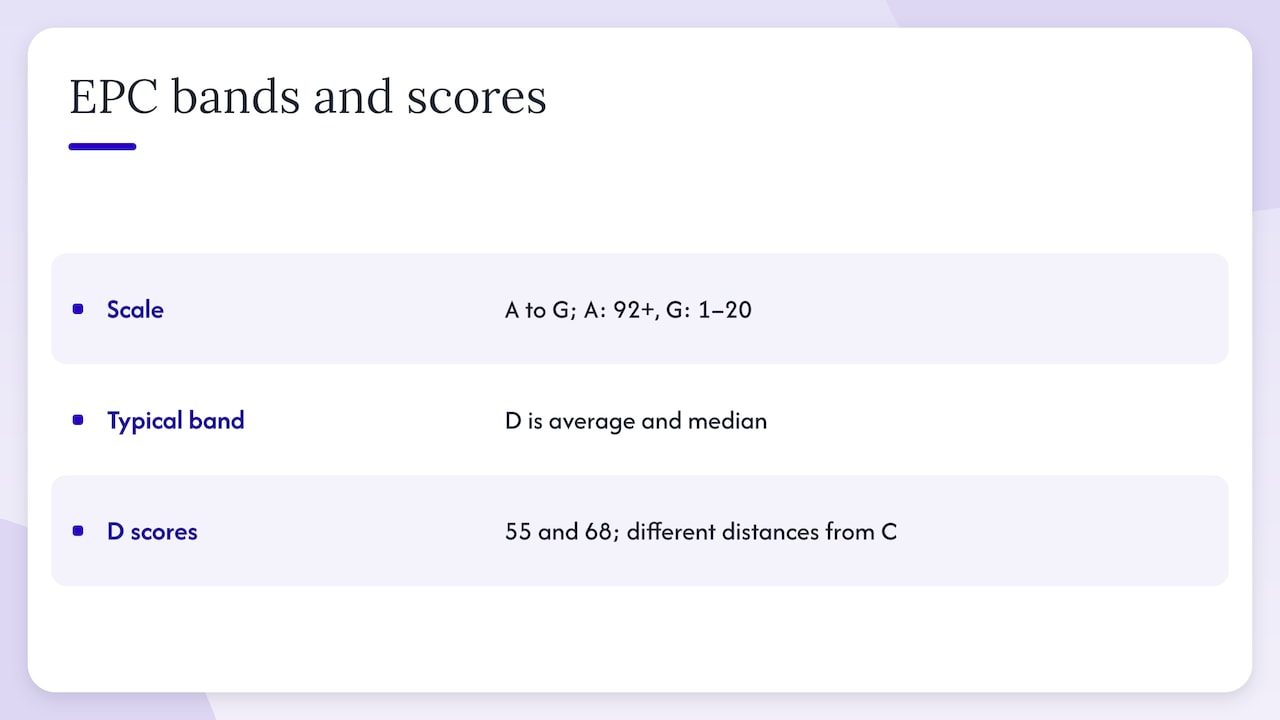
The score matters as much as the letter. Two homes can both be a D, but one at 55 and one at 68 are very different distances from a C.
How long a certificate lasts
An EPC is valid for 10 years from the date it is issued. An expired certificate is not a problem for a property that is not being sold or let. It becomes one the moment you want to market the property.
A snapshot, not a live reading
An EPC records the property as it was on the day of assessment. If the previous owner added an extension, replaced the boiler or insulated the loft afterwards, and nobody lodged a new certificate, the rating you see is out of date. The ONS notes that certificates reflect the building’s features at the time of lodging. Treat the recommendations as a starting point and take updated professional advice before you commit to major works.
Assessors also use assumptions. Where a feature cannot be inspected, such as wall insulation hidden behind plaster, the software applies an assumed rating based on the age and type of the property. Evidence such as installation certificates or photographs can sometimes change that assumption in a new assessment.
Why a postcode search shows nothing
If you get no result, there are three common explanations.
- The certificate has expired. The register may still show it, marked as expired, but it cannot be used to sell or let the property.
- No certificate was ever lodged. This is common for properties that have not been sold or rented since EPCs began, and for new conversions.
- The owner has opted out. The online search lets anyone retrieve an EPC by address or postcode unless the owner or occupier has opted out. Once opted out, the certificate can only be found using its 20-digit report reference number from the assessor. Opting out is done by contacting the register helpdesk with valid identification showing your connection to the property.
A missing result does not prove a property has no certificate. If you are a buyer or tenant, ask the agent or landlord for the certificate number. If you are the owner, check your sale paperwork or ask the assessor who carried out the last survey.
What to do if you need a new EPC
If the property has no valid certificate, GOV.UK explains that you must arrange an assessment before the property is marketed for sale or rent. The assessor visits, records the construction, insulation, heating, hot water and lighting, and lodges the certificate on the register. You then receive the report with its recommendations.
Here is how to prepare so the visit goes smoothly:
- Gather any documents for loft, cavity wall or underfloor insulation, boiler servicing and window replacements (FENSA certificates, for example).
- Make sure the assessor can reach the loft hatch, the boiler, any cylinder and every room.
- Tell the assessor about extensions, conversions or loft rooms, and when the work was done.
- Note the heating controls: thermostat, programmer and radiator valves.
For commercial premises the process is the same in principle, but the assessment is more involved and uses different software. Our commercial EPC service covers offices, shops and other business property across London.
Rental rules: why landlords should check now
If you let property in England or Wales, your postcode search is also a compliance check.
Private rented homes currently need a minimum rating of E. The government has confirmed a new standard: all privately rented homes must reach an EPC C equivalent by 1 October 2030. The same government response sets out the main details:
- Landlords face a cost cap of £10,000 for relevant improvements.
- A landlord who reaches the cap without achieving the standard can register a 10-year exemption.
- Homes graded C or above before 1 October 2029 are treated as compliant until their existing certificate expires.
- An impact assessment puts the average upgrade cost at £5,400 per property.
That third point is the one to act on. A certificate lodged with a C before 1 October 2029 can carry you through to its expiry, which may be up to 10 years later. If your property is a D today, getting the works done and a fresh certificate lodged before that date could save you a second round of compliance later. Check your own rating first, because the rules are set against the Energy Efficiency Rating on the certificate.
The government’s stated reasoning is to align with 2030 fuel poverty targets and carbon budgets, and its approach puts fabric performance, meaning insulation and building materials, ahead of heating systems.
Moving from D to C: where to start
The recommendations on your certificate are listed in a sensible order, but a few principles help you plan.
Fabric first
It is generally more efficient to carry out high-impact fabric improvements such as insulation before replacing the heating system. Better insulation lowers the heat the property needs, which can reduce the size and running cost of new equipment. Fitting a new boiler or heat pump first can mean paying for capacity you do not need.
For homes with solid walls, which includes much of London’s older Victorian and Edwardian housing, internal wall insulation is often among the recommended measures. For a clear explanation of how insulation interacts with the finishes inside a home, including tiled floors and walls, this German guide to tiling and thermal insulation is a useful reference, though building rules there differ from those in the UK.
Use the free costed recommendations
The government’s Find ways to save energy in your home service gives recommendations for properties in England or Wales, including an estimated cost for each improvement. Enter details such as construction date, wall type and insulation, and compare the results with your certificate.
Reassess after the work
The rating only changes when a new certificate is lodged. After you finish the works, keep the invoices and installation certificates and book a fresh assessment. Without evidence, the assessor may fall back on assumptions for the age of your building.
Looking beyond a single EPC in London
If you own several properties, or are researching a neighbourhood rather than one address, a single certificate only goes so far. The Greater London Authority’s London Building Stock Model combines EPC data with borough council records and modelling, giving a wider picture of the energy profile of different areas and building types. It is aimed at planners and researchers, but it shows how varied London’s housing stock is, and why the same street can contain properties in very different bands.
Our view: treat the postcode search as step one
We carry out EPC assessments for homes and commercial buildings across London, and the postcode search is where most of our customers start. The pattern we see is simple. Owners and landlords look up their rating, find it is older than they expected or lower than they hoped, and then want to know what is realistic.
Our advice is to read three things on the certificate before anything else: the score, the expiry date and the first three recommendations. The score tells you how far you are from the next band. The expiry date tells you whether you have a compliance deadline of your own. The top recommendations tell you where the largest gains probably sit, and for most older London properties that means the building fabric.

We also encourage landlords not to wait for 2030. Works are easier to schedule between tenancies, and a certificate lodged with a C before 1 October 2029 can stay valid until it expires. A good assessor will explain what the software has assumed and what evidence could change it, so give them your paperwork.
If the certificate shows something you think is wrong, such as an extension that is missing, ask for a reassessment rather than living with it.
— Danny
Need a new certificate in London?
If your postcode search shows an expired certificate or no certificate at all, our qualified assessors can carry out the survey and lodge the result for you. Our domestic EPC service covers homes across north, east, south and west London, and our commercial EPC service covers business premises. We also advise landlords on MEES compliance and improvement measures. Visit Complete EPC to arrange an assessment.
FAQ
Is it free to check an EPC rating by postcode?
Yes. The GOV.UK service is free and needs no registration. You enter the postcode, choose the address and view the certificate, including expired ones that are still on the register.
Why can’t I find my property’s EPC?
The certificate may have expired, may never have been lodged, or the owner may have opted out of public access. Opted-out certificates can only be retrieved with the 20-digit report reference number. If you own the property, check your paperwork or ask the assessor who surveyed it.
What is a good EPC rating?
A is the best band, with a score of 92 or above, and G is the worst. The average home in England and Wales is a D. For landlords, E is the current minimum for private rentals, and C equivalent is the confirmed target for 1 October 2030.
How long is an EPC valid?
An EPC is valid for 10 years from the date of issue. You can check the exact date under Valid until on the certificate. A new certificate is needed before you market the property if the old one has expired.
Sources
- Find an energy certificate, GOV.UK
- Get a new energy certificate, GOV.UK
- Find ways to save energy in your home, GOV.UK
- Improving the energy performance of privately rented homes: government response, GOV.UK
- Example energy performance certificate, GOV.UK
- Making better use of Energy Performance of Buildings data, privacy notice
- Energy efficiency of housing in England and Wales, ONS (2022)
- Energy efficiency of housing in England and Wales, ONS (2023)
- London Building Stock Model 2, data.gov.uk