
The biggest EPC change so far took effect on 15 June 2025, when a new assessment methodology (RdSAP 10) began for existing homes. A larger reform is still to come. Government has confirmed that privately rented homes in England and Wales will need the equivalent of EPC Band C by 1 October 2030, and the reformed certificate that will sit behind that rule has been pushed back to the second half of 2027. This guide sets out what is already live, what is confirmed, what is still uncertain, and what property owners and landlords in London can sensibly do now.
TL;DR
- Already live: RdSAP 10 started on 15 June 2025. Assessments for existing homes are more detailed, and some agents have reported higher costs.
- Confirmed target: EPC C for all private tenancies by 1 October 2030, with a £10,000 cost cap for landlords.
- Delayed: the reformed domestic EPC, with new metrics, has moved to the second half of 2027.
- Commercial: the rules are different. A valid EPC is needed to rent or sell, and the minimum standard for lettings is currently E.
- Best move now: check your current certificate, its expiry date and its recommendations before you spend money.
Table of Contents
- What has actually changed since 2025
- EPC C by 2030 for rented homes
- The reformed EPC: new metrics, later launch
- Commercial property: what has and hasn’t changed
- A practical plan for landlords and owners
- Our perspective
- How we can help
- FAQ
- Sources
What has actually changed since 2025
Much of the talk about “EPC changes in 2025” mixes three separate things: a methodology change that has happened, a rental standard that has been confirmed, and a certificate redesign that has not yet arrived. Keeping them apart avoids most of the confusion.
| Change | Status | What it means for you |
|---|---|---|
| RdSAP 10 methodology | Live since 15 June 2025 | New domestic EPCs use updated inputs and assumptions |
| EPC C for private rentals | Confirmed target of 1 October 2030 | Landlords need a plan, with regulations expected later |
| Reformed EPC with new metrics | Launch moved to second half of 2027 | Today’s A to G certificate remains in use until then |
| Commercial EPC rules | Unchanged in principle | Valid EPC needed on sale or let; fines apply |
RdSAP 10: the change you can already see
The Reduced Data Standard Assessment Procedure (RdSAP) is the simplified method used to produce EPCs for existing dwellings. Propertymark describes the move to RdSAP 10 as the most significant update in over a decade, aimed at making certificates more accurate and better reflective of how homes are used.
In practice, assessors now gather more detail about the building, and may ask for supporting evidence such as insulation certificates or installer paperwork. If you have had work done, such as loft insulation, cavity wall fill, a new boiler or solar panels, keep the documents. Without proof, an assessor may have to rely on default assumptions for the age of the property, which can undersell it.
The same Propertymark piece notes that some of its members had already reported higher costs for the more detailed assessments. Expect assessments to take a little longer than they once did, and treat very cheap quotes with caution if they do not mention evidence or a proper survey.
Your existing EPC does not stop being valid
An EPC lasts 10 years. A certificate lodged before the changes does not become invalid because the method has been updated. You only need a new one when it expires, when you sell or let and no valid certificate exists, or when you choose to commission one, for example after improvements.
If you are unsure whether your certificate is still valid, look it up on the government EPC register using your address. Check the date, the rating and the recommendation list.
EPC C by 2030 for rented homes
The government’s consultation page on privately rented homes confirms a new target date of 1 October 2030 for the equivalent of EPC Band C, supported by a maximum spend of £10,000 per property for landlords. Regulations are expected to be laid in 2027, so the detail is not final.
The current rule for domestic lettings is an EPC of E. The move to C is the one that will matter most for landlords with older London flats and conversions, where many properties sit in bands D and E.
The £10,000 cost cap
The cost cap limits what a landlord has to spend before they can claim an exemption. It is not a target and it does not mean every property will cost £10,000 to upgrade. Many properties will need far less, and some will need more than the cap allows, in which case an exemption applies once the cap has been reached and properly evidenced.
According to the government’s options assessment, the proposals include a sequence: the primary fabric performance standard comes first, and spending on smart or heating system upgrades would not count toward the cap until fabric is met or an exemption for it is registered. That document is an assessment of proposals, so check the final regulations when they appear before you plan a sequence of works around it.
The same document indicates that the cost of commissioning a new, reformed EPC could count as a relevant cost toward the cap. Again, confirm against the final rules.
Improvements made now still count
If you are waiting for the regulations before doing anything, consider the cost of waiting. Rising energy costs hit tenants first, and void periods hit landlords. Work that improves the fabric of a building, such as insulation and draught proofing, is the sort of improvement likely to stay useful whichever way the final rules fall. Before you commit, talk to a qualified assessor about which measures move your rating most for your property type.
The reformed EPC: new metrics, later launch
The EPC most people know is a single A to G rating. The government’s response on reforming the energy performance of buildings regime sets out four new indicators for domestic certificates: energy cost, fabric performance, heating system and smart readiness. A secondary energy demand metric based on delivered energy is also planned, and the existing energy efficiency rating is retained during the transition so compliance can continue.
Timing has slipped. An update on the consultation page, dated 9 March 2026, says the launch of the reforms has been moved to the second half of 2027 after engagement with industry on the delivery timeline. If you read older articles promising the new certificate in 2026, they are out of date.
What this means in practice
- Until launch, you will still get today’s style certificate. Nothing about the layout changes your obligations now.
- Certificates issued before launch are expected to keep their validity. The government’s options assessment suggests that a property already rated C or better on an existing EPC would generally be treated as compliant until that certificate expires. Some landlords could therefore have a long runway, but this depends on final regulations and on not triggering a new EPC sooner.
- An older EER of C will not be a permanent shield. The same assessment says landlords will need a reformed EPC to demonstrate compliance with the new fabric, heating or smart standards, once those apply.
Why the single rating is being replaced
The single rating has been widely criticised for giving little guidance on what to do next, and the recommendations on older or heritage buildings are often impractical. The government says the new metrics and a more modular assessment approach are meant to give more flexibility and better targeted advice. For owners of period terraces in north and east London, that could be a real improvement over generic suggestions.
Commercial property: what has and hasn’t changed
For non-domestic premises the position is more stable. Under government guidance on EPCs for business premises, you need an EPC when you rent out or sell the premises, or when a building under construction is finished. You can be fined between £500 and £5,000, based on the rateable value of the building, if you do not make an EPC available to prospective buyers or tenants.
On minimum standards, the non-domestic landlord guidance explains that since 1 April 2018 landlords have only been permitted to grant new tenancies, or to extend or renew existing ones, where the property reaches EPC E, unless an exemption is registered. Higher standards, such as EPC B by 2030, have been consulted on, but we would not plan around them until legislation is confirmed.
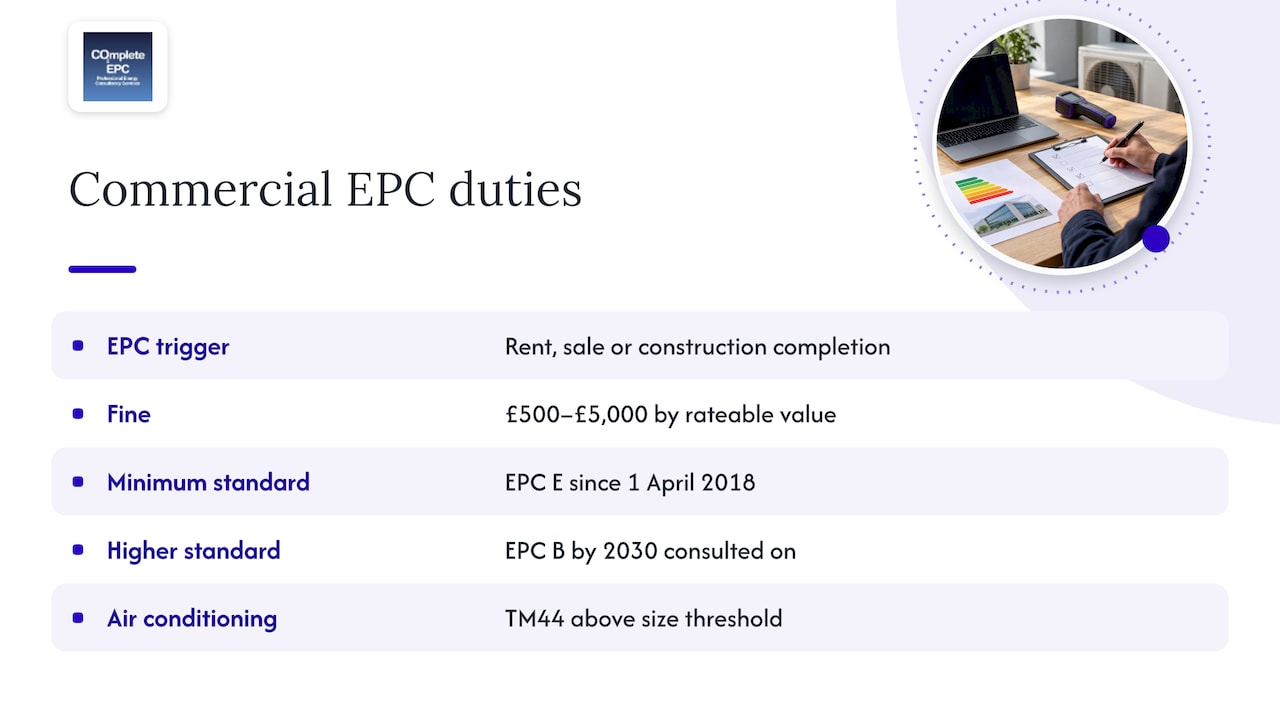
Commercial landlords should also check air conditioning. If you manage offices or retail units with systems above the size threshold, a TM44 air conditioning inspection is a separate legal requirement from the EPC.
A practical plan for landlords and owners
- Find your certificate. Search the register for your address and note the rating, date of issue and expiry.
- Read the recommendations. Note which are cheap (draught proofing, loft insulation, lighting) and which are expensive (wall insulation, heating changes).
- Gather evidence. Collect invoices, guarantees and installer certificates for any work. Since RdSAP 10, supporting documents can make a real difference to the result.
- Order a fresh EPC if you have made improvements. An up-to-date certificate shows the effect of the work. It is also needed before you market the property if the old one has expired.
- Keep a file of every cost. If you later claim an exemption under the cost cap, you will need records.
- Prioritise fabric. Based on the government’s own sequencing proposals, insulation and fabric work is where the compliance route is likely to start.
- Revisit when regulations arrive. Draft regulations are expected in 2027, so keep your plan flexible.
Choosing measures that suit the building
Not every measure suits every London property. Solid-walled Victorian houses, 1930s semis and new-build flats each need a different approach. For homes where electricity use is a concern, some owners also look at add-ons, such as plug-in power-saving boxes and portable energy storage, but remember that EPC ratings depend on the fabric, heating system and installed measures recorded by the assessor, so check what an assessor can actually credit before buying. For a wider look at what can be done, a list of energy-saving home upgrades is a useful way to compare ideas, including glazing and doors.
Our perspective
We assess homes and commercial buildings across London, and the same questions come up repeatedly: “Do I need to do anything now?” and “Will my certificate still count?” Our honest answer is that the rules are settling, but not settled. The 2030 date is confirmed, the 2027 reform is not yet live, and the final regulations are still to be written.
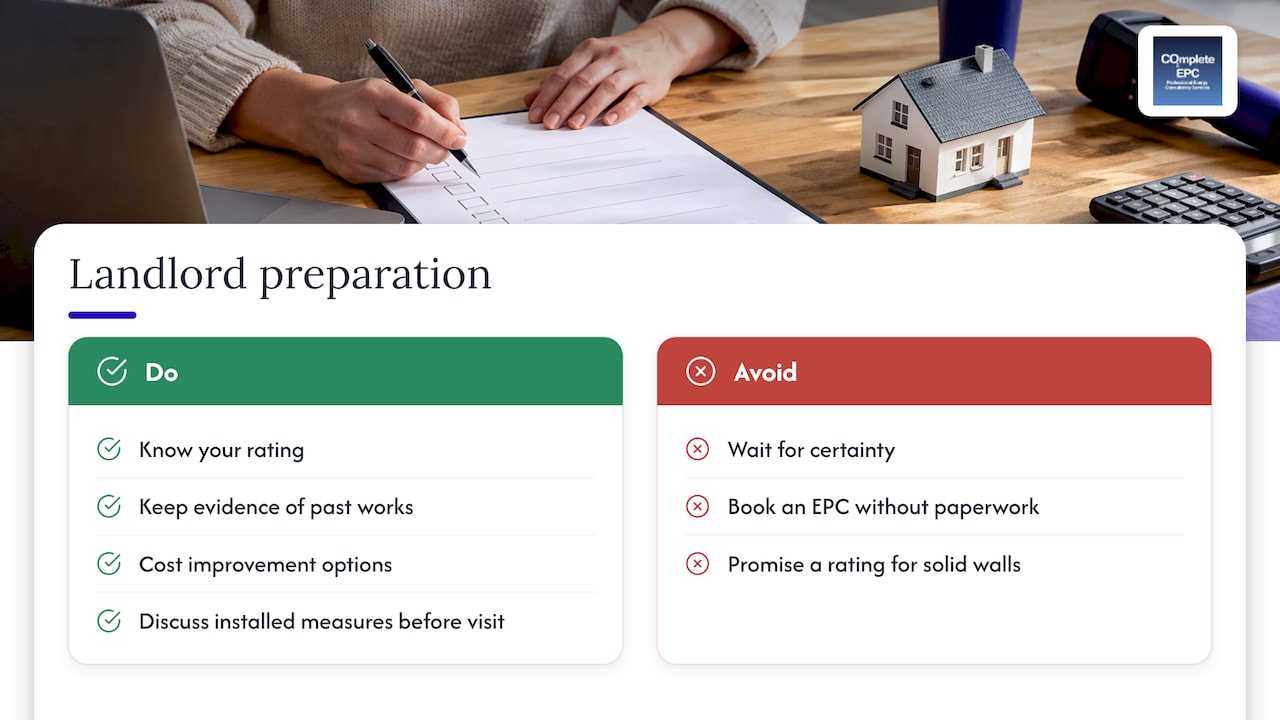
The mistake we see most is waiting for certainty and then rushing. A landlord who knows their rating, holds evidence for past works and has a costed list of improvements has choices. A landlord who finds out in 2029 that a flat is in band E, with several months to do the work, does not.
We also see owners paying for an EPC without having gathered paperwork, which can leave an assessor using default assumptions. A short conversation before the visit about what has been installed usually leads to a fairer result. And where a property has features the standard recommendations handle badly, such as older solid walls, we would rather explain the limits than promise a rating.
— Danny
How we can help
If you need a certificate for a sale, a letting or an improvement plan, our domestic EPC service covers homes across London, and our commercial EPC service covers offices, shops and other business premises. For new builds, conversions and extensions we also carry out SAP calculations. Tell us about the property and we will explain what you need and what it involves. You can start from our main site.
FAQ
Are EPCs changing in 2027?
Yes, the reformed domestic EPC is now planned for the second half of 2027, after the government moved the launch back in March 2026. It is due to introduce new indicators for energy cost, fabric performance, heating system and smart readiness. Regulations for the 2030 rental standard are also expected to be laid in 2027.
What is the new EPC rule for landlords?
The government has confirmed a target of EPC C, or the equivalent under the new system, for private rented homes in England and Wales by 1 October 2030. Landlords face a spending cap of £10,000 per property before they can rely on an exemption. The detailed regulations have not yet been laid, so check them once published.
How do I update my EPC?
You cannot edit a certificate. You book a new assessment with an accredited domestic energy assessor, who inspects the property and lodges a new certificate on the register. Have invoices and installer certificates ready for any improvements, as these can be needed as evidence under the current methodology.
Does improving my EPC rating increase house value?
It can make a property more attractive to buyers and tenants who are looking at running costs, but we cannot promise a specific uplift, as value depends on location, condition and the market. The clearer benefit for landlords is staying lettable under the standards as they tighten.
Sources
- Major EPC overhaul due to take effect on 15 June 2025 (Propertymark)
- Improving the energy performance of privately rented homes: 2025 update (GOV.UK)
- Options assessment (GOV.UK)
- Reforms to the Energy Performance of Buildings regime (GOV.UK)
- Partial government response on EPB reforms (GOV.UK)
- Energy Performance Certificates for your business premises (GOV.UK)
- Non-domestic private rented property: minimum energy efficiency standard (GOV.UK)