

The right EPC assessor is accredited, independent and experienced with your type of property. They are also happy to explain the recommendations in your report. Pick on those four points rather than on the lowest quote alone, and you will get a certificate that stands up when a buyer, tenant or local authority checks it. This guide covers what an assessor does, how to vet one, how to prepare for the visit, what to do with the results and how to correct a mistake.
TL;DR
- Only an accredited assessor can produce a valid EPC, so ask for their accreditation scheme and check it before you book.
- A typical domestic survey takes 30 minutes to 1 hour. Give access to the loft, boiler and hot water tank to avoid a return visit.
- An EPC is valid for 10 years, but the recommendations page is worth reading as a to-do list, not just a formality.
- If something looks wrong, contact the assessor first, then their accreditation scheme.
- Landlords in England must meet the minimum E rating unless a valid exemption is registered.
Table of Contents
- What an EPC assessor actually does
- Why you need an accredited assessor
- How to choose an EPC assessor: a checklist
- Preparing for the survey
- Reading your EPC: what the numbers mean
- EPC advice for landlords
- When an EPC is not enough
- What to do if your EPC looks wrong
- Our perspective: what we tell clients
- Book an assessor who explains the report
- FAQ
- Sources
What an EPC assessor actually does
An energy assessor visits a building, records the features that affect energy use, and enters the data into government-approved software. The software produces the rating on the A to G scale and a list of suggested improvements. The Office for National Statistics describes the process in these terms: an accredited assessor collects the data, and approved software generates the certificate.
The assessor does not decide the rating by opinion. They record evidence: the age and construction of the property, the number and type of windows, wall dimensions, loft insulation, the boiler, hot water cylinder and lighting. The software does the calculation. That is why two assessors visiting the same flat should arrive at very similar results, and why a large gap between two certificates is a reason to ask questions.
Domestic and commercial assessors are not always the same person
Domestic energy assessors cover homes. Commercial premises need a non-domestic assessor, and larger or more complex buildings, such as offices with air conditioning, may also trigger other reports. If you own a shop, office or mixed-use building in London, ask specifically whether the assessor handles non-domestic work. Our own commercial EPC service is aimed at exactly these properties.
Why you need an accredited assessor
The rule is simple. Only an accredited domestic energy assessor may carry out an energy assessment and produce an EPC for a dwelling. A certificate from anyone else is not a valid EPC, and you would have to pay again.
To become a domestic assessor, a person needs a Level 3 Certificate in Domestic Energy Assessment and membership of an approved accreditation scheme. The scheme is the quality regulator. According to government guidance, schemes monitor assessments through sample audits and make sure members are qualified, competent and follow professional codes of conduct.
In practice, that gives you two useful facts. First, every legitimate assessor belongs to a scheme and has a membership number. Second, if anything goes wrong, you have somewhere to take your complaint.
How to choose an EPC assessor: a checklist
Use these checks before you pay a deposit or confirm a date.
- Ask for the accreditation scheme and assessor number. A genuine assessor gives both without hesitation.
- Check the type of property they handle. A terraced house in Walthamstow, a converted flat above a shop in Camden and a 1,500 square metre office are different jobs.
- Confirm independence. An accredited assessor must not have a conflict of interest, such as employment links to the commissioning party or a family relationship. The same government guidance says concerns about non-independent assessments can be reported to the scheme.
- Get the quote in writing. It should say what is included, whether the fee covers the lodged certificate and recommendation report, and how soon you will receive them.
- Ask about turnaround and access. Agree a date, how long the visit takes and which areas must be reachable.
- Ask who answers questions afterwards. An assessor who will talk you through the recommendations is worth more than one who emails a PDF and disappears.
What an EPC costs and why it varies
The National Careers Service puts typical domestic assessments at between £60 and £120, varying by location and property size. A larger house with extensions or several heating systems takes longer to survey, and commercial premises are quoted per building. Treat a quote far below that range with caution, and ask what is left out. We do not publish fixed prices on our site, so contact us for a quote based on your property.
Red flags
- No accreditation number, or reluctance to name the scheme.
- A certificate promised without a visit. Even if you have architectural plans, the assessor is required to carry out a site inspection to confirm the information.
- Any suggestion that the rating can be “arranged” or improved on paper.
- A commissioning party, such as a seller’s contact, who has a personal link to the assessor.
Preparing for the survey
An EPC survey is an evidence-gathering exercise. The assessor needs physical access to every relevant area, and government guidance says they will usually photograph key features such as insulation thickness, boiler labels and glazing types.
Before the visit
- Clear access to the loft hatch and make a ladder available if one is not fitted.
- Unlock the boiler cupboard, airing cupboard and any plant room.
- Find the boiler manual or installer paperwork, plus any records of insulation, new windows or solar panels.
- Gather evidence of work done: FENSA certificates, Building Control sign-off, invoices with dates and product names.
- Make sure every room, including outbuildings that are part of the dwelling, can be entered.
On the day
Expect to be asked about the heating system, the number of open fireplaces, the type of lighting and whether there is a hot water tank. The assessor measures rooms, notes wall construction and checks window frames. For a standard home, 30 minutes to an hour is typical. Flats usually take less time and large or unusual properties more.
If you cannot show evidence for an improvement, such as loft insulation you cannot see or a boiler with no label, the software may use default assumptions based on the property’s age. That can lower your rating. Documents you can produce on the day are the simplest fix.
Reading your EPC: what the numbers mean
The certificate banding runs from A, the most efficient, to G, the least. Official technical notes explain that the bands reflect likely fuel costs and carbon dioxide emissions. The notes add that non-domestic properties can reach A+.
The rating is not your energy bill
A frequent misunderstanding is that an EPC reflects how you live. It does not. EPC calculations use standardised assumptions about occupancy, heating patterns and usage, so that one property can be compared fairly with another. Your real bills may be higher or lower depending on how many people live there and how you heat the home.
Start with the recommendations page
Many owners treat the EPC as paperwork. The recommendations report is where the value sits. Experts quoted in a local authority retrofit booklet note that heat pumps and better insulation have become more affordable and effective over the last decade, so an outdated certificate may no longer show the cost-effective improvements available today.
When you read the list, look at each item for:
- the typical installation cost range shown
- the typical yearly saving
- whether it is a fabric measure (insulation, glazing) or a systems measure (boiler, controls)
- whether it is realistic for your building. A solid-wall Victorian terrace and a 1990s flat will not have the same options.
A good assessor will tell you which two or three are worth doing first. For a broader look at how builders approach this, see this overview of energy efficiency in construction, which covers general principles of insulation, airtightness and efficient systems that apply to any improvement project.
Changes on the way
The single A to G rating is not the whole picture, and government knows it. In its January 2026 response, the government said it will replace the single cost metric on domestic EPCs with four headline metrics: energy cost, fabric performance, heating system and smart readiness. For you, that means a good assessor should already be thinking beyond the band letter and towards actionable retrofit advice. Check GOV.UK for the current timetable before you plan around any change.
EPC advice for landlords
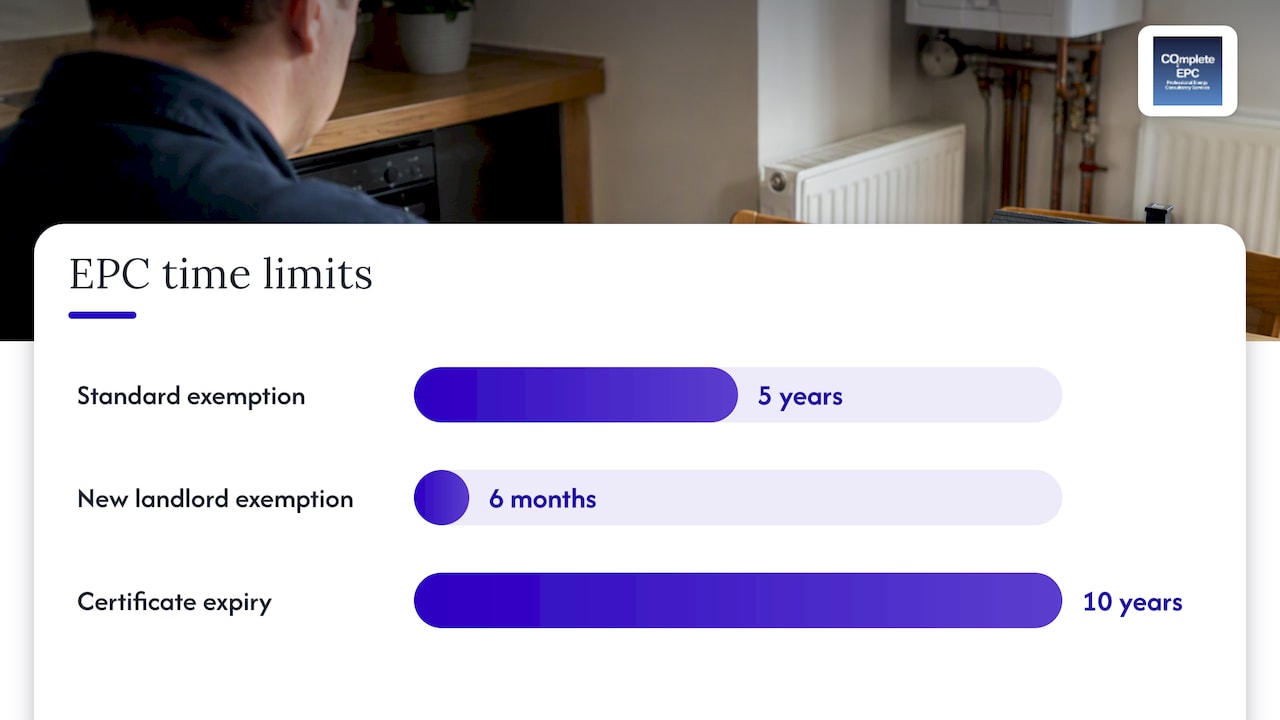
If you let a property in London, the assessor’s report is a compliance document. Under the Minimum Energy Efficiency Standard, domestic private rented properties in England must have an EPC rating of E or above. Letting an F or G property is unlawful unless a valid exemption is registered. Penalties can reach £5,000, and the same guidance says standard exemptions are generally valid for 5 years, while a new landlord exemption lasts 6 months.
A sensible routine:
- Check the certificate date and rating well before each tenancy starts.
- If the rating is E or better, store the certificate and note its 10-year expiry.
- If it is F or G, ask your assessor which improvements will lift it, and get them done before the next let.
- If you think you qualify for an exemption, read the official guidance first and register it properly.
The rules and any proposed changes to the minimum rating can shift, so confirm the current position on GOV.UK or with your assessor before you rely on a figure from any guide, including this one.
Commercial landlords and business owners
For commercial premises, you must have an EPC if you rent out or sell the premises or when a building under construction is finished. The same page gives fines for not having a valid certificate as ranging from £500 to £5,000 depending on the property’s rateable value. If your building has air conditioning above a set capacity, you may also need a separate inspection report, which is why we also offer TM44 air conditioning inspections.
When an EPC is not enough
Some projects need more than a certificate. Knowing this early saves time with planning officers and Building Control.
| Project | Typically needed |
|---|---|
| Selling or renting an existing home | Domestic EPC |
| New build, conversion or extension | SAP calculations |
| New commercial building | SBEM calculations |
| Planning application with energy requirements | Energy statement |
| Overheating risk in flats or non-domestic buildings | TM59 and TM52 analysis |
| Complex buildings | Dynamic simulation modelling |
If you are unsure which applies, describe the project to your assessor before they quote. A firm that covers the whole range can save you from hiring several providers.
What to do if your EPC looks wrong
Mistakes happen: a wrong floor area, a missing extension, insulation not recorded. The official route is in order:
- Contact the assessor. Send photographs and documents showing the correct detail. If they agree, they amend and lodge a corrected certificate.
- Contact the accreditation scheme. Government guidance says that if the assessor does not resolve it, you should contact the scheme the assessor is registered with.
- Arrange another assessment. If the first assessor cannot be reached, a new accredited survey is usually the quickest fix.
You can look up any certificate on the Energy Performance Certificate Register route for England and Wales, which also points individuals to the register for single-property searches. Check the address, floor area and listed features against what you actually own.
Our perspective: what we tell clients
Most of the calls we get begin with “I just need it done for the sale or letting.” That is fair. But the clients who get the most out of the process treat the assessor as an adviser.
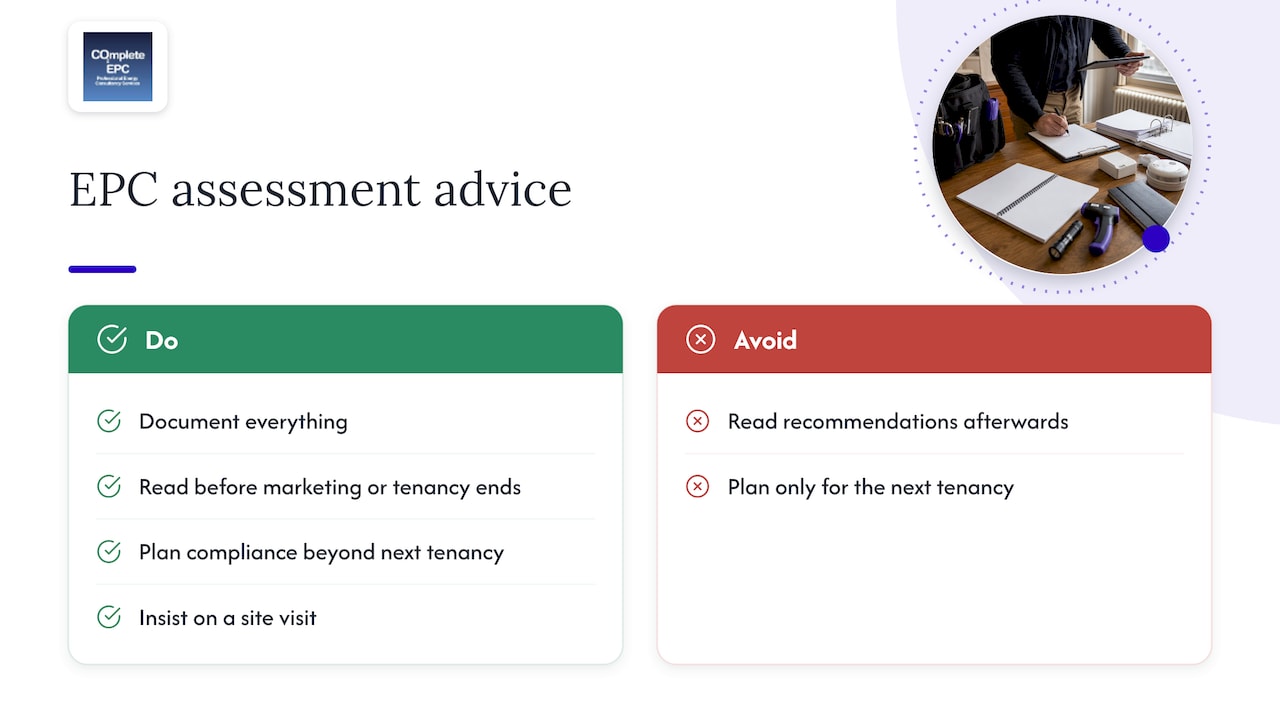
We see three habits that make the difference. First, document everything: owners who produce invoices and certificates for insulation, windows and boilers rarely see defaults dragging the rating down. Second, read the recommendations before the property goes to market or before a tenancy ends, not afterwards, when there is no time to act. Third, for landlords, think in terms of compliance over the next few years, not the next tenancy. A property sitting at E today may be exposed if requirements tighten.
We work across domestic and commercial properties in London, and alongside EPCs we handle SAP, SBEM, overheating and electrical safety work such as EICR and PAT testing. That is useful when a single property needs several documents at once. Whichever assessor you pick, our advice is the same: ask about accreditation, insist on a site visit and ask what you should do first.
— Danny
Book an assessor who explains the report
If you own or manage a home or business premises in London, we can arrange an accredited EPC assessment and talk you through the recommendations. Start with our domestic EPC page for homes or the commercial EPC page for business premises. If you need a quote for another service, such as EICR, PAT or water calculations, you can reach us through the Complete EPC homepage.
FAQ
What happens on an EPC survey?
The assessor walks through the property, measures rooms and records insulation, windows, heating, hot water and lighting. They usually photograph key features as evidence. A standard domestic survey takes 30 minutes to an hour, and the certificate is lodged on the national register afterwards.
How much does an EPC assessor charge?
The National Careers Service gives a typical range of £60 to £120 for a domestic assessment, depending on location and size. Commercial EPCs are priced by building, so you need a quote. Always check what the fee includes.
How do I become an EPC assessor?
For homes, you need a Level 3 Certificate in Domestic Energy Assessment and membership of an approved accreditation scheme. Related experience in surveying or construction helps. New-build assessments use SAP software and require their own competence under a scheme.
What is the best EPC rating for a home?
Band A is the most efficient and G the least. Official notes confirm that bands run from A to G, with A+ available only for non-domestic properties. If you rent out a home in England, the practical target is at least E.
Can I complain about an assessor?
Yes. Raise it with the assessor first. If that fails, contact the accreditation scheme they belong to, since schemes audit members and enforce codes of conduct. Keep your certificate reference and photographs of any errors.
Sources
- Energy Performance Certificates for your business premises, GOV.UK
- Domestic energy assessor, National Careers Service
- Domestic private rented property minimum energy efficiency standard: landlord guidance, GOV.UK
- A guide to EPCs for non-dwellings, GOV.UK
- A guide to EPCs for the marketing, sale and let of dwellings, GOV.UK
- Reforms to the Energy Performance of Buildings regime: partial government response, GOV.UK
- Energy efficiency of housing in England and Wales, Office for National Statistics
- Energy Performance of Buildings Certificates in England and Wales: technical notes, GOV.UK
- Your retrofit journey starts here, Cotswold District Council
- Get energy performance of buildings data, GOV.UK