

The right EPC assessor is accredited with a government-approved scheme, qualified for your type of property, independent of the sale or letting, and willing to inspect the building properly. Price and speed matter, but only after those four checks. A cheap certificate that is later challenged can cost you a delayed sale or a void period.
This guide takes you through the checks in the order we would do them, with the official sources behind each one. It is written for London landlords, homeowners, agents and businesses who need a certificate they can rely on.
TL;DR
- Confirm the assessor belongs to a government-approved accreditation scheme, and check their name or membership number on the official EPC register.
- Match the assessor to the building. Commercial properties with air conditioning or complex systems need the right level of accreditation, not just a general qualification.
- Insist on a real inspection. A rating promised before anyone has seen the property is a red flag.
- Ask who will sign the certificate and confirm they have no conflict of interest with you or the property.
- If the certificate is wrong, complain to the assessor first, then to their accreditation scheme.
Table of Contents
- Why the choice of assessor matters
- Step 1: Check accreditation on the official register
- Step 2: Match the assessor to your property
- Step 3: Confirm independence and who signs
- Step 4: Expect a proper inspection
- Step 5: Compare price, turnaround and what you receive
- Use the recommendations report
- Red flags when choosing an assessor
- Perspective: what we look for when a client asks us
- If you book with us
- What to do if the certificate is wrong
- FAQ
- Sources
Why the choice of assessor matters
An EPC is a legal requirement in England and Wales when you sell, rent out or finish building a property. It gives the property a rating from A (best) to G (worst) and, once issued, is valid for 10 years. It does not need renewing on a sale or change of tenancy while it remains in date.
That 10-year life is the reason to get it right. A certificate that undervalues your insulation or misses a heating upgrade stays on the public register, in front of every buyer, tenant and mortgage lender, until it expires or you replace it.
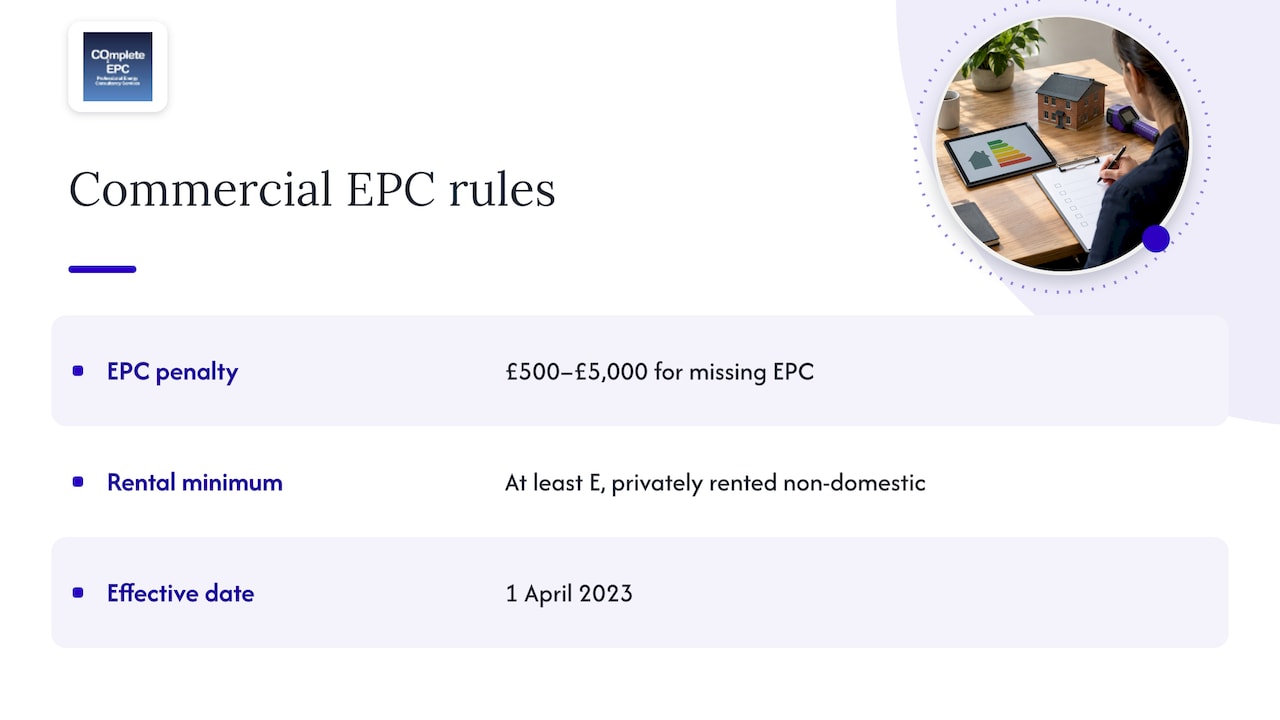
For commercial landlords there is a financial edge as well. You can be fined between £500 and £5,000, based on the rateable value of the building, if you do not make an EPC available to a prospective buyer or tenant. Non-domestic landlords also face minimum standards: since 1 April 2023 privately rented non-domestic properties need at least an E rating, regardless of tenancy changes.
Step 1: Check accreditation on the official register
Only an accredited energy assessor can lodge a valid certificate. Government guidance says you should use a member of an approved accreditation scheme and confirm their active accreditation on the central register, which you can search by the assessor’s name or membership number.
In practice:
- Ask the assessor for their full name, accreditation scheme and membership number before you book.
- Search the register yourself rather than relying on a logo on a website.
- Check the accreditation is current and covers the type of certificate you need (domestic, commercial or both).
- Be wary of anyone who cannot give you a membership number straight away. A genuine assessor has it to hand.
If you are in Scotland, a separate system applies. Assessors there are approved through the Scottish Government, so a London-style register search will not cover a property north of the border.
Step 2: Match the assessor to your property
A domestic assessor and a commercial assessor are not interchangeable. The first is qualified for homes; the second must hold accreditation at a level suited to the building. Government guidance for commercial property is clear that the accreditation needed depends on the features of the building, such as its heating, ventilation and cooling systems.
Use this as a rough guide:
| Property | What to ask the assessor |
|---|---|
| Flat or house for sale or rent | Are you accredited for domestic EPCs? How many similar London properties have you assessed? |
| Period conversion or pre-1919 home | Have you assessed solid-wall and mixed-construction buildings? |
| Shop, office or small unit | Are you accredited for non-domestic EPCs at the right level? |
| Building with air conditioning or complex systems | What is your accreditation level for this complexity? Can you also advise on air conditioning inspections? |
| New build or conversion | Can you supply the SAP calculation as well as the EPC? |
London’s housing stock is mixed: Victorian terraces, ex-local-authority flats, converted warehouses, new-build towers. An assessor who knows how to record a solid brick wall, a loft conversion or a communal heating system will produce a more defensible rating than one who treats every address the same.
Step 3: Confirm independence and who signs
Assessors must be independent. Official guidance on non-domestic certificates states that assessors have to declare potential conflicts of interest, such as employment by, or a family relationship with, the property owner. You should check this up front, because a certificate that breaches the rules can be challenged.
Also ask who will actually attend. Assistants can gather site data under an assessor’s direction, but the accredited assessor remains responsible for the final certificate and must sign it off. Your main contact should be that accredited professional, not a call handler who cannot answer technical questions.
Step 4: Expect a proper inspection
An EPC is an asset rating. It estimates the performance of the building fabric and fixed services, such as insulation, glazing and heating, using standard occupancy assumptions. That is why two identical flats can have the same rating but very different bills.
It also means the assessor’s evidence matters. A proper visit usually involves:
- Measuring the property or checking floor plans against the layout.
- Recording the heating system, controls, hot water cylinder and any renewables.
- Photographing insulation, windows and boiler details as evidence.
- Asking you for paperwork on upgrades: loft insulation invoices, window certificates, heat pump or boiler installation documents.
The methodology for existing homes has been updated in recent years, and assessors now collect more detail than before. If the person on the phone promises a rating before seeing anything, or a visit is over in a few minutes in a three-bedroom house, treat that as a warning. A rating built on assumptions tends to be lower than one built on evidence, because unrecorded features score as if they were absent.
Step 5: Compare price, turnaround and what you receive
Price matters, particularly if you have several properties. But compare like with like. When you ask for quotes, check:
- What is included: the certificate, the recommendation report, and lodging on the register.
- Turnaround: how soon can they attend, and how soon is the certificate lodged after the visit?
- Access arrangements: will they coordinate with tenants or keyholders?
- Re-visit charges: what happens if access fails or evidence is missing?
- Other services: can they also handle related compliance, such as air conditioning inspections or SAP calculations, so you deal with one firm?
A quote far below everyone else’s deserves a question rather than a booking. Ask how the visit will be done and what the assessor will record.
Use the recommendations report
Every EPC carries a list of suggested improvements. There is no statutory requirement for a seller or landlord to carry them out, but they are designed to be cost-effective ways to cut running costs, and a good assessor should be happy to talk them through at the visit.
It helps to be realistic about cost. Government figures from the English Housing Survey put the mean cost of lifting a dwelling from D or lower to a C at £7,320, with pre-1919 homes averaging £10,788 and purpose-built high-rise flats £2,741. London has plenty of both, so ask your assessor which measures matter most for your particular building before you spend anything.
Red flags when choosing an assessor
- No registration number, or a number that does not match the name on the register.
- A guaranteed rating before any inspection.
- Pressure to book immediately, or payment in full by transfer before any paperwork.
- An assessor connected to the sale who will not discuss independence.
- A commercial assessor who cannot say what accreditation level they hold.
- No recommendation report, or a refusal to explain it.
Perspective: what we look for when a client asks us
We carry out domestic and commercial EPCs across London, and the questions that cause trouble are rarely about price. They are about access, missing paperwork and mismatched expectations. A landlord books a certificate for a flat, assumes the new boiler will be spotted, and then has no installation record to show. The fix is simple: gather the evidence before the visit.
Our advice is to treat the assessor as an adviser for the 10 years the certificate lives, not as a one-off supplier. Choose someone who explains what they are recording and why, who will talk about the recommendations, and who can also help if you need related work: SAP calculations for new builds, conversions and extensions, or inspections of air conditioning systems. Our promise to clients is competitive pricing with the lowest rates in the UK market, but we would still rather you checked our accreditation than took our word for it. Every good assessor will welcome that.
— Danny
If you book with us
We provide domestic EPCs for homeowners, landlords, agents and solicitors, and commercial EPCs for offices, shops and other business premises across London. If you are not sure which certificate or related assessment you need, our home page lists the full range, from SAP and SBEM calculations to air conditioning inspections. Ask us for our accreditation details before you book. We are happy to give them.
What to do if the certificate is wrong
Sometimes a certificate contains an error: the wrong floor area, a missing heating system, or a rating that does not fit the property. The route is set out in the scheme complaints guidance:
- Raise a formal complaint with the assessor and give them the chance to correct it.
- If that does not resolve it, escalate to the assessor’s accreditation scheme, which is responsible for investigating their competence and adherence to standards. The scheme dispute process covers concerns about the validity of a certificate, the information on it, and the quality of the survey.
Keep your emails, photos and the original paperwork. A clear record speeds up any review.
FAQ
How do I check an EPC assessor is genuine?
Ask for their name and accreditation scheme membership number, then search the official central register at GOV.UK. It confirms whether their accreditation is active. If they cannot supply a number, choose someone else.
Does the same assessor do domestic and commercial EPCs?
Not always. Commercial buildings need an assessor accredited at a level suitable for the building’s features, such as air conditioning or complex heating. Ask which level they hold and which building types they have assessed.
Do I need a new EPC when a tenant moves out or I sell?
No, as long as the existing certificate is within its 10-year validity. You can check whether a property already has a valid one using the government’s find an energy certificate service. If it has expired, or you have made significant improvements, a new one may be worthwhile.
Do I have to do the improvements in the recommendation report?
There is no statutory requirement to carry them out. They are suggestions for cost-effective savings, and your assessor should be able to discuss them. Commercial landlords should note the separate minimum E rating rules for rented non-domestic property.
Sources
- Get a new energy certificate, GOV.UK
- Selling a home: Energy Performance Certificates, GOV.UK
- Energy Performance Certificates for your business premises, GOV.UK
- Non-domestic private rented property: minimum energy efficiency standard, GOV.UK
- Domestic energy assessor accreditation (Scotland), GOV.UK
- A guide to Energy Performance Certificates for the construction, sale and let of non-dwellings, GOV.UK
- English Housing Survey, Chapter 2: Energy efficiency, GOV.UK
- Dispute resolution, Ofgem