

To assess a property’s energy performance in England and Wales, you need an accredited energy assessor. For an existing building, they visit the site, inspect the fabric and heating, and enter the findings into government-approved software. The software produces an Energy Performance Certificate (EPC) and a list of recommended improvements. If you only want a rough idea first, you can look up the current certificate for most properties for free and then decide whether a new assessment is needed.
This guide covers the full process: what is measured, what the assessor looks at on the day, how to prepare so the result is not pulled down by guesswork, and how the rules differ for homes, rented properties and commercial buildings.
TL;DR
- A formal assessment must be done by an accredited assessor. A site visit for existing buildings, design data for new builds, then approved software produces the certificate.
- You can check any existing certificate on GOV.UK before you pay for anything.
- Gather evidence in advance (boiler details, glazing certificates, insulation records). Where proof is missing, assessors fall back on cautious assumptions based on the building’s age.
- Landlords generally cannot let a property rated below E without a valid exemption, and domestic EPCs are moving to a four-metric format.
- Homes, commercial premises and new builds each use a different assessment route.
Table of Contents
- What an energy assessment actually measures
- Step 1: Check what already exists
- Step 2: Know which type of assessment you need
- Step 3: Use an accredited assessor
- What happens on the day of the visit
- How to prepare for an EPC inspection
- Reading the result
- What a good or poor rating means for you
- Legal duties that depend on the assessment
- Our perspective: assess before you spend
- Booking an assessment in London
- Common mistakes to avoid
- FAQ
- Sources
What an energy assessment actually measures
An EPC rates how energy efficient a building is on a scale from A (most efficient) to G (least efficient). GOV.UK’s guide for business premises describes the same A to G grading for commercial buildings. The rating is about the building, not about how you live in it.
That distinction matters. The government’s own policy paper on the non-domestic regime states that the EPC is not designed to measure operational energy use. It describes the quality of the fabric and services, whoever occupies the building. Two identical flats can have very different bills, and still the same EPC.
In practice, an assessment covers:
- Building fabric: walls, roof, floors and glazing.
- Heating: the type of system (gas boiler, electric heating, heat pump), its controls and hot water arrangements.
- Ventilation and lighting: the proportion of efficient lighting, for example.
- Size and form: floor area, number of storeys, extensions and orientation.
Step 1: Check what already exists
Before booking, find out whether the property already has a valid certificate. GOV.UK runs a service to find an energy certificate for homes, business properties and public buildings in England, Wales and Northern Ireland. Search by postcode or address and you can see the rating, the date and the recommendations.
An EPC remains valid for 10 years, so an existing certificate may be all you need for a sale or let. There are exceptions worth checking:
- If you have made significant improvements since the certificate was issued (new boiler, insulation, glazing), a fresh assessment may give a better rating.
- If the certificate is close to expiry and you are about to put the property on the market, a new one avoids delays.
- If the property has been extended or converted, the old certificate no longer describes it.
Step 2: Know which type of assessment you need
The route depends on the building and the reason for the assessment.
| Situation | Typical assessment | What it relies on |
|---|---|---|
| Selling or renting an existing home | Domestic EPC | Site visit and survey |
| Selling or letting commercial premises | Commercial EPC | Site visit, approved calculation method |
| New dwelling, conversion or extension | SAP calculation | Design drawings and specifications |
| New commercial building | SBEM calculation or dynamic simulation | Design data and building services specification |
| Premises with air conditioning above the threshold | TM44 inspection | Inspection of the system |
For homes, the Energy Saving Trust explains that information on a home’s physical characteristics is entered into Standard Assessment Software (SAP) so an assessor can calculate its energy performance. For commercial buildings, GOV.UK’s guidance on non-dwellings says approved methods such as the Simplified Building Energy Model (SBEM) or a Dynamic Simulation Model are used.
If you are building or converting, you are not assessing an existing structure at all. The assessment is based on design specifications rather than a physical inspection, so the quality of your drawings and product data decides the result.
Step 3: Use an accredited assessor
You cannot do the formal assessment yourself. GOV.UK is clear that an EPC must come from an accredited assessor when you sell, rent out or build. Before the visit, ask for the assessor’s accreditation number and photo ID. The certificate is lodged on the national register, which is how buyers, tenants and agents later find it.
Assessors must also be independent. The GOV.UK guide for dwellings explains that they must declare conflicts of interest, such as employment links or family relationships with the owner. If anyone pressures an assessor to inflate a rating, the assessor is expected to raise it with their accreditation scheme. A good assessor will not promise you a particular letter grade.
What happens on the day of the visit
For an existing home, the visit is a physical survey. A typical home does not need a long appointment, though larger or more complex properties take more time. The assessor will normally:
- Measure the rooms and record the overall dimensions, including extensions.
- Identify the heating system, its fuel, the boiler make and model where visible, and the controls (thermostat, programmer, thermostatic radiator valves).
- Check the hot water cylinder, its insulation, and any solar or heat pump equipment.
- Look at windows: single, double or triple glazing, frame type and age.
- Inspect the loft, if accessible, and note the depth of insulation.
- Establish the wall construction (solid, cavity, insulated or not).
- Count light fittings and note how many use low-energy bulbs.
- Photograph evidence to support what has been entered.
The assessor does not test appliances or lift floors. They record what they can see and what can be proved.
Why evidence matters
An assessor must validate what an owner says. Even when you have plans or can say what the walls are made of, they cannot simply take your word on hidden features such as wall insulation unless it is supported by documents, for example an installation certificate or receipt. If an area is inaccessible, such as a fully boarded loft, the assessor applies a default assumption based on the age of the building instead of guessing.
Those defaults are deliberately cautious. That is why preparation often changes the outcome, and can be the gap between a D and a C.
How to prepare for an EPC inspection
A short checklist saves time and protects your rating:
- Clear access to the loft hatch, boiler cupboard, hot water cylinder and any plant room.
- Boiler documents: the manual, or the make, model and installation date.
- Glazing evidence: FENSA or similar certificates, or installer invoices, showing double or triple glazing and the date.
- Insulation records: cavity wall, loft, underfloor or external wall insulation paperwork, ideally with dates.
- Extension plans and building regulations completion certificates.
- Renewables paperwork: solar panel installation certificates, or heat pump documentation.
- Keys and access for every room, including outbuildings that are heated.
For commercial premises, add air conditioning records, lighting schedules, building services specifications and any previous energy reports.
Reading the result
The certificate shows the A to G rating, then a list of recommendations with estimated costs and savings. Look past the letter and read the recommendations in order. The cheapest measures, such as insulating a loft or upgrading controls, often come first.
The shift to four metrics for homes
Domestic EPCs are changing. The government’s partial response to its EPC reform consultation, published in March 2026, confirms a move away from a single headline rating towards several metrics: energy cost, fabric performance, heating system and smart readiness. The older rating is being retained for a period to keep existing compliance rules working.
What this means in practice:
- An older solid-walled home may do poorly on fabric but well on heating, and the new format shows that split.
- Improvement advice should become more targeted, rather than chasing a better letter.
- A certificate issued under the current system remains valid for its 10 years.
If you are planning work, ask your assessor how the format applies at the time you book, as the transition is still being implemented.
What a good or poor rating means for you
A common question is whether a rating such as 79 is good. On the current scale, EPC bands are set by a numerical score, and 69 to 80 is band C, so 79 sits in the upper part of that band. A score in band C is generally considered a solid result for a UK home, since many older properties fall in D. The recommendations on the certificate will show how much further you could go.
For owners selling, a better rating makes the property easier to market. For landlords, the rating decides whether the property can legally be let.
Legal duties that depend on the assessment
Selling, renting or building
GOV.UK states you must have an EPC when you sell, rent out or build a property. For commercial premises, failing to provide one can bring a fine of between £500 and £5,000, depending on the rateable value.
Landlords and minimum standards
The Minimum Energy Efficiency Standard (MEES) sets a floor for rented property. For homes, GOV.UK’s landlord guidance says that since 1 April 2020 landlords can no longer let or continue to let properties below E unless they hold a valid exemption. For commercial lets, landlords can only grant or renew a tenancy if the property is rated at least E, again unless an exemption applies.
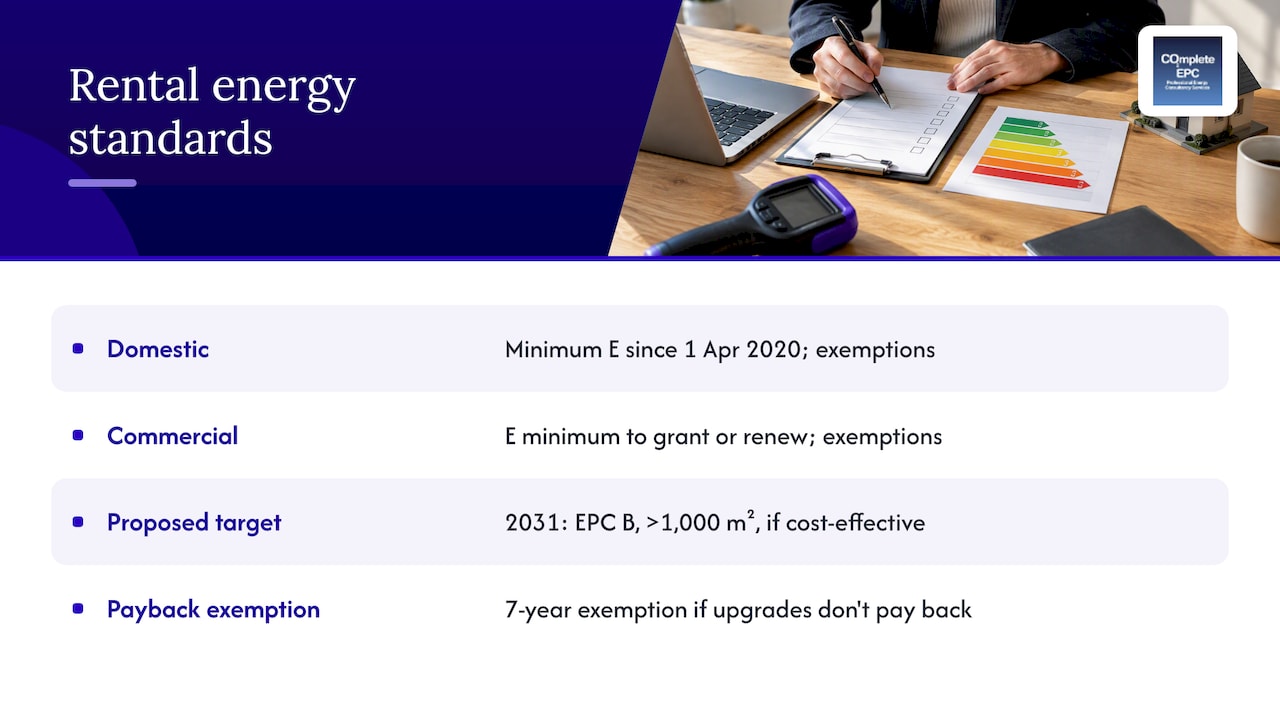
Looking ahead, the government’s June 2026 interim response says that from 2031 it is proposed that private rented buildings over 1,000 square metres in England and Wales will need to reach EPC B where cost effective. It is a proposal, so check the current position before making investment decisions.
The focus for non-domestic landlords is the highest rating achievable through a cost-effective package of measures. A 7-year payback test is used as an exemption route when upgrades do not pay back in time, as explained in the GOV.UK non-dwellings guide.
Our perspective: assess before you spend
Most of the owners and landlords who come to us in London are not asking how a rating is calculated. They want to know why it is lower than expected and what to do about it. Our view is simple.
First, treat the assessment as a diagnostic, not a hurdle. The recommendations list is the most useful part of the certificate, and the cheapest items usually deliver the most for the money.
Second, evidence is cheap and the lack of it is expensive. A boiler manual or an insulation certificate found in a drawer can change what an assessor is allowed to enter. If you are a landlord with several flats, keep one folder per property.
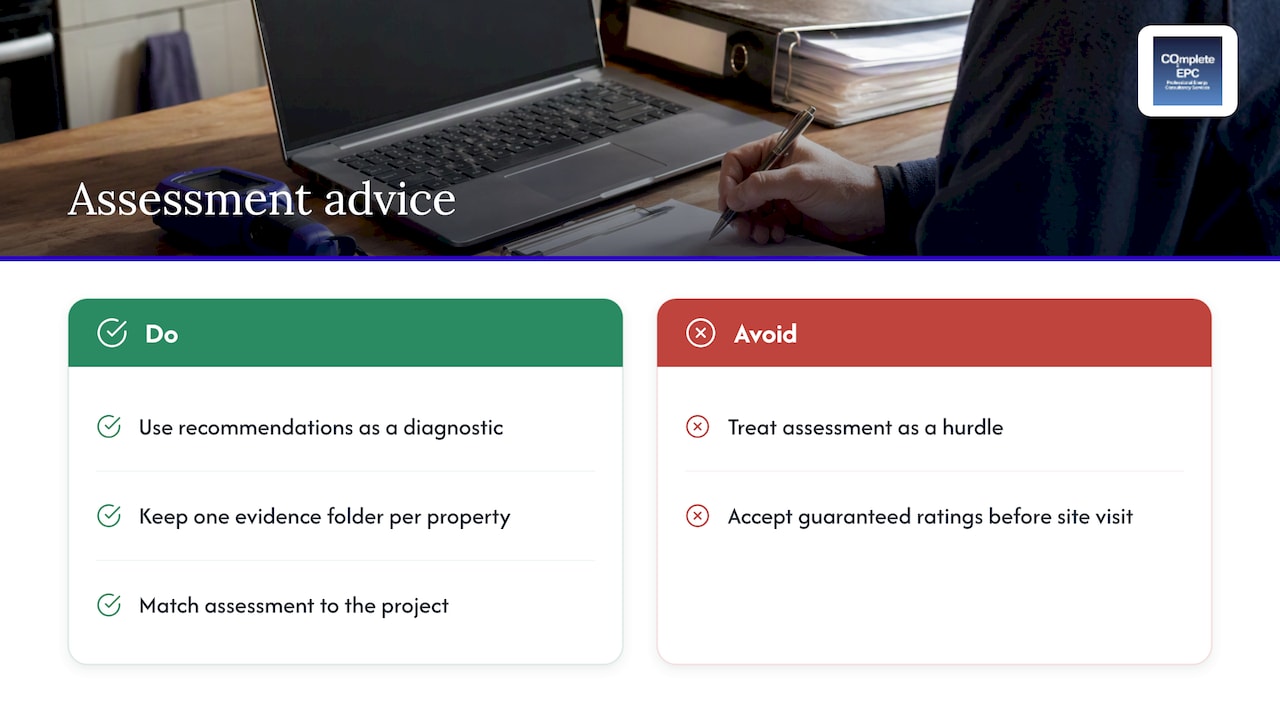
Third, match the assessment to the project. A resale needs a domestic EPC. A new build or extension needs SAP calculations from the design stage, and a commercial building may need SBEM, dynamic simulation modelling or an overheating study. Choosing the right one at the start avoids redoing work when planning or building control asks for something different.
Finally, be wary of anyone who guarantees a rating before seeing the property. The honest answer depends on what the assessor can verify on site.
— Danny
Booking an assessment in London
If you need a certificate for a sale, a let or a building project, we provide domestic EPCs and commercial EPCs across London, run by qualified assessors. For new homes, conversions and extensions, we also prepare SAP calculations, and for new commercial buildings, SBEM calculations. You can see everything we offer, including MEES advice, on our main site.
Common mistakes to avoid
- Relying on an old certificate after major works, and missing the improvement.
- Boarding the loft or blocking the boiler cupboard on the day of the visit.
- Assuming the rating reflects your bills. It reflects the building under standard assumptions.
- Ignoring recommendations on the certificate that could also help you meet minimum standards.
- Leaving assessment too late in a sale or let, when the certificate is needed before marketing.
FAQ
How do I find the energy rating for my property?
Search the GOV.UK energy certificate service with your postcode or address. If a certificate exists and is in date, you will see the rating and its recommendations. If none appears, you will need an accredited assessor to produce one.
Do landlords have to have an EPC?
Yes. You must have an EPC when you rent out a property, and for homes, the landlord guidance says that properties below E generally cannot be let unless a valid exemption is registered. Fines apply to commercial premises that lack a certificate. Speak to an assessor or your local authority if you are unsure which rules apply to your tenancy.
How do I prepare for an EPC inspection?
Give clear access to the loft, boiler and cylinder, and gather paperwork such as boiler manuals, glazing certificates and insulation records. Without evidence, the assessor must apply cautious defaults based on the age of the building. Good records can lift the result.
Is 79 a good EPC rating?
A score of 79 falls within band C, which is a good result for most UK homes. The certificate’s recommendations show what would push the score towards band B. The format is changing for domestic EPCs, so also expect additional metrics in future certificates.
How long is an EPC valid?
An EPC lasts 10 years, as set out in GOV.UK’s guidance for business premises. You can use the same certificate for several sales or lets within that time, provided it is still valid.
Sources
- Find an energy certificate, GOV.UK
- Energy Performance Certificates for your business premises, GOV.UK
- Selling a home: Energy Performance Certificates, GOV.UK
- A guide to EPCs for the construction, sale and let of non-dwellings, GOV.UK
- A guide to EPCs for the marketing, sale and let of dwellings, GOV.UK
- Reforms to the Energy Performance of Buildings regime: partial government response, GOV.UK
- Domestic private rented property: minimum energy efficiency standard, GOV.UK
- Non-domestic private rented property: minimum energy efficiency standard, GOV.UK
- MEES in the non-domestic private rented sector: interim response, GOV.UK
- Non-domestic PRS MEES EPC B future trajectory implementation, GOV.UK
- Energy Saving Trust