

You can check a property’s EPC for free on the government’s official register. Search by postcode, street name and town, or certificate number, and you will see whether a current certificate exists, its rating and its expiry date. If nothing appears, or the certificate has expired, the property needs a new assessment before it is sold or let. This guide covers the search step by step, how to read the result, and what to do next.
TL;DR
- Use GOV.UK’s Find an energy certificate service. It is free and covers homes, business properties and public buildings in England, Wales and Northern Ireland.
- Scotland has its own separate register, so a Scottish address will not appear on the GOV.UK service.
- Check the rating (A to G), the certificate number and the expiry date. An EPC is normally valid for 10 years.
- No certificate, or an expired one? You will need a new EPC from an accredited assessor before you market the property.
- Landlords should look at the rating as well as the date: rented homes generally need at least band E.
Table of Contents
- Why check a property’s EPC?
- How to check an EPC on the official register
- What the certificate tells you
- Is the EPC still valid?
- What if no EPC appears?
- Domestic and commercial properties: what differs
- Landlords: look at the rating, not just the date
- Our perspective
- When you need a new EPC
- Order an EPC in London
- How to prepare for an assessment
- Common mistakes when checking an EPC
- FAQ
- Sources
Why check a property’s EPC?
An energy performance certificate rates how energy efficient a building is, from A (most efficient) to G (least efficient). People check one for different reasons:
- Sellers and landlords want to know whether they already hold a valid certificate before paying for another.
- Buyers and tenants want a sense of likely heating bills and what improvements the home might need.
- Estate agents and solicitors need to confirm a certificate exists and is in date before a property is marketed or a transaction proceeds.
- Businesses checking a commercial unit want to confirm its rating before signing or renewing a lease.
The search takes about a minute, and the register is free to use.
How to check an EPC on the official register
For England, Wales and Northern Ireland, the official route is the GOV.UK Find an energy certificate service. It lets you search by postcode, by street name and town, or by certificate number.
Step-by-step search
- Open the GOV.UK service and choose to search by postcode, or by street name and town.
- Enter the postcode exactly as it appears on post, for example a London postcode such as E1 or N7 followed by the rest of the code.
- Scan the list of addresses and select the right one. Flats in the same block often share a postcode, so check the flat number carefully.
- Open the certificate. You can read it on screen and save it.
- If you already have a certificate number, enter that instead. It takes you straight to the document.
The same service can also find a Display Energy Certificate (DEC) or an air-conditioning inspection certificate and report, according to GOV.UK, so it is useful for non-domestic buildings as well.
Search tips that save time
- If the address does not appear, try the postcode alone and scroll the full list. Addresses are sometimes recorded in a slightly different format, such as a house name instead of a number.
- Try neighbouring postcodes for new builds, conversions and recently split properties, which may be listed under an older or different address.
- For a block of flats, check each flat separately. Each dwelling has its own certificate, and the building as a whole may not have one.
What the certificate tells you
Once you open an EPC, the first section describes the property. Which? says this includes the address, property type, total floor area, overall energy rating, certificate number and expiry date. Check these details first. If the floor area or property type looks wrong, the rating may be unreliable.
The rating graph
The rating graph shows two things: the current rating and score, and the potential rating and score the property could reach if the recommended improvements are carried out, as Which? explains. The gap between the two is the most useful number on the page. A home sitting at D with a potential B has plenty of room to cut running costs. A home already close to its potential has less to gain from works.
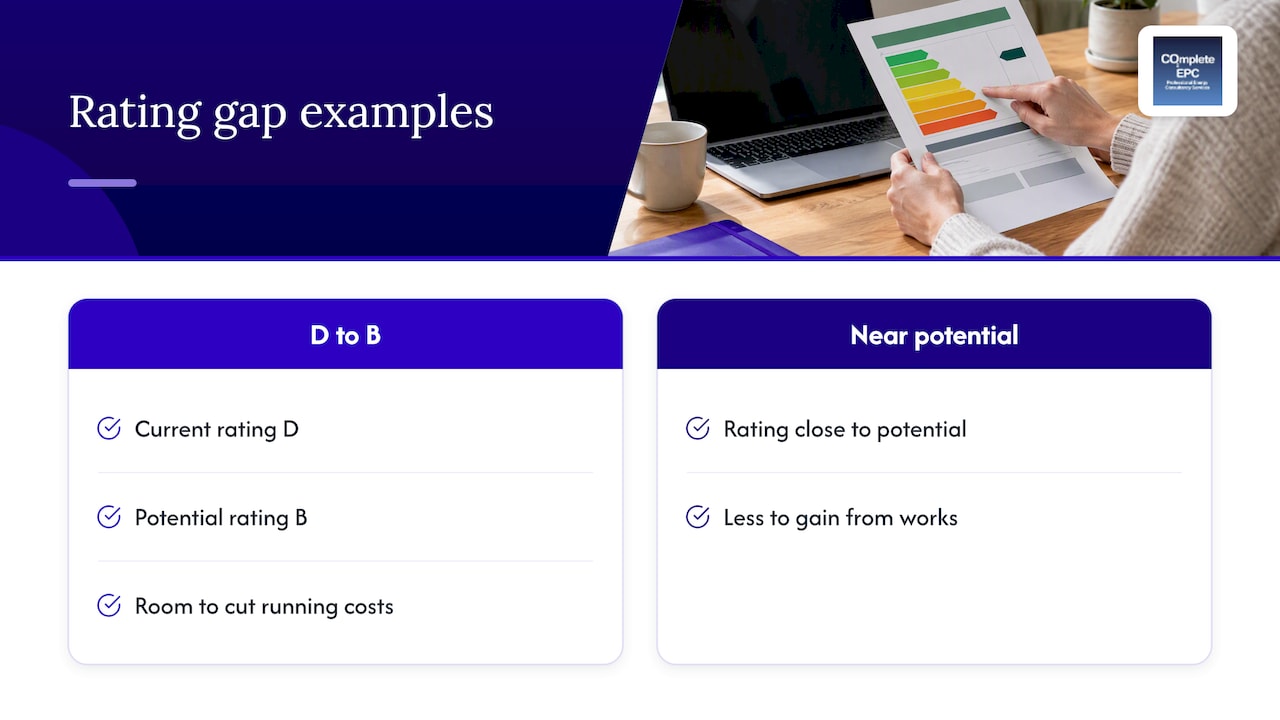
The recommendations list is where the practical value sits. It usually names measures such as loft insulation, wall insulation, heating controls or glazing. For a general explanation of how a rating graph links to upgrades, see this guide to energy label improvements explained.
A quick way to read the bands
| Band | Meaning | What it usually means for you |
|---|---|---|
| A to B | Very efficient | Lower running costs, strong selling point |
| C | Good | Often near the current average, worth maintaining |
| D | Middling | Room for low-cost improvements |
| E | Below average | Minimum for most lettings today |
| F to G | Poor | Cannot normally be let without works or an exemption |
The bands are a guide. The score and the recommendations show where a particular home can improve.
Is the EPC still valid?
An EPC for a building in England and Wales is valid for 10 years, and the government’s technical notes on EPC certificates confirm that figure. The certificate itself shows an expiry date, so checking validity means reading that line. The government’s guide to EPCs for dwellings adds that a certificate stays valid for 10 years or until a newer one is produced for the same building, so always look for the most recent certificate at the address.
A few practical points:
- You can reuse a valid certificate. If it is in date, it can be used for any sale or letting during that period.
- An expired certificate is not always a problem. It matters when you are marketing the property for sale or let. Most owners renew at that point.
- Major works can make an old EPC out of date in practice. If you have extended, converted, added insulation or replaced the heating, a new assessment will show the improved rating even if the old certificate has not yet expired.
What if no EPC appears?
GOV.UK’s guidance is straightforward: use the service to find an existing certificate, and if the property has none or it has expired, get a new energy certificate. There are several reasons nothing may show up:
- The property has never needed one, because it has not been sold, let or built recently.
- The certificate has expired and the register no longer shows it as current.
- The address is recorded differently from how you typed it.
- The property is in Scotland, which uses a separate register.
- The building is exempt from needing an EPC, such as certain listed or temporary buildings. If you are unsure, ask an accredited assessor.
Rule out the address and nation issues first. If you still find nothing, you will need a new assessment. An accredited domestic energy assessor visits, measures and inspects the property, then lodges the certificate on the register.
Domestic and commercial properties: what differs
The GOV.UK service includes business properties, so the search steps are the same. What differs is the type of assessment behind the certificate.
- Homes are assessed with a domestic survey that looks at insulation, heating, windows and lighting.
- Commercial buildings are assessed with a non-domestic method that accounts for how the building is used, its heating, cooling and ventilation, and its floor area. Government guidance on EPCs for non-dwellings covers these in detail.
- Buildings with air conditioning may also need an inspection certificate. You can look for it on the same register.
If you manage commercial space with air conditioning above the relevant threshold, our TM44 air conditioning inspection service covers that requirement.
England, Wales, Northern Ireland and Scotland
England, Wales and Northern Ireland use the GOV.UK service. Scotland has a different one, the Scottish EPC Register. If you are checking a property north of the border, use that register instead. Anything below on landlord minimums is described for England and Wales, where most of our work is based.
Landlords: look at the rating, not just the date
Checking the register is also the first step in landlord compliance. Under the domestic minimum energy efficiency standard, GOV.UK guidance for landlords says that from 1 April 2020 landlords can no longer let or continue to let covered properties with a rating below E, unless a valid exemption is in place.
Practical checks for a landlord:
- Look up each rental property on the register and note its rating and expiry date.
- If any property is F or G, plan improvements before the next tenancy or renewal.
- If the certificate is close to expiry, arrange a new one before you re-let.
- Keep a copy of each certificate with your tenancy records.
Standards for rented property have been under review, so check GOV.UK for the latest position before planning works. Commercial landlords have their own minimum standards, and these also work from the EPC rating, so the same lookup applies.
Our perspective
Most of the calls we get start with the same question: does this property already have an EPC? The answer is often yes, and finding it takes a minute on the official register. We would always encourage you to check there first.
Where we add value is when the search comes back empty, the certificate has expired, or the rating is not what you need. A Londoner with a flat conversion, a landlord with a portfolio of lets, or a business with a new unit all need an accurate certificate quickly. Our qualified assessors produce domestic and commercial EPCs across London, and our service is designed to keep the process simple and fast.
We also look past the letter on the front page. The recommendations in the report are where owners can cut energy costs and improve the value and appeal of the property. We back our service with a lowest-rate guarantee, and we can combine EPCs with related compliance work such as SAP calculations, TM44 inspections and electrical safety testing, so you deal with one team.
Danny
When you need a new EPC
A register check tells you whether you already have what you need. You will normally want a new EPC in these situations:
- You are selling or letting and the property has no certificate, or the existing one has expired.
- You have completed major works, such as an extension, loft conversion, new heating or insulation, and want the certificate to show the improvement.
- You are a landlord whose property sits below band E and you need a fresh assessment after upgrades.
- You are completing a new build or a conversion. These typically rely on SAP calculations for building regulations compliance before the EPC is produced.
- You manage commercial premises and need a non-domestic certificate for a sale, lease or compliance check.
Order an EPC in London
If your search comes back empty, we can help. We provide domestic EPCs for homes and commercial EPCs for business premises across London, including north, east and west London. Our assessors are qualified and experienced, and our pricing is backed by our guarantee of the lowest rates in the UK market. For related work such as EICR, PAT testing or water calculations, start from our main site.
How to prepare for an assessment
A little preparation helps the assessor produce an accurate certificate:
- Make sure every room, the loft and any outbuildings that are part of the property can be reached.
- Have the boiler details, any heating controls and the age of the system to hand.
- Gather paperwork for improvements such as insulation, new windows, solar panels or a replacement boiler. Evidence can influence the result.
- For commercial units, have floor plans and details of heating, cooling and lighting ready.
The more evidence the assessor has about what is installed, the less they need to assume, and assumptions tend to lower the score.
Common mistakes when checking an EPC
- Searching the wrong nation. A Scottish address will not appear on the GOV.UK register.
- Mistaking an old certificate for the current one. The register may hold more than one record for an address. Use the most recent.
- Ignoring the recommendations. The rating is only half the report.
- Assuming a good rating lasts forever. Certificates expire, and works can change the rating.
- Confusing flats in one building. Each flat has its own certificate, so check the right unit.
FAQ
Is it free to check an EPC?
Yes. The GOV.UK Find an energy certificate service is free to use. You can search and view a certificate without paying. You only pay if you need a new assessment from an accredited assessor.
Can I check someone else’s EPC?
Yes. The register is public, so you can look up any address in England, Wales or Northern Ireland by postcode, street and town, or certificate number. This is useful for buyers, tenants and agents who want to see a property’s rating before committing.
How long does an EPC last?
An EPC is valid for 10 years in England and Wales. The expiry date is printed on the certificate, so you can read it straight from the register. If a newer certificate has been produced for the same building, that one is the current record.
What should I do if my property has no EPC on the register?
First check the postcode, address format and whether the property is in Scotland. If it still does not appear, the property has no valid certificate and you will need to book an assessment. In London, we can arrange this for domestic and commercial properties.
Does the process differ for commercial properties?
The search is the same, because the GOV.UK service includes business properties. The assessment itself uses a non-domestic method, and larger or air-conditioned buildings may also have related certificates or inspection reports on the same register.
Sources
- Find an energy certificate, GOV.UK
- How to get an Energy Performance Certificate you can trust, Which?
- Energy performance of buildings certificates in England and Wales: technical notes, GOV.UK
- Domestic private rented property: minimum energy efficiency standard, landlord guidance, GOV.UK
- A guide to energy performance certificates for non-dwellings, GOV.UK
- Energy label improvements explained