
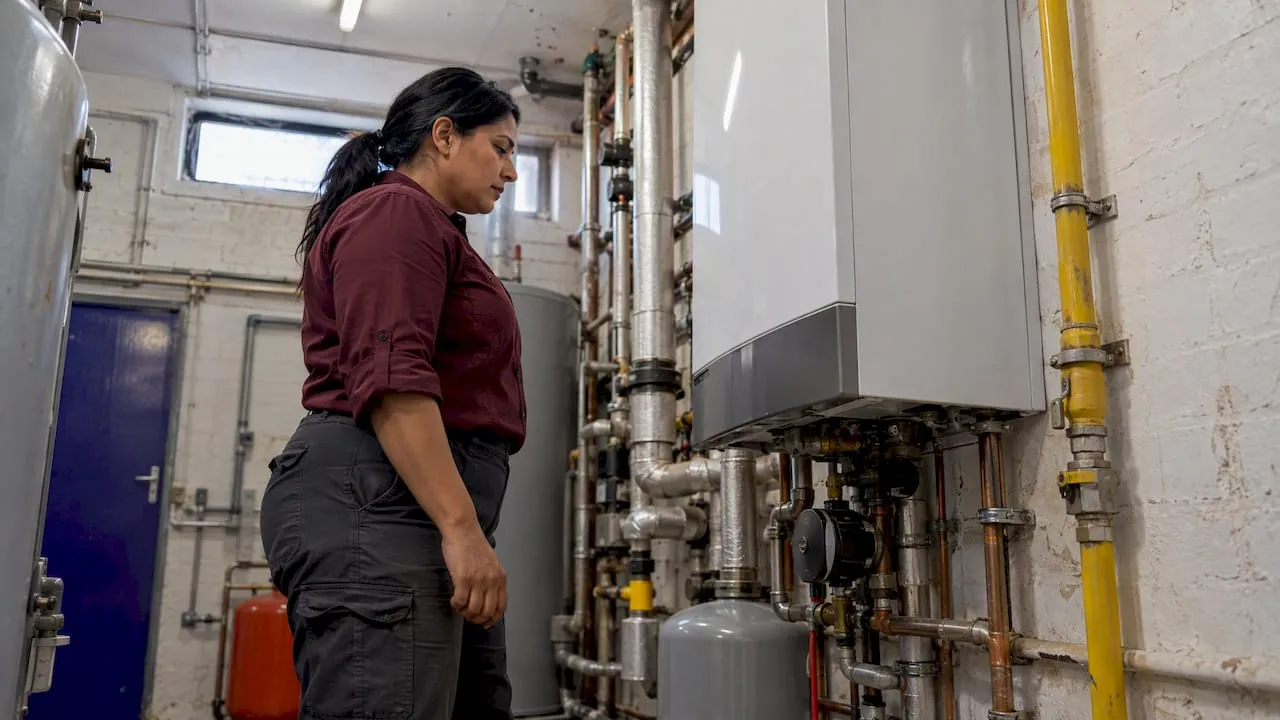
An EPC survey exists to produce an energy performance certificate: an independent record of how energy efficient a building is, what it typically costs to run, and which improvements would make it better. Buyers and tenants use it to compare properties. Owners and landlords need it to meet the law when they sell, let or complete a building. The survey itself is a short, non-invasive visit, and the certificate that follows is valid for 10 years.
This guide explains what the survey is for, what the assessor looks at, how the rating works, and how to prepare so the result reflects your property properly.
TL;DR
- An EPC survey collects the facts needed to rate a property’s energy efficiency and estimate its running costs, so buyers and tenants can compare properties on a like-for-like basis.
- In England and Wales an EPC is required when a building is sold, rented or newly built, or when changes create separate parts with fixed services.
- The visit is non-invasive and usually takes 30 minutes to an hour, with the assessor photographing heating, lighting, insulation and ventilation.
- A certificate lasts 10 years, unless a newer one replaces it, and it lists recommendations to improve the rating.
- Clear access to the boiler, hot-water tank and loft, plus paperwork for insulation or solar PV, helps the assessor record everything accurately.
Table of Contents
- What is the purpose of an EPC survey?
- What the assessor checks during the survey
- What the certificate tells you
- When is an EPC legally required?
- How long an EPC lasts
- How to prepare for the survey
- Who can carry out an EPC survey?
- What does an EPC survey cost?
- Perspective: why we treat the survey as the start, not the end
- Beyond the EPC: related assessments
- Book an EPC survey in London
- FAQ
- Sources
What is the purpose of an EPC survey?
The survey has three jobs.
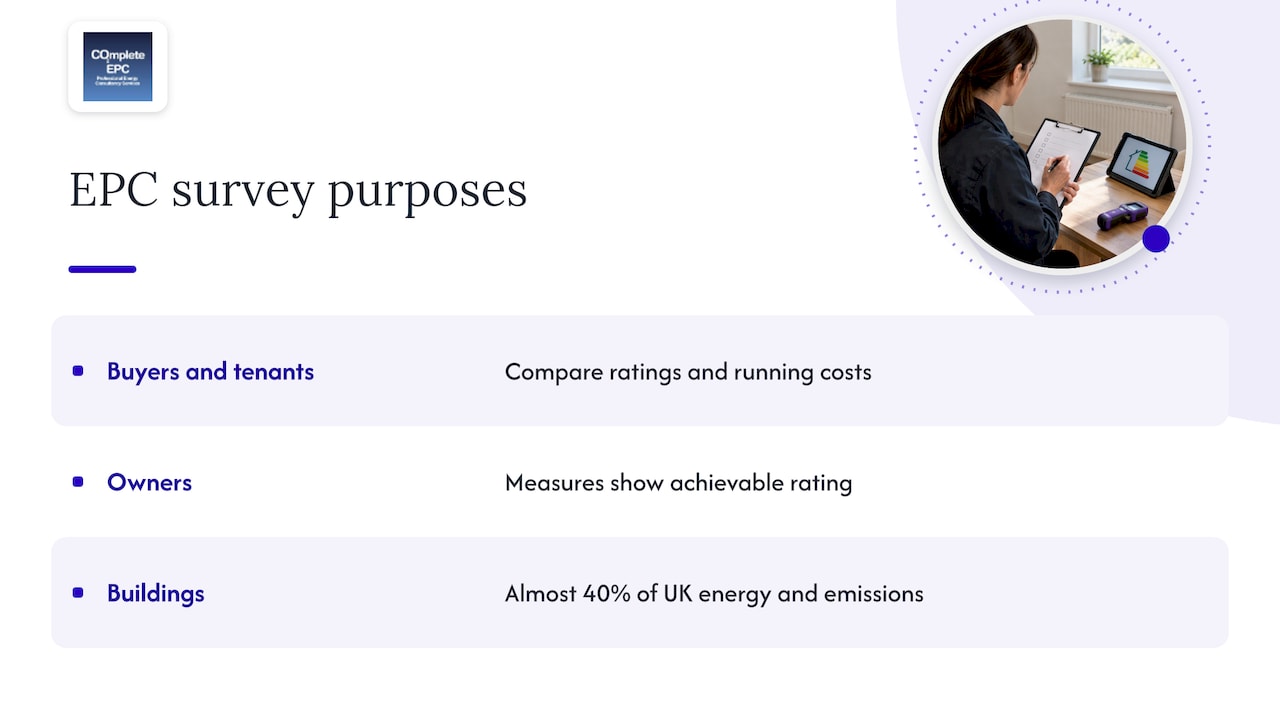
1. Inform buyers and tenants. The government’s own guidance describes the certificate as a way of telling potential buyers or tenants about a building’s energy performance, so they can take it into account before committing (GOV.UK guidance on EPCs). A rating and an estimate of running costs make two properties comparable in a way that a brochure never can.
2. Show how to improve. An EPC does not simply grade a building. It sets out recommended measures, such as loft insulation or a heating upgrade, and shows the rating you could reach if you carried them out. For an owner, that works as a short, prioritised list.
3. Reduce energy use and carbon. The same guidance notes that buildings are responsible for almost 40 per cent of UK energy consumption and carbon emissions. Certificates exist to identify where energy and cost can be cut. Each one nudges the market towards better-performing buildings.
In practice, the survey is the data-gathering step behind all three. Without accurate measurements and observations, the certificate means little. That is why the quality of the visit matters.
What the assessor checks during the survey
A domestic EPC assessment is non-invasive. The assessor does not lift floors, drill walls or open up structures. According to Elmhurst Energy’s guide to what to expect, it usually takes 30 minutes to an hour, and the assessor photographs the heating and hot water systems, low-energy lighting, insulation and ventilation.
Typically the assessor will record:
- Size and layout: the dimensions of the property and the height of the main rooms on each floor.
- Walls, roof and floors: construction type, and any visible insulation.
- Windows and doors: glazing type and number.
- Heating: the boiler or other heat source, controls such as thermostats and radiator valves, and the hot-water cylinder.
- Lighting: how many fittings use low-energy bulbs.
- Renewables: solar panels or other on-site generation, where there is evidence.
- Ventilation: extractor fans, chimneys and open flues.
The assessor then enters this data into approved software, which calculates the rating.
Why some things are assumed
For existing homes, assessments generally use Reduced Data SAP, known as RdSAP. As the Scottish Government’s description of the EPC system explains, this method uses assumptions based on the building’s age to infer characteristics that cannot be seen directly, such as what is inside a wall. That is why evidence matters. If you hold documents proving insulation was installed, the assessor can often record it rather than fall back on an age-based assumption.
New buildings are different. They are assessed using full design data through SAP calculations (homes) or SBEM (non-domestic), not a walk-round survey alone. If you are working on a new build, conversion or extension, our SAP calculations service covers that stage.
What the certificate tells you
Once the survey is processed, the EPC gives you:
- A current energy efficiency rating, shown as a band from A (most efficient) to G (least efficient).
- A potential rating, showing where the property could get to if the recommended improvements are made.
- Estimated energy costs for the property over a three-year period, as presented in the official certificate summary.
- A list of recommendations, usually with indicative costs and the typical saving.
- Carbon dioxide emissions for the building.
The figures describe the building, not how you live in it. They assume standard occupancy and heating patterns, so your actual bills will differ. Think of the EPC as a standardised yardstick, not a forecast of your own spending.
What counts as a good EPC rating?
The bands run from A to G, so the higher the band, the lower the expected running costs and emissions. Higher is better, and the “potential” rating on your certificate shows what is realistically achievable for your property. Older properties, particularly period homes in London, often start in the middle or lower bands because of solid walls, single glazing or older heating. The potential rating is the more useful number when you are deciding what to do next.
If you let property, the rating is more than a number. Minimum energy efficiency standards (MEES) apply to rented buildings, and we cover that below.
When is an EPC legally required?
In England and Wales, an EPC is required when premises are sold or rented, when construction is completed, or when modifications change separate-use parts of a building and provide or extend fixed services. That summary comes from local authority guidance on the MEES regulations.
In practice:
| Situation | Is an EPC needed? |
|---|---|
| Selling a home or commercial property | Yes, available to prospective buyers |
| Letting a home or commercial property | Yes, available to prospective tenants |
| Completing a new building | Yes |
| Converting or splitting a building into separate units with fixed services | Yes, for the affected units |
| Staying in your own home with no sale or letting | Not required, but useful for planning upgrades |
Scotland and Northern Ireland run their own systems. In Scotland, the EPC is typically included in the Home Report required before a property is marketed, according to one overview of selling in the UK. If you own property outside England and Wales, check the rules for that nation.
What happens if you do not have one
Penalties are real. In Coventry, for example, failing to make an EPC available to prospective buyers or tenants of a non-domestic building can lead to a fine of £500 to £5,000, based on the building’s rateable value (Coventry trading standards). Trading standards teams enforce the rules across England and Wales, so London boroughs apply their own enforcement. Check your borough’s guidance for the specifics.
How long an EPC lasts
An EPC is valid for 10 years, unless a newer certificate replaces it in the meantime (GOV.UK guidance). You can reuse a valid certificate for several sales or lettings within that period.
There is a good reason to commission a new survey earlier, though. If you have installed new insulation, a new boiler, double glazing or solar panels, a fresh assessment can lift your band and show buyers or tenants a stronger figure. Because the newer certificate replaces the old one, it is worth timing the survey after the work, not before.
How to prepare for the survey
A tidy, accessible property helps the assessor work quickly and record the right information. Elmhurst’s guidance advises owners to clear access to areas such as the airing cupboard, hot-water tank or boiler, and to provide documentation for insulation or solar PV that cannot be seen.
A simple checklist:
- Unlock every room, including cupboards, the loft hatch and any outbuildings that are part of the sale or let.
- Clear the boiler and cylinder area so they can be reached and photographed.
- Find your paperwork: installation certificates for cavity or loft insulation, FENSA or similar glazing certificates, boiler service records, and solar PV documentation.
- Check the loft is accessible and the hatch is not blocked.
- Note any recent improvements and when they were done.
- Make sure someone is present who can answer questions about heating and any alterations.
The visit is not an inspection of your decor or a test of whether the property is “good enough”. It is a measurement exercise.
Who can carry out an EPC survey?
Only a qualified, accredited energy assessor can produce a valid certificate. In Scotland, for example, SAP and RdSAP assessments are carried out by assessors accredited through Approved Organisations (Scottish Government). Accreditation is also the principle in England and Wales, so always ask whether the assessor is accredited and whether the certificate will be lodged on the national register.
Domestic and commercial assessments differ. Homes use RdSAP. Non-domestic buildings need a commercial energy assessor and a different method, which depends on the use, size and services of the building. If you are choosing between the two, see our pages on domestic EPCs and commercial EPCs.
What does an EPC survey cost?
EPC prices are set by the assessor, not by the government, so they vary. The HomeOwners Alliance reports an average of around £65, citing Reallymoving’s cost of moving report, and its October 2026 spot-check found quotes from £44 to £104 across a range of properties, including £50 to £104 for a 2-bed house in London (HomeOwners Alliance).
What tends to move the price:
- Size and number of bedrooms. Larger homes take longer to measure.
- Location. Prices differ by area.
- Property type. Commercial buildings are priced on their size, use and complexity, so they are quoted individually.
- Urgency. Same-day or next-day bookings can cost more.
We do not publish fixed prices on our site, so the quickest route is to request a quote for your specific property. Our promise is a lowest-rate guarantee, and we aim to keep the process simple.
Perspective: why we treat the survey as the start, not the end
Most people see an EPC as a box to tick before a sale or a tenancy. We see it differently. The survey is the one moment when a qualified person records, room by room, how your building actually uses energy. If that record is accurate, everything built on it is better: the rating, the recommendations, the conversations with buyers, tenants and lenders.
That is why we focus on the details that change a result. A photographed boiler with its controls. Insulation evidence that stops a guess based on the building’s age. A clear note of the extension you added last year. Small things, but they decide whether your certificate reflects the property you own.
For landlords in London, we would also say: do not wait until a tenancy is about to start. Look at the recommendations early, plan upgrades alongside other works, and keep your compliance in order under the minimum energy efficiency rules. Doing it in sequence is cheaper and calmer than doing it in a rush.
Our assessors work across domestic and commercial property, and we back our pricing with a lowest-rate guarantee. Whether you need a straightforward certificate or calculations for a new build, we would rather you ask us a question first than guess.
Danny
Beyond the EPC: related assessments
An EPC is often one of several compliance documents. Depending on your project, you may also need:
- SAP calculations for new homes, conversions and extensions, to show Building Regulations compliance.
- SBEM calculations for new commercial buildings.
- TM44 inspections for buildings with air conditioning systems.
- Overheating analysis (TM59 and TM52) and dynamic simulation modelling for designs where thermal comfort is a risk.
- Energy statements that support planning applications.
- Electrical safety checks such as EICR and PAT testing for landlords and businesses.
Bundling these with one provider can save time on a project that involves several certificates.
Book an EPC survey in London
If you are selling, letting or finishing a building in London, we can arrange a survey with a qualified assessor and give you a clear certificate with practical recommendations. Start with our domestic EPC service for homes or commercial EPC service for offices, shops and other non-domestic buildings. For anything else, you can reach us through Complete EPC.
FAQ
Is an EPC survey the same as a building survey?
No. A building survey looks at the condition of a property, such as defects, damp and structural issues. An EPC survey only records the features that affect energy use and produces a rating and recommendations. It does not assess condition or value.
Does the assessor need to go into every room?
Yes, the assessor needs access to all rooms and the main heating and hot-water equipment so they can measure and photograph what affects the rating. Access to the loft or boiler cupboard helps in particular. Where something cannot be reached or evidenced, the software relies on assumptions.
Can I improve my rating before the survey?
Yes. Work such as insulation, low-energy lighting or heating controls can affect the result, and so can keeping documents that prove earlier work. Have the paperwork ready on the day. If you complete improvements after a certificate has been issued, you can commission a new one, which replaces the old.
How long does an EPC last?
An EPC is valid for 10 years, unless it is replaced by a newer certificate. You can use the same valid certificate for more than one sale or letting within that period.
Who needs an EPC in London?
Anyone selling or letting a home or commercial property in England, which includes every London borough, needs a valid EPC available to prospective buyers or tenants. The same applies when a new building is completed or when a conversion creates separate units with fixed services.
Sources
- A guide to energy performance certificates for the construction, sale and let of non-dwellings (GOV.UK)
- Domestic EPC Assessment: What to Expect (Elmhurst Energy)
- Current EPC System in Scotland (Scottish Government)
- The Minimum Energy Efficiency Standards (MEES) Regulations (Coventry City Council)
- Sell Your Home in the United Kingdom Without an Agent
- How much does an EPC cost in 2026? (HomeOwners Alliance)