

You can estimate what an EPC will cost by looking at five things: the size of the property, its type and layout, whether it is domestic or commercial, how easy it is to access and survey, and how quickly you need the certificate. There is no national price list. Each assessor sets their own fee, so the reliable method is to describe your property accurately, compare like-for-like quotes, and check what is included.
This guide shows you how to build that estimate step by step. It also explains how the rating itself is calculated, because people searching this phrase often mean one of two things: the fee for the certificate, or the energy costs printed on it. We cover both.
TL;DR
- An EPC fee is set by the assessor, not by a fixed tariff. Property size, type, location, access and urgency drive it.
- Commercial EPCs are priced on floor area and building complexity, so two similar-looking buildings can be quoted differently.
- The rating is calculated with government-approved methods: SAP and its reduced-data form RdSAP for homes, and the National Calculation Methodology for non-domestic buildings.
- The running costs on an EPC are standardised estimates, not your actual bills.
- Compare quotes on what is included (survey, lodgement, recommendations, re-issue terms), not on the headline figure alone.
Table of Contents
- Two questions behind this search
- What goes into the price of an EPC
- A practical way to estimate your EPC cost
- Domestic and commercial: how the costing differs
- How the EPC rating is calculated
- Why the energy costs on an EPC are not your bills
- Can you calculate or produce your own EPC?
- Spending to improve the rating, not just to certify it
- Our perspective
- Get a quote for your property
- FAQ
- Sources
Two questions behind this search
When someone types “how to calculate EPC costs”, they usually want one of these:
- What will it cost me to get an EPC? This is the fee you pay an assessor to survey the property and lodge the certificate.
- How does the EPC work out the energy costs and the rating? This is the calculation inside the certificate: the SAP score, the A to G band and the estimated heating, hot water and lighting costs.
The first is a pricing question. The second is a methodology question. They connect, because the data an assessor must collect is what shapes both the effort involved and the final result. We take the fee first, then the calculation.
What goes into the price of an EPC
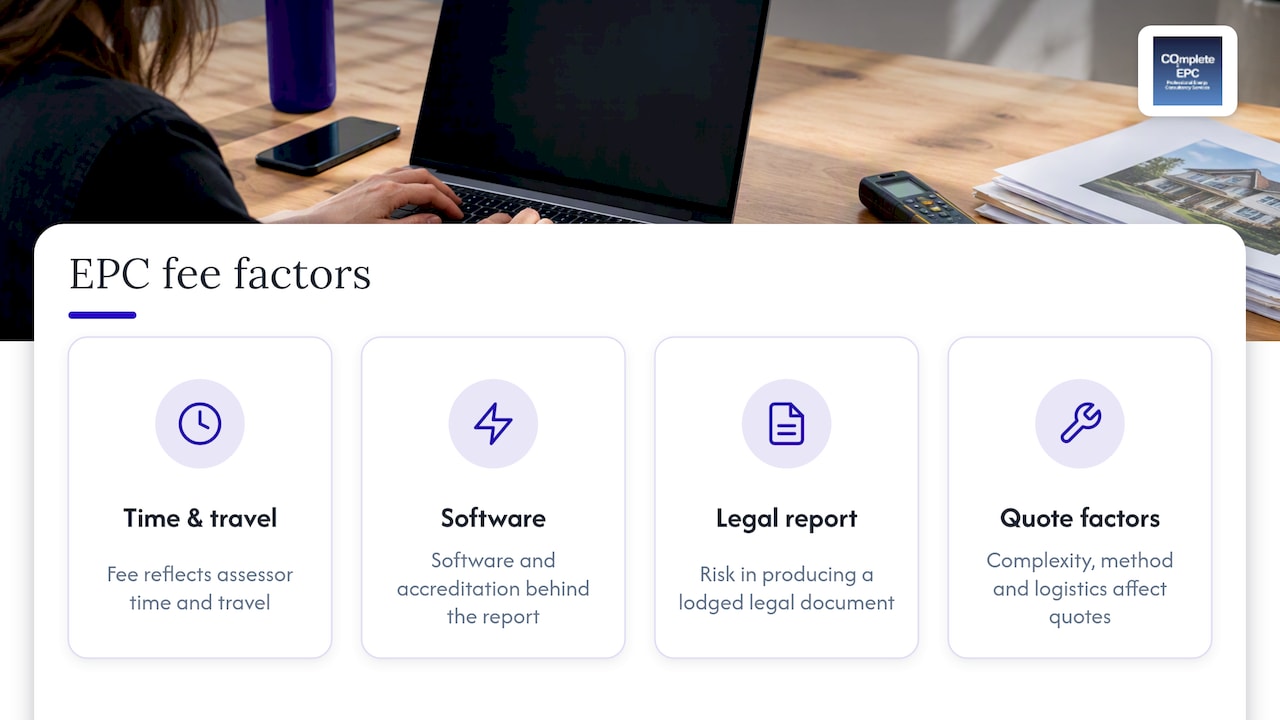
An assessor’s fee reflects time, travel, the software and accreditation behind the report, and the risk involved in producing a lodged legal document. Price differences between quotes for the same commercial building often come down to different assumptions about technical complexity, assessment method and survey logistics, rather than one assessor simply charging more, as Property Tax Partners explains. The same logic applies to homes.
These are the main factors, in roughly the order they matter.
Size and number of rooms
A studio flat takes less time to measure and record than a five-bedroom house. More rooms mean more walls, windows, heating emitters and floor areas to capture. Expect the fee to step up as the property grows, and expect larger or unusual homes to be quoted individually rather than from a standard rate.
Property type and age
A modern purpose-built flat with paperwork for its insulation and boiler is quick to assess. A Victorian terrace with extensions, a loft conversion and mixed wall types takes longer, because the assessor has to work out what each part of the building is made of. Listed buildings and unusual construction can add time.
Location and travel
London assessors cover dense areas with heavy traffic and parking restrictions. A visit to a property in north, east or west London may involve different travel time than one in the centre. Competition between assessors in London can also pull prices the other way, which is why quotes can vary widely for the same job.
Access and survey conditions
An assessor who can enter every room, the loft hatch and the boiler cupboard in one visit works faster than one who has to rearrange a second visit because keys, tenants or locked plant rooms got in the way. Tell the assessor in advance about anything that limits access.
Urgency
Same-day or next-day certificates may cost more, because the assessor has to reshuffle a diary. If you are selling or letting, book as soon as you decide to market the property so you are not paying for speed.
Domestic or commercial
A home is assessed with a standard procedure and a fairly predictable amount of data. A commercial building can include several zones, different heating and cooling systems, lighting types and uses, so the survey and modelling take longer and the quote usually needs a floor plan or floor area first.
A practical way to estimate your EPC cost
You do not need a formula, but you do need a consistent process. This is the method we suggest.
- Collect the basics. Address, property type (flat, terrace, semi, detached, office, shop), number of bedrooms or total floor area, and approximate age.
- Note anything unusual. Extensions, conversions, basements, listed status, multiple heating systems, air conditioning, or a split between residential and commercial use.
- Say why you need it. Sale, new letting, renewal, planning condition or lender requirement. This tells the assessor which certificate type applies.
- Ask for at least three quotes in writing. Give each assessor exactly the same description so the quotes are comparable.
- Compare what is included. Check the visit, the lodgement on the national register, the recommendations report, and what happens if you need an amendment.
- Check timing. Ask how many working days between the visit and the lodged certificate.
The table below shows how each factor tends to push your quote.
| Factor | Pushes the fee up when | Keeps the fee down when |
|---|---|---|
| Size | Many rooms or large floor area | Small flat or compact house |
| Construction | Mixed walls, extensions, conversions | Simple, uniform build with documents |
| Access | Locked areas, tenants, several visits | One clear visit, keys ready |
| Timing | Same-day or next-day request | Normal booking lead time |
| Use | Commercial, multi-zone, air conditioning | Single-use residential unit |
| Paperwork | Nothing to show for insulation or boiler | Building control certificates and invoices to hand |
Domestic and commercial: how the costing differs
Domestic EPCs
For a typical home, the assessor collects measurements and descriptions of the building fabric, heating, hot water, ventilation and lighting, then enters them into approved software. The effort scales with the size and complexity of the home, so quotes are usually built around the number of bedrooms. If you own a house in London, our domestic EPC service covers surveys across the capital.
Commercial EPCs
Non-domestic buildings do not follow the same pricing shape. Floor area matters, but so do the number of zones, the servicing (heating, ventilation, cooling), the lighting and the use of each space. A small shop and a multi-floor office with air conditioning are very different jobs. If your building has air conditioning above the relevant threshold, you may also need a separate inspection, which we cover in our TM44 air conditioning inspections. For a quote on non-domestic premises, start with our commercial EPC page.
New builds and conversions
A new dwelling does not use the existing-property route. It needs a design-stage calculation and a as-built stage calculation before the EPC can be produced. That is a different piece of work, priced separately, and developers should plan for it early. Our SAP calculations cover new builds, conversions and extensions, and for new commercial buildings the equivalent is covered by SBEM calculations.
How the EPC rating is calculated
Understanding the calculation helps you see why the assessor needs the details they ask for.
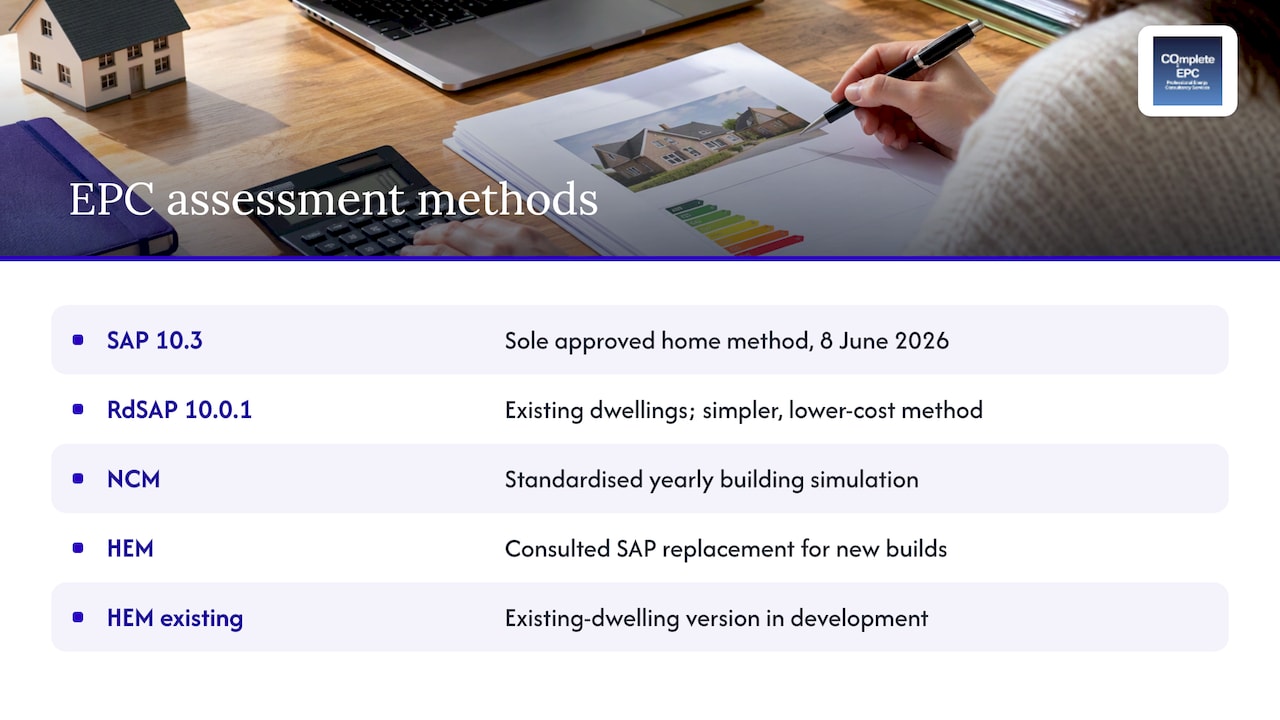
For homes, the approved method is the Standard Assessment Procedure. According to GOV.UK guidance, SAP 10.3 was the sole government-approved methodology for estimating the energy performance of homes as of 8 June 2026, and the Reduced data Standard Assessment Procedure (RdSAP) 10.0.1 is the method used for existing dwellings. The same page explains that RdSAP was introduced in 2005 as a simpler, lower-cost method that relies on a set of assumptions to reduce the data an assessor must collect on site.
That is why a home survey is a visit of measurements and observations, not a full engineering study.
For non-domestic buildings, the government’s technical annex states that content is calculated using the National Calculation Methodology, and that the building is simulated over a year under standardised conditions. The same annex notes that the government has consulted on a new method called HEM to replace SAP for new-build compliance, and that an existing-dwelling version is being developed. Methods can change, so ask your assessor which version they use.
What the assessor feeds into the model
The score depends on how much energy the building would use and lose under standard conditions. The main inputs are:
- Wall, roof and floor construction and insulation
- Windows and glazing type
- Heating system, controls and fuel
- Hot water system and cylinder insulation
- Ventilation and air tightness assumptions
- Lighting type
- Renewable technologies such as solar panels
The software converts these into an energy efficiency score and an A to G band. Upgrading any of these inputs can move the result, which is why the recommendations section is worth reading.
Why the energy costs on an EPC are not your bills
Many people search “how to calculate EPC costs” because the certificate shows an estimated annual cost for heating, hot water and lighting, and it does not match their bills. That is by design. The figures use a standardised model of occupancy and typical usage, so they are indicative and do not represent what the people living there actually pay, which can differ widely with behaviour and household size.
This matters in practice:
- A household that keeps the heating on all day will pay more than the EPC shows.
- A single person who is out most of the day may pay less.
- Energy prices change, but the EPC uses assumed prices, so the numbers are for comparison between properties, not for budgeting.
Use the EPC cost lines to compare one property against another, and use your bills to understand your own use.
Can you calculate or produce your own EPC?
The methodology is published, so you can read how the calculation works and get a rough feel for where your home might land. That is a useful exercise if you want to see which upgrades could help.
A certificate you can use to sell or let a property is a different matter. It has to be produced by an accredited assessor and lodged on the national register, so a DIY calculation cannot replace it. The practical route is to use your own understanding to prepare for the visit, then let the assessor do the formal survey.
To prepare:
- Gather invoices and certificates for boiler installation, insulation, glazing and solar panels
- Make sure the loft hatch, meter cupboard and boiler are reachable
- List any extensions or conversions and when they were built
- Know your heating system type and controls
The more evidence you provide, the fewer assumptions the assessor has to make, which usually helps your rating.
Spending to improve the rating, not just to certify it
The fee for the certificate is small compared with what a rating can mean for a sale or letting. Landlords in England need to know the minimum standard that applies to their property, and we offer MEES advice alongside our EPC work. After the assessment, the recommendations report lists improvements in order of effect, such as loft insulation, heating controls, draught-proofing and glazing.
Glazing is often a candidate. If replacing windows is out of reach, window film energy savings can be a lower-cost thing to look into for reducing heat gain and loss, though you should check how any measure is treated in the assessment with your assessor before counting on a rating change.
Our perspective
We see the same pattern every week. Owners and landlords compare EPC quotes on headline price, then discover they are not comparing the same job: one quote includes the survey and lodgement, another leaves out the recommendations, and a third assumes a smaller floor area than the property really has.
Our approach is to ask a few precise questions first, such as property type, floor area, access and what the certificate is for, so the quote you get is the quote you pay. We employ qualified assessors with industry experience, and we stand behind a UK lowest-rate guarantee on our EPC pricing.
The other thing we would say is to treat the EPC as a planning tool, not just a box to tick. The recommendations show which improvements are likely to lift your rating, and for new builds, conversions and extensions, getting the SAP calculation right early avoids expensive redesign later.
Danny
Get a quote for your property
If you own, let or manage property in London, tell us the property type, size and what the certificate is for, and we will come back with a quote you can compare like for like. Start with our domestic EPC or commercial EPC pages, or visit Complete EPC to see everything else we offer, including SAP calculations, TM44 inspections, EICR and PAT testing.
FAQ
How much should I budget for an EPC in London?
There is no fixed tariff, so the fee depends on the assessor, the size and type of the property, and the access. Get at least three written quotes for the same description of the property, and compare what each includes. Larger and more complex properties will cost more than a small flat.
Why do two EPC quotes for the same building differ?
Quotes often rest on different assumptions about complexity, survey time and what is included. One may assume a single visit with easy access, another may allow for a second visit. Ask each assessor to state their assumptions, and the gap usually explains itself.
Are the energy costs on my EPC what I will pay?
No. They are indicative estimates from a standardised model of how a typical household uses the property, so your actual bills can be higher or lower depending on how you live. Use them to compare properties rather than to forecast your own spending.
Can I calculate my own EPC to save money?
You can read the published method and estimate roughly where a home might sit, which helps you plan improvements. For selling or letting you still need a certificate from an accredited assessor, lodged on the national register, so a DIY figure cannot replace it.
Is the calculation different for a new build?
Yes. New dwellings use a design-stage and as-built SAP calculation, not the reduced-data survey used for existing homes. It is a separate piece of work, so ask for it to be quoted separately and plan it early in the project.