

The best way to improve an EPC rating is to work in order. Read your current certificate, stop heat escaping first (draughts, loft, walls), then upgrade heating and controls, then add glazing, lighting and renewables where they make sense. Tackle the measures that move your score most for the money, and plan them as one package rather than a string of one-off jobs.
This guide is for London homeowners, landlords and commercial occupiers who want a higher energy performance certificate, whether for a sale, a letting or compliance with the minimum standards that apply to rented property.
TL;DR
- Start with your existing certificate on GOV.UK: it lists the recommended measures for your property and shows where you stand.
- Fix heat loss first: draught-proofing, loft insulation to at least 270mm and wall insulation usually come before anything else.
- Heating is the biggest lever, but also the biggest cost. Controls and a condensing boiler are the entry point, and heat pumps change the score most.
- Landlords in England and Wales face a minimum of E now, and the Warm Homes Plan sets a minimum of C from 1 October 2030.
- Commission a fresh EPC after the works, so the improvement is recorded and you can use it.
Table of Contents
- Start with the certificate you already have
- Fix heat loss before you upgrade anything else
- Upgrade heating and controls
- Glazing, lighting and renewables
- A priority order that works
- Costs, savings and what the rules require
- Perspective: why we start with the assessment
- Commercial buildings: extra steps
- Book your assessment
- FAQ
- Sources
Start with the certificate you already have
Before spending anything, look at what is already on record. The GOV.UK Find an energy certificate service lets you search for an existing EPC by postcode, address or certificate number. It covers homes, business properties and public buildings in England, Wales and Northern Ireland.
Open the certificate and read three things:
- The current and potential rating. The gap between the two shows how much room there is.
- The recommended measures. They are listed with indicative costs and savings.
- The date. An EPC is valid for ten years, but if you have made changes since it was issued, it may understate your property.
One caution from the Energy Saving Trust: EPC recommendations are generated automatically from a national model, and the assessor records what they find rather than designing a retrofit plan. Treat the list as a starting point, then decide the order and scope with a qualified professional who knows the building. That is where a site assessment is worth having.
Fix heat loss before you upgrade anything else
The Energy Saving Trust says around 26% of the heat in an uninsulated home escapes through the roof, and around a third through the walls (Energy Saving Trust). Stopping that loss is the foundation of every other upgrade, because a better boiler in a leaky building simply works harder.
Draught-proofing
Draught-proofing is the cheapest place to start. Historic England describes it as unobtrusive and cost-effective, and notes that heat escapes through gaps in windows, doors, floors, service holes and chimneys (Historic England). Cambridge City Council’s retrofit guide goes further: up to a quarter of heat loss can come from a leaky building, and dealing with draughts can save more energy than new windows at a much lower cost.
For a typical London Victorian or Edwardian terrace, the usual suspects are:
- Gaps around sash windows and external doors.
- Gaps between floorboards and skirting boards.
- Loft hatches without a seal.
- Unused chimneys and pipe or cable holes through walls and floors.
Ventilation still matters. Keep trickle vents, extractor fans in kitchens and bathrooms, and any airbricks that serve a flue or a suspended timber floor working properly. Seal the gaps, not the building’s ability to breathe.
Loft insulation
Histic England advises a loft insulation depth of at least 270 millimetres, with gaps around the edges sealed. The Energy Saving Trust puts the saving from topping up from 120mm to 270mm at around £17 a year in Great Britain. That sounds modest, and it is, but it is one of the lowest-cost measures available and it supports the overall fabric score. If you want a closer look at what loft work typically returns, this guide to savings from loft insulation covers the numbers.
Wall insulation
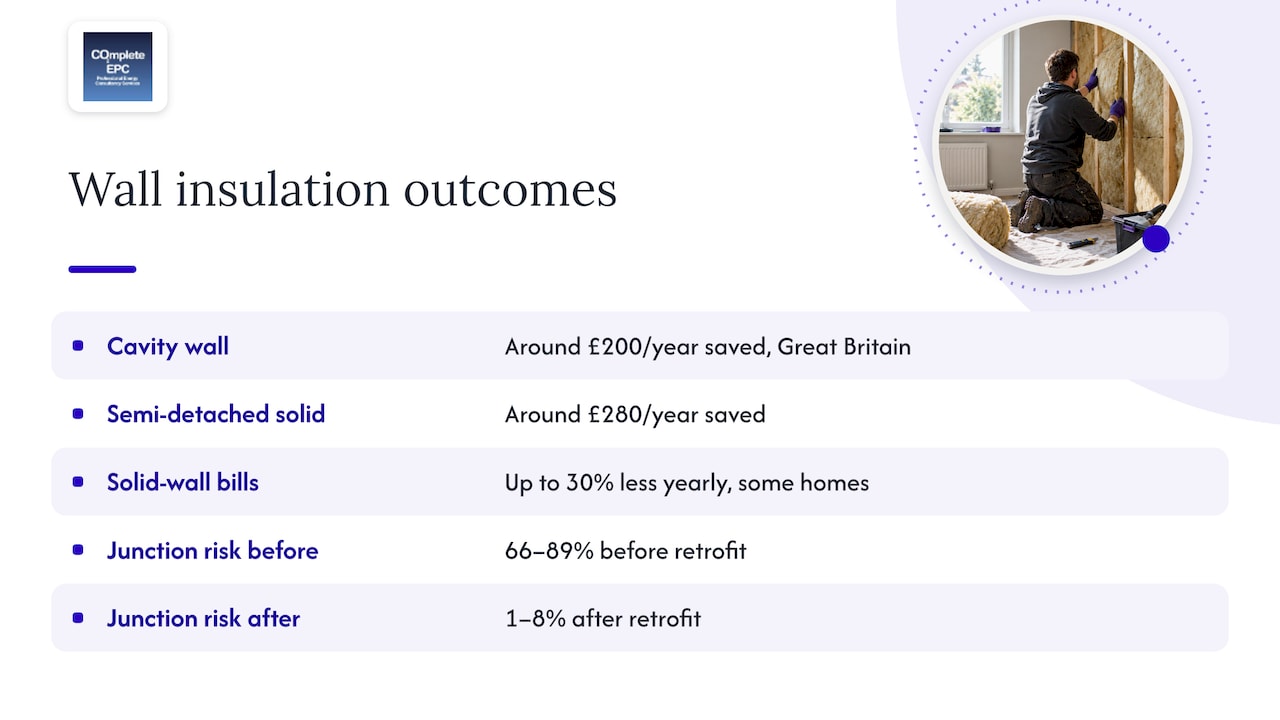
Walls are where the larger gains sit. Cambridge City Council states that improving wall insulation almost always gives the biggest efficiency improvement. The Energy Saving Trust estimates cavity wall insulation saves around £200 a year in Great Britain, and solid wall insulation in a semi-detached house around £280 a year.
If your home has solid walls, as most pre-1920s London housing does, the evidence is strong. Research from the Leeds Sustainability Institute’s DEEP project found solid wall insulation to be the single most effective measure in solid-walled homes, capable of reaching EPC Band C and cutting bills by up to 30% a year for some homes. The same project found that following the PAS 2035 whole-house approach brought condensation risk at junctions down from 66 to 89% before retrofit to 1 to 8% after. The lesson: insulate, but plan junctions, ventilation and moisture with a competent installer.
Upgrade heating and controls
Once the building holds heat, the heating system is next. The Energy Saving Trust lists heating controls, hot water cylinder insulation and a new condensing boiler among the common EPC recommendations.
- Heating controls. A programmer, room thermostat and thermostatic radiator valves are low-cost and often missing from older systems.
- Hot water cylinder insulation. A properly insulated cylinder is a simple, inexpensive item that appears on many certificates.
- Condensing boiler. Replacing an old, inefficient boiler with a modern condensing model is a long-standing recommendation.
- Heat pumps. These sit at the top of the cost and impact scale.
The Investment Property Forum’s 2024 study found that air-source heat pumps typically deliver the largest change in EPC score for commercial buildings, and are typically the most expensive measure too. It also notes that the EPC methodology will keep favouring electrified heat as the carbon factor for electricity falls, and that by 2030 some buildings may be unable to reach an EPC B without it.
For rented homes, the government’s response on improving privately rented homes says the new dual-metric approach is intended to resolve the current problem of people being penalised for installing low-carbon heating such as heat pumps. It also gives landlords the option of keeping their existing heating and delivering bill savings through other smart measures, or using the Boiler Upgrade Scheme to install a heat pump (GOV.UK response). Check the current grant level and eligibility on the official scheme page before you commit.
Glazing, lighting and renewables
Windows
Replacing single glazing with double glazing is listed among the common recommendations. The research we reviewed puts the effect at 2 to 5 SAP points depending on window area, at roughly £400 to £800 per window (Natural Resources Canada guidance). That is a Canadian guideline, so use it as a rough order of magnitude and get London quotes. Because windows are expensive per point gained, they usually follow draught-proofing and insulation in the queue.
In listed buildings and conservation areas, check what consent you need before changing windows. Secondary glazing and good draught-proofing can sometimes achieve a similar benefit with less visual impact.
For offices, low-e coatings matter. Academic guidance from UNSW reports that double-glazed low-e windows can cut an office building’s total annual energy requirement by 8 to 15% compared with conventional double glazing. That study is Australian, so treat the figure as indicative.
Lighting
LED lighting is the quick win on almost every certificate, and for commercial space the Natural Resources Canada guide suggests lighting upgrades can reduce lighting energy use by between 10 and 85%. Be realistic about the EPC effect, though. The IPF found that LED and controls packages on their own do not always improve a commercial EPC, and in some cases make it worse. Lighting works best as one part of a package.
Solar panels and renewables
Solar panels appear in the list of common EPC measures. The European Commission also lists solar panels, shading and digital controls among typical renovation measures (European Commission). For commercial owners weighing a wider upgrade, this EU green homes directive guide shows how efficiency upgrades and on-site generation are being packaged together across Europe.
A priority order that works
Most properties benefit from the same sequence. Adjust it to your certificate.
| Priority | Measure | Typical role in the score | Cost level |
|---|---|---|---|
| 1 | Draught-proofing | Cuts heat loss, supports everything else | Low |
| 2 | Loft insulation to 270mm | Fabric improvement | Low |
| 3 | Heating controls, cylinder insulation | Efficiency of the existing system | Low to medium |
| 4 | Wall insulation (cavity or solid) | Often the largest fabric gain | Medium to high |
| 5 | Boiler or heat pump | Largest heating gain, heat pumps most of all | High |
| 6 | Glazing | 2 to 5 SAP points depending on area | High |
| 7 | LED lighting, solar panels | Supporting measures | Low (LED) to high (solar) |
The IPF stresses that improvements are best built into your next refurbishment cycle, and that costs can become prohibitive when upgrades are done in isolation rather than as a package. If you are already redecorating, re-roofing or replacing a kitchen, that is the moment to add insulation and ventilation work.
Costs, savings and what the rules require
For homes, the Energy Saving Trust figures above give a feel for annual savings. For commercial property, the IPF found that reaching EPC B may need between £200/m² and £800/m² of investment, and that a package of lighting, ventilation and heat pumps will typically meet EPC B for most buildings.
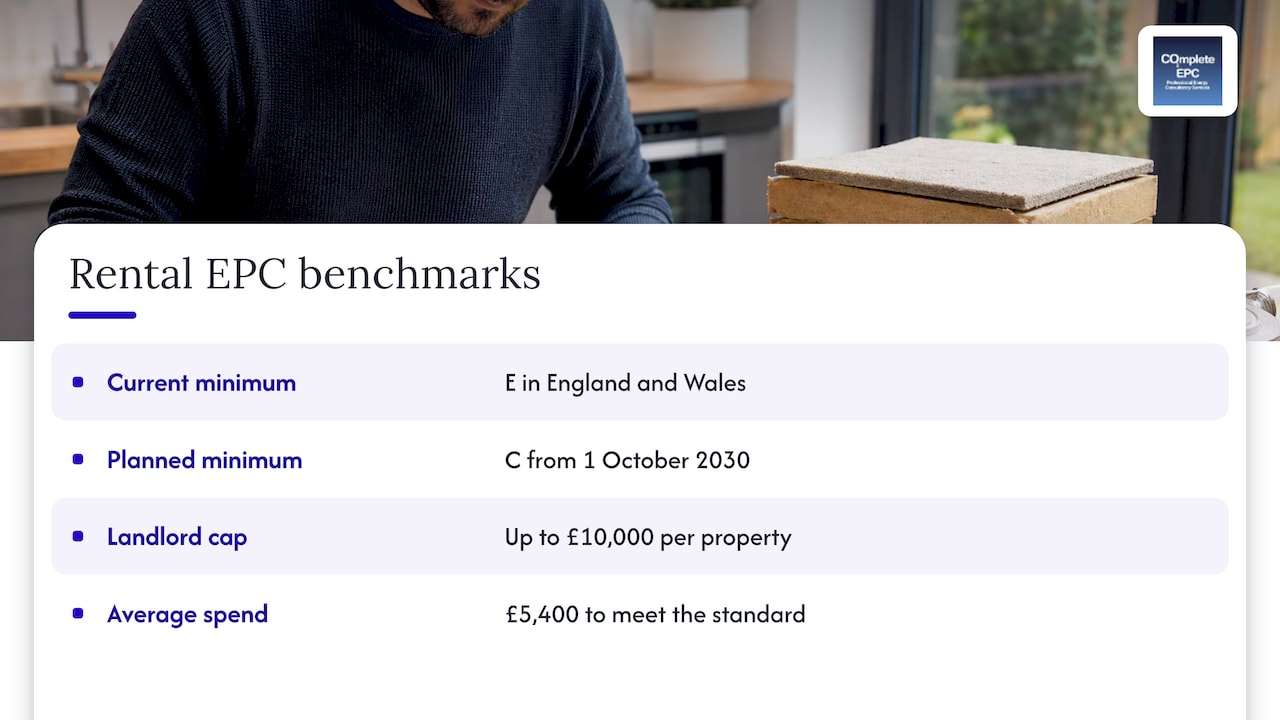
For landlords, the rules matter as much as the cost. Current MEES regulations in England and Wales require in-scope private rentals to meet a minimum EPC rating of E, and the Warm Homes Plan sets a minimum of C from 1 October 2030 (Which?). The government’s response states that landlords will be required to invest up to £10,000 per property on relevant improvements, and its impact assessment estimates average spend to meet the standard at £5,400. Scotland and Northern Ireland follow different timelines, so the figures above apply to England and Wales.
If you own a rented property in London, a good habit is to check your rating now rather than close to a deadline. Contractors get busy as deadlines approach, and you will want time to sequence the work.
Perspective: why we start with the assessment
We see the same pattern across London homes and commercial units. Owners buy the measure they have heard of, usually windows or a boiler, and then find the rating has barely moved.
Our advice is to begin with an accurate assessment of the building as it stands. A qualified assessor records the fabric, heating and lighting, and the report shows which measures are likely to matter for your property. For new builds, conversions and extensions, SAP calculations show how a design performs before it is built, and for commercial schemes SBEM and dynamic simulation modelling do the same job.
Then fix the fabric, upgrade the heating, and commission a new certificate so the work is recorded. We offer domestic and commercial EPCs across London, and our guarantee is that our rates are the lowest in the UK market. Our assessors are qualified, and our aim is to make the process quick and clear.
Danny
Commercial buildings: extra steps
Commercial owners have more levers, and more reasons to look at the whole building:
- Air conditioning. Systems above the relevant size need regular inspection. Our TM44 air conditioning inspection service covers this and often identifies efficiency improvements.
- New or refurbished space. SBEM calculations demonstrate compliance for new commercial buildings.
- Overheating and comfort. Where glazing and insulation change, TM52 and TM59 overheating analysis checks you have not traded a heating problem for a cooling one.
- Complex buildings. Dynamic simulation modelling tests combinations of measures before you spend.
Because the IPF found that single measures often disappoint, model the package first.
Book your assessment
If you are ready to find out where your property stands, we provide a domestic EPC for homes and a commercial EPC for business premises across London. For extensions, conversions and new builds, our SAP calculations support building regulations. Landlords can also ask us about MEES advice and electrical safety testing through our main site.
FAQ
What is the cheapest way to improve my EPC rating?
Draught-proofing, LED bulbs, heating controls and hot water cylinder insulation are the lowest-cost measures on most certificates. Topping up loft insulation to at least 270mm is also inexpensive. Together they will not always change the band, but they build the base for bigger measures.
How do I find out what my EPC recommends?
Search your address or certificate number on the GOV.UK energy certificate service. The certificate lists each recommended measure with indicative costs and savings. If it is old or you have made changes, a new assessment will give an up-to-date picture.
Do I need a new EPC after making improvements?
Yes, if you want the improvement recorded. The old certificate stays valid for ten years but will show the old rating. A new assessment captures the work, which matters for a sale, a letting or MEES compliance.
What EPC rating must a landlord in London reach?
In England and Wales, in-scope private rentals currently need at least an E. The Warm Homes Plan sets a minimum of C from 1 October 2030, so planning improvements early is sensible.
Sources
- Find an energy certificate, GOV.UK
- How to improve your EPC rating, Energy Saving Trust
- How to Save Energy in an Older Home, Historic England
- Retrofitting your home, Cambridge City Council
- DEEP home retrofits, Leeds Sustainability Institute
- Costing Energy Efficiency Improvements in Existing Buildings, Investment Property Forum
- Improving the energy performance of privately rented homes, government response
- Landlords: how to make your property more energy efficient, Which?
- Major Energy Retrofit Guidelines for Office Buildings, Natural Resources Canada
- Guide to Low Carbon Commercial Buildings, UNSW
- Energy renovation of buildings, European Commission