
Energy management solutions are the tools, assessments and routines that show you where a building uses energy, then help you cut that use. They range from a one-off audit or an energy performance certificate (EPC) to a full energy management system with meters, controls and reporting. For most landlords and owners, the sensible route is to measure first, fix the cheapest problems next, and automate only once you know what you are controlling.
This guide explains the main options, how they differ, how to prioritise them and how to judge whether they work.
TL;DR
- “Energy management solutions” covers audits, EPCs, metering, control systems and the habits that keep consumption falling. It is not a single product.
- An audit is a snapshot. An energy management system is an ongoing cycle of targets, actions and review.
- Start with a baseline: an EPC or audit for the building, then act on the low-cost measures before buying hardware.
- Savings figures in public guidance come from specific programmes, so treat them as ranges, not promises.
- Rules and incentives differ by country and sometimes by city, so check the requirements that apply to your property.
Table of Contents
- What energy management solutions actually are
- Energy audit or energy management system?
- Start with a baseline: audits and EPCs
- Measures worth considering
- Monitoring and control: what an energy management system does
- Prioritising and measuring results
- Savings and payback: what to expect
- Rules and incentives depend on where you are
- How we can help
- FAQ
- Sources
What energy management solutions actually are
The phrase is used loosely. Search it and you will find consultancies, software vendors, insulation installers and even generator hire companies. What they share is a goal: use less energy for the same comfort and output, and prove it.
In practice, a solution falls into one of four groups:
- Assessment. An audit, a survey or an EPC that tells you how the building performs today.
- Improvement. Physical measures such as insulation, lighting, heating and cooling upgrades, and on-site renewables.
- Monitoring and control. Meters, submeters and software that track use and adjust equipment.
- Management. The people, targets and review cycle that keep results from slipping.
Most buildings need the first and second group before the third makes sense. A sophisticated control system on a poorly insulated, badly scheduled building mostly tells you, in more detail, that the building wastes energy.
Energy audit or energy management system?
The two are often confused. The German Environment Agency draws a clear line: an audit is carried out at fixed intervals, while an energy management system drives continual improvement through performance indicators, named owners, targets, actions and analysis of deviations. Its guidance also notes that an audit to EN 16247-1 can provide the basis for setting up an ISO 50001 energy management system.
Think of it this way:
| Energy audit or EPC | Energy management system | |
|---|---|---|
| Purpose | Find out how the building performs and what to improve | Keep performance improving over time |
| Timing | At a point in time, repeated at intervals | Continuous |
| Output | Report with recommendations | Data, targets, actions, reviews |
| Effort | Low to moderate | Moderate to high, with ownership inside the organisation |
| Best first step for | Almost every property | Larger or multi-site portfolios, high-use buildings |
A small landlord with a handful of flats rarely needs a formal system. A business with a large office, several sites or heavy cooling and heating loads gains more from the ongoing cycle.
Start with a baseline: audits and EPCs
You cannot manage what you have not measured. The International Energy Agency’s EBC Annex 56 guidebook advises professional residential owners to assess overall building performance before intervening, using an energy audit or, in Europe, an energy performance certificate.
In the UK, an EPC is also a legal document for many sales and lettings, so it does double duty: it satisfies the paperwork and gives you a rated starting point with recommendations. We carry out a domestic EPC for homes and a commercial EPC for offices, shops and other non-domestic buildings across London.
What a good audit looks like
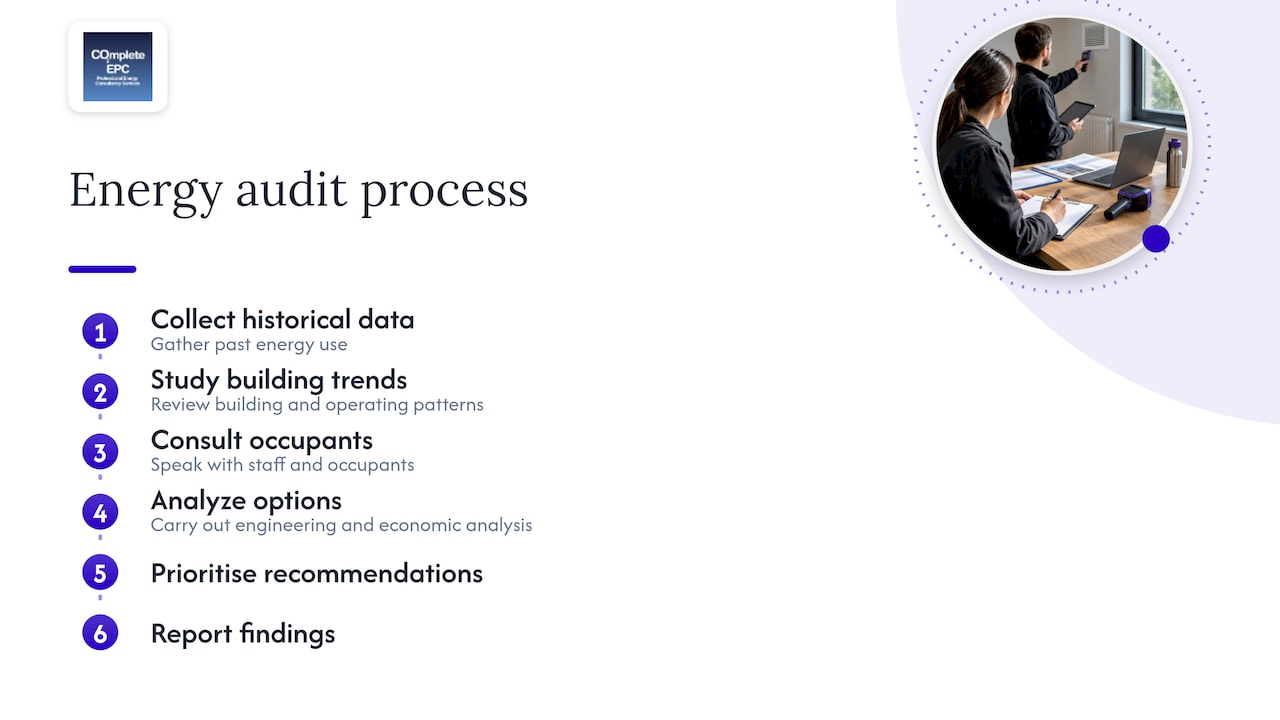
Public guidance from several countries describes a similar process. The US Department of Energy describes the steps as collecting historical energy data, studying building and operating trends, consulting staff and occupants, carrying out engineering and economic analysis, prioritising recommendations and reporting. Natural Resources Canada adds that an audit determines where, when, why and how energy is used, and can verify efficiency projects once they are done.
For a home, the sequence is simple: establish a baseline from past bills, inspect the building envelope and equipment, then choose improvements using estimated cost, savings, comfort and safety. New York State’s energy agency sets out this approach in its home assessment guide, which also mentions optional blower-door and infrared testing.
In the UK, the professional reference is CIBSE’s Guide F on energy efficiency in buildings, which covers audits and surveys, retrofitting, metering and monitoring, assessment of energy-saving measures, and reporting.
Measures worth considering
Measures sit on a spectrum from free to capital-intensive. The IEA guidebook lists insulation and envelope improvements, window films or reflective roofs, efficient lighting with occupancy and daylight controls, thermostat setbacks, better schedules and sequencing, equipment maintenance, efficient heating, cooling and appliances, retrocommissioning, heat reclaim, on-site renewables and electrification. It also suggests landlords and tenants formalise shared responsibilities through green-lease provisions and occupant guidance.
Here is how that sorts for a typical London landlord or business:
| Type | Examples | Typical use |
|---|---|---|
| Operational, low cost | Switching off unused lighting, thermostat setbacks, tuning schedules, occupant education | Any building, immediately |
| Maintenance | Servicing equipment, maintaining controls and insulation | Offices, shops, flats with communal plant |
| Fabric | Insulation, glazing, window films, reflective roofs | When the audit shows heat loss or overheating |
| Equipment | Efficient lighting with sensors, heating and cooling upgrades | At replacement or when payback is clear |
| Generation and electrification | On-site renewables, heat pumps | Larger refurbishments and new builds |
The US Environmental Protection Agency’s commercial real estate guide makes the same split: low-cost steps include tracking performance, turning off unused lighting, thermostat setbacks, occupant education, maintenance and optimised schedules, while capital measures include retrocommissioning, efficient lighting, window films, insulation and HVAC upgrades.
New Zealand’s energy agency offers a useful checklist habit for businesses. Its commercial building checklist recommends matching heating and cooling schedules to occupancy, maintaining controls and dampers, applying seasonal resets and sequencing chillers. It also advises assigning responsibilities, keeping an action list and reporting regularly.
If you are considering on-site solar and storage, a structured look at your bills and load pattern comes first. This bills-to-kW checklist on peak shaving and solar walks through that thinking for homes, small businesses and industry.
Monitoring and control: what an energy management system does
An energy management system (EMS) combines hardware and software. IBM’s overview describes four core functions: monitoring through meters and submeters, analysis of the data, control of equipment such as HVAC, and reporting with charts and audit trails.
The US Better Buildings programme uses the wider term energy management and information systems (EMIS), defining it as a broad family of tools and services for commercial-building energy management rather than one product. Cornell’s facilities team describes how a control system lets operators adjust setpoints, schedules, fans, pumps, dampers and valves.
What does that mean for you?
- Submetering shows which tenant, floor or system drives the bill.
- Scheduling stops plant running in empty buildings.
- Alerts flag a fault or an unusual overnight load before it becomes a large bill.
- Reports give you evidence for tenants, lenders and sustainability targets.
Before buying, ask who will read the data. A system nobody checks is an expense, not a solution.
Prioritising and measuring results
The most widely used framework is simple. ENERGY STAR’s guidelines run through commit, assess performance, set goals, create and implement an action plan, evaluate progress and recognise achievements. It is a loop, so the evaluation feeds the next round of goals.
For larger estates, Natural Resources Canada recommends a long-term, phased plan aligned with capital planning, together with tracking of energy and emissions over time.
A simple ranking method
For each measure on your audit or EPC report, note three things: cost, annual saving and disruption. Then:
- Do the no-cost and low-cost actions straight away.
- Bundle fabric work with planned refurbishment, so you open up walls and roofs only once.
- Replace equipment at end of life with the efficient option, not a like-for-like swap.
- Add metering and controls once the basics are in, so the data reflects a building that is already tuned.
What to measure
The Building Commissioning Association’s EMIS evaluation protocol asks for annual energy savings, annual energy-cost savings, system cost and simple payback. It treats peak demand, comfort, maintenance, net present value and savings-to-investment ratio as additional metrics. Those are good columns for your own tracking sheet.
Savings and payback: what to expect
Published figures vary by programme and building, so quote them with their context. New York State says implementing recommended home upgrades typically cuts home energy use by 5% to 30%, and that is a state programme estimate, not a guarantee for every home. The US Better Buildings cost and benefits report says energy information systems can enable up to 20% site-energy savings when they are part of a best-practice energy management programme.
Your own result depends on:
- the starting condition of the building and its heating, cooling and lighting
- how many measures you carry out, and in what order
- occupancy patterns and tenant behaviour
- whether someone owns the follow-up
- energy prices over the payback period
The audit’s cost and saving estimates, set against your own bills, give a far better forecast than any headline percentage.
Rules and incentives depend on where you are
Standards and requirements differ between countries and local jurisdictions. Natural Resources Canada notes that an emissions-reduction audit can align with ASHRAE Standard 211 Level 2 or ISO 50002 Tier 2, and that emissions factors and building performance requirements vary by local jurisdiction.
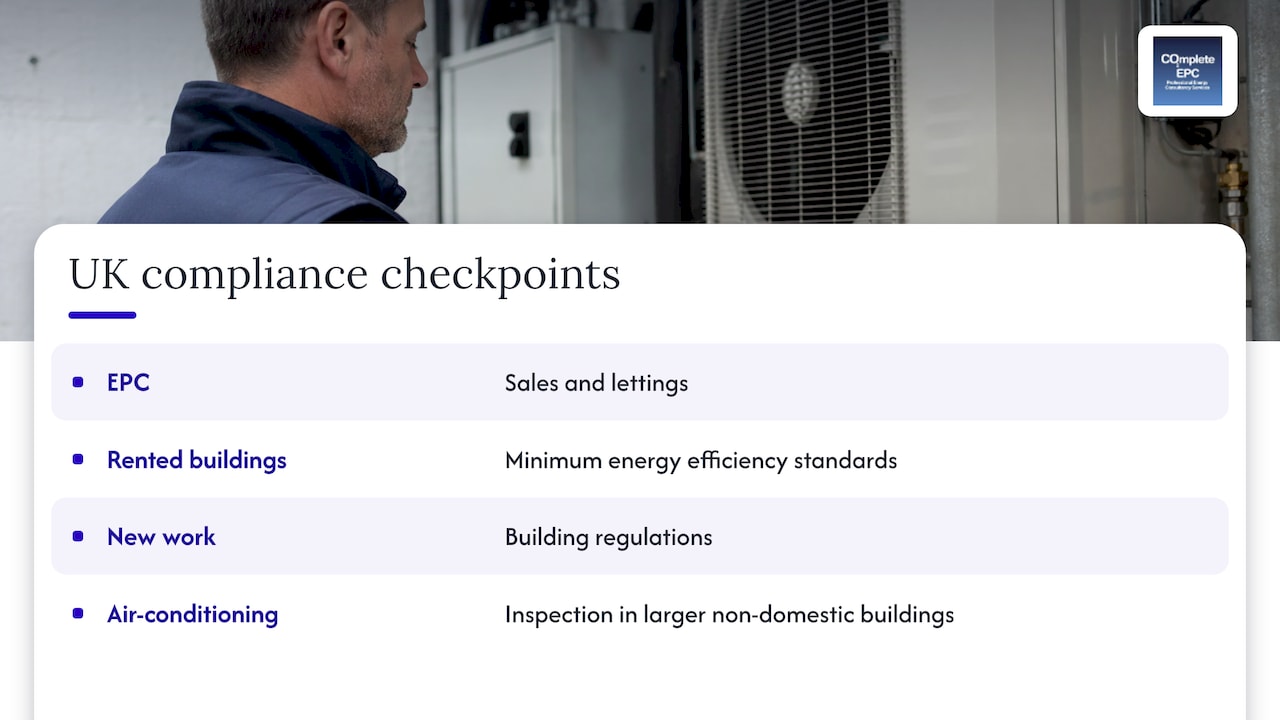
For UK property, the practical checkpoints are the EPC for sales and lettings, minimum energy efficiency standards for rented buildings, building regulations for new work, and inspection of air conditioning systems in larger non-domestic buildings. Which apply depends on property type, size and use, so confirm the current position on the official government pages or with an assessor before you commit to a programme.
Our view: certify first, then optimise
Most of the energy management projects we see go wrong in the same way: money goes to hardware before anyone has a clear picture of the building. We would reverse that order.
Start with an accurate assessment. For an existing home or commercial unit, that is an EPC with its recommendation list. For a new build, conversion or extension, it is SAP or SBEM calculations, which set out how the design will perform before the first brick is laid. For larger or more complex schemes, dynamic simulation modelling and overheating analysis show how the building behaves through the seasons, so you can size services properly instead of guessing.
Our work is designed to give landlords, owners and agents a clear, usable report: what the building scores, what the legal paperwork needs, and which improvements are worth your attention first. Alongside energy work, we also handle electrical safety testing, so one team can cover compliance for the same property.
Energy management is a habit, not a purchase. Get the baseline right and every later decision, from insulation to controls, gets easier to justify.
Danny
How we can help
We provide energy performance certificates, SAP and SBEM calculations, TM44 air conditioning inspections, energy statements for planning, overheating assessments and dynamic simulation modelling for properties in London. Our guarantee of competitive pricing and qualified assessors are part of how we work.
If you need a baseline for a home, start with our domestic EPC service. For offices and shops, see our commercial EPC page. For new developments, our SAP calculations cover the design-stage assessment. For anything else, our main site lists every service, including EICR, PAT testing and water calculations.
FAQ
What is the difference between an energy management solution and an energy management system?
An energy management solution is the broad term for any combination of assessment, improvement, monitoring and management. An energy management system is one part of it: the meters, software and procedures that track use and keep improvement going. You can benefit from a solution, such as an audit or EPC, without ever installing a system.
Where should a landlord start?
Start with an EPC or audit for each property to establish the baseline and see the recommended improvements. Then act on the low-cost measures, and plan fabric and equipment work around refurbishments or tenancy changes. Add metering later if the portfolio is large enough to justify it.
Do I need an energy management system for a small business?
Not always. A small premises often gains most from an assessment, tidy schedules, maintenance and staff awareness. A system becomes worthwhile when you have several sites, high or variable loads, or a need to report energy and emissions regularly to lenders, tenants or clients.
How much can I save?
It depends on the building. Public programmes quote ranges, such as 5% to 30% for home upgrades in one US state, and up to 20% for energy information systems within a good management programme. Use your assessment’s own estimates against your bills for a realistic figure.
Can an EPC help with energy management?
Yes. It rates the building, records how it performs and lists recommended improvements, so it works as a ready-made starting point. In the UK it is also a legal requirement for many sales and lettings.
Sources
- Energy management systems in practice, German Environment Agency
- Cost-Effective Energy and Carbon Emissions Optimization, IEA EBC Annex 56 guidebook
- The Energy Audit Process & State Applications, US Department of Energy
- Conducting an energy audit, Natural Resources Canada
- The Complete Guide to Home Energy Assessments, NYSERDA
- Guide F: Energy efficiency in buildings, CIBSE
- Commercial Real Estate: An Overview of Energy Use, US EPA
- Commercial building checklist, EECA New Zealand
- What is an Energy Management System, IBM
- A Primer on Organizational Use of EMIS, US Better Buildings
- Energy Management and Control System, Cornell
- ENERGY STAR Guidelines for Energy Management
- GHG Emissions Reduction Audit Guide, Natural Resources Canada
- EMIS Field Evaluation Protocol v2.0, Building Commissioning Association
- Energy Information Systems: Cost and Benefits Report, US Better Buildings